Guangzhou Revisited: The Nanyue King Palace Museum Takes Us on a Journey Through History
Travel date: July 2020
Transport: flight (Nanjing – Guangzhou), then self-drive
Route: Nanhai Temple (visit time: 1.5 hours, entrance fee: 15 yuan), Lingnan Impression (arrived at 16:40, park closed at 5 pm so couldn’t enter), Science and Technology Museum at Guangzhou University Town (exterior only), Beijing Road for street food bites
Accommodation: CityNote Xino Hotel (Guangzhou Beijing Road Dafo Temple Park Front Metro Station), 271 yuan per standard room
Transport: walking, taxi
Route: Lu Xun Memorial Hall (1.5 hours, free admission with online reservation in advance), Guangdong Museum (1.5 hours, free admission with online reservation in advance), United Bookstore
Accommodation: Xino Hotel, Beijing Road
Transport: walking, metro
Route: Nanyue King Palace Museum (1.5 hours, free admission), Yuexiu Park (2 hours, free admission with online reservation in advance), Guangzhou Museum, dinner at Yue Hai Lou
Accommodation: Jinzhou International Hotel
Transport: walking, taxi
Route: Sun Yat-sen Memorial Hall (free for medical workers), Beijing Road, dinner at Tao Tao Ju
Accommodation: Huamao Hotel
Transport: bus, taxi, metro, flight (Guangzhou – Nanjing)
Route: Shangxiajiu Street, Xiguan Mansion, Liwan Lake Park, meal at Xin Tai Le
Nanyue King Palace Museum
Address: junction of Beijing Road and Zhongshan 4th Road, Yuexiu District, Guangzhou
Admission: free with reservation
From the hotel, it’s a one-kilometre walk to the Nanyue King Palace Museum. This is the west gate on Beijing Road; just show your reservation at the door and enter for free.
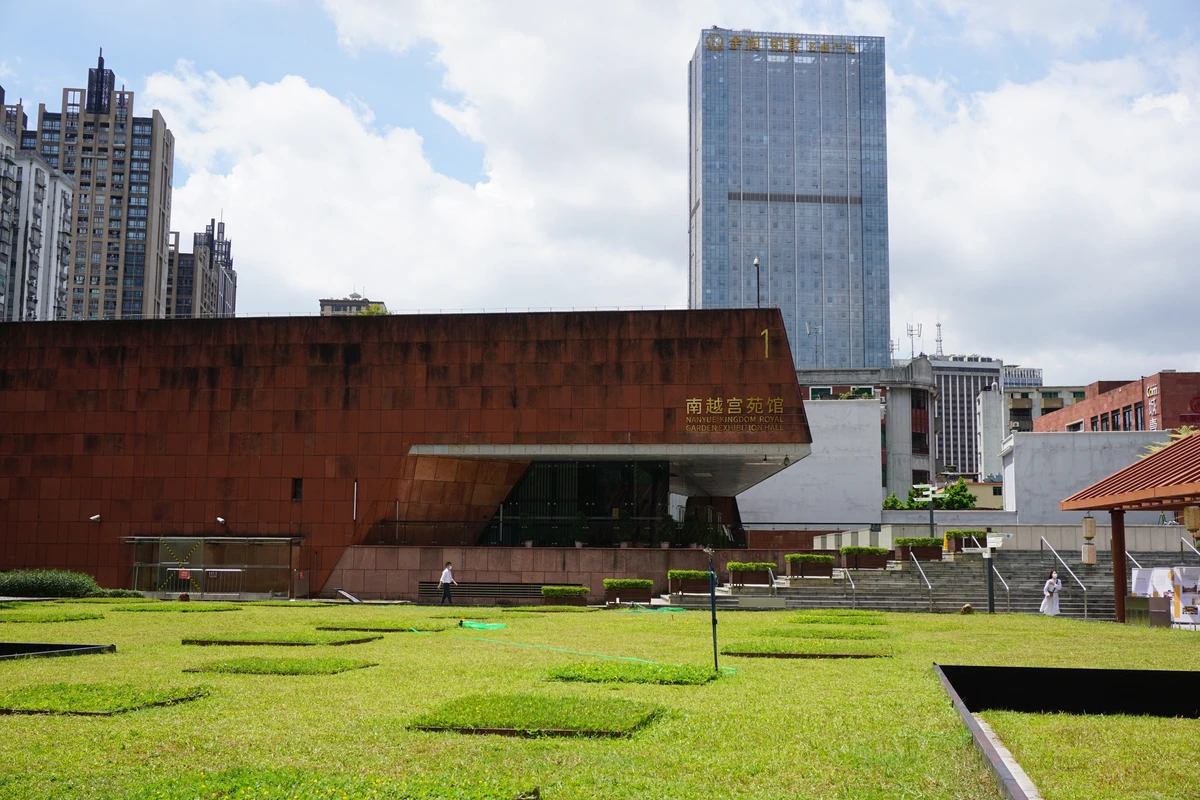
Once inside, a deep-red museum complex surrounds a lawn so green it seems to drip with moisture.
To the left after entering through the west gate is Building No.3 – the Nanyue King Palace Museum.
The residential architecture outside the museum is full of character.
An information board uses text and diagrams to give an overview of the whole museum.
We naturally entered the nearest Building No.3, the Nanyue King Palace Museum. Right inside, a clear and detailed ‘Exhibition Visitor Guide’ map is displayed.
In the entrance hall, the central-axis floor is marked with the names of successive dynasties. Facing you, the eight large characters ‘Lingnan: a 2,000-Year Centre’ highlight Guangzhou’s standing.
Flanking the hall are bronze-red reliefs. The relief on this side depicts the four main exhibition areas: the Nanyue King’s Palace, the Southern Han Palace, the 2,000-year famous city of Guangzhou, and ‘Remembering the source of water’.
We officially entered the Nanyue King’s Palace exhibition hall. Photos and text give an overview of this period of history.
Here, an urban model reconstructs the Nanyue Kingdom’s capital city. A map on the wall shows the distribution of Nanyue site remains within Guangzhou’s urban area.
Under a glass cover is a model of Palace No.1.
Using key artefacts, pictures, and multimedia, the hall introduces the Nanyue royal garden and pond: the garden was composed of a large stone-constructed pool and a winding stone canal, forming a landscaped scene. The Nanyue King’s Palace is one of the rare Western Han regional king’s palaces; its garden is the earliest discovered imperial garden site in China. Its landscaping concepts and techniques reflect the fashion of Qin-Han gardens and are an early masterpiece of Chinese garden architecture.
The stone structures displayed in the showcases are remnants from the ‘Fan Pool’ and the winding stone canal of the Nanyue Palace. Ancient Chinese architecture was predominantly earth and wood, while Western architecture relied more on stone. The discovery of a large amount of stone construction material at the Nanyue site shows that East-West cultural exchange was already taking place at that time.
There are also interactive games you can try; by all means, have a go.
Take the stairs to the second floor to continue the journey.
A series of displays on large bricks and glazed tiles.
‘Qin bricks and Han tiles’ is a phrase synonymous with the peak of Chinese building technology during the Qin and Han periods. In palaces, bricks and tiles were already widely used. The building materials of the Nanyue Kingdom were large in size, varied in specification, with dense bodies, exquisite craftsmanship, and highly skilled techniques.
Photos show the script and imperial seals of the Nanyue Kingdom.
There’s also a ‘little archaeologist’ interactive game
that lets visitors learn about the construction of the Nanyue King’s Palace through historically themed gaming.
Qin-Han palaces often used large bricks for flooring. The Nanyue Palace employed many types of large bricks – square bricks, fan-shaped bricks, hollow bricks… each type with its own purpose.
This bear-decorated stepping stone was part of the palace steps.
Pictures illustrate the process of firing bricks and tiles.
Here, everyday pottery from the Nanyue Kingdom is on show. Pottery was the main household ware left behind from the palace. Nanyue pottery comes in many types and is very hard.
‘The Investiture of Zhao Tuo’ painting recreates the historical scene when Zhao Tuo founded the Nanyue Kingdom.
It introduces the earliest written culture in Lingnan.
The archaeological discovery of the Nanyue Kingdom site opens a new chapter in Guangzhou’s urban history. The founding and development of the Nanyue Kingdom laid the foundation for Lingnan’s social progress.
Continue up to the third floor for the Southern Han Palace exhibition.
The foreword introduces the history of the Southern Han and the archaeological findings at its palace.
The exhibition’s first section covers the history of the Five Dynasties’ Southern Han Kingdom; the second uses underground archaeology to outline the Southern Han capital, Xingwang Fu; the third focuses on the Southern Han palace site, showcasing mainly unearthed artefacts combined with historical settings and multimedia to fully present outstanding achievements in city construction, porcelain-making, and metal-casting.
The walls are covered with unearthed Southern Han bricks and tiles.
Green-glazed architectural components.
Green-glazed pottery jars unearthed from the Southern Han period.
Uniquely shaped pendant beasts and crouching beasts.
Photos and text on the walls explain in detail how these small components were used in architecture.
The Southern Han open drainage channel.
The fourth section presents the archaeological discovery and funerary precinct system of the Southern Han royal mausoleums;
Text and photographs describe the Southern Han mausoleums.
A reconstructed tomb chamber of the Southern Han De Mausoleum.
The fifth section showcases the Southern Han Kingdom’s achievements in external transport and trade. The concluding text at the end of the exhibition hall sums up this period of history.
View from the connecting corridor of the exhibition building.
On the top floor of the exhibition building’s north side, ‘The 2,000-Year Famous City of Guangzhou’ exhibition is being held.
The introductory hall uses video narration to present Guangzhou’s 2,200-year-plus urban development, allowing visitors to appreciate its important role as the centre of Lingnan.
The Nanyue King’s Palace site is the core memory of this famous city.
A Han dynasty pottery house model.
Guangzhou’s maritime development.
Guangzhou’s archaeological discoveries are explained: this place was not only the royal palace of the Nanyue Kingdom and the Five Dynasties’ Southern Han Kingdom but also the seat of government during the Qin-Han, Six Dynasties, Southern Tang, Song, Yuan, and Ming periods – for two millennia, it has been Lingnan’s political nerve centre.
Here is a model of a Song-dynasty building, imaginatively restored by combining archaeological site data.
This wall displays roof-ridge tiles from successive dynasties.
From these exhibits we can learn about Guangzhou’s dynastic changes – relics from thirteen dynasties from the Qin through to the Republic, like a physical history book reflecting Guangzhou’s urban construction. Here, we get a rapid understanding of the city’s rise and fall, the memory of a city.
Stepping out of the exhibition building into the open air, the expanse of green instantly relaxes the mind.
After leaving the exhibition building, follow the signs to continue your visit. Hugging the perimeter wall, it’s a lush, green experience all the way.
The tall, luxuriant broad-leaved banyans of the south.
Upright mango trees.
Next to a mango tree there is a display.
A long row of display cases parallel to the wall presents ‘Brick, Tile, and Ceramic Specimens from the Qin-Han to Ming-Qing’.
The cultural layers at the Nanyue King’s Palace site are richly accumulated, with a great variety and large quantity of unearthed bricks, tiles, and ceramics of fine quality and beautiful designs.
From these cabinets of bricks, tiles, and porcelain shards, one can clearly trace the evolution of the building industry – precious physical evidence for studying the history of China’s building materials and ceramics over two thousand years.
On the south side of the exhibition building is the Guangzhou Ancient Well Exhibition Hall. This is because over 500 wells from various dynasties have been discovered within the Nanyue King palace site excavation area, making it a natural museum of ancient Guangzhou wells. So this spacious thematic hall exists. The ‘Remembering the source’ exhibition hall combines site remains and artefacts.
In the middle of the hall, a section that rises through two storeys shows the cultural strata of different periods.
Standing in the depths of history, gazing up at the stacked archaeological layers of successive dynasties, we trace the history of Guangzhou’s drinking-water development.
Labels clearly identify the cultural layers of different dynasties.
Beside a cultural layer, a ceramic drainpipe shows part of the drainage system of that time.
The protected well-site exhibition area is on the lower ground floor. Here, the Nanyue King’s palace wells and water channels from 2,000 years ago, and the Southern Han palace wells and water channels from 1,000 years ago, exist side by side in the same location, suggesting that the area around the Nanyue King Palace Museum has been Guangzhou’s ‘dragon vein’ precious land since ancient times.
This drainage channel is part of the Southern Han palace drainage system.
These are the remains of the Southern Han palace drinking-water well and well platform.
The upper floor of the exhibition hall, through artefacts, photos, and text, shows well-related elements from each dynasty. The display uses the era of the well as the vertical axis and different well types as the horizontal axis, combined with well-curb materials, objects unearthed inside wells, well models, and reconstructed scenes to systematically present the history of Guangzhou’s wells and interpret the folk customs and drinking-water culture associated with them.
The exquisitely structured ‘Yue King Well’.
A reconstructed model of Southern Dynasties iron and leather armour. In this rich thematic hall, the remnants of ancient wells and drainage channels give us a vivid understanding of the traces of Guangzhou’s drinking-water history, and from one side, an appreciation of the city’s historical development.
This is the site of the Nanyue Kingdom’s water-storage well. It has been backfilled for protection; only textual and photographic descriptions are presented on the original spot.
On the plaza, there is a small weather station. By monitoring and recording environmental conditions, it provides scientific data for setting conservation measures for the site.
Three Southern Han palaces have already been excavated within the Nanyue Kingdom palace site.
The green lawn area before me is the rear hall foundation of Southern Han Palace No.1. Palace No.1 consisted of two halls – front and rear. The rear hall is roughly square, with 36 pillar bases; the palace was vast in scale. The original site has been backfilled for protection, and now square greenery markers on the ground show the layout of the pillar bases.
Above the original site, lightweight materials are used to mark and display the elevation outlines of the palace and corridors.
On the south side of Palace No.1’s foundation is a Qin-dynasty shipbuilding site. Text and archaeological photographs tell us that the Qin-period shipbuilding site discovered in 1975 included three shipyard slips and a timber-processing area. The three slipways are arranged in parallel, oriented northeast-southwest, built upon gray-black riverbank silt. Each slipway consists of wooden sleepers, rails, and blocks, used to support the vessels under construction.
On the ground, staff have used timber to simulate the excavated state of the slipways, with gravel spread to mimic the original gray-black mud, giving visitors a direct visual impression of the known eastern end of the slips; the westward extension is only symbolically indicated.
The Nanyue King’s Palace consisted of the palace halls and the royal garden. To the south of the halls stands Building No.1 – the Nanyue Garden Hall, the main building protecting the winding stone canal site.
Standing at the entrance of the Nanyue Garden Hall, looking at the vegetation and the framework structures. On closer inspection, the green lawn has varying shades of green and different plants – all deliberately arranged. In the centre of the green lawn, a red steel framework structure has been erected to mark the outlines of Nanyue Palace No.1 and Corridor No.1. The palace was a large platform-style complex, facing south, consisting of a north and a south major hall connected by a north-south corridor, forming an H-shaped plan. This form lets us vividly imagine the scale and grandeur of the royal palace over two thousand years ago.
The garden has a public archaeology display centre.
Just inside, there’s a visitor interactive zone.
The Garden Hall presents the original appearance of the winding stone canal site beneath a protective building. It’s a clever and creative display – visitors walk along elevated corridors with a strong sense of immersion, while the cultural relics are well protected.
The Nanyue garden site discovered in 1997 is part of the imperial garden within the Nanyue King’s Palace. This is the earliest Qin-Han imperial garden example found in China to date.
Archaeological excavations were carried out here in 1995 and 1997, uncovering a large stone-built pool and the winding stone canal.
The winding stone canal meanders for over 150 metres. Both walls are built with sandstone blocks, the bottom paved with sandstone slabs, and on top a layer of gray-black river pebbles, with larger yellowish-white river pebbles dotted in a zigzag pattern.
The hall also hosts a special exhibition: ‘Love Song of the Northern Land’ – Ningxia Rock Art Exhibition.
It’s my first time seeing rock art. They look like black-and-white charcoal drawings. After Baidu-ing, I learned that rock art is called ‘history books carved on stone’, created before the invention of writing. Using images and symbols, they record early human survival activities – they are historical scrolls drawn or carved on cliffs by prehistoric people.
Handprint rock art is the oldest form of all rock art.
After visiting the underground remains, climb to the top-floor of the protective building. Here, it’s a whole new world.
On the roof platform of the protective structure, the winding stone canal site has actually been correspondingly recreated.
A 1:1-scale hanging garden reproduction re-creates the beauty of the thousand-year-old imperial garden, with shimmering water and lush flowers and plants. At the east end of the canal, a crescent-shaped deep pool is constructed. To the west of the canal, a flat stone bridge is built, and stepping stones were laid beside it for us to walk through the garden easily. Standing here, it feels a bit magical – beneath your feet is a time-worn royal garden, outside the hall a modern city of skyscrapers; two thousand years of time and space meet right here.
On the lawn stands a stone drum. The outer side is carved with an animal-head door-knocker design, the base decorated with lotus patterns, and the front with dragon motifs – this is a baogu stone (drum-shaped bearing stone) left over from the Qing-dynasty Guangdong Provincial Administration Commission Office.
On the west side of the museum is the Southern Han Palace Hall.
Enter here to visit the protected Southern Han Palace site exhibition area.
This museum is magical. By displaying sites and artefacts and providing video and audio guide systems, it helps us understand the circumstances of the archaeological excavations, appreciate precious unearthed cultural relics, and, more importantly, brings us a sense of historical reality by being right at the archaeological site.
This exhibition area mainly presents the remains of the Southern Han Palace No.2 foundation. Here is a visitor guide map of that site. Photos and text introduce the site overview.
Palace No.2 was a large architectural complex composed of multiple halls, courtyards, and covered corridors. Based on archaeological data, it is inferred that this palace group is the most important surviving Southern Han palace remains and one of the largest palace discoveries in Chinese archaeology. Palace No.2 faces south; so far four north-south courtyard compounds have been identified, with courtyards between the halls and corridors to the east and west. Halls, courtyards, and corridors together form an interconnected architectural compound. What we see now is only its eastern half, because the main structure extends westward under Beijing Road and could not be fully exposed.
It is known to have four north-south compounds. This is the courtyard north of the first hall. The ground of the courtyard is paved everywhere with these exquisite square bricks featuring butterfly and peony patterns.
Inside the protected display area, you can also see the remains of Southern Song building foundations superimposed in two layers.
Remnants of a Northern Song government-office plaza floor and a Yuan-dynasty well, among others.
This is the surviving Northern Song office plaza surface. The plaza was paved with blue-gray rectangular bricks laid in a herringbone pattern, edged with side-standing bricks. To the east of the plaza was an L-shaped brick channel; to the west, a north-south stone-paved path.
A platform-style building above the Northern Song office plaza.
The east corridor of Palace No.2, running north-south, with its platform foundation encased in bricks, the brick floor and pillar grid structure inside the corridor relatively well preserved.
The pillar base stones of Palace No.2’s east corridor. The archaeologically discovered ‘sang dun’ (stone pillar bases) were actually the foundations of the palace columns. From their size and distribution, we can infer the craftsmanship and scale of the palace’s construction. These huge, spectacular pillar bases confirm the historical records describing the Southern Han palace as luxurious and magnificent.
The courtyard of Palace No.2’s east corridor.
The foundation site of Palace No.2’s first hall.
Walking out of the site garden into the bright open air, there’s a moment of disorientation. A few seconds ago, we seemed to be in the Nanyue Kingdom two thousand years ago; now we’ve come back to the present. The museum’s presentation approach is highly commendable: there’s excavation research, historical display, and, moreover, contemporary conservation of history.
We still exited through the Beijing Road entrance. Across the street stands Qingxin Tang, founded in 1906. We popped in for a short rest.
The wood-tone interior fits the herbal theme perfectly.
Glass jars hold all kinds of flowers and herbs.
Translucent, springy peach gum with black sugar, and the more popular matcha.
Once again strolling under the arcade buildings, we continued our wander in the Beijing Road Cultural Tourism Zone.