Haizhu Wetland: Earth's 'Lungs' and 'Kidneys' Turned into a Tourist Spot—Can It Nourish the Heart?
Haizhu Wetland: Earth's 'Lungs' and 'Kidneys' Turned into a Tourist Spot—Can It Nourish the Heart?
A few days ago, I watched a video showing the beautiful bauhinia and cherry blossoms at Haizhu Wetland. Perhaps most women naturally have a fondness for flowers—why else do we say women are like flowers?
So I felt an urge to go.
Getting to Haizhu Wetland isn't easy.
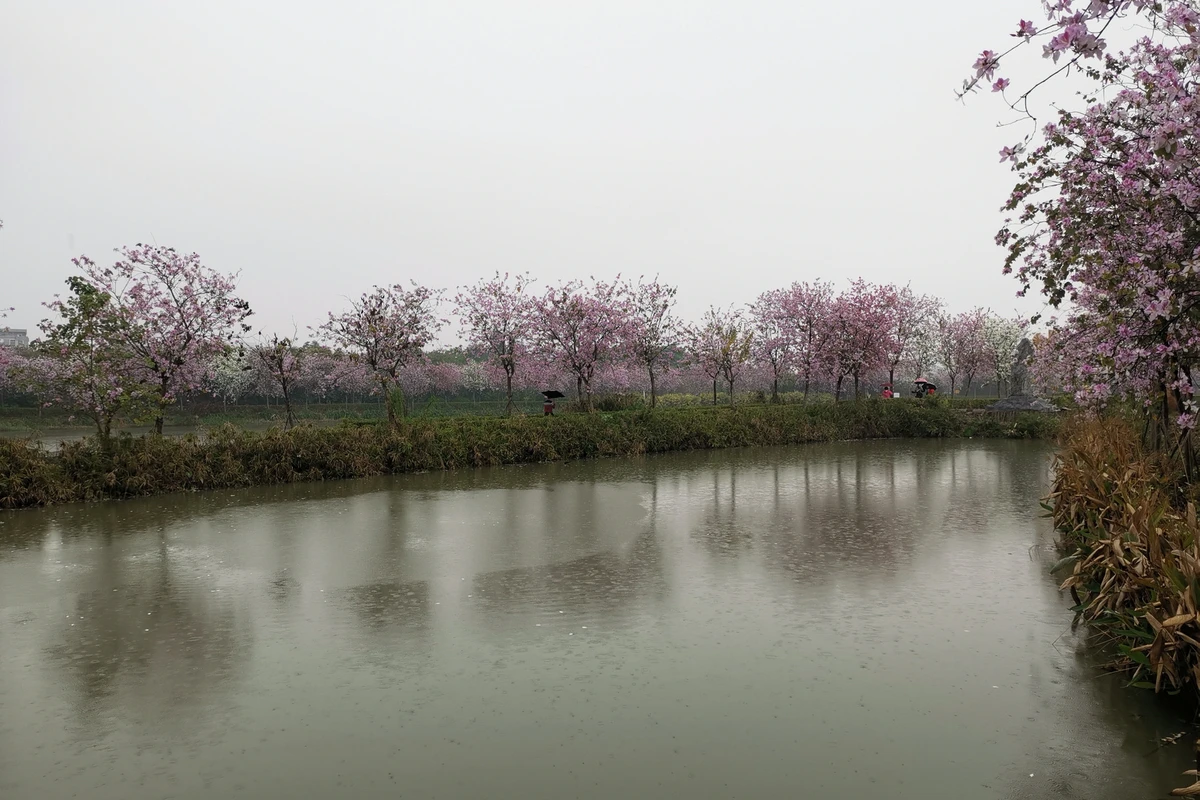
You need to reserve in advance on their official WeChat account. The reservation itself is not difficult, but point 3 of the ticket purchase notice states that once an order is placed, it cannot be changed or refunded (screenshot as proof). Here's the first problem: What if it rains heavily? Once you've booked, you have to go even if it's raining knives—unless you're willing to waste 20 yuan. Not expensive, but 20 yuan per person, what about 100 people's 20 yuan? If 200 people can't make it on time for various reasons, where does the ticket money go? I booked two days ago for today, and it rained all the way. The sky was grey, and holding an umbrella made it hard to take photos.
Should I drive or take public transport? Problem two. Driving is usually convenient elsewhere, but not at Haizhu Wetland. It's not that parking is hard; it's that walking back to the parking lot is inconvenient. For example, if you park at the North Gate but want to see sights at the South Gate, after sightseeing you have to return to the North Gate to drive. The North and South Gates are seven or eight kilometers apart—do you walk? For older people with good mobility, walking a few kilometers is already tough. For those with osteoporosis or leg pains from various reasons, walking that far is pure agony and only makes the pain worse. You might say you can take the electric shuttle. The wetland's electric shuttle runs every half hour, and it's hard to hop on midway. So my advice for elderly friends or those with mobility issues: take a taxi to the wetland, then first ride the electric shuttle to the scenic spots, get off to take photos, and wait for the next shuttle.
Some visitors entering from the South Gate, upon hearing it takes over an hour to walk to the North Gate, simply turn around and leave.
I have decent stamina; I walked 18,000 steps today, exhausting! The next morning, everything below my waist aches, and my legs are sore and painful.
Haizhu Wetland's full name is Guangzhou Haizhu National Wetland Park, and it naturally lives up to 'national'. It's enormous—the largest national wetland park in the central area of a mega-city in China, with a total area of 1,100 hectares. It's divided into Phases 1, 2, and 3. Currently, Phases 1 and part of 2 are open; Phase 3 is still under construction. Look at its online introduction: Haizhu Wetland is located in the southeastern part of Haizhu District, in the central urban area of Guangzhou. Known as Guangzhou's 'south lung' and 'kidney,' it mainly encompasses the 10,000-mu orchard, Haizhu Lake, and 39 related rivers and channels. Total land area is about 800 hectares, water surface 377 hectares. It's a composite wetland ecosystem where Pearl River Delta channel wetlands, urban inland lake wetlands, and semi-natural fruit forests interlace. The wetland has fertile soil and abundant rainfall, traditionally producing over ten kinds of Lingnan fruits such as Shixia longan, red-fleshed carambola, chicken-heart wampee, and rouge guava. Haizhu Wetland carries on the thousand-year-old dike-fruit agricultural culture of the Pearl River Delta wetlands, rich in Lingnan water-town characteristics, an important birthplace of Lingnan culture.
Problem three is evident here. Perhaps because it's still under construction, dirt paths are everywhere. If it's not raining, dust flies everywhere. Supporting facilities are quite lacking. In this huge wetland park, you'll occasionally spot a small gazebo far away to rest, but there are almost no benches along the roadside where you can sit for a short break—presumably to protect the environment. Service centers are few, so it's safer to bring your own water and food. The restrooms are beautifully decorated, but not many in number.
The main entrance of Haizhu Wetland Park is a stone-built archway featuring Cantonese-style Lingnan cultural landscape design, towering and majestic. Standing under it, a person looks as tiny as a bamboo pole.
Too many people, so I only took side and distant shots.
In the square beneath the archway, there are colorful flowers, mostly yellow chrysanthemums and purple-red hyacinths, and naturally, crowds of dancers.
Walking 100 meters past the archway, you see Green Heart Lake, covering about 6,000 square meters—the size of a football field. The lake water connects with the channel water, crystal clear.
After being long shut in the city, suddenly seeing such a large Green Heart Lake made me pause. Beyond the park, traffic still bustles, but Green Heart Lake, less than 1,000 meters away, feels like a tranquil paradise.
On the nearly 120-meter waterfront boardwalk, some are taking photos, some sitting and relaxing, enjoying a moment of leisure. I wish such moments could be longer, much longer.
Photograph the beautiful scenes (I'm not a photographer, so no fancy editing), and they become vivid paintings. If you have distant horizons in your eyes and poetry in your heart, you'll find beauty in life.
A white cable-stayed bridge named Feilong Bridge flies over Longtan Stream, with clusters of flowers adorning the bridge, a microcosm of Guangzhou as the 'City of Flowers.' Pulled by white cables, it resembles a beautiful sailboat floating on the water. From any angle, its beauty varies.
After crossing the bridge, you reach the open Urban Garden. Narrow winding paths cut through the fields, decorated with heart-shaped arches. The fields are planted with galsang flowers, luring women to step among the blossoms to take photos. There are uniformed staff stopping people from trampling the flowers.
The main star makes its grand appearance!
Along the lake roads of Phase 1, a 3.2-kilometer bauhinia corridor, thousands of Palace Pink Bauhinia trees compete in full bloom. The clear river water and soft pink blossoms together paint a pink dream stretching for several kilometers. This is Haizhu Wetland Park's 'greeting flower.' Most are pink clusters, interspersed with a few white ones, red and white mixed, blooming profusely under Guangzhou's sky, so beautiful it takes your breath away.
Misty rain gives it an ink-wash painting feel, with reflections visible.
Palace Pink Bauhinia doesn't coyly put on pose; its blossoms are as simple as roadside wildflowers, but it has a passionate, unrestrained nature. Unfettered, straightforward, its branches stretch upward freely as if to touch the high sky, and its flowers bloom anywhere at will, showcasing its inclusiveness and openness.
Bauhinia symbolizes family bonds, reunion, and brotherly harmony. During the Eastern Han dynasty, a man named Tian Zhen and his brothers Tian Qing and Tian Guang divided their property. When everything else was settled, there remained a bauhinia tree they intended to cut into three. The next morning, when they came to chop it, they found the tree withered, blossoms fallen all over the ground. Tian Zhen sighed to the sky: 'People are inferior to trees!' From then on, the three brothers no longer separated but lived together in harmony, and the bauhinia tree revived, blooming with luxuriant foliage and flowers.
Because of this story, in poems about sibling affection, bauhinia became a symbol of longing for dear ones.
Lu Ji wrote: 'Three bauhinias delight on one trunk, four birds grieve in separate woods.'
Li Bai sighed: 'The Tians in haste split flesh and blood, the blue sky and bright sun crack the bauhinia.'
Tang poet Wei Yingwu's poem 'Seeing the Bauhinia Wheel': 'Many mixed blooms have piled up, only you remain fragrant in late spring. Just like the tree in my old garden, I suddenly miss those in my old home.'
I used to think only purple was romantic, but since the pink muhly grass and Palace Pink Bauhinia emerged, pink too has become romantic. Though in my eyes, purple is a restrained, elegant romance, while pink is a shy, maidenly romance.
Looking at the signs, the cherry blossom grove lies in Phase 2. Following the directions, I met returning visitors and asked how far to see the cherry blossoms. The answers varied:
'An hour's walk, you'll get tired walking.'
'Still five kilometers, I've walked an hour already—you walk until your feet break.'
'Don't know, anyway it's far.'
No electric shuttle station nearby, so we had to walk. After walking in the rain for a while, an electric shuttle finally appeared. The driver said he had to drop off the current passengers before coming back. We waited about 20 minutes, and the shuttle arrived. I asked the female driver if the cherry blossoms were blooming well. She replied: 'They're almost fading.' My heart sank a bit, but since I'd come this far, I had to see them.
We got on, and the driver whipped out her phone for us to scan and pay by WeChat—10 yuan each. After less than ten minutes' ride, we got off and then walked back until we finally reached the cherry blossom grove.
They say it's ten mu of cherry blossoms, but I couldn't see the end. Looking far into the distance, verdant woods tinted with black, pink like rosy clouds. Up close, raindrops and dew glisten, making them mouthwatering; layers surround like pearls, clusters cluster into brocade, as if stepping into a dreamy fairy tale world. Those cherry blossoms falling in the rain scatter not just tears; petals flutter profusely, drifting silently with the wind, submerging not only bewildered eyes but also a drenched mood.
Cherry blossoms are Japan's national flower, but they originated in China. According to Japan's authoritative work Sakura Daikan, cherry blossoms are native to the Himalayas. After artificial cultivation, this species gradually spread to the Yangtze River basin, southwestern China, and Taiwan Island. Historical records show that as early as the Qin and Han dynasties over 2,000 years ago, imperial courts grew cherry blossoms, with a cultivation history of over 2,000 years. During the Han and Tang dynasties, they were commonly planted in private gardens. By the height of the Tang dynasty, from palace courtyards to commoners' fields, dazzling cherry blossoms could be seen everywhere, highlighting the majesty of a flourishing China. At that time, when many nations sent envoys to China, Japan deeply admired the brilliance of Chinese culture, including cherry blossom cultivation and appreciation. Cherry blossoms were brought back to Japan by Japanese visitors along with architecture, clothing, tea ceremony, and swordsmanship—similar to how our traditional Chinese medicine was 'taken' by Japan and later sold back to China at high prices...
There are quite a few memorable poems by poets and celebrities using cherry blossoms for expression.
Tang poet Li Shangyin wrote in 'Untitled (No. 4)':
Where does the sorrowful zither follow the brisk pipe? Cherry blossoms on the lane forever, willow banks.
The old maid of the east cannot get married; broad daylight is on the third month's middle day.
The princess of Liyang is only fourteen; after Qingming in warmth, we watch together from the wall.
Back home I toss and turn until the fifth watch; swallows on the beam hear my long sighs.
Modern Su Manshu wrote in 'Cherry Blossoms Fall':
Cherry blossoms for ten days bloom as they please, Is it too much to circle them a thousand times a day?
Yesterday wind and rain came perversely, To whom can I cry this grief from the human heaven?
Can't bear to see the foreign sands bury the fragrant bones, Don't let pure tears drip into the deep cup.
Don't let sentimentality recall in future years, An inch of spring heart already turned to ash.
Premier Zhou Enlai, whom we respect, wrote in 'Impromptu on a Spring Day':
Cherry blossoms red along the field path, Willow leaves green by the pond.
Amid the swallows' chirping, Another year of yearning.
If it weren't for the cherry blossoms, Phase 2 of Haizhu Wetland would hardly be worth recommending, because apart from the blossoms, it's all orchards and fruit trees. Moreover, there's not a single store in the entire Phase 2, service stations are closed, and patrol security is very sparse. If you walk on foot, it would take at least two hours to trek through Phase 2 without stopping—definitely not suitable for the elderly or children.
While sheltering from the rain, I rested in a pavilion. A woman grower sat opposite us. When we chatted and told her we each paid 20 yuan for entry, she said she'd never come. We laughed. She spends every day here planting flowers and nurturing plants—why would she need to pay to enjoy the scenery? She earns seven or eight thousand yuan a month from this work, which really impressed me.
On the way to the South Gate, there are several tall kapok trees with sturdy trunks and brilliant blossoms!
Haizhu Wetland: the flowers are all in bloom. Phase 1 is brimming with spring, while Phase 2's fruit trees await ripening. After reading my whole article, will you come or not? I wonder, as this wetland, designated Earth's 'lungs' and 'kidneys,' keeps being upgraded into a tourist attraction, can it truly nourish the heart, liver, and lungs of Earth's people?
(3340 2021/3/4)