Why is Guangzhou Called the 'City of Rams'? Beyond the 'Slim Waist,' What Other Captivating Buildings Await?
All photos in the article were taken by the author of "Black and White Touch," all rights reserved, unauthorized reproduction is strictly forbidden!
Among China's enormous traveling population, there is a group who plan their journeys tightly around the climate: southward in winter to escape the cold and embrace warmth, northward in summer to flee the heat and seek coolness. They are known as "migratory bird people," most of whom are seniors. These "migratory bird seniors" saw famous mountains and great rivers in their youth, and as they grow older their passion for travel hasn't faded—if anything, their experience has only deepened. They want to see scenery not just in the right place at the right time, but in a comfortable place at a comfortable time. Truly, as the saying goes, "The old are cunning, the old horse is slippery."
Though I'm not exactly advanced in years, my "travel age" is hardly young. If I don't borrow a little cunning now and then, how can I face all those years of starlight and wind and frost? So the "heroic feat" of dashing off to Northeast China to freeze on a whim in deep winter will probably never happen again; but when heavy snow swirls and I hatch a meticulous plan to fly to Lingnan and treat myself, that whim is sure to be acted upon immediately.
And thus, in mid-January this year, just when the north was locked in bitter cold, I arrived in sunny Guangdong.
There's a line in the song "Nanshan Nan": "You're in the southern sunshine while snow is falling thick; I'm in the northern cold night, as if it's spring all year round..." At first hearing, I thought Ma Di had lost his mind. But that day, having flown in a single day from snow-dusted Qingdao to sunshine-bathed Guangzhou, I found my senses wavering, with "snow falling thick" and "spring all year round" melting and fusing together, the south and the north shimmering side by side. With a heart full of tangled feelings—love and resentment, bitter memories, sweet longings—the "losing-my-mind" feeling was perhaps not so strange after all.
Of course, I came to Guangdong with no girl on my mind, only a pure desire to see Lingnan's scenery. Not a bit crazed, unburdened, I traveled from Guangzhou via Foshan and Shunde south to Zhuhai and Macau, then east to Shenzhen, and finally reached Chaoshan. I savored Lingnan's traditional culture (Guangfu, Hakka, Chaoshan, etc.) and experienced Guangdong's trendy prosperity. Joy shared is double joy, so in the next few articles I'll share with you all that I saw and heard.
In ancient Lingnan there was a place called Guangxin, where the seat of Cangwu, one of the earliest ancient states in southern China, was located. Guangdong (abbreviated "Yue") got its name because it lies east of Guangxin. Situated south of the Nanling Mountains (the general name for the mountain ranges south of the ancient Chu state), Guangdong is the inheritor of Lingnan culture, with unique features in language, food, customs, and traditions. That is why Han Chinese from the Central Plains, who had different customs, were called "Hakka" (meaning "guest people") when they migrated here.
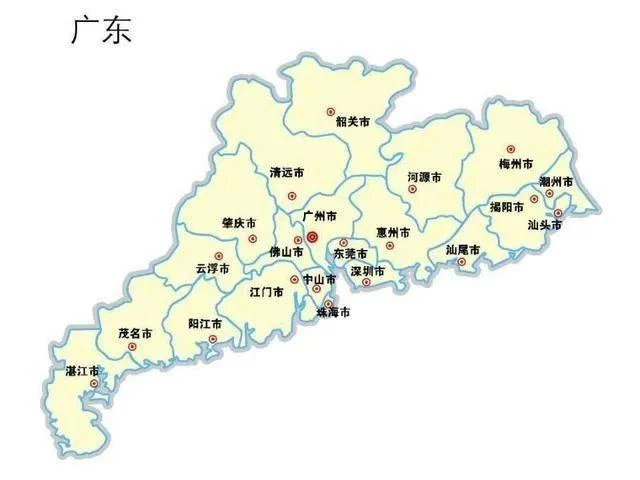
Besides the Hakka, Guangdong's Han population also includes the Guangfu and Chaoshan sub-groups. The Guangfu people mainly live in Guangzhou, Foshan, Dongguan and areas of southwestern Guangdong; Chaoshan people mainly in Shantou, Chaozhou, Jieyang, Shanwei, etc.; while Hakka people mostly in Meizhou, Heyuan, Huizhou, Shaoguan and other places. Moreover, Guangdong has several autonomous counties and ethnic townships where Yao, She and other minority ethnic groups live in compact communities. Different regional and ethnic cultures have been clashing and blending for a long time, forming Guangdong's rich human landscape and the multifaceted Lingnan culture.
The first stop of our Lingnan journey: let's take a stroll around Guangzhou, the provincial capital.
In China, some cities have names related to animals. Sanya, which I've shared before, is nicknamed the "Deer City"; Baotou, which I recently visited, is also called the "Deer City"; Lhasa's ancient name "Rasa" translated into Chinese means "Land of Sheep"... These affectionate names mostly stem from romantic legends. Guangzhou also has an animal name: the "City of Rams." About this "City of Rams," there is a legend:
Over two thousand years ago, Guangzhou was a vast, desolate land facing the sea. People toiled all day yet couldn't get enough to eat or wear. One day, celestial music floated through the air, and five immortals dressed in colorful robes, riding five rams, descended upon Guangzhou. The five rams held ears of grain in their mouths. After the immortals bestowed the grain ears upon the local people, they blessed the land to forever be free of famine. Then they rose into the sky and left, the five rams turning into stone rams. From then on, this place became a fertile land, hence Guangzhou got the names "City of Rams" and "City of Rice Ears."
(The Five-Ram Stone Statue on Yuexiu Hill is an emblem of Guangzhou)
Ancient fertile Guangzhou continued to shine with splendor into the modern era: during the Tang and Song dynasties, it was China's largest port on the Maritime Silk Road; in the Qing dynasty, it was the only foreign trade port in the country; after reform and opening up, it became a window for introducing Western technology, culture, and economy. Since 1989, Guangdong Province, spearheaded by Guangzhou, has continuously held the top spot as China's number one economic province, with its economic aggregate accounting for one-eighth of the national total. Today, Guangzhou, along with Beijing, Shanghai, and Shenzhen, is ranked among China's four first-tier cities—a place brimming with opportunities and challenges, an international metropolis that young people and ambitious individuals yearn for.
Strolling through Guangzhou, you can feel the dazzling prosperity of this super metropolis everywhere.
On the southern bank of the Pearl River stands the Guangzhou Tower, the city's most iconic landmark. With its slender, gracefully curving figure, it has been vividly nicknamed "Slim Waist" by netizens.
Gazing at the "Slim Waist" from Ersha Island at night, its ever-changing colored lights like a colorful dress hugging its body, soft and gorgeous, sexy yet dignified. Even though beneath the tower there are many magnificent buildings, they all pale before its gleaming radiance and proud silhouette, like humble dwarfs guarding a noble Snow White.
The affectionate name and the distance drape a coy veil over the Slim Waist, but up close, the Guangzhou Tower reveals its towering and imposing side: China's second tallest tower at 600 meters pierces the heavens like a path to the sky; spiraling steel bars crisscross solidly like bedrock. Guangzhou Tower can withstand magnitude-8 earthquakes and grade-12 typhoons, with a design lifespan of over 100 years. Beneath the pretty skin lie extraordinary design and superior technology.
The Guangzhou Tower is located in Haizhu District, right in the central city, facing Zhujiang New Town, Huacheng Square, and Haixinsha Island across the river. Given its excellent location and outstanding height, many places across the city offer different viewing angles.
At Haixinsha Pier, you can face its towering grandeur directly.
Along the Pearl River bank, you can admire its elegant form behind trees and its multicolored reflections in the water.
Or on a foggy day at Huacheng Square, feel its now-you-see-it, now-you-don't graceful figure.
The tall and graceful Guangzhou Tower is certainly outstanding, but when we lower our sights, we find the "dwarfs" around are also magnificent and distinctive. The most concentrated area of these beautiful buildings is Huacheng Square, separated from the tower by the river on the opposite northern bank.
Huacheng Square is called Guangzhou's "urban living room." The living room is the face of a home, so the host will naturally display the most eye-catching decorations here. If the Pearl River and the Slim Waist are the "portrait of stunning scenery" on the wall, then the buildings of Huacheng Square are the carefully arranged "desk and tea table, potted plants and greenery." Here, over 600 towering trees, a 2-kilometer-long wooden plank walkway, a floating island lake covering 15,000 square meters, plus the architecturally innovative new library, grand theater, new museum, International Finance Center, etc. At the end of each year, the Guangzhou International Light Festival, one of the world's top three light festivals, and light concerts are held here...
Now, let's look at some captivating buildings on the square:
Below is the new Guangzhou Library, the first building that caught my eye upon arriving at Huacheng Square. It stands out among the surrounding structures with its elegant "之" shape and walls that resemble open pages.
The library is designed on the concept of "beautiful books," with layered textures symbolizing the overlapping of books and the accumulation of culture. It also incorporates Lingnan architectural elements such as arcades, expressing artistic features of the region. Not only is the exterior beautiful, but with two underground floors and ten above ground, it is one of the largest city libraries in the world.
At night the library is closed, but the lighting makes the building even more alluring.
(Please turn your screen horizontally; no further prompt will be given below)
Below is the Guangzhou Opera House. Designed by British-Iraqi architect Zaha Hadid, the main structure features two "pebbles" in tones of black, white, and gray, like a pair of gems resting on an undulating desert, thus called "the twin rounded boulders." The theater has an opera hall, an experimental theater, a contemporary art museum, and three rehearsal halls (opera, ballet, and symphony), and has been rated among the "World's Top Ten Opera Houses."
Outside the theater stands a sculpture called "Flying Qin," with a cherubic angel playing a string instrument in the air, adding romance and fantasy to the entire building.
Below is the new Guangdong Museum, shaped like a treasure box. What treasures lie inside will be detailed later in the section about "two museums."
In the next picture, the blue building on the left is the Guangzhou International Finance Center, and the white building on the right is the Guangzhou CTF Finance Centre, with heights over 400 meters and 500 meters respectively. They are known as the "Twin Towers" of Guangzhou, standing on the northern bank of the Pearl River opposite the Guangzhou Tower on the southern bank, and they rank among the TOP 3 on Guangzhou's skyscraper list.
Viewing the Twin Towers from Haixinsha Island:
On Haixinsha Island, to the south of Huacheng Square, there is the Asian Games Park. The opening and closing ceremonies of the 16th Asian Games in 2010 were held here. The Asian Games stands and screen framework on the island are spectacular, especially at night, when neon and searchlights blaze, creating a riot of colors that is breathtakingly beautiful.
The silhouette of the Asian Games stands rippling in the lake:
The front of the stands dazzlingly brilliant:
Opposite the stands is the screen framework. The screens have been removed, but it has taken on a new "function"—as four giant "lighting technicians."
It also resembles loyal guards safeguarding the security of the Financial Center, the tranquility of the Pearl River, and the beauty of the Slim Waist...
West of Haixinsha is Ersha Island, another islet in the Pearl River, with the river flowing around it. On the island are beautiful buildings like the Xinghai Concert Hall and the Guangdong Museum of Art. High-end residential areas and sports training bases are set amidst vast green spaces, and various art sculptures are scattered here and there, exuding an artistic atmosphere and modern flair.
Guangdong Museum of Art:
Guangdong Overseas Chinese Museum:
Xinghai Concert Hall: the whole building resembles a magnificent grand piano.
Strolling on Ersha Island, you can feel the rippling blue waves of the Pearl River and gaze at the new city of Zhuhai in the distance; even the sea breeze is tinged with an artistic and modern vibe.
Sculptures on the island that make you pause:
If you want the strongest flavor of modern Guangzhou, the place to go is Zhujiang New Town, where the aforementioned Huacheng Square is located. It is the site of Guangzhou Tianhe CBD, one of China's three national-level CBDs, and the densest concentration of skyscrapers over 300 meters in China. In this concrete forest of giants, K11 caught my attention.
(Quite a few luxury cars below the building; noble Rolls-Royces show off the wealth and charm of Tianhe CBD)
K11 is a shopping mall full of personality, personality that comes from blending art, humanity, and nature. It was the art element that drew me. Right at the entrance, a sculpture firmly captured my gaze:
This sculpture is called "Eternity – Northern Qi Dynasty Round Carving Bodhisattva Standing Statue and Amazonian Barbarian." It assembles a solemn, dignified Eastern Bodhisattva standing statue with a violent Western Amazonian barbarian. Through elements diametrically opposed in aesthetics and culture, it humorously yet powerfully raises questions about the cultural contradictions and power struggles between East and West in human history.
(Installation art: Time Tower)
Zhujiang New Town is today's flourishing hub, while the prosperity of modern-era Guangzhou was centered in Liwan District, formerly known as "Xiguan." Wealthy merchants once gathered here; the famed Guangzhou Thirteen Hongs were established here. Next we'll move to Xiguan to feel the prosperity and history of a past era.
At the heart of Xiguan lies the Shangxiajiu Pedestrian Street, a commercial street that most tourists coming to Guangzhou will visit. The street comprises Shangjiu Road, Xiajiu Road, and Dishifu Road, stretching 1,218 meters in total. It was Guangzhou's first commercial pedestrian street.
The pedestrian street is lined with hundreds of shops, including time-honored brands like Tao Tao Ju with an inscription personally written by Kang Youwei, Lian Xiang Lou, the "No.1 Lotus Seed Paste House," the "King of Cured Meats" Huangshanghuang, the century-old Sheng Mao Tai, and many others. As early as the early 6th century, when Bodhidharma, founder of Zen Buddhism, came ashore to preach here, the area was already a commercial hub. Over the long course of history, a unique Xiguan culture blending Chinese and Western elements gradually took shape.
Shamian is another historically significant site in Xiguan, located at the southern tip of the area. It was once a British and French concession.
Shamian was originally a sandbank, bordering Bai'etan to the south. In the Ming Dynasty, a Huajie Pavilion was set up here to manage the entry and exit of foreign merchants' goods. In the mid-Qing period, Xigu Fort was built here to protect the city of Guangzhou. After the outbreak of the Second Opium War, on the pretext that "the Thirteen Hongs were destroyed and merchant quarters and foreign firms must be restored," Britain and France coerced the Qing government into ceding Shamian as a concession in 1859. It was not until 1946 that the Chinese government formally reclaimed Shamian. Over nearly a century, more than a dozen countries set up consulates here, nine foreign banks and over forty foreign firms operated here, and the Guangdong Customs Club, the Guangzhou Club and others were established here. Shamian has witnessed the changes in Guangzhou's modern history, experiencing many significant events, and is a microcosm of China's modern history and the history of foreign concessions.
Today's Shamian preserves nearly a hundred heritage buildings that merge Western architectural art with Lingnan culture. Green islets, ancient buildings, flower-lined avenues over a thousand meters long, and ancient trees create an utterly distinctive charm.
The picture below is the Our Lady of Lourdes Chapel, a Catholic church located at No. 14 Shamian Street, built in 1890.
The picture below is the Christ Church Shamian, built in 1865, located at No. 60 Shamian South Street. It was originally used as an Anglican church.
Speaking of churches, another Catholic church in Guangzhou is even more renowned. It is one of the world's four all-granite Gothic cathedrals (the other three being Notre-Dame de Paris, Westminster Abbey, and Cologne Cathedral). Completed in 1861, designed by a French architect and built by Chinese craftsmen at a cost of 400,000 francs, it can rival Notre-Dame de Paris. It is the Sacred Heart Cathedral, also known by its stone structure as "Stone House."
All walls and pillars of this grand cathedral are constructed from granite, making it China's only all-stone church and a must-visit landmark when traveling in Guangzhou.
Another unmissable landmark is also a religious building—the Great Buddha Temple.
Guangzhou boasts many famous temples. When Patriarch Bodhidharma came to China to spread Buddhism during the Southern and Northern Dynasties, the first place he arrived at was the Guangzhou region, which is why it is called the "First Landing Place in the West." After that, Zen Buddhism branched out and flourished, and Guangzhou, as the source of Zen, has thriving Buddhist traditions. At Faxing Temple, Huineng ended the debate among monks over whether "wind is moving" or "a banner is moving" with his "it is your minds that are moving," stunning everyone and becoming the Sixth Patriarch. At Six Banyan Temple, the exiled Su Shi, touched by the six ancient, shade-providing banyan trees, inscribed the characters "Six Banyans"...
But I didn't visit these famous temples; I only went to the Great Buddha Temple at night. Not only because it was first built in the Southern Han Dynasty (917–971 AD), with a long history and flourishing incense, but also because it incorporates local Lingnan styles and has great artistic character. Especially at night, the layered temple halls are resplendent in gold, possessing the aura of Chongqing's Hongyadong and the charm of the bathhouse in "Spirited Away."
Less than 500 meters south of the Great Buddha Temple lies another commercial street worth visiting in Guangzhou—Beijing Road. Interestingly, Shanghai's commercial street is called Nanjing Road, Guangzhou's is called Beijing Road. What's the logic?
Beijing Road is home to a concentration of Guangzhou's time-honored shops: many shops, large scale, complete range of business, and bustling with activity. Moreover, an excavation at the northern section of Beijing Road unearthed eleven layers of road surfaces from five dynasties spanning from the Tang Dynasty to the Republic of China period, while the southern section revealed the foundation of the Gongbei Tower with five layers from the Song Dynasty to the Ming and Qing Dynasties. Unearthed cultural relics include a large number of stone slabs, wall bricks bearing drum stones, and a copper clepsydra. Today, the relics are preserved under glass, becoming a distinctive historical feature within the bustling commercial district.
The above text skims the surface, the pictures are fleeting glimpses, giving you a cursory look at Guangzhou's most well-known buildings and landscapes. I've barely touched upon the architectural decorations and customs of Guangfu culture, Guangzhou's history and nature. But no need to rush. In the next article, we'll visit the wildlife park to meet adorable animals from around the world, go to Yuexiu Mountain and Baiyun Mountain to enjoy the natural beauty of evergreens and seasonal flowers, and visit the Guangdong Museum, the Chen Clan Ancestral Hall, and the Museum of the Nanyue King of the Western Han to appreciate the extraordinary and refined essence of Lingnan.
See you in the next issue!