Explore All of Guangzhou Chimelong Safari Park in One Article
All photos in this article were taken by the author of “Black and White Touch.” All rights reserved; unauthorized use is strictly forbidden!
The previous article took you on a tour of Guangzhou’s magnificent buildings epitomized by the Canton Tower — some towering and majestic (the Twin Towers), some down-to-earth yet bustling (Shangxiajiu), some ancient and splendid (Dafo Temple), some serene and elegant (Shamian)...
But just as a fine garment needs not only a beautiful exterior but also a quality lining, if Guangzhou’s various landmarks are its “face” showcasing its cosmopolitan charm, then the mountains and museums I’ll show you today are its “lining” reflecting its deep and profound cultural heritage.
Later articles will take you to Guangzhou’s “Two Mountains and Three Museums”—Baiyun Mountain, Yuexiu Mountain, Guangdong Museum, the Museum of the Mausoleum of the Nanyue King, and Chen Clan Ancestral Hall. After reading, you’ll gain a deeper and more thorough understanding of Guangzhou. But before those, I want to take you first to a park in Guangzhou, because just like Shanghai’s Disney, Shenzhen’s Window of the World, and Hulunbuir’s Matryoshka Square, these theme parks have become “tourism synonyms” for their cities.
That park is — Chimelong Safari Park.
Beijing and Shanghai also have large-scale safari parks, but following my travel philosophy—see only the best of its kind—I held back on visiting them even though I’ve been to Beijing and Shanghai several times, each time with the urge to go to a safari. I waited until Guangzhou because Chimelong Safari Park is the largest wildlife theme park in the world with the greatest diversity of animal species, hailed as “China’s most internationally-acclaimed safari park.”
That morning, full of anticipation, I arrived at Chimelong Safari Park in Panyu.
After entering through the North Gate and walking past Swan Lake surrounded by flowering trees, I reached the little train boarding area, ready to get on and have a “mid-range, slightly intimate” encounter with various wild animals.
I say “mid-range” because in my imagination, the train windows would have protective mesh, through which visitors could feed or even stroke the animals. With luck, a beast might climb up the window for a thrilling face-off, like scenes from documentaries on the African savanna. In reality, the train had no mesh, and animals rarely came close to the track—predators stayed even farther away. But compared to a typical zoo, there were no barriers, and the animals had spacious enclosures, more freedom, and more vitality. Coupled with the humorous, lively commentary from the guide on the train, this journey from “Australian Forest” to “African Savannah” still offered some unexpected fun.
(Occasionally, animals would “migrate” and occupy the track)
The train set off. The first stop was the Australian Forest, where among the eucalyptus trees characteristic of Australia, we saw the country’s national animal, the red kangaroo, and the world’s second-largest bird, the emu.
Some kangaroos looked around cluelessly, adorably goofy; others lounged on the grass like a beauty reclining, very charming.
The tall emus paced back and forth like patrolling guards.
Passing through the Indian Gate, we arrived at the American Jungle. Here we saw adorable alpacas and encountered the elegant and sacred black-necked swan, one of the “Ten Great Love Birds of the World.” The most eye-catching was the scarlet ibis, whose entire body—including legs and toes—is bright red. Each of them resembled a leaping flame, and no matter whether they were perched in a tree, by the water, among flowers, or alongside other animals, they always stole the show.
Further ahead we entered the West Asian Desert, where an Arab nomadic vibe filled the air. Here we saw snow-white yaks, the “ships of the high plateau,” and the agile “four-unlike” Pere David’s deer. What caught my eye was a scene of a Bactrian camel and an argali. The towering camel stretched its neck to gaze ahead while the short argali bowed its head to graze; the usually gentle camel suddenly radiated a regal aura.
At the end of the desert was the South Asian Rainforest, a dense broadleaf forest and the magical kingdom of the Asian elephant.
Winding through the lush jungle, magnificent herds of Asian elephants appeared and disappeared among the deep trees. It was a close-knit family with clear roles: mothers and calves whispered to each other, brothers strode side by side, and some rebellious little elephants temporarily broke away from the group, looking endearingly clueless and adorable.
Besides elephants, there is another cute creature not easily seen in other zoos: Malaysia’s national treasure, the Malayan tapir, nicknamed the “alternative five-unlike.” Its nose resembles an elephant’s trunk, its ears like a rhino’s, hind legs like a rhino’s, feet like a tiger’s, and body like a bear’s. It has a black-and-white coat, an odd and interesting appearance, and a clumsy, adorable manner. Despite its looks, in Chinese legend the “mu” (tapir) is a dream-eating beast, said to have been assembled from leftover parts when the gods created animals—hence why it looks like a bit of everything and nothing at all.
The fifth stop was the European Mountain Region, where winding slopes were inhabited by unique European mouflons and blue sheep, along with charming fallow deer, red deer, and white-lipped deer. They grazed, occasionally casting a European-style salute at visitors.
After the mountains, we finally reached the predator zone—the Wild Zone. Since the train has no glass, for safety, deep ditches wider than any animal could leap separated the predators from the track. Though it put them farther away, the view was wide open, and we could take in a full sweep of various fierce carnivores. Lions and tigers were all quite lazy, but a black bear rolling around and playing with an iron ball was utterly adorable—shedding all aloofness and ferocity, it attracted the most attention.
(The fidgety bear: photos taken from the moving train came out blurry, just bear with it)
The last stop was the African Savannah, which boasted the greatest variety of animals: ostriches, hippos, rhinos, zebras, giraffes, gnus, springboks, and more. Many of them can be seen in other zoos, so I’ll just highlight a few interesting behaviors.
Giraffe brushing its teeth:
The animal below with a white ring on its rump is called a waterbuck. The guide said the function of the white ring is to dazzle predators when fleeing!
The safari has both a driving tour area and a walking tour area. The above was what we saw on the driving tour. Next, we entered the walking area, where we could get even closer to the animals.
The first area after getting off the train was Qinglong Mountain, which features a “Jurassic World”—artificial dinosaurs hidden in the dense forest that surprise or startle visitors from time to time.
For example, the Dilophosaurus pictured below would spray “venom” whenever visitors passed by, catching them off guard.
And the T-Rex below, with a roar in the dim light, was enough to make even the bravest person shudder.
After Qinglong Mountain, we arrived at Rainforest Walk, where we found beautiful parrots and fantastic hornbills;
Bizarre giant anteaters;
Motionless two-toed sloths;
Black-bearded saki monkeys (mainly found in Brazil, they wag their tails when excited), “melancholy” white-eared marmosets;
And agile siamangs.
Each animal’s uniqueness and cuteness could fill hundreds of words, but that would make this article too lengthy, so I’ll just briefly describe the one that left the deepest impression.
The standout was the orangutan below. This species is found in parts of Indonesia and Malaysia, and in the park they live in the “Reaching for the Moon” area. This orangutan seemed to understand the significance of its habitat’s name, striking a pose as if reaching for the moon—how clever!
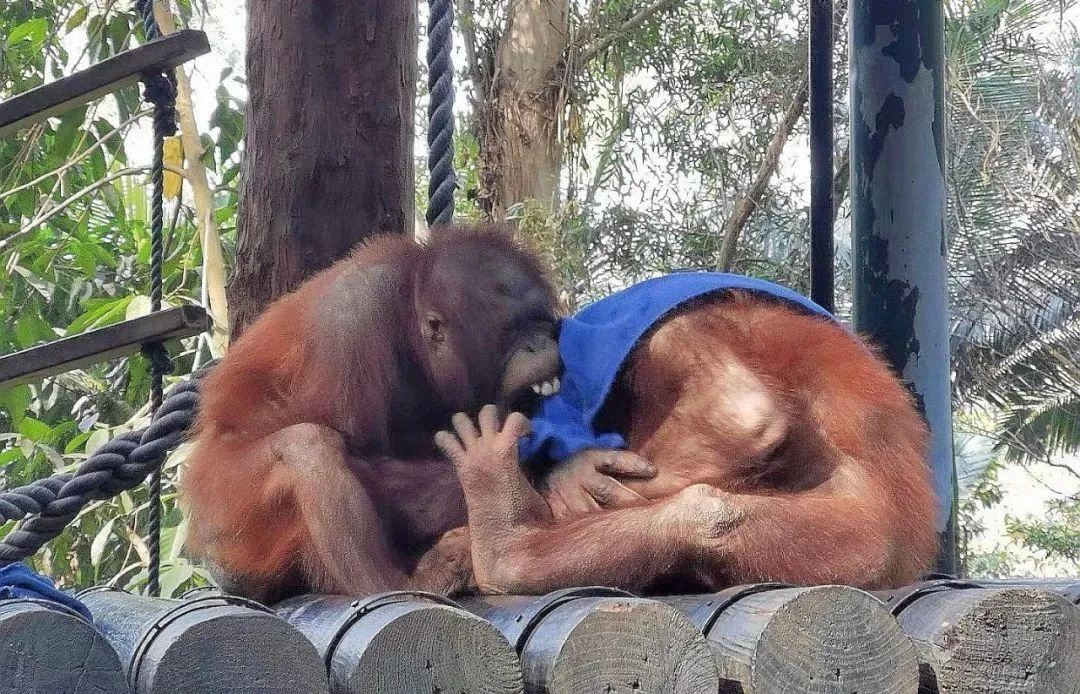
Two others below were tussling, scratching and biting each other over a blue cloth.
The winner sat on a rooftop clutching the “trophy,” gazing at it tenderly as if offering it to a sweetheart. If it could sing, it would probably sing “Unchained Melody” from Ghost: Oh, my love, my darling, I’ve hungered for your touch...
The wealth of expressions and emotional body language made me exclaim again: what clever orangutans!
But what I saw next completely overturned my understanding of animal intelligence: the fighting orangutans stopped as soon as they realized no one was watching, and the “moon-reaching” one rested the moment visitors walked away, only performing again for the next wave of onlookers... What I had taken for genuine baring of teeth, fierceness, and earnest longing turned out to be the brilliant acting of a bunch of drama queens!
A twinge of annoyance crossed my mind: who was fooling whom? I was just taking it too seriously.
These cunning little rascals...
Not far north of Rainforest Walk lies the Mystic Snake Valley, with a sensual snake-woman sculpture at its entrance. Many mythologies, Chinese and foreign, feature deities with a snake’s body and human head—often seductive yet dangerous, like Medusa. But in reality, not all snakes are venomous or threatening. Let’s get acquainted with a variety.
Below is an albino red-tailed boa. Boas are a type of large snake; this one can reach 3 meters long, and its tail is quite strong, able to grip things.
Next is a milk snake, non-venomous, gentle, and highly adaptable, suitable as an ornamental pet.
Then the golden python, a rare albino mutation of the Burmese python that can grow up to 7 meters, found in India, Sri Lanka, Myanmar, and northern Thailand.
The next two are a reticulated python and an albino reticulated python: mainly distributed in Southeast Asia and the Amazon basin, the world’s largest and most powerful constrictor, up to 8 meters, non-venomous but temperamental; after domestication, they become relatively docile.
After the snake valley, we moved on to Tiger Hill. Though tigers are common in zoos, Chimelong’s tigers are special. Besides common species like the South China tiger, Bengal tiger, and Siberian tiger, there are rare white tigers, golden tigers, and silver tigers—the white tiger being the park’s star attraction.
Golden, silver, and white tigers result from a coat-color gene mutation in Bengal tigers. China initially imported 8 silver and white tigers, and now there are 200 golden, silver, and white tigers. The silver tiger is entirely silver-white with light to dark brown stripes; there are only about fifty in the world, earning it the title “treasure among tigers.” The white tiger is cream-white with coffee-colored stripes, bright blue eyes, and a majestic yet elegant appearance, hailed as “the aristocrat of tigers.”
(Cute tiger siblings)
The white tiger diving show on Tiger Hill is a big highlight. Beautiful white tigers, guided by food, climb poles, dive into water, and swim with agile, graceful movements—both adorable and fierce.
After the white tigers, let’s check out other charming animals in the park.
Some have model-like poise: tall and slender, brightly feathered, or plump yet gracefully light on their feet.
(Flamingos in vivid plumage are “Adelina by the Water.”)
(The long-necked giraffes have a natural supermodel aura.)
(Those light-stepping elephants are plus-size models.)
They also have a regal air: some bristling with fury, some calm and collected.
(The mandrill with “hair standing on end.”)
(The “composed” Arabian baboon.)
They are masters of sleep: even if the earth exploded, it would not disturb their sweet dreams.
(If there were a “sleeping king,” the koala would leave Biden in the dust.)
(The giant pandas just eat and sleep, living like carefree immortals.)
They have a poet’s melancholy: either meditating alone or sighing to the sky.
(A solitary, pensive chimpanzee.)
(A golden snub-nosed monkey bidding farewell to the setting sun.)
(A koala reminiscing about a dream after waking.)
And then there are the meerkats, constantly glancing around, alert and cute.
And the flocks of swan geese taking off in unison from Swan Lake—romantic and spectacular.
Besides driving and walking, you can also take the cable car to get a bird’s-eye view of animals in the Asian rainforest and African savanna, and enjoy silhouettes gliding over Swan Lake.
The two photos below show the African savanna, with rustic African-style huts and giraffes, zebras, gnus, waterbucks, and others strolling idly—a scene of primal wildness.
The next photo is the South Asian rainforest, where the elephant herds that were half-hidden from the train are now fully visible.
The next photo shows the American jungle; from this angle, scarlet ibises look like dots of cinnabar decorating the vibrant tapestry of the jungle floor.
The park also had animal shows that gave me a clearer view of the animals’ shapes and behaviors, and deepened my understanding of the planet we live on. Though humans may be the paragon of creation, we occupy less than 16% of the vast Earth. Living long in concrete jungles, we may fall into the illusion that buildings, bridges, roads, and machines are the whole world. In reality, beyond cities and villages lie boundless gobi deserts, endless sands, infinite oceans, and vast forests... where countless creatures live, numberless stories unfold, and astonishing wisdom emerges.
When we grow weary of daily routines and numb to worldly affairs, a glimpse of the richness and splendor beyond the human world can restart a benumbed heart and reawaken a withered soul. So for the sake of our own happiness, we must protect this wider world of animals.