One Garden, Two Mountains, Three Museums – A Complete Guide to Guangzhou, the City of Rams (Part 2)
All photos in this article were taken by the author of "Black and White Touch". All rights reserved. Unauthorised use prohibited!
After the One Garden (Chimelong Safari Park), let's go and explore Guangzhou's Two Mountains and Three Museums.
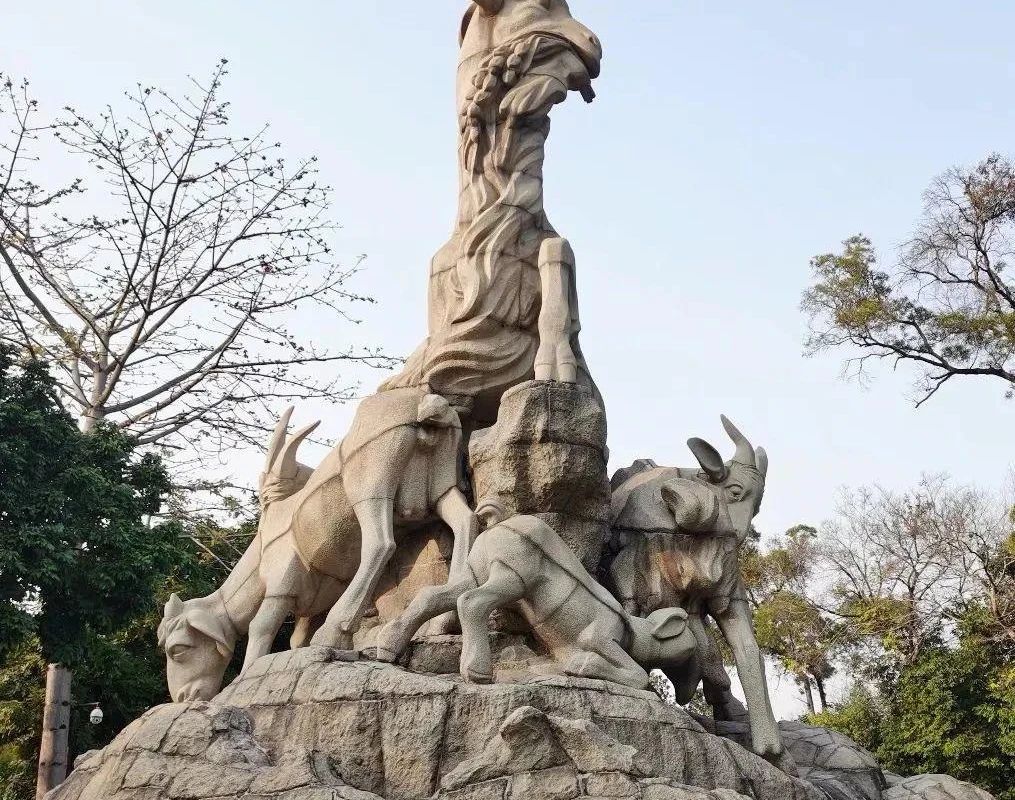
In the first article introducing Guangzhou, I mentioned the city's nickname "City of Rams". If Canton Tower is Guangzhou's dazzling modern landmark, then the Five Rams Statue – which tells the legendary origin of the name "City of Rams" (see previous article) – symbolises the spirit of Guangzhou. As shown below, the little ram kneeling at the front, suckling, symbolises gratitude; the mother ram looking back tenderly beside it represents loving-kindness; another ram quietly grazing with head lowered signifies diligence; behind it, a ram helping to scratch an itch stands for mutual support; and the tall ram on the highest point, its head held high, horns stretching into the sky, holding a rice ear with "one stalk and six shoots", smiles back at the world, symbolising courage.
Gratitude, loving-kindness, diligence, mutual support and courage are the meanings embodied in the sculpture, and they are also the spirit of Guangzhou people. At the 16th Asian Games held in Guangzhou in 2010, the Five Rams image served as the emblem and mascot, taking Guangzhou's image to Asia and the world.
The Five Rams Statue was built in 1959, carved from 130 pieces of granite. Its rustic form is deeply moving. In 1989, additional sculptures depicting five immortals bestowing rice ears upon the people were added at the base of the statue, together with surrounding pavilions, terraces, corridors and landscaped gardens, forming the present-day "Five Immortals Garden" scenic area – a must-see for visitors to Guangzhou.
Five Immortals Garden is located on Yuexiu Hill, where seven hillocks and three artificial lakes create a scenic park of green mountains, clear waters and flowering trees. Yuexiu Park is not only beautiful, but also intimately connected with Guangzhou's history and culture. Let's take a look at other famous sights on Yuexiu Hill.
Entering from the south gate and walking uphill, the first landmark you see is the "Monument to Dr. Sun Yat-sen's Study and Administrative Office". This was originally the Yuexiu Tower where Sun Yat-sen and Soong Ching-ling once lived. In June 1922, Chen Jiongming's troops mutinied and bombarded Yuexiu Tower. In 1930, this monument was erected on the former site, inscribed with the names of Sun Yat-sen and 62 guards, and recording the history of their bloody battle against the rebels.
Further up, you reach the "Foshan" stone archway, first built in the sixth year of the Daoguang reign of the Qing dynasty (1826). It is a granite structure with four pillars, three bays and one storey. In the third year of the Yongle reign of the Ming dynasty (1405), a Guanyin Pavilion was built on the hilltop, later converted into a Buddhist temple – hence the inscription "Foshan" (Buddha Mountain) on the archway.
Not far from the Foshan Archway stands the "Ancient Chu Court" stone archway, first built in the first year of the Shunzhi reign of the Qing dynasty (1644) and rebuilt in the sixth year of the Tongzhi reign (1867). Legend has it that Guangzhou was once called "Chu Court", which gives the archway its name. The reverse side is inscribed with "Yuexiu Remarkable Peaks".
At the summit, another majestic stone monument comes into view – the Sun Yat-sen Memorial Monument, built in memory of the revolutionary pioneer Sun Yat-sen. It is 37 metres high, with a spiral staircase inside. The front panel, made of massive granite blocks, bears the full text of Sun Yat-sen's will.
On the way down, you can see the ancient Guangzhou city wall, built in the 13th year of the Hongwu reign of the Ming dynasty (1380). It is one of three ground-level historical relics from early Ming Guangzhou (the other two being Zhenhai Tower and the Bell Tower behind Wuxian Temple). Today, only about 1,000 metres of the wall remain on Yuexiu Hill – a relic of Guangzhou's northward expansion and a silent witness to its history as a revolutionary hero city.
Yuexiu Hill also features Zhenhai Tower, built in the early Ming dynasty over 600 years ago. At the time, Japanese pirates repeatedly harassed China's southeastern coast. To strengthen defences, local officials built Zhenhai Tower on the hilltop, taking the meaning of "guarding the sea frontier". Climb the tower and a panoramic view of Guangzhou unfolds before your eyes. Today, it houses the Guangzhou Museum.
A short distance south of Yuexiu Park is the Sun Yat-sen Memorial Hall, completed in 1931 on the site of the presidential office where Sun Yat-sen served as provisional president in 1921.
The hall is an octagonal building of solemn grandeur, rich in national characteristics. Its clever design uses a steel frame and reinforced concrete mixed structure, creating a column-free space spanning 71 metres. In front of the hall stands a 5-metre-tall bronze statue of Sun Yat-sen.
On the east and west sides of the front lawn, ornamental cloud-and-crane pillars stand – the crane motifs symbolising good fortune and blessings, while also expressing deep reverence for Sun Yat-sen.
The Yuexiu Hill we have just toured is an offshoot of Baiyun Mountain. Baiyun Mountain is one of the famous mountains in Guangzhou and indeed all of southern China, celebrated as the "First Beauty of Guangzhou". So let's go explore Baiyun Mountain.
Baiyun Mountain lies in the northeastern part of Guangzhou, about 4 km wide east to west and 7 km long north to south. The broad mountain consists of over 30 peaks and includes eight scenic areas: Luhu Lake, Fei'e Ridge, Santai Ridge, Mingchun Valley, Kezi Ridge, Moxing Summit, Mingzhu Tower and Heyi Ridge. To fully explore them all takes the better part of a day.
Entering from the West Gate and walking east along the tree-lined avenue, you come to Plum Blossom Valley. Guangzhou is also called the "City of Flowers" because, located in the subtropics, flowers bloom all year round. Although I visited in late January, Plum Blossom Valley was bursting with spring. A tranquil valley with bamboo and streams, peach and plum blossoms in full bloom, drew visitors to stop and admire spring, and take photos.
Not far from Plum Blossom Valley is Huangpodong Reservoir. Legend has it that in the Yuan dynasty, female textile pioneer Huang Daopo came from a poor family and drifted from Shanghai to Yacheng in Hainan, where she learned textile techniques from the Li people. Decades later, Huang Daopo, now an old woman, missed her hometown deeply and set off on the return journey. Passing through Guangzhou, she saw the poverty and backwardness, so she stayed briefly in Baiyun Mountain and taught the locals textile skills. To express respect and remembrance, people named this place "Huangpodong" (Granny Huang's Hollow).
Surrounded by hills on three sides and water on one, the reservoir is framed by tall, brightly coloured dawn redwoods that captivate the eye.
South of Huangpodong Reservoir stands Mingzhu Tower, first built in the early Republican era. When warlord Chen Jitang ruled Guangdong, he turned the area into a summer retreat for his concubine Mo Xiuying. Later, due to poor public security, few visitors came, and the pavilion fell into ruin. It was rebuilt after liberation, and now you can enjoy distant views and the charm of lake and mountain scenery.
(Distant view of lake and mountains)
A short way south of Mingzhu Tower is Peach Blossom Stream. This landscape was inspired by Tao Yuanming's "The Peach Blossom Spring", featuring a rich plant community dominated by peach trees, complemented by rustic, natural pavilions and gardens. On Peach Blossom Island, clusters of peach blossoms bloom; cliffside carvings are exquisite; green mountains and clear waters create a paradise on earth. The "Peach Garden Heralds Spring" here is one of the Eight Scenic Spots of Yunshan.
Continuing south, you reach Baiyun Mountain's highest peak – Moxing Summit.
Moxing Summit stands at 382 metres above sea level. Standing on the peak, on rainy days you can appreciate the poetic scene of "white clouds soaring above Baiyun Mountain, white clouds floating below it" – this is how Baiyun Mountain got its name (literally "White Cloud Mountain"). On fine days, looking around, all the peaks are verdant and lush, mountain flowers in full bloom; gaze into the distance, and skyscrapers dot the landscape while the Pearl River flows from west to east, meandering through the vast plain – a breathtaking view of the "Southern Gateway of the Motherland".
When I visited, it was foggy; the Pearl River and buildings were shrouded in white mist, the view somewhat disappointing.
On the descent, I passed the Guangzhou Forest of Steles, which houses nearly 300 stone inscriptions – poems and calligraphic masterpieces by famous scholars across the ages, modern poets and calligraphers, all extolling the scenery of Lingnan, the City of Rams and Baiyun Mountain. It showcases the splendid culture of the Chinese nation.
Further on, you reach the Yellow River Stone Plaza in the Yunshan Lianquan Scenic Area. A stone tablet on one side introduces the origin of Chinese civilisation and the Yellow River. It states: "Chinese civilisation has three direct sources, namely the Yellow River civilisation, the Yangtze River civilisation and the Northern Grassland civilisation." Seeing references to the Yellow River civilisation here in Guangzhou, through which the Pearl River flows, felt quite familiar.
Not far from the Yellow River Stone, in a flower bed, lies a strangely shaped stone from the bottom of the Yangtze Three Gorges. It is one of three massive rocks excavated from the second-stage cofferdam foundation pit after the Yangtze was dammed in 1997. The rock, with its bright colours and rounded edges, resembles white clouds or rolling hills, stimulating the imagination.
Next to the Yangtze Stone is Yunding Square, composed of a viewing platform and Wanwan Pavilion, famous mainly for watching sunsets and night scenes. As early as the Yuan dynasty, this was one of the Eight Scenic Spots of Guangzhou, where one could enjoy a sea of lights and fishing boat lanterns on the Pearl River. At dusk, standing at Wanwan Pavilion, you can see the multicoloured sunset glow; leaning on the railing and gazing into the distance, the misty clouds give an aesthetic feeling of "reluctant to let the setting sun depart the human world".
(View from Wanwan Pavilion: Guangzhou's skyline, with Twin Towers and Canton Tower towering above the rest)
Heading further south, you arrive at Zhengxian Cliff. Legend has it that during the late Qin dynasty, alchemist Zheng Anqi roamed to Baiyun Mountain in southern China and lived in seclusion there. One year, a plague raged. To save the people, Anqi went up the mountain to gather the magical herb Sweet Flag, but accidentally slipped and fell off a cliff. Suddenly, the cry of a crane was heard, and a white crane carried Anqi up from the cliff, circled Baiyun Mountain once, then flew off into the eastern sky. Later generations built the "Zhengxian Shrine" on the spot where he ascended to immortality, and designated the 24th day of the seventh lunar month – the day Anqi flew away on a crane – as "Zhengxian Festival". Every year on that day, thousands of people spontaneously climb the mountain to worship Zhengxian, making it a grand traditional folk festival in Guangzhou.
Statues depicting Zhengxian curing the sick:
From Zhengxian Cliff, I walked all the way south through a dense forest and a beautifully manicured lawn, arriving at Nengren Temple.
Nengren Temple was founded in the fourth year of the Daoguang reign of the Qing dynasty (1824) by Monk Yinjian. At first it was just "a few thatched huts". It was gradually expanded and by the Guangxu period had become the largest Buddhist temple on Baiyun Mountain. From top to bottom, structures like Ciyun Hall, Sweet Dew Spring, Grand Buddha Hall, Tiger Running Spring, Sixth Patriarch Hall, Jade Rainbow Pool, stone bridges and gateways are artfully arranged, blending with the surrounding landscape into a gorgeous picture.
In the temple I saw a cliff carving and thought it was the character for "sheep", but reading the nearby explanatory panel, I realised it was "tiger". In the 24th year of the Guangxu reign (1898), famous general Liu Yongfu was stationed in Guangzhou with his Black Flag Army. On the Double Ninth Festival, he took his colleagues to Baiyun Mountain. Gazing from the summit, moved by the times, he was filled with emotion. Back at camp, he wrote this peculiar "tiger" character, which his subordinates carved on a rock wall at Nengren Temple.
East of Nengren Temple lies the Pugu Scenic Area, where babbling streams and lush green lawns create an elegant and enchanting environment that makes you linger. Along the stream are statues of Zhengxian collecting herbs, as well as Su Shi and Deng Shichang. Zhengxian's story was introduced earlier; Deng Shichang was a native of Guangzhou, Guangdong, a patriotic naval officer, and national hero in the late Qing Beiyang Fleet. In the 1894 Sino-Japanese Naval Battle, he commanded the cruiser "Zhiyuan" valiantly and died for his country. Su Shi (Su Dongpo) was exiled to Huizhou, Guangdong in the first year of the Shaosheng reign (1094) and wrote over 100 poems there. The famous line "Eating three hundred lychees a day, I would not mind being a Lingnan native forever" has been celebrated through the ages.
At the southern foot of Baiyun Mountain lies Yuntai Garden – fittingly, as the garden of the City of Flowers, Yuntai Garden is the largest landscaped garden in China. Here, uniquely shaped trees, year-round blooms and numerous elegant, novel scenic spots are gracefully arranged amid lakes and mountains that blend European flair with Oriental gardening.
The structure in the picture below is the garden's glass greenhouse, shaped like an orchid. Inside are zones for cacti and succulents, palms, and exquisite orchids – a miniature tropical botanical garden.
Various cacti:
Beautiful orchids:
Outside, there are also many colourful flowers. Below, varieties of Chinese roses:
Below, pink silk trees:
Beyond gorgeous flowers, the garden also features landscaping displays showcasing ancient and modern civilisations from around the world, as well as commemorations of international friendships – quite fascinating.
Ancient rock paintings:
The sculpture below is titled "Europe · Asia", given to Guangzhou by Yekaterinburg, Russia in 2012 to mark the 10th anniversary of the sister city relationship. The prototype is the Europe-Asia boundary marker located within Yekaterinburg's territory.
The next sculpture was a 2004 gift from Auckland, New Zealand to Guangzhou, commemorating the 15th anniversary of their sister-city ties. Its form symbolises Aucklanders' love for the surrounding ocean and local flora.
Below, the Roman colonnade by Yanhu Lake:
Having enjoyed the natural beauty of the Two Mountains, let's now explore the Three Museums and appreciate Guangzhou's history and culture.
There are some cities in China whose fashionable modern "good looks" are so dazzling that people easily overlook their historical depth. It's like meeting a beauty or a handsome face – you're awed by the face and figure, but you don't think about or have time to explore deeper, leaving only an impression of an attractive "shell".
Cities like Shanghai, Chongqing... and now Guangzhou fall into this category. They are all renowned historical and cultural cities. The weighty histories of Shanghai and Chongqing have been shared in previous articles. Guangzhou is the birthplace of Cantonese culture and, as the capital of Guangdong, a hub of Lingnan culture. To understand these cultures, the Guangdong Museum, Chen Clan Ancestral Hall and the Museum of the Nanyue King of the Western Han are unmissable destinations.
Without further ado, let's step inside.
【Guangdong Museum】
The Guangdong Museum is located on the Cultural and Art Square in the southern part of Guangzhou's new urban axis – the Zhujiang New Town central area. Its exterior resembles a delicately carved ancient openwork treasure box, which already appeared in the previous article about Guangzhou landmarks.
(Please view in landscape mode)
Inside this "treasure box" are many gems: traditional crafts with strong local characteristics such as Duan inkstones, Chaozhou wood carvings, Guangcai porcelain, Shiwan pottery sculptures, Guangzhou ivory carvings, plus various collections reflecting local history, culture and folk customs. Through exhibitions like "Arts of Fire and Earth", "Treasures of Purple Stone" and "Essence of Lacquer and Wood", we can gain a comprehensive understanding of Guangdong's history.
Right in the lobby, I saw several sets of distinctive Guangdong crafts. For example, the Jiulong Xiangyun Zhengde Plate below belongs to Guangcai porcelain:
Guangcai was briefly introduced in the article about Jingdezhen. Let's delve a bit deeper: Guangcai is short for Guangzhou overglaze gold-decorated porcelain (or Guangzhou coloured porcelain). It is a type of overglaze-painted porcelain produced in the Qing dynasty specifically for export. To meet foreign demand, plain porcelain blanks fired in Jingdezhen were shipped to Guangzhou, painted according to foreign merchants' requests, then baked at 700–750°C. It began during the Kangxi–Yongzheng transition of the Qing, flourished under Qianlong and Jiaqing, and continued throughout the Qing dynasty to the present day.
Below, the sculpture "A Toast to Celebration" belongs to Shiwan pottery:
Shiwan ware, also called "Guangjun", is the main product of the famous ancient Shiwan kiln, located in Shiwan, Foshan. The defining feature of Shiwan ware is its skilful imitation of various famous kilns, with the imitation of Jun ware being the most renowned. Shiwan pottery focuses on witty, everyday themes and forms, using exaggerated yet expressive artistic techniques to convey dynamic beauty. Close to life and popular taste, it sold well in Guangdong and Guangxi, and was exported overseas – a brilliant flower in the Lingnan ceramic garden.
Below, "Boy Worshipping Guanyin" is Guangzhou jade carving:
Guangzhou jade carving has a history of over a thousand years, reaching its peak in the 1930s. Today, the area around Changshou Road is still home to the South's largest jewellery and jade market. Guangzhou jade mainly uses jadeite, often employing relief carving. Decorative motifs include fruits, flowers, birds, dragons, phoenixes, Guanyin, Buddha and symbols of fortune, prosperity and longevity. Carvers pay great attention to the stone's natural grain and colour, designing according to the material, so works appear natural and heavenly. Guangzhou jade carving, with its unique style, is listed alongside Beijing, Yangzhou and Shanghai jade carving as one of the Four Great Schools of Chinese jade carving.
Apart from the scattered craft exhibits in the lobby, the museum has dedicated halls introducing Guangdong's traditional crafts. Let's first explore the Chaozhou Woodcarving Hall.
The previous article mentioned that Guangdong's Han people are divided into three major sub-groups: Cantonese, Hakka and Teochew (Chaoshan). Chaozhou woodcarving is a dazzling gem of Teochew culture.
Chaozhou woodcarving is one of the traditional Chinese woodcarving schools, popular in the old Chaozhou Prefecture area of eastern Guangdong, including Chaozhou, Chao'an, Raoping, Puning, Shantou, Chenghai, Chaoyang, Jieyang, Jiexi and Huilai. It is characterised by rich, dense compositions, exquisite delicacy, intricate openwork, and glittering gold. It ranks among China's Four Great Woodcarving Schools. Because the surface is often lacquered and gilded after carving, it is also called "gold-lacquered woodcarving".
Below, an openwork crab basket:
The crab basket is an important motif in Chaozhou woodcarving. Originally just decoration on building beams, it later evolved from a half-basket relief into fully three-dimensional round carving, becoming an independent ornament. This piece, carved from a single block of camphor wood, features ten crabs in various poses, exquisitely translucent and beautifully shaped. It once won a bronze medal at the "World Festival of Youth and Students Art Exhibition".
Below, part of a large gold-painted lacquer screen depicting scenes from the classic poem "Bin Feng":
The birthday screen consists of twelve panels, each with congratulatory essays, interlocking floral designs, fretwork patterns symbolising longevity, and narrative scenes. All are decorated in gold lacquer painting, reflecting a harmonious rural life of peace and contentment. The expansive setting, vivid figures and detailed scenes make it a masterpiece of Chaozhou woodcarving art with powerful artistic appeal.
Below is a Chaoshan residential hall: the Yongqing Hall of the Lin family in Chaozhou from the Republican period:
At Yongqing Hall, you can see the furniture, furnishings and architectural ornaments typical of a Chaoshan home. Gold-lacquered woodcarvings adorn doors, beams, windows, screens and other elements of the house – richly ornamented beams and rafters, resplendent and magnificent. The most precious item is the ancestral shrine on the altar in the main hall. Standing 3.28 metres tall, exquisitely crafted and superbly elegant, it is one of the tallest and most beautiful ancestral shrines extant, and was selected for the "National Treasure" special exhibition.
Below, a "Mantanghong" (All-Red) gold-lacquered woodcarving:
Mantanghong is a ritual utensil shaped like a flat vase, its surface carved in relief with flowers, birds and antique motifs. A wooden pillar is inserted in the middle, topped with a tin plate, used to hold candles during sacrifices. Usually placed at both ends of an incense table, during rites candle flames blaze high, filling the hall with red brightness – hence the name "Mantanghong" (full hall red).
Gold-lacquered woodcarving ruyi sceptre:
Below, a rectangular offering box with figures, flowers and birds:
The zhuanhe offering box is used in Chaoshan rituals to hold sacrificial offerings. It generally consists of a base, a lid and a fruit tray. Normally displayed on the hall table, during rites it is placed before the ancestral shrine; the lid is opened, the base and tray are stacked on the lid, offerings are placed on top, and worship proceeds. Besides zhuanhe boxes and mantanghong, Chaoshan rituals also use deity pavilions, deity palanquins, candlesticks and other sacred instruments, all decorated with gold-lacquered woodcarving.
Below, an openwork antique-style door panel insert – an architectural ornament:
Chaozhou woodcarving techniques include round carving, openwork carving, etc. Round carving is three-dimensional, allowing viewing from all sides. Openwork carving absorbs the strengths of sunken carving, relief, round carving and painting, creating multi-layered compositions where the background is entirely pierced through, resulting in a spectacular effect.
After viewing woodcarvings, let's go and look at Duan inkstones.
Duan inkstones are named after their origin in ancient Duanzhou (present-day Zhaoqing, Guangdong). Prized for fine, smooth stone, brilliant natural markings, ease of ink grinding without water loss, and both practical and aesthetic excellence, they are acclaimed as the finest inkstones. Duan stone inkstone making began in the Tang dynasty, and after 1,400 years of heritage, the deep traditional cultural connotations carried by Duan inkstones continue to endure.
Let's admire some Duan inkstones that are wonderful both in form and meaning:
Below, the "Four Sacred Creatures Righteous Spirit" inkstone: carved with traditional motifs of the Azure Dragon, White Tiger, Black Tortoise, Vermilion Bird, dragon-headed bat and auspicious ruyi clouds, symbolising good fortune, prosperity and blessings.
Duan stone Sea of Clouds and Dawn Sun inkstone: made during the Qianlong reign of the Qing dynasty, it is a type of green stone inkstone.
Duan stone Su Dongpo's Bamboo Hat inkstone from the Daoguang reign of the Qing dynasty:
Duan stone Fish-shaped inkstone from the Daoguang reign of the Qing dynasty:
A contemporary Duan stone inkstone: "Hills Beyond Hills, Towers Beyond Towers".
In addition to Guangcai porcelain and Shiwan pottery, the museum also houses other famous ceramics from ancient times to the present. Let's step over to the Ceramics Hall to appreciate ceramic art.
The collision of water, earth and fire gave rise to the colourful and brilliant ceramic culture. Porcelain is an important contribution of the Chinese nation to world civilisation. As early as the Neolithic period, our ancestors learned to make and use pottery. Mature celadon porcelain was fired in the Eastern Han dynasty. Over subsequent dynasties, the industry developed, reaching its peak in the Ming and Qing. By at least the Tang dynasty, China had begun exporting large quantities of ceramics. The sea routes from the East and South China Seas to all continents bear witness to this glory – these overseas trade passages are known as the "Ceramic Road".
Let's look at famous ceramics (and pottery) through the ages:
Neolithic Banshan-type double-eared painted pottery jar with five-circle design:
Henan Lushan kiln black-glazed jar with added colours (Tang dynasty):
Jizhou kiln black-glazed vase with carved "Tianqing Temple" inscription (Song dynasty):
Cizhou kiln peacock-green glazed prunus vase with human figures (Yuan dynasty):
Chaozhou kiln white-glazed standing Guanyin figure (Ming dynasty):
Chaozhou kiln melon-shaped ewer with applied decoration (Ming dynasty):
Peacock-green glazed plain tricolour yuhuchun vase with official promotion motifs (Qing dynasty):
Guangcai punch bowl with figural design (Qing dynasty):
Shiwan kiln unglazed biscuit "Gold Thread Cat" by Huang Bing (Qing dynasty): Huang Bing was a famous Shiwan pottery sculptor of the mid-to-late Qing, skilled in making bird, animal and figure sculptures.
Shiwan kiln duck with "Huo Jin" mark and hair texture (Qing dynasty):
Guangcai gold-traced plate with Dutch script design (Qing dynasty):
Besides ceramics, Duan inkstones and woodcarvings, the "Guangdong History and Culture Exhibition" and "Guangdong Natural Resources Exhibition" are also permanent displays, systematically introducing the province's history and nature. Due to space constraints, I'll highlight some important historical events and artefacts.
Nurtured by the Five Ranges and nourished by rivers and seas, Guangdong is the heartland of Lingnan culture, the birthplace of the Maritime Silk Road, the cradle of modern democratic revolution, and a pioneer of reform and opening up. The History and Culture exhibition presents Guangdong's unique historical and cultural features through four sections: "Origins of Southern Guangdong", "Sailing the World", "Forging Ahead", and "Beacon Fires of Guangdong".
(Cargo of the ancient Maritime Silk Road)
Below, a Southern Dynasties gilt bronze bowl-shaped vessel with flower, leaf, bird and fish motifs. Its unique shape and decoration reflect cultural exchanges between Guangzhou, Central Asia and West Asia.
In the mid-Ming, Italian missionary Matteo Ricci arrived in Guangdong, starting the introduction of Western learning to the East. As Western missionaries continued to come, European religion, science, music, technology and ideas were continually introduced to Guangdong, influencing the hinterland. The artefacts below reflect this history.
Republican-era zitan musical instruments:
A navigation sextant:
A telescope:
Blue-and-white plate with biblical story figures, scalloped rim:
After the Qianlong Emperor implemented the "Single Port Trading" policy, Guangzhou became the country's sole foreign trade port. Specialised trading firms – the famous Thirteen Hongs of Guangzhou – were established. The number of firms was not fixed; in the 18th year of Jiaqing and 17th year of Daoguang, there were exactly thirteen, hence the customary name "Thirteen Hongs". With the Hongs' establishment, Guangzhou became the centre of Sino-Western trade during the Qing's golden age, a key source of government tax revenue, and a transit point for those versed in Western learning. Chinese wallpapers, tea wares, silverware, fans and other goods were sold abroad through the Thirteen Hongs.
Below is Kaiping Diaolou and Villages in Kaiping City, Jiangmen, Guangdong – the province's first World Cultural Heritage Site. There are 1,833 existing diaolou, mostly built in the 1920s and 30s. These multi-storey tower buildings integrate defensive and residential functions with a blend of Chinese and Western architectural styles, reflecting the history of overseas Chinese, and the cultural and social forms of East-meets-West fusion and rural customs.
Sun Yat-sen once said: "The reason my home province of Guangdong is important to the nation lies not in its convenient terrain, but in its people's strong enterprising spirit; not in material progress, but in the people's fierce patriotism." The Opium War, the Hundred Days' Reform, the 1911 Revolution, KMT-CCP cooperation... Lin Zexu, Kang Youwei, Liang Qichao, Sun Yat-sen... In modern times, Guangdong was a stage for dramatic events and a gathering of heroes, all contributing brilliantly to saving the nation and advancing society.
In the second year after the War of Resistance broke out, the Japanese invaded South China. Guangdong's soldiers and civilians fought bloody battles to save the country, resisting and pinning down about one-seventh of the Japanese invaders.
(Captured Japanese spoils of war)
The natural resources exhibition showcases Guangdong's flora and fauna, mineral resources, jades, topography and climate. I cannot cover everything, so again I'll share some highlights.
Guangdong lies in the tropical and subtropical zones, characterised by a southern subtropical and tropical monsoon climate with abundant sunshine, heat and rainfall. Annual average temperatures rise from 19°C in the north to over 24°C in the south. Most areas receive 1,500–2,000 mm of annual precipitation. The climate is warm, rainfall plentiful, and it's green all year round. The terrain is complex and diverse, mostly mountains and hills, followed by platforms and plains, interspersed with rivers and lakes. Guangdong's mainland coastline stretches 3,368.1 km, the longest in China. The Pearl River, at 2,129 km, is China's third longest river. The province's animal and plant resources are also very rich: 829 species of terrestrial vertebrates, 281 freshwater fish species, and 22 species under national first-class protection, including South China tiger, clouded leopard, bear macaque and Chinese white dolphin. There are 7,055 species of wild vascular plants. In mineral resources, bounded by the Nanling Mountains to the north and the South China Sea to the south, Guangdong has favourable metallogenic conditions. 149 types of minerals have been discovered – relatively complete, with particular strengths in non-ferrous, rare and rare-earth metals, and non-metallic minerals – making it one of the provinces richer in mineral resources.
Dinosaur skeletons unearthed in Guangdong: Heyuan and Nanxiong have yielded dinosaur bones, eggs and footprint fossils. Heyuan even holds a Guinness World Record for "largest collection of dinosaur eggs" with over 10,000 eggs discovered.
Below, chrysoberyl cat's eye: A cabochon gem displays a bright band of light under illumination, like a cat's eye – this is the "cat's eye effect". It is caused by numerous parallel needle-like or fibrous rutile inclusions or hollow tube inclusions. The denser and more numerous the inclusions, the less transparent the stone and the stronger the cat's eye effect.
Tiger's eye cat's eye:
Star rose quartz:
Below, jade artefacts – a white jade bowl with an imperial poem from the Qianlong period of the Qing dynasty:
Guangning jade carving of a chicken: So lifelike, I noticed a visitor drooling while looking at it.
In addition to these five permanent exhibitions, during my visit there were also temporary shows like "The Tang-Tubo Ancient Road – A Joint Exhibition of Fine Cultural Relics from Seven Provinces" and "Republican-era Overseas Shopping – The Foreign Goods Trend in Early 20th Century Guangdong". Let me show some precious artefacts from these.
In the early 7th century, the Tang empire and Tubo established close relations. The Tang–Tubo Ancient Road from Chang'an to Lhasa (then called Luoxie) subsequently took shape, presenting a scene of "exchanging gold, jade, silk and embroidery, with messengers to and fro, an unbroken stream of friendship". Stretching over 3,000 km, the road passed through present-day Shaanxi, Gansu, Qinghai and Tibet. It was a vital route from the central plains to Qinghai, Tibet, and even Nepal and India from the Tang era onward, and a bridge maintaining ethnic bonds and promoting cultural exchange and fusion. The "Tang–Tubo Ancient Road" exhibition recreates the splendour of those exchanges.
Below, a black-glazed double-eared flask with carved peony design, originally housed in the Ningxia Museum, a Western Xia artefact:
Tang dynasty silver boot from the Ancient Road Museum in Huangyuan County, Qinghai Province: Tang writer Linghu Chu once wrote a poem "The Young Warrior": "Bow back gleaming, sword reflecting frost, I rode out of Xianyang in the autumn wind. Before retaking Hehuang for the Son of Heaven, I will not look back to my hometown." Hehuang refers to present-day Qinghai.
Tang dynasty silver gilt flying horse pattern gold foil ornament from the Ancient Road Museum in Huangyuan County, Qinghai: In 640 Princess Wencheng, and in 707 Princess Jincheng, journeyed to Tubo; both passed through Qinghai, leaving footprints and stories, and many Tang artefacts that tell of the ancient route's prosperity.
A Qing dynasty "ga'u" amulet box from the Tibet Museum: Ga'u is a cherished chest ornament for Tibetan women, often made with turquoise, coral and dzi beads, indicating family wealth and the wearer's skill, and is very popular in Tibet.
The "Republican-era Overseas Shopping" exhibition felt like stepping into a nostalgic old movie. Exhibits come from early 20th century when Western goods flooded Guangdong – a brief but legendary era. Within a few decades, Chinese and Western lifestyles blended, bringing new novelties to daily life. Chinese and foreign commodities became unique cultural symbols of that age. Even today, the aesthetic blending of East and West from that period remains a retro fashion.
Below, a Danish-made telephone: This wall-mounted type was a popular imported phone from the late 19th century to the 1930s.
1930s British automatic player piano:
AGFA PD16 camera: AGFA was a major imported camera brand during the Republican period.
1920s Kodak film projector:
Shanghai-made Seagull 203 folding camera: In the 1960s, the Shanghai Camera Factory began developing domestic advanced SLR cameras; in 1967 it successfully produced China's first advanced SLR. The 203 model was one of the best-selling cameras at the time.
Chen Clan Ancestral Hall, also called "Chen Clan Academy", was planned in the 14th year of the Guangxu reign (1888) and completed in the 19th year (1893). Chen is the most common surname in Guangdong, and the hall was a collective ancestral hall jointly financed by Chen clan organisations from various counties in Qing-era Guangdong. It also served as temporary accommodation for Chen clan members visiting Guangzhou to prepare for the imperial exams, await official appointments, or deal with litigation.
The Chen Clan Ancestral Hall is the largest surviving traditional Lingnan ancestral-hall-style building complex in Guangdong, with magnificent decorations and excellent preservation. It comprises nineteen individual buildings of various sizes: lofty halls, spacious rooms, elegant verandas and graceful courtyards. It epitomises the best of Guangdong folk architectural decorative arts, skilfully employing woodcarving, stone carving, lime sculpture, pottery sculpture, polychrome painting and other techniques on architectural elements. Themes are broad, forms vivid, colours rich, craftsmanship superb. It is a resplendent hall of folk decorative art, hailed as "a shining pearl of Lingnan architecture". Guo Moruo praised it: "Heavenly work can be rivaled by man; human work is beyond the understanding of heaven. Truly a world created, better than ten years of reading."
(Pottery decoration on the entrance wall)
In 1959, the Chen Clan Academy was turned into the Guangdong Folk Arts Museum, housing collections of ceramics, embroidery, carvings and other handicrafts that reflect Lingnan folk customs. Today, the exquisite architectural decorative arts and historical folk art masterpieces come together in a brilliant display – truly an unmissable journey of folk aesthetics in Guangzhou.
Below, the centerpiece of the main hall – a Guangzhou woodcarving of a sacred pavilion, the museum's most precious and magnificent artefact.
This sacred pavilion is a ritual object used to welcome and seat deities, a valuable witness to the annual "Procession of the Flood Saint" festival of the eighteen villages of Gangwei Society, Panyu district during the Qing dynasty. Made of around 150 wooden components, it is huge, structurally complete, exquisitely crafted, and imposing. Its painted decorations feature auspicious patterns, opera stories and folk legends, reflecting late-Qing folk aesthetic tastes and values, and possessing great historical and artistic value.
Below, a decorative ironwork openwork panel: The iron decorations at Chen Clan Ancestral Hall absorbed features of Western garden architecture. The openwork panel on the terrace is divided into four sections with motifs of "Kylin and Phoenix Delivering Jade Books", "Dragon Playing with Pearl", "Three Goats Bringing Prosperity", and "Gold and Jade Fill the Home". With dignified tones, exquisite composition and profound meaning, such ironwork is rarely seen in traditional Guangdong architecture.
Below, a wooden gable from the Chaoshan region: In Chaoshan vernacular architecture, gable shapes and decoration are heavily influenced by the Five Elements theory, evolving into five basic styles: Metal, Wood, Earth, Water and Fire. The Wood gable is described as "round head and straight body", with a concave curve at the top, the ends curving upward into sharp points. The decoration carries rich symbolism – bats, peaches and pines for longevity, parrots for harmony, eagles for soaring ambition, and the central "Heavenly Official Bestows Blessings" (commonly known as the "crowning motif") for promotion.
Below, a blue-rimmed Manchurian window with birds and flowers of the four seasons:
Below, a traditional Guangzhou home study: The desk is set with the four treasures of study; the curio cabinet displays the owner's collections. Stepping into this study, lighting a sandalwood incense burner, reading by the window, playing with treasures – truly wonderful.
Below, a Guangzhou ivory carving artwork – a birthday congratulation lantern: Guangzhou ivory carving has a long history dating back over two thousand years to the Western Han. The tomb of the Nanyue King yielded ivory counting rods and fragmentary carvings. From the Qing dynasty to the Republican period, as Guangzhou was a hub of Sino-foreign trade, the ivory carving industry flourished, producing exquisite tribute items for the court and export art popular in overseas markets.
Xiuyan jade cloud-dragon ball:
Shiwan pottery sculpture reflecting a well-off life – a bountiful sugarcane harvest:
A sculpture depicting Lingnan folk customs and Guangzhou's thriving commerce – weighing on a giant steelyard:
Beyond what's shown, the Chen Clan Ancestral Hall also displays painted porcelain, Guangzhou embroidery, Chaozhou embroidery, woodcarving, Duan inkstones, paper-cutting and more. Its content is rich and pieces exquisite. Friends travelling to Guangzhou should definitely visit and admire it in person. Next, let's head to the Museum of the Nanyue King of the Western Han to experience the ancient mystery and splendour of Guangzhou.
【Museum of the Nanyue King of the Western Han】
In 1983, the tomb of Zhao Mo, the second king of the Nanyue Kingdom, was discovered in Guangzhou. It was well preserved and is the earliest painted stone chamber tomb of the Han dynasty found so far.
Over ten thousand artefacts were unearthed from the tomb, reflecting the political, economic and cultural development of the Nanyue Kingdom over two thousand years ago. Let's glimpse its features through the museum's collections.
The Nanyue King's tomb contained a wealth of treasures, everyday utensils, and fifteen sacrificial victims, fully embodying the Han belief that "death should be served as life was", as well as Nanyue characteristics: politically imitating the Qin and Han empires, economically leaping forward, and culturally diverse and blended. It authentically recreates the basic face of Nanyue society.
The most eye-catching artefact in the museum is the jade suit sewn with silk threads below: The tomb occupant wore this silk-sewn jade suit, rested on a pearl pillow, held a pearl lump in his mouth, and had his head and chest covered with a "face cover" and "pearl vest". A total of 47 jade discs were found inside and outside the coffin, implementing a relatively complete jade-and-pearl burial. The ancients used jade and pearl burials to prevent putrefaction and guide the soul to heaven.
The tomb occupant's teeth and skull: Besides the king's remains, fifteen sacrificial victims were found in the tomb – four were the Nanyue king's consorts, one a steward, and ten servants. These artefacts are significant for studying the Nanyue Kingdom's official rankings, harem system and burial customs.
Below, a rhinoceros-horn-shaped jade cup: The Han dynasty believed rhinoceros horn cups could dissolve poison. This cup is carved with a sharp-mouthed kui-dragon. The dragon's head is in low relief; its body gradually rises to high relief; the base is fully three-dimensional. Combining multiple carving techniques, it can be deemed an unparalleled Han jade masterpiece.
Below, an openwork double-ring jade pendant with dragon and phoenix: The pendant consists of inner and outer rings. The inner ring has an openwork carving of a swimming dragon, its claws extending beyond the ring; the outer ring an openwork phoenix standing on the dragon's claw. The composition is perfect, the craftsmanship superb, displaying the romance and realism characteristic of Han art. This artistic treasure of Han jade was chosen as the museum's logo.
Below, a bronze tiger tally with gold-inlaid inscriptions: Tallies were ancient credentials used for military, diplomatic, customs, postal and other purposes. This one bears the five characters "By royal command, dispatch chariot and troops," serving as proof of executing a royal order.
Six-mountain pattern bronze mirror: The use of bronze mirrors in Lingnan was a custom brought by the Qin people. Besides their reflective function, mirrors were also believed to ward off evil spirits.
Han-style ding tripod: The Nanyue King's tomb yielded a large number of cooking, eating and washing vessels, showing cultural features of the Qin, Han, Yue and Chu. They reveal the tomb owner's luxurious lifestyle of ritual bronzes and music, feasting and dancing.
Below, a round-carved long-sleeved jade dancer: The dancer wears an upright spiral hairstyle and Han costume, performing a long-sleeve dance – a type of Han court dance popular in the Chu region. It reflects the cultural influence of the Han dynasty on the Nanyue Kingdom.
Here, the Guangzhou journey comes to an abrupt end. So far, Guangzhou has been the city that consumed the most words – three articles, nearly 20,000 characters (Beijing also took three articles), and even at that, many scenic spots and artefacts were omitted.
I wanted to write everything I saw and thought about as comprehensively as possible, but that can lead to excessive length and clutter. When I tried to streamline, I found this I didn't want to omit, nor that, and finally it became this flowing "stream of consciousness" journal. Because Guangzhou really is a city of diversity and colour!
If you have persisted and read this far, perhaps you have spent an hour (to read all three parts). I sincerely thank you. But I think you should also thank me, because I spent four days seeing it with my own eyes, and another three days writing. Seven days condensed into a one hour "virtual tour" – surely such effort deserves some encouragement?
More encouragement gives me more motivation.
Next stop, we'll head to Foshan and Shunde, where the allure of martial arts and the temptation of delicious food await...