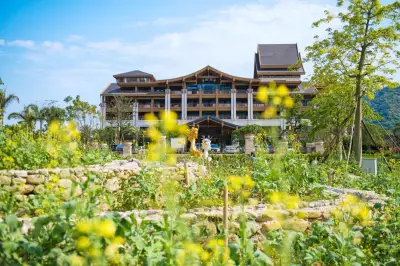
Chapter 3132: Yu Yin Shan Fang – A Lingnan Garden with Bamboo Between Walls and Fragrant Orchids and Osmanthus
Jumbo Huang's Exploration and Photography
The Complete Ancient Architecture of the Huang Family
Chapter 3132: Yu Yin Shan Fang – A Lingnan Garden with Bamboo Between Walls and Fragrant Orchids and Osmanthus
© Original images (all image rights belong to Jumbo Huang's Exploration and Photography. Any form of reprint must contact Huang_Jumbo or Jumboheritagelist). The images in this chapter have commercial value. All images in this pictorial publication are strictly prohibited from incomplete screenshot reprints! Please be respectful. Especially reject any reprints that manually overlay commercial website watermarks! This work reserves all rights. The text in this work may not be directly or indirectly used for any profit-making commercial activities; violators will be prosecuted. Some partial text sections in this pictorial publication may come from publicly available networks or the public domain, solely for personal study, research, and appreciation, with no clear commercial purpose. (©Image by Jumbo Huang, Part of Text citation resources was from public domain)
Still waters run deep, calming fire and warding off evil spirits.
Women who love to travel always appear younger and more vibrant than those around them.
The essence of travel lies in forgetting the exhausted self and unleashing one's fresh charm.
I stepped into the courtyard of Yu Yin Shan Fang, surrounded by solid wood furniture and exquisite glass windows. Birdcages hung from ancient trees, goldfish swam in the pond, and couplets adorned the study walls. It was truly a journey through time.
I visited the Red Rain and Green Cloud landscape. A few women were taking photos; some had very loud voices, uninhibitedly shouting about how to pose in the scenic area, which was quite annoying.
According to historical records, as early as the Han Dynasty, private gardens appeared among the common people in the Lingnan region. Thereafter, Lingnan gardens continued to develop, gradually maturing by the late Ming Dynasty. In the early Qing Dynasty, the Pearl River Delta region of Lingnan enjoyed a relatively developed economy and a flourishing culture. Private garden building became increasingly popular after the mid-Qing Dynasty, gradually forming its own characteristics in garden layout, spatial organization, the use of water and rocks, and plant arrangement. Yu Yin Shan Fang, one of the four famous classical gardens of Guangdong in the Qing Dynasty, showcases the brilliance of Lingnan garden art with its superb gardening skills and distinct garden personality.
At the Red Rain and Green Cloud scenic spot, there is a famous couplet on the second gate, composed by the garden's original owner, Wu Bin, and inscribed by the renowned scholar Chen Yungong. Chen Yungong was a Jinshi (successful imperial examination candidate) in the 33rd year of the Kangxi reign, serving through both Kangxi and Yongzheng periods, rising to the position of Left Assistant Censor-in-Chief of the Court of Judicial Review. He authored the three-volume 'Beiyuan Poetry Collection'. The first line of the couplet reads: 'Three bows of land are enough for red rain.' 'Bow' here refers to an arrow, anciently used to metaphorically denote a distance of one hundred paces, implying the garden area is very small, merely three hundred paces across. 'Red rain' narrowly refers to the firecracker vines in front of Shenliu Hall. In full bloom, clusters of flowers cascade down, petals falling into the pond like a shower of red rain, a magnificent sight. Broadly, it describes the entire garden, which is adorned with flowers and fruits all year round, brilliant and beautiful. The second line, 'A corner of shade, deep with green clouds,' perfectly captures the garden's environment of lush greenery and tranquil seclusion, and the traditional Lingnan garden technique of 'tall trees and deep ponds,' vividly portraying the optimal effect of the garden's plant landscaping.
The Washing Red and Crossing Green Bridge Corridor is a spot where the most women come to take photos. Within the garden lies a clear pond, with lotus leaves spreading across the water. Over the lotus pond lies a covered bridge, small and exquisite, with a total length of only 20 meters. Yet it cleverly combines bridge, corridor, pavilion, and railing into an integrated and refined structure. This covered bridge divides the garden into eastern and western sections. The west is 'Red Rain,' the east is 'Green Cloud,' hence the name 'Washing Red and Crossing Green.' It is said that this bridge was built with reference to the 'Liubo Bridge' at 'Haishan Xianguan.' It is hailed as the most classic design in Lingnan gardens and has become the iconic landscape of the garden. Under the eaves and on the pillars, the bridge is decorated with wooden openwork carvings of patterned lattice. The railings on both sides of the corridor are designed with backrests, allowing visitors to rest and enjoy the scenery—a truly ingenious touch. Through the arch bridge of the corridor, one can faintly glimpse waterside pavilions, rockeries, and trees, layers of scenery adding a sense of haziness and achieving a profound effect.
I saw some beautiful women in Hanfu attire coming to take photos at the Washing Red and Crossing Green Bridge Corridor. There were many professional photographers in the scenic area. Beside the bridge is Shenliu Hall. The Deep Willow Hidden Treasures scenic spot, Shenliu Hall, was the garden owner's reception room, named after a line from a Tang Dynasty poem: 'Idle gate faces the mountain path; deep among willows is the study hall.' It is the main building of Yu Yin Shan Fang, with a hip-and-gable roof. The open and spacious corridor and courtyard steps outside the hall lead directly to the pond surface. The exterior is magnificent, and the interior decoration is exquisite, rich in the style of Lingnan architecture. The iron flower trellis in front of the hall is entwined with ancient firecracker vine, its branches and leaves lush. There is a pillar couplet in front: 'Whose busy traces on the snow? Reluctant to abandon the hometown garden, how many spring flowers, how many autumn flowers; a humble abode shelters me, wishing to gather famous scholars in straw sandals, old friends come with the rain, new friends come with the rain.'
Inside Shenliu Hall, which is covered with firecracker flowers, there is a dragon-pattern caisson ceiling in the center of the main hall. The ceiling decorations of Linchi Bie Guan and Wopiao Lu are coin-pattern caissons. Eastern Han texts record: 'The well (caisson) symbolizes the Eastern Well constellation. Algae, things in water, are all used to suppress fire.' By the Song Dynasty, caissons were also called 'covering the sea.' With a vast sea on the roof, naturally, no fire should be feared. Ancient building names avoid the word 'fire'; even 'catching fire' is euphemistically called 'running water.' Thus, many important buildings have names that contain water elements. For example, 'Shen' of Shenliu Hall contains water; 'Chi' (pond) of Linchi Bie Guan contains water; 'Xun' (fragrant, associated with water vapor) of Laixun Pavilion contains water. Linglong Waterside Pavilion not only has the word 'water' in its name, but the entire building is situated in water, enough to overcome fire. Wopiao Lu does not have a water-related name because its roof is specially equipped with a wind-fire gable to block actual fire.
Historically, in the couplets at the main gate of Shanyan Wu Ancestral Hall in Yu Yin Shan Fang, 'Red clouds shelter, rising sun greets the door,' the character for 'door' (门) deliberately lacks a hook on its final stroke. Similarly, at the main gate of Qianju Wu Ancestral Hall, the couplet 'Southern mountain spring brimming, eastern land sun ascends,' the character 'ascends' (开) also lacks a hook on its last stroke, both written straight down to avoid the suggestion of a 'fire hook.'
Inside the hall, a strong scholarly atmosphere pervades, with numerous treasures, exquisite wood carvings everywhere, and master calligraphy shining brilliantly. On a precious sandalwood carved screen, there are calligraphy works by famous Qing Dynasty figures. These include poems by the three great talents of the late Qing—Liu Shanzhou, Zhang Chuanshan, and Weng Fanggang—as well as the calligraphy of Grand Secretary Liu Yong of the Qianlong reign. Two rare large carved wood canopies, 'Pine and Crane for Longevity' and 'Squirrels and Grapes,' display superb craftsmanship of exceptional skill. Thirty-two peach wood fan paintings adorn Shenliu Hall with magnificence, showcasing typical Lingnan architectural style. In terms of spatial organization, two carved canopies divide the interior into two interconnected 'rooms.' Additionally, partition panels and lattice screens create one enclosed, highly private, and complete 'chamber' with two 'compartments,' making the interior space captivating.
I visited Linchi Bie Guan. Originally a study, it is a flush-gable roof building facing a square lotus pond. In ancient times, literati regarded the inkstone as 'a pool' (chi), and dipping the brush to write was called 'facing the pool' (linchi). Hence, naming the building this way is exquisitely apt. Inside, the hall is simple and unadorned, starkly contrasting with Shenliu Hall. The exterior is novel, with the central bay decorated with finely patterned ice-crack lattice false windows painted gold. To adapt to the frequent typhoons in the Lingnan region, the roof slope is not steep, and the roofline is straight, reducing wind resistance, lending the building a simple yet elegant appearance. A pillar couplet on the corridor reads: 'By the pond, washing inkstone, sometimes gulls can be befriended; moving steps under the moon on winding corridors, seeking poetry unaware cranes follow.' One can imagine how delightful it was when the garden owner would invite literary friends on a clear, moonlit night with the fragrance of lotus flowers wafting in the breeze to compose poems.
Wopiao Lu is a flush-gable roof building with wind-fire walls, a small cottage specially built by the garden owner for guests to rest. The interior is simply furnished, with uniquely designed windows. The north side features a row of louvered windows for ventilation and light. The south side has a row of Manchurian windows inlaid with blue and white glass. By changing the overlay of the blue glass, one can view the outside scenery and enjoy the rare sight in the south of 'thousand-mile ice' and 'red leaves of Fragrant Hills.' When all windows are opened, the natural scenes of spring and summer appear.
I walked into Linglong Waterside Pavilion. Inside, tables and a guqin (zither) were arranged; a few women were doing makeup, and a man was photographing a woman in Hanfu. Linglong Waterside Pavilion is an octagonal pavilion with a curved-ridge hip roof. With windows open on all eight sides, it is bright and transparent, situated in the water. It was a place where the garden owner gathered literati to paint and socialize. Due to its functional needs, the pavilion is relatively large, reflecting the practical nature of Lingnan garden culture. Inside, eight peripheral columns and four central columns are all made of Borneo ironwood, offering high ornamental and research value. Opening the windows reveals the surrounding scenery clearly. On moonlit nights, with the interior dark and the outside bright, the long shadows of bamboo resemble traditional Chinese paintings, a breathtaking sight. There is a couplet handwritten by the garden owner in the pavilion: 'Every thought of famous mountains passed, sitting to watch strange rocks and textured clouds, still vivid before the eyes; casually speaking of having crossed the vast sea, quietly facing bright ripples and moon reflections, enough to purify the spirit.'
I then walked into [The Complete Ancient Architecture of the Huang Family] No. 18376: Shanyan Wu Ancestral Hall. Yu Yin Shan Fang is not only a masterpiece of Lingnan garden culture but also represents Lingnan ancestral hall culture and academy culture. Shanyan Wu Ancestral Hall, dedicated to the ancestors with Wu Biaoyang, the father of garden owner Wu Bin, features dignified architecture, solemn in appearance. The layout is three bays wide and three bays deep. The scale, components, couplets, and plaques all exude a rich flavor of clan culture. Inside the offering hall, a rarely seen wooden carved imperial edict plaque is displayed, bearing three imperial decrees by Emperor Xianfeng conferring the titles of Tongfeng Dafu (a senior official rank, second grade) upon the garden owner Wu Bin and his father and grandfather, and the title of Lady upon his grandmother, mother, and wife. In addition to the meticulous interior layout, the roof ridge is decorated with abundant stucco reliefs, exquisite in pattern and profound in meaning. On the gable ridges of both sides of the offering hall and the sleeping hall roofs, there is a dragon-shaped beast with a wide-open mouth biting the ridge, called a Chiwen. Its dragon form gradually evolved from the chiwei (owl tail), and its body is said to be derived from a whale. Chiwen is known for gazing and swallowing, a sea deity capable of summoning clouds and rain. Placed on the roof, it was believed to help ward off fire with its divine power.
The most distinctive residence in Yu Yin Shan Fang is Yu Garden. In 1922, Wu Zhongyu, the fourth-generation grandson of the original owner, added 'Yu Garden' as a place for daily living and entertaining guests. His children also once lived there. Yu Garden is connected to Yu Yin Shan Fang, playing a complementary role. The plan of Yu Garden can be divided into three parts. The main entrance is on the south side, facing the village lanes. Upon entering through the south gate, there is an entrance hall and a main hall. The central part is a boat hall, two stories high. The ground floor serves as a living room, divided into front and rear cabins separated by a carved wooden door canopy. Centered around the boat hall, the ground floor features a small square outside. The building plan is winding and circuitous, containing bridges, pavilions, ponds, chambers, a Guanyin Hall, and an Arhat Hall. The Fish-Viewing Bridge echoes with the boat hall, captivating visitors who pause in admiration. The second floor houses a study and living quarters. From the second-floor terrace, one can overlook the garden scenery and fully appreciate the pavilions, terraces, rockeries, and pond waters of Yu Yin Shan Fang—an excellent example of borrowed scenery.
Stylistically, the entrance hall and main hall of Yu Garden take the form of a three-bay hall. The two black-lacquered doors and high enclosure walls create a solemn and dignified atmosphere. Buildings such as halls and studies adopt a tower-like form, with open lattice doors and windows, directly connecting to inner courtyards, light wells, and terraces, allowing seamless indoor-outdoor integration. The decorations, patterns, colors, and furniture are all locally sourced, adding a strong southern Chinese flavor.
The rear garden is a small garden within a garden, featuring a winding water course for floating wine cups and a Chinese chess endgame setup, planted with various Lingnan fruits. Cascading springs and small waterfalls babble; in spring, insects chirp and frogs croak; in summer, lychees ripen and cicadas sing—a natural ecological scene that makes visitors linger, reluctant to leave.
Yu Yin Shan Fang could not be left behind, so a pseudo-classical building was erected in a corner of the garden. Wenchang Garden, centered on the Wenchang culture of China, inherits the gardening techniques of Yu Yin Shan Fang to create a garden form of 'water in the center, towers on every side, tall trees and deep ponds, willow shadows and osmanthus fragrance,' giving rise to the two major attractions: 'Wenchang Flying Pavilion' and 'Guabang Green Mountain.'
Wenchang Pavilion stands 15.4 meters high, with an octagonal appearance. Its design employs a spatial division that seems to have four floors but actually has three, enhancing the scenic beauty of the elevation while conforming to the auspicious yang number. The entire structure is tall, straight, and soaring, with graceful flying eaves and upturned wing corners, exuding a dignified air. When the wind blows, Buddhist bells tinkle, refreshing the spirit. Inside the hall, the caisson ceiling is painted with figures, flowers, birds, and landscapes, meticulously detailed and vivid. The ceilings of the corridors on both sides of Wenchang Pavilion are also covered with paintings of local Panyu customs and inspiring comic strips, offering enlightenment on life as one admires them.
Guabang Mountain is an attraction echoing and complementing Wenchang Pavilion. In the past, Wenchang Pavilion, the statue of Kuixing (the star god of literature), and Guabang Mountain were cleverly integrated into a whole, making it a must-visit place for scholars. Climbing Wenchang Pavilion, worshipping Kuixing, and overlooking Guabang Mountain, it felt as if 'success in the imperial examinations' was right before one's eyes. Guabang Mountain stands 8 meters high, with a broad body, a cluster of peaks rising abruptly, majestic and craggy. It features perilous paths, caves, rock cliffs, precipices, waterfalls, and flowing springs, creating varied landscapes. The restroom is hidden within a cave, an ingenious and novel concept. Visitors can climb up via steps or pass through the cave. The top of the cave entrance is built in a 'dome' shape, resembling hanging stalactites, quite spectacular.
Yu Yin Shan Fang is one of the four great classical private gardens of Guangdong in the Qing Dynasty. Construction began in the sixth year of the Tongzhi reign (1867) and was completed in the tenth year (1871). It is a National Key Cultural Relics Protection Unit and a National Outstanding Modern Architecture Unit, reflecting its high historical and scientific value. Together with Foshan Liang Garden, Dongguan Ke Garden, and Shunde Qinghui Garden, it is known as the 'Four Great Gardens of Guangdong.' As the only one among the four that has largely preserved its original appearance, and with its architectural feature of 'concealed but not revealed, shrinking a dragon to an inch,' it is hailed as a representative work of classical Lingnan gardens. It is a hall where one can feel the spirit of Cantonese scholar-officials, appreciate the art of Lingnan garden architecture, and explore local folk culture.
Yu Yin Shan Fang tailors its decoration to the functional use of its buildings, with simplicity and complexity complementing each other. Simplicity reveals elegance, while complexity maintains harmonious beauty. The wood carvings, brick carvings, stone carvings, and stucco reliefs, regarded as the essence of Lingnan garden decoration, are widely used to adorn door heads, window lintels, roof ridges, walls, and gable walls. The extensive application of decorative pieces compensates for the lack of spatial variety and enriches the visual experience. The calligraphic and painting works inside are not only artworks for appreciation but also form part of the wall decoration. The decorative features of the ancestral hall buildings are also unique. The tops of the gable walls are designed relatively high, with curved upturned ridges; the main ridge features brilliant stucco reliefs. The main decoration is concentrated at the top, while the lower part merely reveals the natural color of the bricks.
In terms of partition materials and door/window decoration, Yu Yin Shan Fang shares commonalities with traditional Chinese architecture. Interiors often use wooden partition panels, screens, flower canopies, and paneled walls to separate spaces instead of brick walls, which not only divides space but also forms an important part of interior decoration. In particular, the garden boasts a great variety of door and window styles, becoming an important means of architectural expression. Special attention is paid to the psychological and emotional interplay between indoor and outdoor spaces, directing the natural charm indoors to achieve a reciprocal communication between humans and nature. A window couplet in the Weiguxiang Room of the garden reads: 'Lingering charm of poetry heard in the neighboring courtyard; cool bamboo shadows enter the empty window,' which is a realistic portrayal of this reciprocal communication.
The classical architecture of Yu Yin Shan Fang, with its unique external form, arises from the high integration of architectural function, structure, and art. Its fundamental artistic modeling characteristics come from the structure itself. The load-bearing system primarily uses a post-and-beam wooden frame structure: roof tiles are laid on rafters, rafters rest on purlins, and purlins are supported by beams. The weight of the roof is mainly borne by the beams and columns and transmitted to the foundation. This structure is open, stable, and uses fewer columns, providing a larger usable interior space. However, the fatal weakness of the wooden frame is its poor fire resistance. Coupled with the relatively backward firefighting tools and equipment in ancient times, a fire in a building would be difficult to control. Therefore, fire prevention was a matter of great importance for both the imperial court and the common people. In ancient times, fire was a taboo subject, dreaded to the point of being euphemistically called 'running water.' Thus, warnings related to fire were cleverly integrated into the decorative culture of traditional architecture. The 'fire-avoidance' decorative culture is a major feature of the ancient architectural decoration in Yu Yin Shan Fang.
The methods employed in Yu Yin Shan Fang to suppress fire and ward off evil, although sounding idealistic, actually served a promotional purpose similar to modern fire-prevention signs in ancient times, constantly reminding people to 'be mindful of fire.' They became a distinctive symbol in ancient Chinese architecture.
Traditional Chinese culture has always complemented rites with music and emotions with reason. 'Rites' embody norms and order, while 'music' embodies aesthetics and taste. Architectural color, as a branch of humanistic color, conveys this cultural message of 'rites and music' more explicitly through symbolism and vividness. Although color has both physiological and psychological dimensions, ancient Chinese architectural color was not only considered from an aesthetic perspective but also as a conceptual culture, thus rooted more in psychological aspects. According to the ancient Chinese simple 'Five Elements' philosophy, the five colors are represented by blue, white, red, black, and yellow respectively.
Flowers and trees are inherently natural objects without any intention. However, in the long course of historical development, as they became increasingly connected with people's lives, natural flowers and trees were continually infused with human thoughts and emotions, and merged with cultural and life content, thus forming a cultural phenomenon related to flowers and trees. As the late renowned Chinese scientist Gao Shiqi once said: 'Flowers represent many human emotions,' 'Flowers embody many human spirits,' 'Flowers symbolize many human wishes.' Flowers and trees, along with their associated figures and anecdotes, have left behind many thought-provoking poems, songs, stories, and allusions that have been passed down to this day. Yu Yin Shan Fang, a literati garden, fully reflects this cultural accumulation in its plant arrangement.
The couplet 'Three bows of land are enough for red rain; a corner of shade, deep with green clouds' not only highlights the garden-building purpose of honoring ancestors and perpetuating their blessings but also uses plants to thematically compose the natural landscape. Immersing oneself in the garden and savoring it carefully, one naturally appreciates the poetic and picturesque charm of this famous couplet. In front of 'Shenliu Hall,' the flower trellis is entwined with a firecracker vine personally planted by the original owner, Wu Bin. Its stem is as thick as a tree, coiling around the pillar like a dragon, bursting with vitality. Around the Spring Festival, the flowers bloom profusely. On a flat plane, green leaves and golden blossoms cover the floral eaves; vertically, hanging tassels cascade down like a shower of red rain, a spectacular sight. The jackfruit tree in the northeast corner of the garden has a vast canopy, offering dense shade that feels like green clouds covering the area, quiet and cool. The meaning of 'lingering shade' is self-evident. In a small residential garden where space is limited and the arrangement of mountains, water, and buildings is constrained, this superb and ingenious method of plant landscaping is truly admirable. The bamboo (Yazhou bamboo) planted between two walls, known as 'bamboos sandwiched between walls,' is also a unique green landscape of the garden.
Anyone who has visited Yu Yin Shan Fang will never forget the two ancient elm trees in the garden. Both trees lean in a cliff-like manner toward the pond, resembling two dragons venturing into the sea, a magnificent sight. Wu Bin once served in the Ministry of Justice in the capital. Due to his dedicated service to the court, three generations of his family received imperial honors from Emperor Xianfeng. In the imperial decree to his grandmother, nee Luo, she was praised with the phrase 'radiant in Di robes, forever shining with the glory of the red tube,' meaning that the honor she received upon being titled was like wearing a garment adorned with golden pheasant feathers, shining with red brilliance. Golden pheasant feathers are brilliantly colorful, and the birds like to roost in elm trees. Thus, planting two elms was intended to attract more golden pheasants to roost there, displaying the glory of the Wu family's female members and serving as a direction for future female descendants to strive toward. Moreover, the character 'yu' (elm) sounds like the 'Yu' in Yu Yin Shan Fang, making it most suitable to plant elms as the garden's signature trees. Consequently, two flower beds were built in a prominent spot in front of 'Shenliu Hall' to plant the elm trees.
Yu Yin Shan Fang is densely planted with osmanthus, especially at the east gate of Linglong Waterside Pavilion, where 'two osmanthus trees greet the courtyard'—a golden osmanthus on one side and a silver osmanthus on the other, implying a houseful of gold and silver. Above the west window of the pavilion hangs a large plaque reading 'Can you smell the osmanthus?' and the exterior pillar couplet includes the line: 'The fragrance of osmanthus wafts over; have you forgotten the world? Facing the sentient flowers.' This shows the garden owner's intense love for osmanthus. Osmanthus, also known as sweet olive, is a small evergreen tree of the olive family. 'Of autumn flowers, none can match the osmanthus in fragrance'; 'Suppressing the west wind, it reigns over all blooms; for it, ten parts of autumn color are busy.' Indeed, osmanthus is the most fragrant among autumn flowers, thus able to overcome the power of the autumn wind and claim the foremost position. The garden owner was utterly intoxicated by the fragrance of osmanthus.
The owner's love for osmanthus, beyond its scent, was more about using it to express himself. Throughout history and across cultures, 'osmanthus' (or laurel) has been a symbol of high honor. In ancient Greek mythology, laurel was a 'sacred plant' dedicated to Apollo, the god of science and arts. The ancient Greeks also wove laurel leaves into wreaths, called laurel crowns, to honor outstanding poets. In Britain, excellent poets are honored with the title 'Poet Laureate.' In ancient Chinese imperial examinations, 'plucking the osmanthus branch from the moon palace' signified passing the examinations. The success and prosperity of descendants in official careers was expressed as 'orchids and osmanthus together fragrant.' In modern society, achieving a certain honor is still referred to as 'winning the laurels.' The garden owner, Wu Bin, was a Qing Dynasty juren (provincial graduate). After donating grain, he obtained the position of Secretary of the Grand Secretariat. Soon, he was selected as a vice director in the Ministry of Justice, serving as a principal officer. In the fifth year of the Xianfeng reign, he was honored with the title Tongfeng Dafu, a second-grade official rank, with honors extended to three generations: his grandparents, parents, and wife. Later, his two sons also successively passed the provincial examinations, hence the saying 'Three juren in one family, father and sons pluck the osmanthus branch together.' This was not only 'plucking the osmanthus from the moon palace' but also 'orchids and osmanthus together fragrant.' Therefore, the garden owner planted osmanthus everywhere and filled the railings along the garden paths with various orchids, his intention clearly evident. According to Wu Xihua, the fifteenth son of Yu Garden owner Wu Zhongyu, Wu Baoying passed the provincial examination in Guangxu 27 (1901) and had a son the same year. To celebrate 'plucking the osmanthus from the moon palace,' he named his son Wu Qinggui, who became the last owner of Yu Yin Shan Fang. Additionally, the white camellias and wintersweet planted in the garden were also used by Wu Bin to express his strong character and spirit of struggle.
Palm family plants are commonly used in Lingnan gardens, especially the fan palm. For centuries, common people have used its leaves to make palm-leaf fans for cooling off. During the Qingming Festival, people traditionally use palm fans to guard homes and ward off evil. Legend has it that after Yu Garden was built, the female members of the Wu family moved in. One young lady was afraid of the dark. Yu Garden was situated at the edge of the village, surrounded by fields and canals. At nightfall, with insects chirping, frogs croaking, trees rustling, and shadows cast on windows, the young lady was always terrified and unable to sleep, thinking it was the work of ghosts and monsters. So the garden owner planted a fan palm on the north side of Yu Garden, both to invite blessings and to guard the home. This is because fan palms are trees where bats love to roost. After planting the fan palm, bats came in droves, bringing 'ten thousand blessings (bats in Chinese homophone) to the door,' delighting the owner. Moreover, the fan palm is a palm family plant. In Taoism, there is a deity named Zhong Kui, specifically tasked with vanquishing evil and subduing ghosts. 'Zong Kui' (palm and fan palm) sounds like 'Zhong Kui.' Once the palm tree was planted, the young lady found psychological comfort and a pillar of spiritual support. She became braver, no longer afraid of the dark, and regarded the insect chirps and frog croaks as a lullaby, sleeping especially soundly. Thus, the fan palm became a geomantic plant for welcoming blessings and guarding the home.
In Yu Yin Shan Fang, there is not only the folk auspicious pattern of 'Three Goats (Yang) Ushering in Prosperity' carved in wood, but also in the plant arrangement, sour starfruit, bauhinia, and Araucaria were planted. By taking their homophonic sounds, an auspicious atmosphere of 'Three Yang Opening Prosperity' was deliberately created. The sour starfruit, bearing abundant fruit, expressed the owner's wish for 'family line to multiply and descendants to fill the house.' Folk legend holds that bauhinia is a tree with spiritual properties. According to anecdotal novels from the Han, Wei, and Six Dynasties: once, three brothers dividing family property intended to split a bauhinia tree in front of their door into three parts. The next day, the tree withered. Moved by this, the brothers decided not to cut it, and the tree flourished again. Araucaria, evergreen and towering, symbolizes longevity and fortitude. Thus, these three plants convey auspicious meanings.
The flowers and trees in Yu Yin Shan Fang set off the architectural forms and the pond-and-rock scenery, creating garden landscapes with alternating density, irregular spacing, and variations in light and shadow. The colors, fragrances, and forms of the flowers and trees also embody the garden owner's emotions, aesthetic orientation, and spiritual pursuits. Every flower, every tree, every step, every scene harbors profound meaning, inexhaustible to behold and endless to appreciate.
Yu Yin Shan Fang does not merely offer visitation services; it also innovatively organizes many cultural activities. Periodically, it allows the public wearing theatrical costumes to enter for free. To inherit and promote the quintessential Chinese arts, Yu Yin Shan Fang specially collaborates with the Guangzhou Guocui Drama Photography Studio to hold a 'Drama Costume Month' during the National Style Season, themed 'Water Sleeves and Silk Garments, a Dream of Splendor.' During last New Year's Day holiday, it launched special activities such as drama performances, costume experiences, and costume exhibitions, allowing visitors to fully indulge their theatrical passion.
Yu Yin Shan Fang has also introduced a 'Qipao Month' during the National Style Season, themed 'Graceful Posture, Oriental Charm.' Qipao follows the times, carrying civilization with its flowing lines, freehand elegance, and rich poetic sentiment, expressing the virtuous, elegant, gentle, and refined temperament of Chinese women.
Last November, Yu Yin Shan Fang launched an activity allowing free entry for anyone wearing Hanfu. Hanfu, the full term for 'traditional Han Chinese clothing,' embodies the outstanding craftsmanship and aesthetics of Han dyeing, weaving, and embroidery, inheriting over 30 Chinese intangible cultural heritages and protected Chinese arts and crafts.
Her immortal sleeves fluttering lightly, one smells the rich fragrance of orchid and musk; her lotus garment stirring gently, one hears the tinkling of jade ornaments.
Yu Yin Shan Fang also offers the service of the 'First Writing Ceremony.' This ceremony originates from the Spring and Autumn period and the time of Confucius. It is the traditional Chinese term for a ceremony marking the beginning of a child's literacy and etiquette learning, commonly known as 'breaking the ignorance.' In ancient times, it was an extremely grand ceremony, holding great significance for every scholar, and is considered one of the four major life ceremonies (this is a paid event).
Yu Yin Shan Fang has also built a new cultural and creative shop, located on the second floor of Wenchang Pavilion in the book bar area, making it the ideal choice for visitors seeking tranquility. The book bar is divided into two sections. The left half offers a diverse selection of books for browsing, along with all-in-one computers providing online reading functions. The right half features a selection of unique cultural and creative products with Yu Yin Shan Fang characteristics, such as a butterfly-loves-flower keychain, a unicorn lion keychain, a 'Sole Dominance' commemorative coin, a 'Rainbow Bridge Reflecting Moon' commemorative coin, and a kapok flower bookmark, all exquisitely crafted, enabling visitors to truly take Lingnan culture home.
Yu Yin Shan Fang scenic area is open year-round from 8:00 to 18:00. Ticket sales and entry stop at 17:00. Full-price tickets are 18 yuan, half-price tickets 9 yuan. Free entry for children under 1.2 meters in height and seniors over 65 (with relevant identification). Park guide: 80 yuan per session; audio guide attendant: 8 yuan per use. The park is located at North Avenue, Nancun Town, Panyu District, Guangzhou City, Guangdong Province.
Jumbo Huang's reference materials from Guangzhou Panyu Yu Yin Shan Fang Cultural Tourism Development Center All Rights Reserved