Just How Delicious Is a 20-Yuan Sachima?
When I think of Guangzhou, I naturally equate it with the “City of Gastronomy.” If you love food and have a good appetite, this city won’t let you leave disappointed. Any random alley hides several excellent restaurants; an unassuming offal stall or sweet soup shop may have been in business for decades. You could say a bad-tasting restaurant simply can’t survive in Guangzhou.
Before each trip to Guangzhou, I ask local friends for restaurant recommendations, and the answers are almost never the same. Everyone has a mental food map, often tied to the personality and tastes of the friend recommending. But easygoing Cantonese people never argue over which place is better—that might just be their approach to life: eat what you like, no need to take it too seriously.
Not long ago, I took another trip to Guangzhou. I tried the famous Yutang Chun Nuan, sampled their 20-yuan Sachima; went to a “dai pai dong” (open-air food stall) that had moved indoors and downed five bowls of chicken soup in one go; as always, I had a bowl of sweet soup to satisfy this sweet-toothed Shanghainese; and finally, by chance, I met Uncle Squid, the reclusive street-food legend on Wenming Road, and was utterly won over by a single piece of grilled squid.
Yep, there’s a reason I can’t lose weight—and that’s why I wrote this article. It covers the five restaurants/stalls mentioned above; not many, but none will disappoint.
Work can wait, but morning tea cannot.
Morning tea (yum cha) holds an unshakable place in every Cantonese heart. Though it starts early, it’s not just about eating and drinking tea—it’s a way of life: leisurely tea-drinking with a couple of good friends, a pot of tea and a few dim sum dishes, completely at ease.
I still remember a business trip to Guangzhou two years ago; one morning, Orca and I unhurriedly had morning tea at a cha chaan teng near our door before diving into the fast-paced crowd. While writing this article, C described to me the scene of “weekend yum cha during childhood,” which made me feel this is a solemn matter for Cantonese people:
The whole family would dress up neatly; the mother who loves looking pretty would wear a skirt and put on lipstick; Grandpa, if in a good mood, would even slick his hair with pomade. They’d go to the restaurant they’ve been eating at since childhood. Once seated, the adults would boil water to rinse the tableware and then pour tea. The kids would gather around the menu, ordering every dim sum dish they liked! The family would eat and chat, and before you knew it, it’d be noon!
The Yutang Chun Nuan I visited this time carries a childhood halo and collective nostalgia for locals. I chose Yutang Chun Nuan for two reasons: first, it often comes up when I promote the White Swan Hotel; second, it truly enjoys a widespread reputation that makes you curious.
When Xiao Luo heard I insisted on going there, she was incredulous. “This is where my dad took me as a kid,” she said, while promptly springing into action and booking the restaurant two months in advance. It’s one of the hottest restaurants on Shamian Island; they say walk-in waits are generally over three hours.
The interior is decorated in an antique style, featuring Lingnan-style gardens. Around a fish-viewing pond are separate yet interconnected spaces, each with its own hall name; private rooms also offer views of the Pearl River. Worth noting are the walls’ colorful Manchurian windows, characteristic of Xiguan style, reflecting Guangzhou’s blend of Chinese and Western cultures.
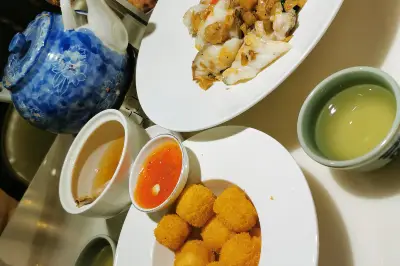
Since I had an early flight to catch, Xiao Luo and I settled into Yutang Chun Nuan shortly past 8 a.m. and ordered the Yangcheng Shrimp Dumplings, abalone sauce chicken feet, crispy egg tarts, mixed beef rice noodle rolls, and the restaurant’s signature Sachima with olive seeds. The title of this article came from Xiao Luo’s remark before arriving: “I’ve got to see just how delicious a 20-yuan Sachima really is.”
Ordering tea before the food arrives is an important step. The tea menu was comprehensive; we chose aged white tea. Since I’m an outsider, the server helped brew the tea, while at the next table locals did it themselves—all part of the yum cha enjoyment.
Each table had a newspaper; early risers could catch up on world affairs, and the uncle next to us was already reading.
Because it was so early, we were bleary-eyed and only our tongues were awake. Like zombies, we expressionlessly began judging every dim sum dish we had ordered.
That was basically our expression—showing just how sleepy we were.
The highlight of the morning was the crystal-clear Yangcheng Shrimp Dumpling, so good that we declared we’d return the same day next year. The dumpling is named after “Yangcheng” (a poetic name for Guangzhou), a bold claim, but one bite and we were convinced. The wrapper is chewy and bouncy, and inside each dumpling is a whole large shrimp, distinct and perfectly textured—truly outstanding.
There’s a professional standard for good shrimp dumplings: the skin looks semi-transparent, right? But when picked up, it doesn’t stick to the bottom or tear, with a curved, comb-shaped seal at the top and a full, plump shape. The more pleats, the more filling and broth it can hold. A gentle bite delivers an endless aftertaste. On the spot we counted—the Yangcheng shrimp dumplings averaged over 12 pleats, a testament to the skill.
We accidentally poked a hole in the wrapper, but that didn’t spoil how good the dumplings were!
Also earning high praise was the crispy egg tart. The pastry was beautifully neat, layered upon layered; the custard filling was like a mirror, almost luminous.
You have to eat this with your hands, because the pastry flakes at the slightest touch and melts in your mouth. The custard has a tofu-like tenderness, rich egg fragrance, and isn’t overly sweet.
The chicken feet were distinct, not sweet or spicy, and held a clear advantage over average dim sum. The rice noodle rolls weren’t good, so we’ll just leave it at that.
Finally, let’s talk about the olive-seed Sachima. Sachima is a Manchu snack that became popular in Beijing after the Manchus entered China proper, evolving into a classic pastry for all seasons. Because it’s high in calories and staves off hunger, it was adopted as the ideal dry ration by the horse and camel caravans that traveled the ancient Jingxi (Western Beijing) trade route, inadvertently spreading this Manchu delicacy across the country.
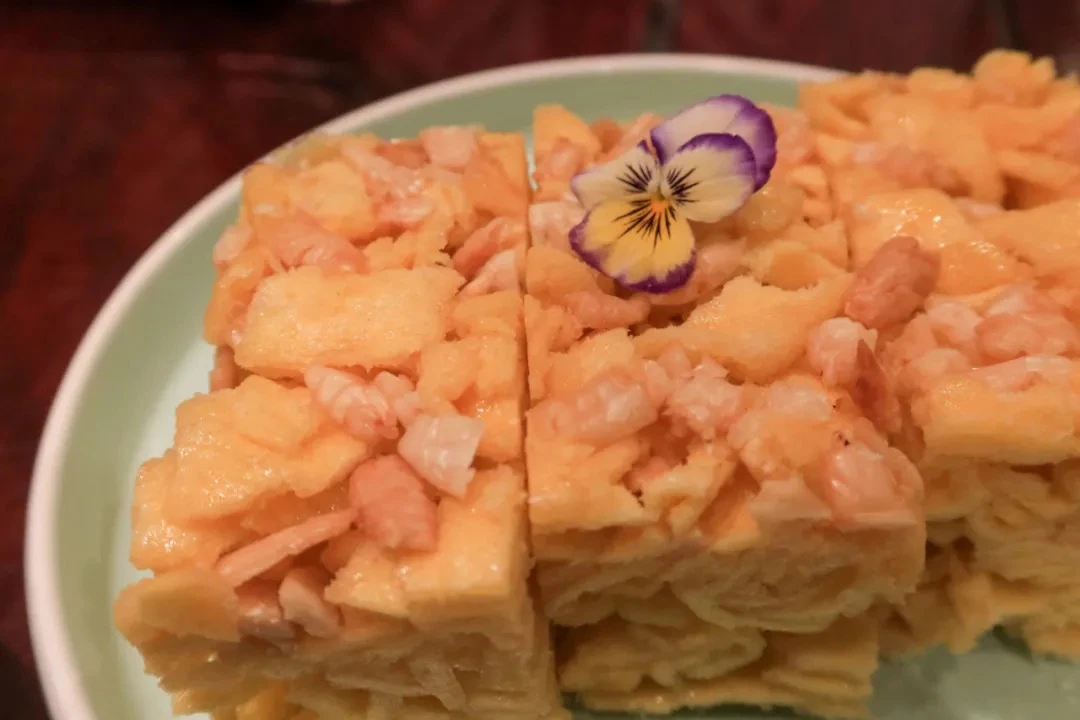
Yutang Chun Nuan’s Sachima is very airy and fluffy, topped with costly olive seeds, with a base of shredded coconut for extra texture. It tastes sweet, soft, and full of egg fragrance.
Here’s a little kitchen trivia: the softness, color, and aroma of Sachima are affected by the amount of egg used. If you reduce the egg liquid, the color pales, emulsification is compromised, and the texture turns firmer; moreover, fewer egg whites mean the fried pastry loses much of its eggy aroma.
So Yutang Chun Nuan’s Sachima is still a fine Sachima; those who like it adore it, and it has won over many gourmets and influencers. But unfortunately, neither of us liked it. My ideal Sachima is soft and bouncy, eggy, not sticky, but with a bit of chew. This one fell apart like snowflakes with every bite, and after a few mouthfuls felt cloying—neither of us wanted a third piece.
One more thing: their Sachima is given as a welcome gift for hotel guests, and is also sold at the pastry shop and through the WeChat official account of the White Swan Hotel Guangzhou. It has a best-before period of 5 days and a shelf life of 7 days, priced at 48 yuan apiece; they even sell a Sachima cake. This single Sachima generates millions in gross merchandise volume annually, which shows just how popular it is. If you’re interested, give it a try.
For this chicken soup, I’d fly to Guangzhou again.
No chicken can escape Guangzhou alive. I have a friend who once, while devouring chicken without mercy, declared her love for white-cut chicken, scallion oil chicken, salt-baked chicken, sizzling clay pot chicken… basically everything chicken-related. In her excitement, she brazenly proclaimed:
“I am the King of Chickens!”
“Pfft, no girl should say that about herself.”
Cantonese people so obsessed with chicken inevitably say, “Good luck and good fortune, let’s eat chicken!” when treating friends. I was in Guangzhou during Christmas as a cold snap hit. Cantonese people are super sensitive to temperature—when it dips just a few degrees, what they miss most is a steaming chicken pot.
Chicken pot is a type of Cantonese hot pot (da bin lou), distinct from the spicy Sichuan-style hot pot we usually think of. Traditionally, clay pots were heated over charcoal stoves; later copper pots came along. You can toss all sorts of ingredients in, but without chili oil or spicy dipping sauces, and it’s still wonderfully satisfying and lively.
Guangzhou is full of chicken pot joints, and if you see one with a crowd at the door, the flavor won’t be half bad. My friend Nubi (social handle: Yi Buzhengjing) took me early to Ji Lao Rong Chicken Pot near Beijing Road. Shortly after we sat down, a long queue formed outside.
The chicken pot shop felt exactly like a dai pai dong transplanted indoors: small foldable tables and plastic stools created that familiar, down-to-earth street atmosphere.
There were four types of chicken: Qingyuan chicken, old hen, orchard chicken, and caponized rooster. Old hen is tough; Qingyuan chicken is tender but small; orchard chicken is raised on grain and has more flavor; the caponized rooster is a castrated big rooster with meaty, firm flesh from more exercise. With a larger group, we picked the latter two.
Live chickens were freshly slaughtered in the kitchen, scalded and plucked; soon the proprietress brought out the chopped chicken pieces. We tossed them into the pot, waited for it to boil, and were ready to eat.
Wait! But first, drink the soup. The clear broth deserves attention: Cantonese people created the ‘qing bu liang’ (cooling and nourishing) broth base, tailored to local conditions. Different medicinal herbs are added to the clear broth for a balanced, mild tonic effect—in short, it’s nourishing without making you ‘heaty.’
A small white clay stove heated the sand pot; the clear broth contained angelica, codonopsis, goji berries, and red dates. The charcoal stove provided steady heat, the sand pot distributed it evenly, slowly infusing the medicinal properties into the soup and chicken. Perhaps it’s this simple, unadorned method that unlocks the greatest value of a free-range chicken after its death.
The chicken soup was amazing! I downed five bowls in one go.
The chicken wasn’t fatty and tasted great—in Cantonese terms, “it has chicken flavor.” It didn’t toughen even after long cooking. Paired with the classic Cantonese dipping sauce—ginger paste, chili rings, and soy sauce—it’s simple yet brings out the chicken’s true taste.
Sides can be ordered to your preference. In this season, try the Chinese yam (huai shan) that Cantonese love; a single yam can be used in a hundred different soups, tasty and nourishing. And of course, don’t forget to order some greens!
One bowl of sweet soup sustains a shop.
Guangzhou’s old eateries cluster in the older districts of Yuexiu and Liwan. After the chicken pot, we went straight to ‘Sweet Soup Street’ for a sweet soup. At the intersection of Dezheng Middle Road and Wenming Road, three sweet soup shops are clustered, each bustling. The most famous are Baihua Desserts and Meigui Desserts.
Both shops have been around since people my age were kids—little stores over 20 years old. Standing outside, you can take in the whole shop in one glance; the walls are plastered with dizzying menus.
The storefront and cashier area of Baihua Desserts are covered with the shop’s rules.
They offer over 400 combinations of desserts, giving me choice paralysis every time. The shop even has its own sales process guidelines for customers, yielding this golden phrase: “The best food critic isn’t someone else but yourself; the best dessert is the one that suits your own taste.”
In deep winter, a bowl of Phoenix milk paste is most comforting—rich in milk and egg flavor, thick but not greasy, with egg liquid fully beaten in for a silky-smooth texture, a complex mouthfeel. Xiao Luo always orders turtle jelly with condensed milk; the seemingly mismatched combination collides spectacularly.
Though Baihua has more choices and I often sing its praises, when it comes to a showdown, I still side with the neighboring Meigui Desserts. The shop is even smaller than Baihua and also packed with people.
I particularly love their almond tofu—jade-like, cold, silky, and it melts on the tongue. So before I was fully satisfied, my dozen-odd yuan silently disappeared.
A must for street-food late-night snacks, encountered only if fate allows.
Just as we were chatting and eating desserts, the three girls across the table suddenly lit up, and Nubi was the first to dash out.
“Uncle Squid is here! You’re like a living lucky charm!”
Who is Uncle Squid? Before I saw him, my local friends were telling me his legend, never expecting I’d encounter him so soon. Rumor has it he’s been selling squid for 30 years. With just a bicycle, a charcoal stove, and a homemade iron grilling rack, he’s established a firm foothold in Guangzhou’s cutthroat food scene. As soon as he appeared, a crowd soon gathered around his bike—but luckily my friend Nubi was at the very front.
Uncle Squid’s offerings are simple: small and large portions of shredded squid and squid head, with samples hanging from his cart. I recommend going straight for the large portion, or you won’t have enough! Fresh squid is pressed very thin, clamped in an iron grilling rack, first roasted at the corners for even heating. Slowly the fragrance of squid begins to waft; then it’s basted with sauce and grilled some more.
The grilled shredded squid is fresh, savory, crispy, and crunchy—so crunchy it shatters—completely unlike the chewy dried squid we’re used to. Honestly, at 20 yuan a portion, it’s not great value, but it’s strangely addictive. I went back to buy shredded squid two days in a row; it totally hit the spot.
Supposedly, Uncle Squid sets up his stall in front of Meigui Desserts around 9 p.m., and only on clear days. I suggest calling ahead via Dianping before you go, so you don’t make a wasted trip.
Food lovers will never grow tired of this city. I hope your Guangzhou trip is full of delicious, satisfying meals! If you have any favorite Guangzhou eateries or stalls to recommend, leave a comment—I’ll check them out next time!