A Trip to Guangzhou’s Nanhai God Temple During the 2022 Spring Festival
I spent this year’s Spring Festival in Guangzhou.
Due to the pandemic, I hadn’t been able to celebrate the New Year in Guangzhou for two years. Although there were sporadic outbreaks this year, both Taiyuan and Guangzhou were low-risk areas, so flying was quite convenient.
This year, Guangzhou’s Spring Festival was unusually cold, and the second and third days of the lunar new year saw continuous drizzle, making it impossible to go out. So on the fourth day, when the sky cleared, we were eager to find a place for an outing.
Huangpu District is quite far from downtown Guangzhou, so we chose the nearest attraction, Nanhai God Temple.
The history of Nanhai God Temple stretches back to the end of the Qin and early Han dynasties, the era of the Nanyue King Zhao Tuo and the Maritime Silk Road. At that time, Guangzhou was the port through which silk was exported from the Lingnan region to the West, making it the starting point of the Maritime Silk Road. Nanhai God Temple was built by ancient people to pray to the gods for safe voyages. The temple site was also the ancient port of departure on the Silk Road—Fuxu Port. But over time, Fuxu Port gradually silted up, and the sea port moved to the area around Huangpu.
The temple was first built in the 14th year of the Kaihuang reign of Emperor Wen of Sui, and has been renovated many times through the ages. According to some sources, 'Guangzhou’s Nanhai God Temple is the only surviving sea god temple from ancient China that remains intact and is the largest architectural complex.' It was destroyed during the Cultural Revolution, and what we see today is a reconstruction from the 1980s.
Nanhai God Temple is easily accessible, with both a metro station and a BRT bus stop. After getting off at the bus stop, it’s just a three-hundred-meter walk. I remember the last time I came, the path was lined with small stalls selling incense and candles, and fortune tellers. This time, it has been turned into a tidy avenue. A bit further on, there’s a newly built visitor center. As seniors, we didn’t need to buy tickets, so we headed straight to the entrance.
At the gate, we had our health codes checked and registered our ID information, then walked right into the scenic area.
Crossing the 'Bathing Sun Bridge' (Yuri Bridge), we entered the West Square, which is the venue for the annual 'Thousand-Year Polo Festival' temple fair held on March 20.
What is the 'Polo Festival'?
It is the birthday of the sea god.
Legend has it that during the Tang Dynasty, an envoy from India came to China, missed his return date for some reason, and ended his days in Guangzhou. He was later enshrined as 'Daxi Sikong' in the sea god temple. When he came, he brought a jackfruit sapling and planted it at Nanhai God Temple. That’s why people also call the temple 'Polo Temple', and the sea god’s birthday became known as the 'Polo Festival'.
Legend says the sea god has five sons—Da’an, Yuan’an, Shi’an, Chang’an, and Zu’an—who live separately in fifteen villages around the temple. On the day of the Polo Festival, villagers from five villages carry five divine statues in a grand procession to the temple fair, an event known as 'Five Sons Paying Homage to the King'.
From the West Square, we followed signs past the Ming Dynasty wharf site and the Qing Dynasty wharf site. Although they’re called 'sites', there’s actually nothing to see.
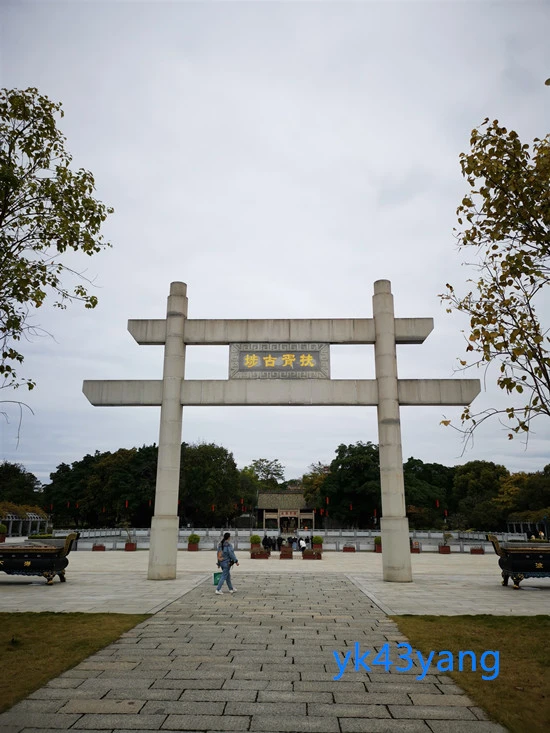
Then we reached the southernmost end of the Nanhai God Temple scenic area, where a paifang (memorial arch) stands, bearing the inscription 'Fuxu Ancient Pier' on its central panel.
To the north of the arch, it looks like an old river channel. Across to the north is the South Square, dotted with many ancient banyan trees, lush and leafy—I have no idea how old they are.
At the north end of the square stands the stone memorial arch inscribed 'Calm Seas' (Hai Bu Yang Bo). When the temple was built in the Sui Dynasty, it was a wooden arch. It wasn’t until after the Ming Dynasty that a stone arch was constructed. The one we see today was built in the 28th year of the Daoguang reign.
The 'Calm Seas' arch is a symbol of Nanhai God Temple. It’s said there are over thirty such arches in the Pearl River Delta and Hong Kong-Macau region, but this one is considered the original.
Beyond the arch is the temple’s main gate—called the 'Tou Men' (Head Gate). The gate structure dates to the Qing Dynasty and retains its Qing style even after modern renovations. It has a hard-gable roof, is three bays wide, and features splayed walls on both sides, symbols of high status.
In front of and behind the gate, there are left and right front and rear 'shu tai' (teaching platforms), following the architectural system of the Zhou Dynasty. On the eastern and western front platforms are painted clay statues of Shunfeng’er (Wind-Accompanying Ear) and Qianliyan (Thousand-Mile Eye), two deities, showing that in seafaring, grasping information is paramount.
In front of the Head Gate stand two stone ornamental columns carved with dragons and clouds, exquisitely done. Such columns were a sign that ancient kings encouraged subjects to offer advice.
The pair of red sandstone lions at the gate are relics from the Ming Dynasty, now protected under glass covers to prevent damage.
Above the gate hangs a plaque inscribed 'Nanhai God Temple'. On both sides are couplets: 'When white waves surge, spray lashes the sky, mountains shake, breathing thunder and wind; After dark clouds part, cloud tips brush the islet, the sea’s bosom opens, swallowing stars and moon.'
The original couplet was written by Lin Zijue of Zengcheng in the Qing Dynasty, and the current one was rewritten by the renowned calligrapher Lu Youguang of Guangdong in 1991.
The two door panels are painted with door gods, likely Qin Qiong and Yuchi Gong.
Entering the Head Gate, you can see the inner teaching platforms on both sides.
To the left and right of the gate are two stele pavilions: the Tang Stele Pavilion on the east and the Kaibao Pavilion on the west.
Inside the Tang Stele Pavilion is the 'Nanhai God Guangli King Temple Stele', erected in the 15th year of Yuanhe under Emperor Xianzong of Tang (AD 820) during a renovation of the temple. It was composed by Han Yu, prefect of Yuanzhou, written by Chen Jian, prefect of Xunzhou, and carved by the renowned craftsman Li Qi—three masters of their time, hence it’s called the 'Three Uniques Stele'. This Tang stele is the temple’s most treasured artifact. The inscription describes the origin and development of Nanhai God Temple, Tang-dynasty rituals for worshipping the sea god, and the maritime trade of the time. It’s said that the term 'haishi' (maritime affairs) first appeared on this stele.
The pavilion columns bear a couplet: 'Zhu Ce passes through the city, entering the hall in spring breeze, thinking of Confucius’ descendants; articles convey the Way, arriving at the gate, flower shadows recognize the Han stele.' Zhu Ce refers to the official sent on imperial orders in the 13th year of Yuanhe to worship at the temple, after which a major renovation began.
The Kaibao Stele Pavilion houses the 'Great Song Dynasty Newly Renovated Guangli King Stele', erected in the 6th year of Kaibao under Emperor Taizu of Song. The inscription records how, after conquering the Southern Han and reclaiming Lingnan, the Song Dynasty first established a Maritime Trade Office (Shibo Si) in Guangzhou to manage foreign trade, ordered envoys to repair the temple, and appointed founding duke Pan Mei as the first Shibo Shi (Maritime Trade Commissioner) of the Song. This stele is the temple’s second most treasured artifact.
To the left front of the Tang Stele Pavilion is an Imperial Stele Pavilion, an octagonal pavilion with double eaves. The Kangxi Emperor’s stele that was once housed here has now been moved to the Qing Stele Pavilion behind the Ceremonial Gate.
Facing the courtyard is the second gate—the Ceremonial Gate (Yi Men).
It stands on a raised platform, with a central flight of steps leading up to it.
Above the gate hangs a horizontal plaque reading 'Sheng De Xian Zhan' (Sacred Virtue Reaches All), and on both sides are couplets: 'The sea-guarding god’s blessings are eternal; the temple’s grandeur guides the south.'
Flanking the Ceremonial Gate are encircling corridors. On the outer eastern side of the corridor stands a statue of Daxi Sikong. Known locally as the 'Foreign Ghost Gazing at Polo', this is the Indian tribute envoy mentioned earlier. The statue’s left hand is raised to the forehead as if gazing at the sea. The shrine bears couplets that capture his homesick sea-gazing: 'Sailing from the South Sea, his deep affection clings to jackfruit; lifting his gaze to white clouds, worry for his homeland in Magadha.'
In the eastern corridor, there is also a statue of Lady Jinhua (Golden Flower).
It is said that the Jiajing Emperor of the Ming Dynasty successfully prayed to the South Sea God for a son, after which praying for children at Nanhai God Temple became a folk custom. The process involves first worshiping the South Sea God, then going to Zhaoling Palace to worship his wife, and finally kneeling before Lady Jinhua and taking away the child puppet placed beside her, somewhat similar to the northern custom of 'tying the doll'.
To the west of the outer corridor is a Guanyin Hall, where a statue of Avalokitesvara Bodhisattva is enshrined. The hall also has couplets: 'Guanyin has form, like the western moon; hearing and seeing soundless, the South Sea tides.'
It may seem odd that a Taoist temple houses a Buddhist bodhisattva, but this reflects the Chinese religious tendency toward syncretism. Having the compassionate Guanyin join in protecting seafarers naturally increases safety!
Along the inner corridors on both sides are stele galleries housing many famous steles. Among them:
the 'Baoqing Renovation Stele' from the first year of the Baoqing era of the Northern Song, which records how successive Song emperors bestowed the title 'Hong Sheng Guang Li Zhao Shun Wei Xian Wang' upon the sea god, and notes that the renovation funds came directly from maritime trade rather than official allocation.
Another is the 'Record of Nanhai Guangli Hong Sheng Zhao Sheng Wei Xian Wang' from the first year of the Qiandao era, detailing the process of imperial titles conferred by Tang and Song emperors and depicting the peak of Guangzhou’s foreign trade in the Song Dynasty.
Then there’s the 'Record of Sacrifices to the Nanhai God' from the 15th year of the Zhizheng era of the Yuan Dynasty, which describes how on the first day of the lunar new year, the Yuan emperor personally distributed incense to envoys in the Daming Hall, sending them to offer sacrifices at mountains, towns, seas, and rivers. Among them, the envoy to the South Sea traveled for four months to perform the rites here.
Because of glare from the glass covers, I couldn’t take good photos, so I photographed a few that didn’t reflect:
this one is the 'Renovation Stele of Nanhai Temple' from the 4th year of Zhiping in the Song Dynasty;
this one is the 'Record of Renovation of Nanhai Temple' from the 8th year of Chenghua in the Ming Dynasty;
this one is the stele of 'Record of Sacrifices to the Nanhai King' from the 15th year of Zhizheng in the Yuan;
and this is the 'Stele of the Six Lords of the Song'.
There are many more steles, but I couldn’t examine them all.
From the corridors we entered the main hall courtyard.
Facing the courtyard is the great hall, and in front stands a ritual pavilion—equivalent to a worship pavilion in other temples.
The pavilion, a hip-and-gable roofed pseudo-classical structure, has couplets on its front columns:
'At the head of Huangmu Bay, think back to the past, clouds of sails and trade winds, marvel at how things change, ask where is the awe-inspiring power of the Hong Sheng God now?
Under the fiery cotton tree, observe this moment, wandering footprints, quiet thoughts, caress broken steles, recall how folk customs endure through the ages.'
Inside the ritual pavilion stands an Eastern Han bronze drum. According to the introduction, it was unearthed in Gaozhou and is the third largest bronze drum in China. The drum body is finely decorated, and six lively frogs are cast around the drumhead, testament to the exquisite craftsmanship of the time. However, truth be told, judging from its condition, I doubt it’s an original.
To the left and right of the ritual pavilion are two more stele pavilions.
In the western pavilion stands the Kangxi Emperor’s stele. In the 22nd year of Kangxi, Qing forces captured Taiwan. In the 23rd year, the maritime ban was lifted. In the 42nd year, on the emperor’s 50th birthday, he sent Fan Chenglie, Vice Minister of Revenue, to offer sacrifices to the South Sea God here, and brought the imperial inscription 'Wan Li Bo Cheng' (Calm Seas for Ten Thousand Miles). However, the stele we see now is clearly a replica; the original was destroyed during the decade of turmoil.
In the eastern pavilion stands an imperial stele erected in the 3rd year of Hongwu of the Ming Dynasty. It reads: 'The Five Sacred Mountains and Four Seas are lofty mountains and vast waters; their deities receive their mandate from the Supreme Emperor, and no titles bestowed by the state can add to their glory. Therefore, all previous titles are revoked, and the deities shall be honored by the original names of the mountains and rivers.'
Zhu Yuanzhang, having been a monk, understood the rules of the divine realm better than scholars ever could.
The pavilion columns bear couplets:
'Seas and mountains are tranquil, without boundaries, they share this prosperity; noble is the heavenly rank, what need for bestowed titles to bless our common folk.'
The red sandstone bixi (dragon turtle) under the Hongwu stele is enormous and looks like an old artifact.
In front of each stele pavilion stands an ancient kapok tree, approximately three hundred years old, reputed as Guangzhou’s No. 1 and No. 2 famous trees, and a marvelous sight in the temple. During every Polo Festival, the trees are ablaze with red blossoms, a spectacular scene. Qu Dajun once wrote 'Song of the Ancient Kapok at Nanhai God Shrine':
'A ten-zhang coral is the kapok tree, its flowers redder than dawn clouds bright;
In the southern sky, all trees seem fiery, but none startle like the kapok’s sight.
Ancient trunks tower, writhing to the sky, when they bloom, leafless, how dazzlingly they vie!
White pom-poms like butterfly cocoons on branches, red blossoms like powdered hibiscus in the light.'
We arrived outside the blooming season, so we didn’t see the kapok flowers. The last time I came, the flowering had just ended; the ground was littered with red flowers that hadn’t withered, and visitors were picking them up. It’s a Guangzhou custom to dry and clean the kapok blossoms and use them in soups.
Kapok trees flower first, then put out leaves; the fiery red blossoms are the city flower of Guangzhou, Meizhou, and other places. Seeing such immense ancient kapok trees, even without blossoms, was still a feast for the eyes.
In front of the main hall, there’s also a jackfruit tree. A Polo temple must have a jackfruit, they say, and this one was newly planted during the 1980s renovation. When the tree is heavy with jackfruits, it’s another great sight at the temple.
The main hall of the temple is five bays wide with a hip-and-gable roof. The front columns bear couplets:
'The temple began in the Kaihuang reign, linking the distant Maritime Silk Road; the Red Emperor’s name endures into the new age.
Granted the title Guangli in the Tang, forever preserving Lingnan’s cultural treasures; its majestic spirit shines over ancient Panyu.'
In the center of the main hall is enshrined the South Sea God.
This deity is the god of the south—Zhurong. Zhurong is mythologically a fire god, embodying both fire and water as sea god, which is rather curious when you think about it.
On both sides of the main hall stand statues of the Six Lords, assistants to the South Sea God. They are: Zhu Li Hou (Daxi Sikong), Zhu Hui Hou (Dugong Sikong), Ji Ying Hou (Patrolling Sea General Cao), Shun Ying Hou (Patrolling Sea Tidian Commissioner), Fu Ling Hou (Prince Yilang), and Zan Ning Hou (Prince Erlang).
Legend says that beneath the seat of the South Sea God lies the temple’s 'dragon’s lair', where the soil is always damp. But since it’s under the divine throne, there’s no way to verify.
Under the western wall of the main hall rests an iron bell from the Ming Dynasty, weighing over three hundred jin, cast in the sixth year of the Jingtai reign of Emperor Daizong. At that time, Yu Qian had just led Ming forces to repel the Oirat invasion, so this bell was bestowed upon the temple to signify peace. Speaking of Yu Qian, his achievements were unparalleled, but his end was tragic: he was executed by the Yingzong Emperor, who reclaimed the throne after the 'Duo Men Coup'.
Behind the main hall is Zhaoling Palace, the rear palace of the South Sea God, where the sea goddess, his consort, is worshipped.
The front corridor columns of Zhaoling Palace bear couplets:
'Assisting Zhu Rong to protect the fiery land, her earthly virtue revered in sacrifice; crossing Fuxu to pacify the precious hall, cloud garments and wind ornaments dignified in ceremony.'
The gate also has couplets:
'Fragrant virtue’s grace lingers over the Guangdong seas; worshiping in season, people admire her feminine dignity.'
The rear palace had fallen into disrepair. During the Republic era, Mo Xiuying, wife of Chen Jitang, funded repairs for Nanhai God Temple. Due to insufficient funds, the rear palace was reconstructed with cement and brick pillars. When it was renovated in 1986, that Republic-era structure was preserved.
Inside, the consort of the South Sea God is enshrined, dignified and serene. During the reign of Emperor Renzong of Song, she was titled Lady Ming Shun.
Behind the rear palace stands another ancient kapok tree, somewhat younger but still considered old compared to others elsewhere.
Circling back to the front courtyard from the west side of the main hall, there is a Guandi Temple on the west side—a temple within a temple, quite a curious sight. It is newly built. The three characters 'Guandi Miao' above the gate are collected from the calligraphy of Yan Zhenqing. The couplets on either side read: 'Red-faced and red-hearted, riding Red Hare chasing the wind, galloping never forgetting the Red Emperor; Green Dragon gazing at history, wielding the Green Dragon crescent blade, in hidden deeds worthy of Heaven.' Interestingly, the signature attributes them to Su Shi.
Outside the western gate of the temple, the pair of stone lions are precious cultural relics.
These lions were made of white stone from Seven Star Crags by Prince Jingnan Geng Jingzhong as a gift for Prince Pingnan Shang Kexi. They originally stood in front of the Prince Pingnan’s mansion. During the Republic era, when Chen Jitang ruled Guangdong, the provincial government was built on that site, and the lions remained in front of the provincial office until after liberation, when they were moved here, to Nanhai God Temple.
Outside the west gate is the Guangdong Folk Culture Garden, featuring models of traditional Guangdong architecture. There’s also a Zhuque (Red Phoenix) Terrace, symbolizing the feng shui principle of 'dark warrior in the north, vermilion bird in the south'. However, the terrace doesn’t display a vermilion bird but rather five 'Polo chickens'.
Polo chickens are folk crafts made of mud, paper, and chicken feathers. Legend has it that long ago, an old lady surnamed Zhang lived near Polo Temple and kept a large rooster. The village landlord stole and slaughtered it. Heartbroken, the old woman gathered the feathers, returned home, and made a fake rooster out of yellow clay and paper.
Strangely, that fake rooster could crow at dawn again. So the old woman made many more to sell at the temple fair, and it’s said that a 'Polo chicken' can bring happiness to the family. Thus, the custom of buying Polo chickens at the Polo Festival has been passed down.
Personally, I’ve never believed such stories. That Polo chicken couldn’t even save its own life—how could it protect yours?
Further west, there’s a small earthen mound called 'Zhangqiu'. At its base stand many stone figures and horses, moved here from somewhere unknown. A flight of steps leads up to the 'Bathing Sun Pavilion' on top. This time, the steps were closed and visitors were not allowed up. Last time, you could climb all the way.
The Bathing Sun Pavilion existed as early as the Tang Dynasty. At that time, Zhangqiu was surrounded by water on three sides, and from the pavilion one could watch the sunrise over the sea. Among the Eight Sights of Guangzhou (Yangcheng) rated during the Song and Yuan dynasties, 'Bathing Sun at Fuxu' ranked first.
In the early Shaosheng era of Emperor Zhezong of Song (AD 1094), Su Dongpo was banished to Huizhou and passed by Nanhai God Temple, staying overnight at Haiguang Temple. The next morning, he climbed the Bathing Sun Pavilion to watch the sunrise and immediately composed this seven-character regulated verse:
'Sword-like vigor pierces the night sky, auspicious light tomorrow reaches the southern bay.
Sitting, I watch the sun valley float golden halos, far off imagine Qiantang’s snowy waves surge.
Already feeling the desolation soothe my ailing bones, I let the night mist wash my fading face.
Suddenly startled by birds, travelers rise, flying into a thousand peaks of purple and green.'
Today, 'Su Dongpo’s Poem Stele' stands inside the pavilion.
At the foot of Zhangqiu Hill, there are red bean trees. Thanks to Wang Wei’s poem: 'Red beans grow in the south, in spring they sprout new sprays. Gather them till full your hands, they best remind of love always.' Red beans have become 'love beans'. During every Polo Festival, many young people come here to pick up these beans and give them to their sweethearts.
With that, our visit to the sea god temple came to an end. We took the metro back to Nangang and had lunch at a Hunan restaurant there. Thus concluded our day’s outing.