Huadu Qixidi: Four Hundred Kinds of Aromatic Plants, Over a Hundred Million Plants, Eight Kilometers of Fragrant Trails Spanning Centuries
Huadu Qixidi: Four Hundred Kinds of Aromatic Plants, Over a Hundred Million Plants, Eight Kilometers of Fragrant Trails Spanning Centuries
One day on a tourist bus to Conghua, I overheard a fellow traveler say that there is a very beautiful place called Qixidi in Huadu, but you need to book in advance. I went online and finally found this place.
The scenic area’s introduction goes like this: Qixidi – China’s first natural aromatic resort. Eight square kilometers of a fragrant realm; the most fragrant place in the world, a unique aromatic kingdom, over a hundred million wild aromatic plants; an aromatic homeland with a long history, passed down through countless generations; natural ten-mile sandbanks, five-mile waterfalls, gorges, streams, bamboo sea, terraced fields, lakes, ancient trees, bizarre rocks… satisfying all our yearnings for nature!
Qixidi is a land of accumulated fragrance left behind in the human world. There are nearly 400 species of native aromatic plants, numbering over a hundred million, and nearly 100 patches of natural aromatic plant communities (sandalwood zone, rue zone, rosewood zone, cattail zone, acronychia zone, myrtle zone, pepper zone, fragrant zone, mushroom zone, cornel zone, heavenly fragrance zone, etc.). Four seasons of fragrant flowers, everywhere fragrant grasses, and patches of fragrant forests.
It was the phrase "the most fragrant place in the world, a unique aromatic kingdom" that captivated my soul.
On March 14th, I set off on my fragrance-seeking journey.
Never believe the claim "only an hour’s drive from Guangzhou." That statement is both true and false. One hour refers to reaching the sign that says “Qixidi, Aromatic Realm Sanctuary” by the roadside. To actually reach the scenic area, there are still 10 kilometers of mountain road, with lush, verdant mountains on both sides. The navigation constantly reminds you: "winding road ahead, drive carefully"; "landslide-prone area ahead, drive cautiously." With such warnings sounding, the car twisted and turned along the long, secluded mountain road. My heart was in my throat, uneasy. Half an hour later, we finally reached the entrance of the scenic area.
I took out my phone and showed the QR code for the pre-booked ticket. The staff told me I had bought the wrong ticket. The 68 yuan ticket is a discounted ticket for seniors, children, and military personnel. I hadn’t noticed this at all when booking; I just picked the cheapest one and paid (there were four ticket prices: 68, 98, 138, and 198 yuan, quite expensive indeed). The staff told me I could refund and rebook, and by requesting the refund on the official account, it would be credited instantly. The young man quickly operated on his phone to purchase the tickets, and we spent 198 yuan for two tickets.
After the routine health code check and temperature measurement, we were finally let in and told to go ahead and have a cup of tea.
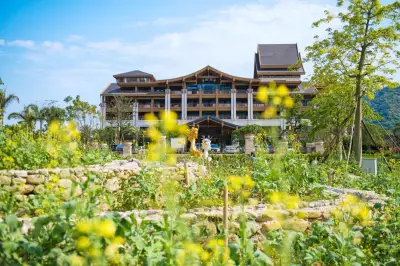
The car arrived at "Guichao," which is actually the visitor service center. The building felt like a birdcage – I wonder if the idea is to evoke weary birds returning to their nest.
A pretty young lady staff member (speaking Mandarin) handed me a cup of tea. The tea was dark, and tasted completely different from black tea, green tea, or Pu'er – a slightly peculiar sweetness. She told me this is Huangqi tea, a fragrant tea that dispels dampness, beautifies the skin, and is sweet, a cup of tea to start your aromatic journey.
The young lady pointed to the scenic area map and said: "First go to the tea house ahead to make a sachet. It starts at 11 o'clock. Then take the hiking trail on the left. It takes about one and a half to two hours round trip. When you get there, don't go any further – that section of the path is very difficult. After hiking, drive and tour the right-hand route."
Then she asked me to add her on WeChat (Qixidi Butler – Suxin, a very nice name, as if you could smell the fragrance of flowers), saying there is no signal in the mountains. I retorted, "Doesn’t your official account say the scenic area has free WiFi and free parking?"
She said: "WiFi only covers this area; there is none in the mountains."
She sent me the scenic area map and an arrow-marked trail map via WeChat, and told me to contact the butler via WeChat if I had any problems. At that moment I thought, if there’s no signal in the mountains, what use is the WeChat butler?
We arrived at the tea house, a simple room for making sachets, to experience sachet making.
On a simple long table, jars and bottles were arranged. A young man (called a fragrance master here) was explaining. Guided by the fragrance master, you could identify the properties and effects of various fragrant materials, learn about wonderful traditional incense-making methods, and craft your own personalized sachet. The master said this spice calms the mind, that one stops coughs, warms the stomach, etc. Anyway, as he spoke, I kept forgetting. When I made my own sachet, I picked up the jars of ground fragrant powders and, regardless of their effects, scooped a little of whatever smelled nice (total weight within 30 grams), put it into a small measuring cup, then into a small white gauze bag, and finally into a chosen pink, blue, or gray sachet, tightened the drawstring, threaded the cord, and the sachet was done.
By then it was noon. Thinking about the one- to two-hour hike, we decided to settle our stomachs first.
We went to Taoxiang Guan, which should be the only restaurant in the scenic area. The ambiance was very elegant, with colorful pictures of various herbs and spices on the walls. The tables and chairs were all wooden, giving a very organic feel. Fragrant flowers for mountain offerings – Taoxiang Guan centers on fragrance, using wild aromatic ingredients from Qixidi, harvested and cooked according to the season. All seasonal fragrant flowers, melons, fruits, vegetables, rice, and other ingredients come from the scenic area, irrigated with natural mountain spring water, bathed in the fresh air of fragrant forests all year round. They only pick the best of each season and carefully combine them into the most suitable health-preserving aromatic cuisine.
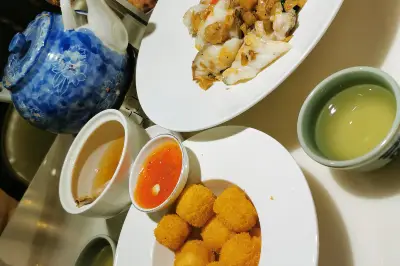
We ordered two dishes and a bowl of rice: Steamed Eggplant with Perilla and Minced Garlic, Braised Beef with Rue and Tomato, and Qixidi Aromatic Rice.
Before the dishes arrived, I took pictures of the surroundings: a stream flowing gently, a small boat moored at the bank, a few peach blossoms blooming.
Both dishes were well-prepared, with very distinctive flavors and a unique, aromatic taste.
Perilla is very familiar to Guangzhou locals, wonderful for stir-frying snails; tomato-braised beef is also a home-style dish. But because rue was added, it had a special fragrance. Rue is a perennial herb with erect stems, pinnately divided leaves with oblong lobes, yellow flowers, and capsule fruits. The whole plant is aromatic and can be used medicinally. This was my first time tasting rue in a dish, and it awakened infinite possibilities on the taste buds – a feast for the eyes, nose, and palate that really whetted the appetite.
There were no crowds lining up here. Since the 1960s, the original residents have been relocated. There has been no chemical fertilizer, pesticide, or industrial pollution, no noisy, chaotic environment. Although they say you need to book, you can actually visit anytime, as long as you have the time. You can quietly enjoy eight square kilometers of fragrant realm, perhaps the lowest-density habitable sanctuary – a secluded lake island, ten-mile sandbanks, five-mile waterfalls, seven-mile gorges, hundreds of streams, a hundred acres of lakes, a thousand terraced fields, a thousand acres of bamboo sea, secluded valleys of fragrant herbs, hidden fragrant forests. Wind blows slowly, the sun lingers; at dawn, sparse shadows play through the grove by the door.
On Peach Blossom Island, only a few peach trees were in bloom. Down at the mountain foot, there were many patches of rapeseed flowers, but they were sparse and drab in color.
Qixidi has so many aromatic plants that ordinary people simply can't identify them. However, in the Hundred Fragrances Garden, most plants are labeled, effectively making it a living botanical garden for science education.
It was my first time seeing so many aromatic plants, and I felt like Granny Liu entering the Grand View Garden. I learned that the leaves of the Liangmianzhen used in toothpaste really do have needles (thorns) on both sides. The material for Caoshanhu lozenges is indeed called Caoshanhu. The money tree is named so because its leaves form a palm-like shape. I even saw a plant whose golden hairs resembled those of a golden retriever…
If you wanted to get acquainted with every plant, you’d probably need to stay here for quite some time.
I used to think Guangzhou is called the City of Flowers because fresh flowers bloom everywhere, all year round, in profusion. Since the Han Dynasty, the people of Guangzhou have had a habit of growing, admiring, loving, and protecting flowers. The name "City of Flowers" has endured for over 1,700 years and has never been replaced by any other city.
Today I learned that Guangzhou is called the City of Flowers because of the Suxin flower (jasmine).
During the Southern Han period, there was a girl named Suxin in Guangzhou’s Haizhu District. She greatly loved a flower called "Yeximing." When the Southern Han emperor ascended the throne, he summoned three thousand beauties from across the land, and Suxin was among them. The emperor adored her and planted Yeximing all over the palace. Every morning when the palace maids got up and washed, the flowers would float downstream, giving rise to Guangzhou’s "Liuhua Lake" (Floating Flower Lake). At such times, Guangzhou truly became a "City of Flowers." When every plant is endowed with a captivating story, the plant gains a deeper soul, and the meaning of admiring it changes profoundly. That is the joy of appreciating plants.
Everything you see here is discovered on foot. I suggest that older people, or those with weak legs, absolutely do not take this route.
We walked along what is said to be the Xiangpu Ancient Plank Road, restored at a cost of millions.
We walked for nearly two hours, surrounded on all sides by big mountains, just the two of us. I had thought only Conghua in Guangzhou had many mountains; I didn't expect Huadu’s mountains to be so large and numerous, and so intensely green, with trees planted all over them. There were hardly any directional signs on the mountain paths. The better sections had stone steps, but there were mostly rocky and dirt paths, the dirt paths covered with fallen leaves – not poetically beautiful, but slippery.
Listening carefully, streams murmured, a hundred rivulets flowing gently through the mountains. The five-mile waterfall clusters: gradually the sound of water was heard, flowing down between two peaks; the water was clear and green, so clear you could see the bottom. Then came cliffs and steep crags, torrents swift as arrows, fierce waves rushing. Unfortunately it wasn’t the rainy season, so the waterfalls were just thin trickles racing down – named Dianshi Waterfall, Youlong Waterfall, Guifei Pool, etc.
The mountain air was wonderfully fresh. The monumental health medicine work "Primordia Medicine" points out that ozone, negative ions, and phytoncides are the three treasures of air.
The negative ion content in Qixidi’s air is as high as 6,000 per cubic centimeter, four times the WHO’s fresh air standard. Over a hundred million aromatic plants emit phytoncides; being there, every breath is refreshing, enjoying natural aromatherapy 24 hours a day.
In this scene, it truly felt like living in a "Shangri-La"!
Climbing to the last scenic spot, a place with a sign reading "Ninefold Mountain," the sign said: "Chest swelling with layered clouds, straining eyes to follow returning birds. When you stand atop the peak, all other mountains seem small." At first you see one layer, two layers, three layers of mountains. Breaking free from visual limits, you gaze into the distance, and then there are nine layers of mountains – myriad peaks and ravines, vast and boundless. Endless layers, misty and ethereal.
Life is about seeing mountains three times: seeing a mountain as a mountain, seeing a mountain as not a mountain, and then seeing a mountain just as a mountain again. Seeing mountains is like life itself. Only here, gazing at the clouds slowly rising among the mountains, straining to track the evening birds disappearing into the forest, can you truly cleanse your soul.
I couldn’t walk any further and asked the young man, "Life is about seeing mountains three times; which stage have you reached?"
My question sparked his curiosity, and he insisted on climbing Ninefold Mountain to see for himself.
I stood waiting by the sign.
After quite a while with no movement, I thought the view up there must be great, that he was beholding the three stages of life. After another wait, he came down and told me a terrifying fact: he couldn’t find the way down. My WeChat voice messages went unheard, he asked me to send a location but I didn’t respond, and my phone didn’t ring when he called.
When he stood before me, my phone finally rang with his incoming call, because there’s barely any signal up the mountain, and it’s delayed.
He then said, "I crawled up on all fours like a dog, there was no path, and then I lost my way. I even shouted for you from up there, but you didn’t hear." I truly hadn’t heard a thing – how far had he gone? It was terrifying! Thankfully, it turned out okay!
We retraced our steps, seeing the same mountain views, rocks, bamboo groves. Since it was the dry season, we didn’t see streams flowing over stones, but the sound of running water echoed by our ears all the way. Peach blossoms appeared again.
I could barely drag my legs along…
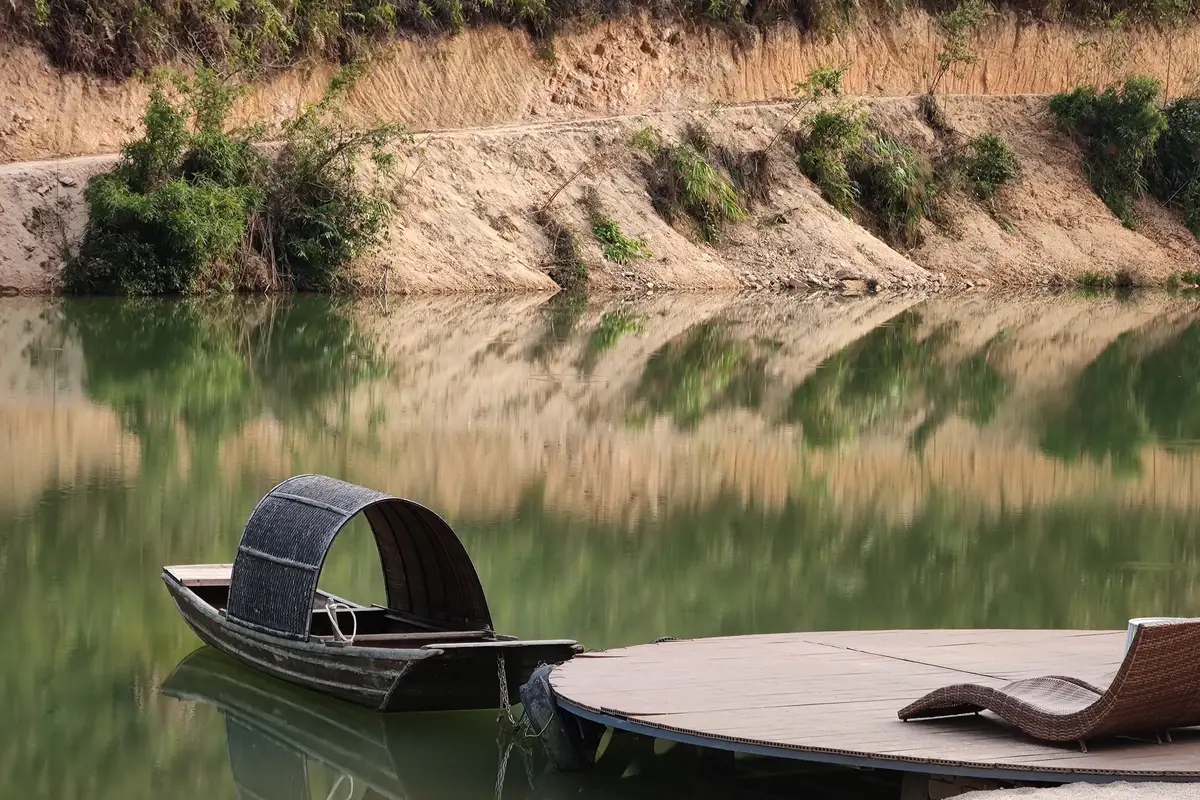
Driving the other route, vast mountains stretched on, and occasionally a small boat was moored amid the lake and mountain scenery, somewhat reminiscent of the red boat on Nanhu Lake in Jiaxing. We got out and took several photos – perhaps the most evocative scene.
The next day, my back and legs were sore and aching, even my arms hurt. I was utterly exhausted. That’s the consequence of my habit of staying home.
A one-day fragrance-seeking journey gathered the vast aromas of nature into a sachet. The nose smelled fragrance, the teeth held fragrance, and the brain surged with waves of a thousand-year cultural fragrance. Good or bad, superior or inferior, kind or evil – just see if it’s "fragrant" or "not fragrant." Fragrance is a mirror that illuminates the human world!
(3,559; some photos thanks to the young man. 2022/3/15)