Qixidi, Huadu: Four Hundred Scented Plants, Over a Hundred Million Blooms, and an Eight-Kilometer Fragrant Trail Bridging a Thousand Years
Qixidi, Huadu: Four Hundred Scented Plants, Over a Hundred Million Blooms, and an Eight-Kilometer Fragrant Trail Bridging a Thousand Years
One day on a tour bus heading to Conghua, I overheard someone say that Qixidi in Huadu was stunningly beautiful but required advance booking. I searched online and finally tracked down this place.
The scenic area's introduction goes like this: Qixidi — China's first natural aromatic resort. An 8-square-kilometer earthly fragrant realm; the most fragrant place on earth, a unique aromatic kingdom, with over a hundred million wild aromatic plants; a historic aromatic homeland where fragrance has been passed down for a thousand years. Natural ten-li sandbars, five-li waterfalls, gorges, streams, bamboo groves, terraced fields, lakes, ancient trees, peculiar rocks... Satisfying all our yearnings for nature!
Qixidi is a kingdom of accumulated fragrance left behind in the human world, home to nearly 400 species of native aromatic plants totaling over a hundred million individuals, and nearly 100 natural native aromatic communities (sandalwood, rue, rosewood, cattail, zhenxiang, myrtle, pepper, balm, mushroom, dogwood, celestial fragrance, and more). Fragrant flowers in every season, sweet grasses everywhere, and sprawling scented forests.
The line "the most fragrant place on earth, a unique aromatic kingdom" completely captivated me.
On March 14th, I set out on a fragrance-seeking journey.
Don't ever believe the claim "just an hour's drive from Guangzhou." That's both true and false — one hour only gets you to the roadside sign saying "Qixidi, an Earthly Fragrant Realm Sanctuary." To actually reach the scenic area, there's still 10 kilometers of mountain road, flanked by lush, towering hills. The navigation keeps warning: "Winding mountain road ahead, drive carefully; landslide-prone zone, proceed with caution." Amid these prompts, the car zigzagged along the deep, secluded mountain path, my heart fluttering with unease. After half an hour, we finally arrived at the entrance.
I took out my phone to show the QR code for my pre-booked ticket. The staff said I'd bought the wrong ticket — the 68-yuan one was a discounted price for seniors, children, and military personnel. I hadn't noticed that when I booked; I'd simply picked the cheapest option (tickets were priced at 68, 98, 138, and 198 yuan, all quite steep). The staff told me I could refund the ticket and buy a new one via the official account, with an instant transfer. The young guy deftly repurchased on his phone: two tickets cost 198 yuan.
After the routine health code check and temperature screening, we were finally allowed in and invited to have a cup of tea up ahead.
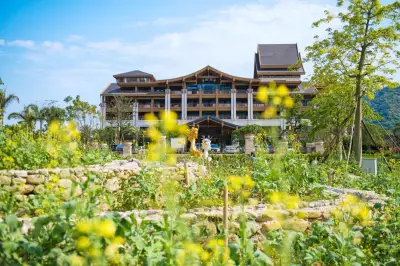
We drove to "Return to the Nest," actually the visitor center, a building resembling a birdcage — perhaps meant to evoke the sentiment of weary birds returning home. A young woman (a staff member) who spoke Mandarin handed me a cup of tea. The tea was black, with a taste utterly different from black, green, or pu'er tea — oddly sweet. She explained it was Huangqi tea, a fragrant herbal tea that dispels dampness, beautifies the skin, and has a sweet character. One cup, she said, would kickstart my aromatic journey.
The young woman pointed to the scenic area map: "First, go to the tea hut ahead to make a sachet — it starts at 11 a.m. Then take the hiking route on the left; it'll take an hour and a half to two hours round trip. Stop when you get there; the path beyond is very rough. After the hike, drive to explore the route on the right."
She then asked me to add her on WeChat (Qixidi Housekeeper – Suxin, a lovely name that seemed to carry the scent of flowers), warning that there was no signal in the mountains. I countered, "But your official account says the scenic area offers free WiFi and parking?"
She replied, "WiFi only covers this stretch, not the mountains."
She sent me the scenic area map and a route arrow diagram via WeChat, telling me to contact the housekeeper if I had any problems. I thought to myself, if there's no signal in the mountains, what use is the WeChat housekeeper?
We arrived at the tea hut, a simple room for sachet-making, and experienced crafting one.
On a plain long table were bottles and jars. A young man (called an aromatist here) was giving explanations. Guided by him, you could identify the properties and effects of various aromatic materials, learn about fascinating traditional incense-making methods, and create your own personal sachet. The aromatist said this spice calmed the mind, that one relieved coughs, another warmed the stomach, and so on. Honestly, as he spoke, I forgot them all. When it was time to make my own sachet, I simply sniffed the jars of ground spices, picked whatever smelled good to me, and spooned a bit of each (the total amount of all spices was to stay under 30 grams). I put it all into a small measuring cup, then into a small white gauze bag, and finally into a chosen sachet pouch — pink, blue, or gray. After tightening the bag's drawstring and threading a cord through, my sachet was done.
It was already noon, and knowing we'd be hiking for an hour or two, we decided to settle the stomach issue first.
We went to Peach Blossom Fragrance Restaurant, seemingly the only restaurant in the scenic area. The setting was elegant, with colorful pictures of fragrant herbs and spices pasted on the walls and wooden tables and chairs that felt very eco-friendly. The restaurant centered its dishes around aromatics, using wild seasonal ingredients from Qixidi. All fragrant flowers, vegetables, fruits, and rice were produced locally, irrigated by natural mountain spring water and constantly steeped in the fresh air of fragrant woods. They selected only the finest of each season, thoughtfully paired to create the most appropriate seasonal health cuisine.
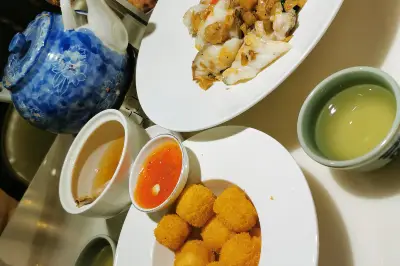
We ordered two dishes and a bowl of rice: steamed eggplant with perilla and minced garlic, beef stewed with Yunxiang and tomatoes, and Qixidi aromatic rice.
Before the food arrived, I photographed the surroundings: a long trickling stream, a small boat moored at the bank, a few peach blossoms in bloom.
The dishes were both excellent, with unique flavors and a distinct, special fragrance.
Perilla is very familiar to Guangzhou locals; it's superb for stir-frying snails. Beef stewed with tomatoes is a home-style dish, but the addition of Yunxiang gave it a unique aroma. Yunxiang is a perennial herb, with erect stems, feathery divided leaves elongated in shape, yellow flowers, and capsule fruits. The whole plant is fragrant and can be used medicinally. I was tasting Yunxiang in a dish for the first time — it sparked limitless possibilities on the tongue, a feast of color, scent, and taste that whetted the appetite.
Here, there were no crowds jostling in queues. The indigenous residents had been relocated since the 1960s, so the area has never suffered from chemical fertilizers, pesticides, or industrial pollution. Despite the claim that booking is required, you can actually go anytime, as long as you have the time. You can quietly enjoy the 8-square-kilometer fragrant realm, perhaps the lowest-density sanctuary on earth — a secluded lake island, ten-li sandbars, five-li waterfalls, seven-li gorges, a hundred streams, a hundred-mu lake, a thousand terraced fields, a thousand-mu bamboo sea, secluded valleys of herbs, and secret fragrant forests. The breeze lingers, the sun loiters, and in the morning woods, sparse shadows play upon the door.
On Peach Blossom Island, only a few trees were in bloom. At the foot of the hill, there were many patches of rapeseed flowers, but unfortunately sparse and monochromatic.
Qixidi has far too many aromatic plants; most people couldn't identify them. However, in the Garden of a Hundred Fragrances, nearly every plant was labeled — a living science popularization garden.
Seeing so many aromatic plants for the first time, I felt like Granny Liu visiting the Grand View Garden. I learned that the leaves of the plant used in Liangmianzhen toothpaste indeed have "needles" (thorns) on both sides; the material for Caoshanhu lozenges is literally called Caoshanhu (sarcandra); the money tree is so named because its leaves grow into the shape of a palm. I even saw a plant whose rhizome looked like a golden retriever's fur...
If you wanted to get to know every plant, you'd probably need to stay here for quite some time.
I always thought Guangzhou was called the City of Flowers because flowers bloom everywhere year-round in lush profusion. But today I learned it's actually because of the Suxin flower.
During the Southern Han Dynasty, there was a girl named Suxin in what's now Haizhu District of Guangzhou. She was very fond of a flower called "Yeximing." When the Southern Han emperor ascended the throne, he recruited three thousand beauties from across the land, and Suxin was among them. The emperor adored her and planted Yeximing everywhere in the palace. Every morning when the palace maids rose and washed, the Yeximing petals would drift downstream — hence the origin of Guangzhou's "Liuhua Lake" (Flowing Flower Lake). And so, Guangzhou became the "City of Flowers." When each plant is given a moving story, it gains a deeper soul, and the significance of admiring them changes profoundly. That's the joy of appreciating plants.
Everything you see is reached on foot, so I strongly advise older people or those with leg problems against this route.
We walked along the ancient Fragrant Waterfall boardwalk, reportedly restored at a cost of tens of millions.
We trekked for nearly two hours, surrounded by huge mountains on all sides, with only the two of us. I had thought only Conghua in Guangzhou had many mountains; I hadn't expected Huadu's mountains to be even bigger and more numerous, and overwhelmingly green, thick with trees. The mountain path had few directional signs. The best parts had stone steps, but mostly it was rocky or dirt trails, the dirt paths strewn with fallen leaves — not poetic, but slippery.
Listening carefully, I could hear the gentle murmur of flowing water, with hundreds of streams meandering slowly among the hills. The five-li waterfall group gradually grew louder as water cascaded between two peaks, clear as pale green silk and see-through to the bottom. Then cliffs and precipices, with torrents swift as arrows and fierce waves galloping. Unfortunately, it wasn't the wet season, so the waterfalls were reduced to trickles racing down — there was the Dotted Stone Waterfall, the Swimming Dragon Waterfall, the Imperial Consort Pool, and more.
The mountain air was superb. The monumental medical work *Prime Regimen* points out that ozone, negative ions, and phytoncides are the three treasures of air.
The air at Qixidi has a negative ion concentration as high as 6,000 per cm³, four times above the World Health Organization's fresh air standard. Over a hundred million aromatic plants release phytoncides. Immersed in this environment, every breath clears the mind and invigorates the spirit, offering natural aromatherapy around the clock.
It truly felt like living in a "Utopian paradise"!
At the last scenic spot we climbed to, a sign proclaimed "Nine-Heavy Mountain." It read: "Rolling clouds are born from my chest, straining my eyes I see returning birds. I must ascend the ultimate peak, to behold all other mountains dwarfed." At first, what you see is one, two, three layers of mountains. Once freed from visual limits and gazing far, there are nine layers — myriad ridges and ravines, vast and boundless, terraced and continuous, veiled in drifting mist.
Life is said to involve seeing mountains three times: first, mountains are just mountains; second, mountains are not mountains; and third, mountains are once again mountains. Seeing mountains encapsulates the whole of human life. Only here, watching sun-tinted clouds rise among the peaks and straining to track the birds vanishing into the woods at dusk, can one cleanse the soul.
I simply couldn't walk any further and asked the young man, "When it comes to seeing mountains three times, which stage are you at?"
My question sparked his curiosity, and he insisted on climbing Nine-Heavy Mountain to see for himself.
I waited by the sign for him.
A long time passed with no sign of movement. I thought the view up there must be spectacular, capable of revealing life's three stages. After a while longer, he came down and told me something hair-raising: he couldn't find the way back down. "You didn't listen to my WeChat voice messages, didn't respond when I asked you to share your location, and didn't answer my calls."
The moment he stood before me, my phone finally rang with his call. There was barely a signal up the mountain, and it came through with a delay.
He said, "I had to crawl on my hands and feet like a dog just to get up there. There was no path. Then I couldn't find the way back. I even shouted for you up there, but you didn't hear a thing." I truly hadn't heard anything. Just how far had he climbed? Absolutely terrifying! Thankfully, it ended in alarm but no harm.
We retraced our steps, seeing once more mountain views, rocks, and bamboo groves. It was the dry season, so we missed the beauty of clear springs flowing over stones, though the sound of running water echoed constantly in our ears. We saw peach blossoms again.
I could barely drag my own legs anymore...
We drove to explore the other route, through vast, boundless mountains. Occasionally we glimpsed a small boat moored against a backdrop of lakes and hills, reminiscent of the Red Boat on South Lake in Jiaxing. We got out and snapped several photos — perhaps the most meaningful scene of the trip.
(Credits for two photos to the young man)
The next day, my back, waist, and legs were sore and painful; even my arms ached, an utter exhaustion. This is the price of my preference for staying home.
A one-day fragrance-seeking journey gathered the vast scents of nature into a sachet. The nose inhales fragrance, the teeth retain it, and the mind surges with the waves of thousands of years of incense culture. Good or bad, superior or inferior, kind or evil — it all depends on whether it is "fragrant" or not. Fragrance is indeed a mirror illuminating the human world!
(3559 2022/3/15)