Liuhua Lake: Early Summer Bliss, a Quintessential Lingnan Urban Garden – Indulge in a Moment of Lazy Leisure
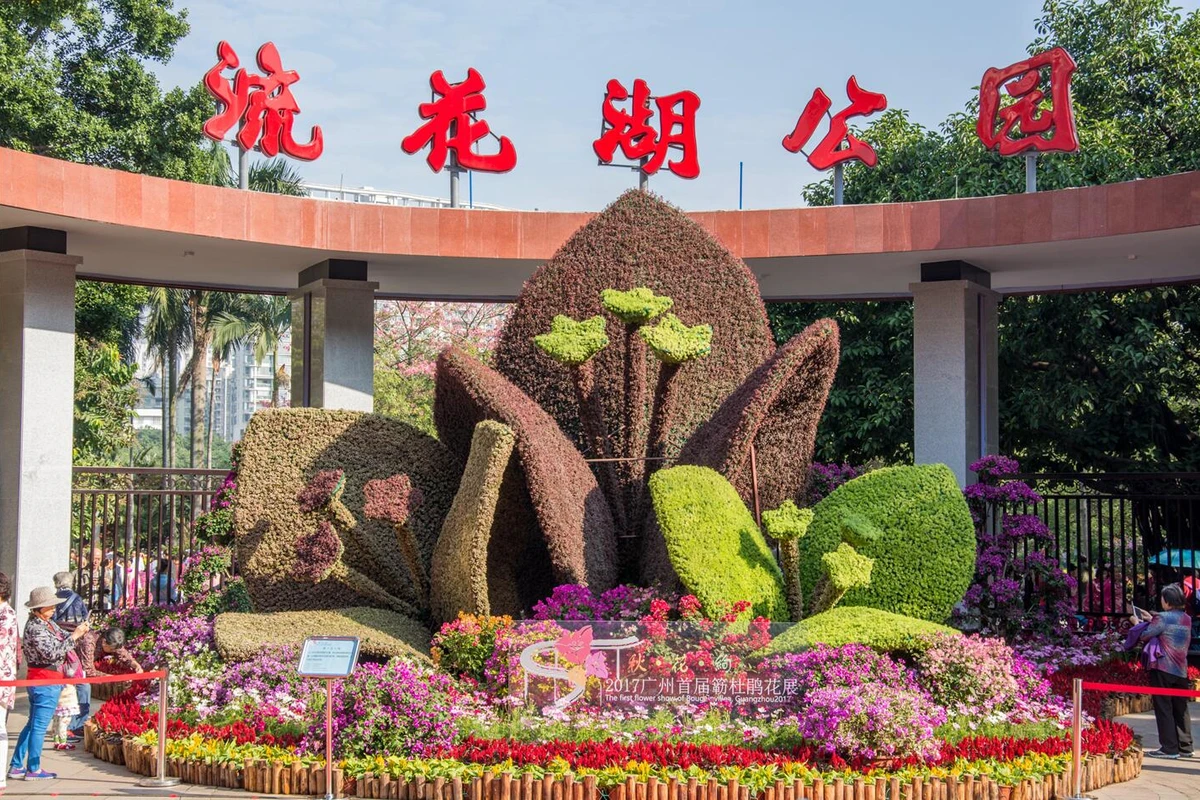
Liuhua Lake Park is located in Yuexiu District, Guangzhou, adjacent to Guangzhou Railway Station. Covering 544,300 square meters, it is a comprehensive park integrating sightseeing, recreation, and relaxation. It officially opened in October 1959 and has been free to the public since July 2009. The lake is named after the ancient Liuhua Bridge from the Southern Han Dynasty at its northeast corner. Water makes up two-thirds of the park's total area, making it one of Guangzhou's four major artificial lakes, and it still serves flood storage and drainage functions.
Liuhua Lake Park features subtropical scenery, dominated by palms, banyan trees, flowering shrubs, and spacious lawns. The park is divided into three open zones: a sightseeing and rest area, a recreational activity area, and a flower, bird, and bonsai appreciation area. There are over 20 major attractions, including Liuhua West Garden, Frankfurt Garden, Lù Island, and Rongyin Amusement Park.
Pucuizhou is located to the left of the south gate, covering 4,885 square meters. This area combines Chinese and Western architectural styles with Lingnan-style garden layouts.
The park's design for this scenic spot follows the principles of 'natural harmony and ecological priority.' Landscape elements like trellis corridors and fountains fill the entire area with a romantic atmosphere.
Compared to other areas, Pucui Garden is less crowded and relatively quiet. Sit peacefully in the pavilion and enjoy the lake view, gazing at Liuhua West Garden and the birds on Lù Island in the distance.
In Pucui Garden, you can admire rose apples, pittosporum, lofty fig, autumn maple, Chinese hibiscus, camphor trees, wild peony, bird's nest fern, dogbane flowers, camellias, and golden bottlebrush trees.
The Bald Cypress Grove is one of Liuhua's Eight Scenic Spots, 'Red Clouds Brushing Emerald,' located at the southern end of the park, covering about 2,500 square meters. It is named for the hundreds of bald cypress trees planted here. Tall bald cypresses line the winding paths, their feathery leaves changing with the seasons. In recent years, the park has added meandering paths and eco-friendly resting platforms, surrounded by colorful and diverse plants that blend naturally. A wooden boardwalk along the lakeshore allows visitors to wander through the forest, enjoying water, flowers, and woods, an ideal spot to get close to nature and soak up negative ions.
In spring and summer, the bald cypresses don fresh green leaves, their branches sprouting tender greenery. Walking through this dripping verdure is tranquil and refreshing, like stepping into a fairytale 'Wizard of Oz' world.
Qiexian Pavilion is by the bald cypress grove, blending Chinese and Western architecture with Lingnan garden touches. It is serene and elegant. Sit here and let the cool lake breeze soothe your weary soul.
Frankfurt Garden is located within Liuhua Lake Park. Also known as the Rose Garden, it is a typical German Baroque-style garden. Built in 1996, it was a gift from Frankfurt, Germany, to celebrate the 2,210th anniversary of the founding of Guangzhou city, a historical testament to Sino-German friendship. The garden is not large and doesn't draw huge crowds, so you can take your time admiring the flowers.
Rose (Rosa rugosa Thunb.): Native to China. A deciduous shrub of the Rosaceae family, with many prickles on its branches, odd-pinnate compound leaves with 5-9 oval leaflets with marginal spines. Petals are obovate, double to semi-double, in purplish-red or white. Fruits are oblate, ripening August to September. Roses love ample sunlight, are cold and drought tolerant, and thrive in well-drained, loose, fertile loam or light loam. They grow poorly in clay soils, with reduced flowering. Plant in well-ventilated spots away from walls. The branches are slender, trailing, and densely thorny; they bloom only once a year.
Each rose has its own posture. Look at this one standing gracefully like a beautiful maiden; see that one, a bud about to burst. In the morning, crystalline dewdrops roll among the leaves, sparkling in the sunlight.
The Crape Myrtle Garden covers about 4,000 square meters and features several varieties of crape myrtle, with around 300 trees. Most are cultivated in the 'withered peak' bonsai style, with seemingly dead stumps but luxuriant foliage and branches. When in bloom, the crape myrtles present a spectacular display of purple, pure white, and pink blossoms.
Withered peak bonsai crape myrtle
Blooming from June to September, crape myrtles have elegant postures, smooth clean trunks, and vibrant flowers. They bloom during the flower-scarce summer and autumn, hence the nickname 'Hundred Days Red.' There's also a saying: 'In summer green fills the eyes, this flower's red fills the hall.' They are excellent for bonsai, appreciated for their flowers, trunks, and roots.
The Lotus Pond is next to the Crape Myrtle Garden. At this time, staff are clearing last year's withered stems and leaves; the lotus seedlings were planted not long ago, so now only a few lotus leaves can be seen.
The lotus, of the Nymphaeaceae family, is a general term for two plants of the genus Nelumbo. Also known as lotus flower or water hibiscus, it is a perennial aquatic herb. The underground stem is long and thick, with nodules; the leaves are shield-shaped and round. Blooming from June to September, the flowers grow singly at the top of pedicels, with many petals inserted in the receptacle, in red, pink, white, purple, or sometimes with colored patterns and edges. The nut is oval, and seeds are ovoid. In Chinese traditional culture, the lotus is not only an elegant ornamental plant but also endowed with noble moral integrity, regarded as the 'gentleman of flowers.'
Wang Changling's 'Lotus Picking Song' portrays the lotus: 'Lotus leaves and silk skirt cut in one hue, lotus blooms open on either side of the face.' The Immortal Poet Li Bai also praised it: 'Lotus emerges from clear water, natural without adornment.'
Yang Wanli's well-known lotus couplets include: 'The endless green of lotus leaves blends with the sky; the lotus bathed in sunlight is exceptionally red,' and 'A tiny lotus tip has just emerged; already a dragonfly stands on it.'
The great Confucian Zhou Dunyi of the Northern Song Dynasty especially admired its integrity: 'I love the lotus alone, for it grows out of the mud but is not stained, washed by clear ripples yet not seductive. Its stem is hollow inside and straight outside, neither creeping nor branching. Its fragrance spreads far and becomes purer, standing gracefully and clean, to be admired from a distance but not desecrated.'
Yanyu (Misty Rain) Pavilion is in the southeast part of the park, a Han-style waterside pavilion with an elegant, classical design. Together with the three themed flower landscapes of crape myrtle, rose, and lotus, it forms one of Liuhua's Eight Scenic Spots: 'Lotus Pond in Misty Rain.'
The overall landscape is simple, elegant, and graceful. Imitation wood boardwalks ingeniously connect the attractions, blending water, flower appreciation, and scenic viewing into one. From the pavilion, when misty rain descends, the drizzle falls like threads.
Listen to the heavenly sound of rain, your heart merging with the scene. All is silent, as if by a lotus pond, misty rain ethereal, the raindrops sounding ethereal. The lotus sways gracefully, fragrance wafts everywhere, rain splashes on the water, wind brushes the lotus leaves, raindrops fall, clouds move, a thousand scenes before your eyes. The lotus pond in misty rain captivates at first sight. The mind becomes still, forgetting the journey home.
Liuhua Yanyu Pavilion stands on the east side of the park, by the bank, rising from the water. It has two stories, green-tiled flying eaves, bright and transparent. A waterside winding corridor and a curved bridge lead in, like a playful dragon in water. The pavilion is neighbored by crape myrtles and metasequoias. Surrounded by thousands of lotuses, with clear jade water, it captures the refreshing southern breeze.
On sunny days, it greets the morning sun with rippling reflections; on cloudy days, it becomes misty and blurred. The distant views are veiled, dreamlike yet real. Standing by the railing, gaze far and wide, breezes gentle, green waters shimmering. Before you, a red bridge lies across, pavilions dappled in shadows, green trees encircling the lake. The lake light plays with reflections, varied and enchanting. On the lake, couples' graceful silhouettes, leisurely paddle boats – a scene like a poem or painting.
This pavilion also overlooks Fuqiu and Furong islands to the north and south. By the water, green willows sway in the breeze, misty and alluring, tempting you to explore. Inside the islands, willows shade hidden paths, winding trails lead to secluded spots, revealing an unexpected world. At sunset, a slanting sun casts thousands of rosy rays, the lake and sky brilliant, shimmering gold – a breathtaking sight. Photography enthusiasts gather at the curved bridge and waterside pavilion, capturing fleeting beauty. Truly, sunset is infinitely fine, but the lake scenery is even more charming.
This pavilion also overlooks Fuqiu and Furong islands to the north and south. By the water, green willows sway in the breeze, misty and alluring, tempting you to explore. Inside the islands, willows shade hidden paths, winding trails lead to secluded spots, revealing an unexpected world. At sunset, a slanting sun casts thousands of rosy rays, the lake and sky brilliant, shimmering gold – a breathtaking sight. Photography enthusiasts gather at the curved bridge and waterside pavilion, capturing fleeting beauty. Truly, sunset is infinitely fine, but the lake scenery is even more charming.
Liuhua East Garden Art Museum
Meng Garden is in the eastern part of the park, completed in February 1986. It was one of the earliest gardens in Guangzhou parks to showcase ethnic minority customs. The scenic area is modeled after the residential style of the Dai people in southwestern China, evocative and thought-provoking, combined with layered rockery ponds, flowing waterfalls, and lush flowering plants.
Lingbo Path is a lakeside boardwalk on the park's east side. It follows modern health and environmental trends, and is planted with colorful and diverse plants suited to the local conditions.
Furongzhou Scenic Area is one of Liuhua's Eight Scenic Spots, 'Three Intoxications of Hibiscus.' Located north of Liuhua Lake Park, built in 1976, it covers about 2,100 square meters. Surrounded by water on three sides with sparkling ripples, it has over a hundred hibiscus shrubs. During the blooming season (August to October), the hibiscus flowers stretch in profusion, reflecting in the lake, catching the eye. A pavilion and corridor building was constructed by the water in a unique and elegant style. Designed by Zheng Zuliang, a second-generation Lingnan architectural master, in the 1960s, its spatial contours form the main view of Furongzhou, long regarded as a model of Lingnan garden architecture with local character.
Red Bridge and Palm Embankment is one of Liuhua's Eight Scenic Spots, 'Rainbow Shadow and Palm Breeze.' Built in the late 1950s, it lies on the park's central axis. It is currently the longest, straightest, and most distinctive palm embankment in Guangzhou and is a protected historical building. The Red Bridge Pavilion was designed by Zheng Zuliang, a key figure in modern Lingnan architecture and garden design, in October 1959. A horizontal plaque, written by the renowned calligrapher Dong Baizhen, reads: 'Cui Wu Fei Xia' (Emerald Dance and Flying Rosy Clouds), vividly describing how, at dawn and dusk, the palm leaves on both sides flutter like two emerald ribbons under the rosy sunlight, as if welcoming visitors.
Fuqiu is one of Liuhua's Eight Scenic Spots, 'Floating Islet Asking Stone.' It is a small island in the lake's central area, long and narrow, flat, surrounded by water on all sides, covering about 5,000 square meters. The island features various palm plants, creating a characteristic subtropical landscape. Viewing pavilions, flower trellis corridors, and shaded plant galleries are integrated with the plants, blending architecture and environment. Lush trees, emerald lawns, and fragrant flowers offer a broad, refreshing sensory experience. Walking here, the scenery changes with every step, giving a sense of gardens beyond gardens, evoking a desire to seek the industrious figure of Fuqiu Gong.
The fitness and recreation area now has 32 sets of fitness equipment, such as two-person space walkers, horizontal bars, parallel bars, sky ladders, waist massagers, 12 table tennis tables, and four badminton courts with rubber flooring. The spacious and reasonably laid-out area well meets the growing fitness needs of the public.
Rongyin Amusement Park is in the northwest of the park, close to Liuhua Road, covering about 9,000 square meters. It has over 30 rides, including a phantom roller coaster, pirate ship, bumper cars, flying chairs, etc. As a comprehensive amusement park with park characteristics, it is a great place for children to play.
Nongqu Garden is a science-themed area, recreating farming, fishing, and rustic pastoral life. The garden also nurtures many rare plants, such as the 'Queen of Tea' Camellia nitidissima, a banyan root waterfall reminiscent of rainforests, traveller's palm, Mucuna birdwoodiana (heque flower), honeysuckle, and more.
A green-shaded path faces Egret Island, where you can watch the 'paradise of birds' up close. Here you can see grey herons, egrets, red-whiskered bulbuls, light-vented bulbuls, magpie robins, Japanese white-eyes, blackbirds, and more. There are rare species like red-billed leiothrix, light-vented bulbul, crested myna, and hwamei, some globally endangered, making it a valuable ecological education spot.
Scenes of farmers plowing from the agrarian era
A leisurely tabby cat basking in the sun, completely unafraid of strangers—you can pet it freely.
Lù Island is one of Liuhua's Eight Scenic Spots, 'Silver Egrets Flying Together.' It is a small island formed during the lake excavation and park construction, covering about 6,500 square meters and surrounded by water. The lush trees have attracted many birds, especially egrets and herons, hence the name. In 1981, the Guangzhou Green Committee designated it as a bird attraction base. Through artificial bird attraction and closed protection, it successfully drew large numbers of birds—thousands of birds under an acre of shade. Every morning and evening, the birds' flights in and out are spectacular, drawing many visitors to watch. It is known as a 'little bird paradise' in bustling Guangzhou.
Since 1999, the park has leveraged Lù Island's unique natural environment to explore artificial wetland construction. After three stages—self-experimentation, expert consultation, and full implementation—the wetlands centered on the island are now under scientific planting and management, showing initial ecological effects. Currently, the island hosts a large population of state-protected wild birds, including grey herons, egrets, red-whiskered bulbuls, light-vented bulbuls, magpie robins, Japanese white-eyes, blackbirds, and rare species such as red-billed leiothrix, crested myna, and hwamei, which are globally endangered. It has become a precious ecological science education site.
A black swan with its cygnets, playing freely around Lù Island.
At noon on Lù Island, the birds rest in the trees, yet you can still hear their calls, and occasionally birds dart out from the woods.
The small houses are resting spots for black swans and other birds. The island has large groves mainly of rainforest-like banyans and water-tolerant trees.
Liuhua West Garden is one of Liuhua's Eight Scenic Spots, 'West Garden Bonsai Charm.' Located west of the lake, built in 1964, it covers 3 hectares and is renowned for its bonsai exhibitions. It is hailed as the 'Home of Lingnan Bonsai.' Many displays are masterpieces of the Lingnan school or award-winning works from domestic contests. Hundreds of uniquely shaped bonsai are full of interest, condensing nature's landscapes into a small space, revealing grandeur in miniature. There are many rare mature specimens, such as rare black pines, precious old Podocarpus, elms, Sageretia, and Murraya, with some trees over a century old, highly ornamental and popular among enthusiasts. A highlight is an oak tree planted by Queen Elizabeth II during her visit to China, symbolizing Sino-British friendship.
As the saying goes, 'For Chinese bonsai, look to Lingnan; for Lingnan bonsai, look to West Garden.' Lingnan bonsai are diverse: some are vigorous and upright with intertwined roots, others elegant and airy with sparse branches. They resemble nature yet surpass it, praised as 'soundless poetry, three-dimensional paintings.'
After its completion, Liuhua West Garden invited Mr. Kong Taichu, founder of Lingnan bonsai, to serve as technical advisor. He devotedly cultivated masterpieces here and passed on his decades of cultivation and pruning techniques to successors, significantly contributing to the art's development. Today, the garden still maintains bonsai personally planted by Mr. Kong.
In the 1960s, Premier Zhou Enlai presented his bonsai work Sageretia 'Spring Returns Again' as a precious gift to the Emperor of Ethiopia. During Queen Elizabeth II's visit, West Garden gave her a 60-year-old Murraya bonsai in the name of state leaders, playing a unique role in cultural exchange.
An oak tree planted by Queen Elizabeth II during her visit, symbolizing Sino-British friendship.
Yajing Yuan, with its small bridges and flowing water in Liuhua West Garden, is an exemplar of elegant Lingnan garden style.
A small lotus pond inside the garden
Leisure corridor for resting and chatting
Pulin Square is one of Liuhua's Eight Scenic Spots, 'Pulin Gazing at the Moon.' Located in the central scenic area, it covers about 13,000 square meters and is the park's largest activity square. The design incorporates the mood of 'expressing feelings through floating flowers,' from overall shape to pavement patterns, from floral ponds to paving, all reflecting the imagery of Liuhua's charm. The square's planar effect resembles scattered blossoms, perfectly blending with winding streams, dynamic rockery waterfalls, and well-arranged plants, making visitors feel as if they are in the ancient Huanhua Stream.
Lakeside leisure corridor
The 'Lanyue Pavilion' on the south side, as the park's highest point, offers a panoramic view of Liuhua's beauty.
Rong Island is mostly planted with banyan trees; here you can see the spectacle of banyan root waterfalls like in a tropical rainforest.
1. Within Guangzhou, you can take the following bus routes to Liuhua Lake Park: Bus: 2, 5, 7, 12, 15, 31, 38, 42, 62, 105, 133, 181, 202, 215, 239, 251, 288, 289, 518.
2. Metro: Line 2, Yuexiu Park Station, Exit C or D, then walk straight for 500 meters. (Routes above are for reference only.)
3. Self-driving is not recommended.