Hotel Lessons in the Post-Pandemic Era
Over the past three years of the pandemic, the most significant change in travel consumption has been in habits.
When the pandemic first hit, we all thought it would soon pass and everything would return to normal.
But as three years slipped through our fingers, under the normalization of the pandemic, many consumer habits have undergone disruptive changes, some even irreversible.
As an observer and participant in the tourism industry, I believe that in crisis there is both danger and opportunity. How to avoid danger, seize opportunity, and even turn danger into opportunity has been my focus of research and reflection over these three years.
Take the international brand Four Seasons, which I know well and love, as an example. After the Gulf War broke out in 1991, transatlantic air travel ground to a halt, the U.S. imposed a business travel ban, and the market faced the constant threat of terrorism. Tourism was dragged to its lowest point in history, and this always-dominant hotel brand faced declining occupancy and massive layoffs. Yet at that very moment, Four Seasons did not cut advertising spending; instead, it bought up large tracts of quality land at low prices and renovated old properties. With its solid strength, it achieved a holistic brand upgrade.
How similar this is to the present. Today, we face paralyzed air travel, disrupted world trade, and a market that can shut down at any moment due to the pandemic. The tourism industry is now at its lowest point in history. As the global pandemic eases and tourism begins to regain momentum, every step we plan for the post-pandemic era becomes crucial—each move fraught with tension.
Serviced apartments, once only available to long-stay guests or owners, are now rapidly opening up to short-term visitors. Not only can you find many short-rent listings on Ctrip, with a booking process just like hotel rooms—simply enter your check-in dates to search and book—but the hotels themselves are actively promoting short-stay deals through their WeChat official accounts.
In the post-pandemic era, most travelers increasingly seek to avoid excessive contact with others. The social aspect that hotels once prided themselves on is fading; when 'contactless' becomes a necessity, short-term rental services in serviced apartments become particularly appealing.
Earlier this year, I traveled to Guangzhou for business. Previously, I would have chosen the Rosewood Hotel, whose exquisite and elegant rooms always exude a gentle, feminine touch. This time, however, I opted for the Rosewood Residences, intrigued by the difference since it was bookable on Ctrip.
The Residences comprise 355 units, each with a private elevator. When the elevator doors open, you step into a small foyer for your room, where you can change your shoes.
Staff have a dedicated side entrance for delivering newspapers, meals, and other services, all designed to avoid disturbing the guest’s private space.
The room size is similar to a hotel guestroom, but because it’s brighter and more minimalist, it visually feels more spacious.
Each room comes with an open kitchen fully equipped with utensils, a bathtub as standard, and—most surprisingly—a washing machine, all tucked away in inconspicuous corners without wasting any space.
In my opinion, the view from the floor-to-ceiling windows is better than from the hotel rooms, because the units are lower, allowing you to look straight out at the Canton Tower.
None of the typical hotel services are missing, yet they are more personalized—such as bespoke lobby service and complimentary breakfast, afternoon tea, and drinks; whenever you’re hungry, you can simply drop by for snacks. The gym even has a dedicated relaxation area for apartment guests, and daily activities are held in the studio, offering guests more ways to enjoy a healthy lifestyle.
With the promotion of pro-birth policies, family travel is set to become a major trend in domestic tourism.
Even though the hotel industry’s ecosystem looked bleak during the pandemic, family-friendly hotels saw steadily rising occupancy rates, often fully booked during holidays and weekends.
Let me again use my Guangzhou trip earlier this year as an example. At that time, Guangzhou had just been removed from the COVID risk list for only two days, and those who had been cooped up at home rushed out with their families for a quick road trip. Qingyuan, just an hour’s drive from Guangzhou, was the top choice.
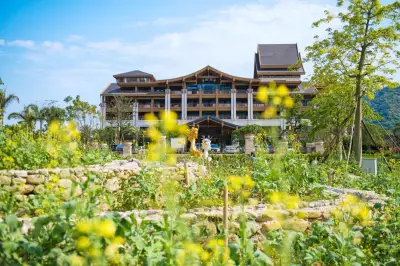
To people from outside Guangdong, Qingyuan is mostly known for its chicken, and not much else. Yet the Rosewood’s sister brand, Qianli Hotel, spotted the potential in this ‘back garden of Guangzhou’ and dove into the family travel market.
First, the area has a hot spring source, providing a foundation for a resort experience. The hotel places great emphasis on guests’ outdoor enjoyment—hot springs, lawns, BBQ areas, swimming pools—all designed to create spaces for connecting with nature.
Second, the hotel invests heavily in activities: for children, there’s a small vegetable garden, a toy house, a science corner, a playground, and more; for adults, there’s a chess and card room, table tennis, archery, yoga, and meditation. While kids learn and play under professional supervision, adults can unwind and enjoy a leisurely pace on their trip.
Let’s first analyze a few concepts of B&B/homestay accommodation:
1. The Airbnb model of staying in someone else’s home;
2. Homestays based in ancient towns or villages that once served as inns;
3. Social-media-driven ‘influencer’ homestays designed to capture young people’s attention.
Airbnb withdrew from the Chinese market this year—a regrettable move, yet it shows that the concept of staying in someone else’s home is increasingly difficult to promote in China. Ancient towns and villages have targeted the post-80s and post-90s generation, but now with late-90s and post-00s consumers becoming the main force, overly similar ancient villages no longer interest them.
With the rise of social media platforms like Douyin and RED, taking photos for check-in posts has become a travel essential. Thus, influencer homestays are the lifeline of the current market. Throughout the stay, guests don’t really need to focus on their own feelings—as long as they can snap gorgeous photos, post them, and wait for likes, they share the experience in name, but their understanding of the environment often comes through others’ perspectives.
In April, the pandemic kept me stranded in Yunnan—no flights back to Beijing—so I ended up spending a solid two weeks in Lijiang and Dali.
During those two weeks, I revisited classic tourist spots like Dayan Ancient City in Lijiang, Shaxi Ancient Town, and Dali Ancient City. None of them had changed much; the architectural styles were similar, and the goods on sale were much the same. The only difference was far fewer people—no tour groups, and the guesthouses and inns were deserted.
By contrast, Erhai Lake near Lijiang remained lively. Whether in the well-known Shuanglang or newly developed areas like Haidong, you’d see stylish young men and women, each with a photographer and a convertible sports car. Every guesthouse had its own Instagrammable spot. At one where I stayed, Tinghua Island, there was a swing over the water that fulfilled the dream of a photo in a long white dress. You had to queue for over an hour just to take a picture, and rooms were booked out for two weeks in advance.
Of course, Erhai Lake today is not the same concept as before. The earlier Erhai, targeting the post-80s generation, followed a bohemian artistic vibe, preserving elements of indigenous culture. Those 'Sanmao'-esque figures in red dresses and jangling accessories were what made the place popular.
Now, Erhai targets the post-00s crowd with a Santorini style: white-washed houses built into the hillside, brimming with flowers and lawns.
At sunset, with the strains of violin music and seagulls taking flight, you feel as if you’re in Greece.
In the newly developed Wenbi Village, I stayed at a guesthouse called Muxinbao for nearly a week. This homestay opened during the pandemic, with an investment of millions, betting on a travel boom in the post-pandemic era. For them, the pandemic was a good time for renewal and iteration; upgrading hardware and software and refining a quality product were the top priorities.
Log tables and chairs, pour-over coffee pots, white canvas tents, starry string lights, and bonfires at dusk—the camping trend that took off in early 2020 has only grown stronger, as if every middle-class individual dreams of camping.
Lakesides, grasslands, deserts, mountain peaks—all the off-the-beaten-path, once-undiscovered destinations have become campers’ temporary bedrooms. Falling asleep under the stars and waking up to sunlight sets free souls that the pandemic had trapped, returning them to nature.
While in Lijiang, I visited Baisha Ancient Town. For regular visitors to Lijiang, it’s a new frontier, not yet commercialized, and its living environment is much better than other ancient towns.
Nearby, three businesses caught my eye: a hotel, a guesthouse, and a ranch, all centered around camping and nature.
The Wuyulan Hotel, overlooking Baisha Ancient Town, embraces a vintage theme. From guest rooms to public areas, every corner is scattered with curated vintage finds from around the world, and each room offers a unique angle to admire the Jade Dragon Snow Mountain.
The hotel specializes in Naxi-style rustic luxury camping. Besides an artfully designed bar shaped like a tent and made of rosewood, you can also opt to dine under canvas. A long wooden table is laden with freshly grilled mountain delicacies: charcoal-roasted rabbit leg, Pu’er tea-marinated pork belly, milk fan brushed with osmanthus sauce, traditional brown sugar rice cakes, delightfully chewy Naxi-style jelly, handmade baba bread, crispy tofu… all while a pot of Yunnan black tea simmers over charcoal. The view dissolves into emptiness, and your heart swells with contentment.
At a higher altitude than Baisha Ancient Town sits Shi Luoke, a guesthouse built where the explorer Joseph Rock, author of 'Shangri-La,' once lived. Houses of stone, steel, and solid wood, with glass walls all around, exude a back-to-basics charm.
The lounge area for guests isn’t the lobby but tents set up amid alpine meadows. You can lie down, lie on your stomach, roll around as you please, sip tea, play Guandan (a card game), or simply sit quietly and soak in nature.
Inside Baisha Ancient Town, Hutuwu is hidden behind a wooden gate. Open it, and a world opens up: horses and sheep, mountains and water, coffee and tea, and tents scattered here and there.
The owner, with poetic flair, dug a small lake on the highland and placed a pure white piano beside it. To the naked eye, the lake may seem small, but through a camera lens, you realize how stunning it is.
For travelers longing to escape the crowds and enjoy a quality vacation, camping is a fresh choice.
Currently, the growth of luxury camping (glamping) is enormous, predicted to triple in the next five years, with the post-00s generation being the fastest-growing segment.
While ordinary people are still questioning the concept of the metaverse, pioneers are already exploring metaverse travel and concept hotels.
Late last year, Marriott Bonvoy collaborated with three international artists—Tcrek, JVY, and Erick Nicolay—to create three NFTs, making Marriott one of the first hotel brands to launch NFTs.
In early May this year, the world’s first metaverse hotel, M Social Decentraland, officially opened. It belongs to Singapore’s Millennium Hotels and Resorts group; simply register an account and you can use the hotel.
In June, a domestic metaverse hotel was also launched. Yuanzhou Tourism’s high-end hotel brand entered the Fractalist Metaverse and acquired a large virtual building on the waterfront of the core area, Fractal Island.
Capital may not understand NFTs or the metaverse, but where young people gather, there lies infinite potential in data.
The current metaverse hotels focus not on accommodation but on meetings. In times when travel is inconvenient, people from different countries and cities can don headsets and attend meetings inside the hotel as if they were actually there.
Not only can you observe the meeting in 3D, but you can also enter the room like a real person, with settings customized to different themes. The ways of interaction may be more engaging than the often long and dull offline conferences.
Zuckerberg said the metaverse is a more natural way to participate in the internet. After integrating online and offline with the Internet of Things, will the next step in tourism be to gradually downscale the real world and amplify the virtual? In the virtual world, you can not only browse and shop but also stay comfortably?
Staying in a real hotel room equipped with VR, your eyes see the metaverse; you can step out onto the terrace to feel the breeze, chat with other guests, have a drink, and even plan a trip together—a real-life version of ‘the body stays still while the mind travels far.’
In the real world we live in, pollution has damaged the atmosphere and oceans, causing global warming, mass extinction, and recurrent pandemics. Perhaps creating virtual worlds and high-tech sanctuaries is now the most urgent task.