What Does a Crab Feast at a Top Chinese Crab Restaurant Look Like?
[ a feast with crabs]
Distant things
usually sound more interesting than they really are,
but a "feast" is quite the opposite —
most of the time it’s far less exciting to eat
than to hear about.
It’s like an overlong symphony:
so noisy you could fall asleep to it.
Yet the crab feast I had not long ago
was completely different.
Japanese Sazenka is my benchmark for crab cuisine outside China, and the reason it succeeds is that it breaks free from the (boring) rusticity, (rigid) purity and (outdated) traditions of classic Japanese cuisine, blazing a path full of charm, drawing heavily on the aesthetics of Chinese crab dishes and then elevating them in its own way. Back in China, there is a hidden gem that interprets Japanese and Korean ingredients through the aesthetics of Chinese crab — its name is "Xie Dao" (The Way of Crab). The roving prince of crabs is full of amorous feelings, and Xie Dao understands every nuance of that romantic flair.
"What I want to create is Eastern cuisine, using fine ingredients and blending the flavor sensibilities of Chinese, Japanese and Korean cooking," says the beautiful owner Lu Qing. I breathed a sigh of relief — ah, at last a chance to eat a crab feast like no other!
Personally, I believe high‑end dining has hit an unprecedented bottleneck this year. Not because the food isn’t good, but because everything is too good. When diners eat, they find everything on the plate, yet there is no touching sense of "rise and fall" — what we often call aesthetic fatigue.
When it comes to crab feasts, let me list the flat "high‑end" sensations from China, Japan and Korea:
In Chinese cuisine, cold appetizers easily start with drunken mitten crab, either raw‑drunken or cooked‑drunken — basically the difference between killing first and then violating, or violating first and then killing. The climax of a Chinese crab banquet is often the crab‑picking performance, the culinary equivalent of smashing a rock on one’s chest. As they pick the crabs, chefs incidentally explain the painstaking effort behind crab roe and "bald butter" (mainly crab roe and tomalley). The variations that follow — pouring, ladling, boiling… — are almost reduced to using it as seasoning. I’ve also seen a more brutal version: starting with at least three crabs per person, sea crabs and lake crabs all thrown in, and invoking over‑familiar top origins like Yangcheng Lake or Sanmen until people are sick of crabs and life.
A Japanese crab feast centers on snow crab, king crab and red king crab, basically following the "Kani Douraku" routine; chilled crab legs leave Chinese stomachs feeling cold. Korean crab cuisine adores soy‑sauce‑marinated crab, with Russian snow crab and king crab best eaten raw. After that, it’s a race to see who can cut fastest and pile the shells highest.
Lu Qing says: "Our crab feast has no standard procedure. We don’t limit the crab species — we even have coconut crab and king crab — and even less do we limit the ways of eating. We work with elements from all three countries."
"Apart from crabs and various ways of preparing them, we also create other dishes that satisfy the palate. Because our audience is broad, we are constantly learning," says Lu Qing.
"Rise and fall" is a psychological feeling. A melody without rise and fall is not music — noise and syrupy ditties can both be seen as lacking it. In fine dining, continuity matters, but it shouldn’t be as stiff as a dead crab leg. Lu Qing sums it up: "Chinese people love richness and change."
In the restaurant business, profit comes first, and the 'homework‑copying' honor‑roll students are getting more and more adept. Even recommendations on various high‑end dining internet platforms have become eerily similar. Thus, low‑level honor students copy answers while high‑level ones copy the rules—commonplace. The remaining honor students, those with a 'chivalric spirit,' are dismissed as immature money‑burners. My good friend Daodao says that an investment of 10,000 yuan per square meter is normal for high‑end Chinese restaurants, but someone like Lu Qing, spending nearly 20,000 per square meter with a single store costing over 19 million, really has guts. Lu Qing answers confidently: "If you compare with high‑end Japanese cuisine, we are an 'alternative' with relatively low investment." Nowadays high‑end Japanese restaurants casually charge 3,000 yuan per guest, yet at Xie Dao the average check is only 1,000 yuan. Customers pay because they get satisfaction far beyond their expectations here.
Stepping into Xie Dao’s Guangzhou branch, attentive diners are entranced by the ever‑changing flowers outside the window — crape myrtle, tallow tree, wisteria — a flurry of falling petals. That garden design is the work of master Xie Yingmin. Upstairs, a spectacular tangle of crabs and threads is a major installation by famed Japanese artist Chiharu Shiota. The handles of the private‑room doors are gorgeous red‑agate lanterns. Looking back at the threads I’d just seen, I feel they are an echo, but more an extension of beauty and imagination — and I think that is Lu Qing’s culinary philosophy itself.
By now I could not wait any longer to taste the ultimate humanistic feast by [Yi Da Kou] in China’s best crab restaurant.
[Autumn Crab Awareness] Xie Dao Tasting Dinner
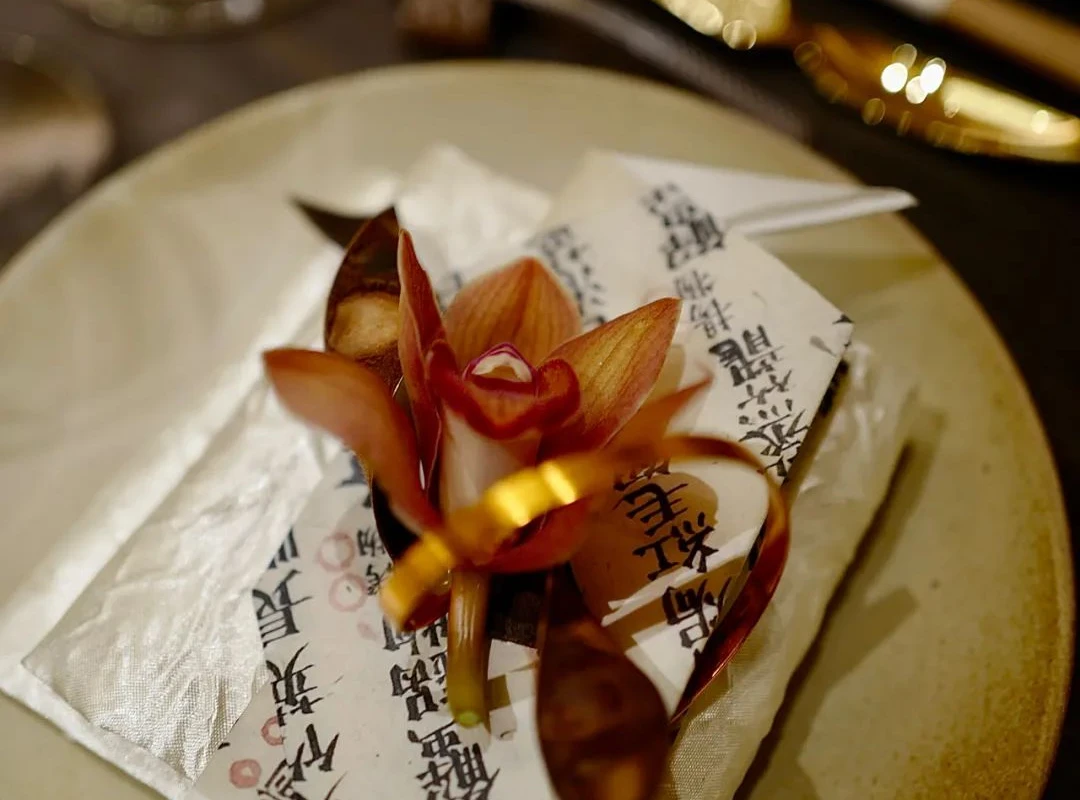
The feast was laid on a round table, which Chinese find the most relaxed and comfortable. One corner of the table was cleverly designed with a teppanyaki‑like area covered by an exquisite wooden lid; when opened, ingredients can be blanched tableside. As the menu, folded into the shape of a crab, was slowly unfolded, sweet Japanese Queen Nina grapes arrived. Before I knew it, the [appetizers] had made all the guests bury their heads and eat as if no one else were there. Yi Da Kou’s founder, Xiaokuan, reminded us gently: "Careful, the appetizers aren’t finished yet."
Firefly squid with sweet pea kernels | Toyama Bay white shrimp | Hazelnut foie gras on Japanese crackers | Kochi yuzu‑vinegar jellyfish | Four‑color tomato with snow crab | Mullet roe sake‑lees gratin | Passion‑fruit papaya pickle | Abalone with green yuzu, low‑temperature cooked
Everyone looked up in sudden realization. The appetizers encompassed an all‑embracing spectrum of flavors: the firefly squid spicy, the abalone sour; the jellyfish fresh and crunchy, the papaya sour and crisp; the white shrimp delicate, crispy and sweet, the mullet roe thick, flaky and savory. The four‑color tomato with snow crab reflected a Korean crab‑cuisine idea. The hazelnut foie gras on Japanese crackers, a creation of master Wang Yong, was memorable, giving the Japanese katsu sando a new aesthetic twist. Switching from the joy of wagyu fat to the space between hazelnut and foie gras, I bit down and felt a pure aroma in perfect proportion, the sweet crunchy cracker adding another layer of pleasure — a match made in heaven.
Pierre Péters Cuvée de Réserve Brut NV Blanc de Blancs, Champagne, France
These kaleidoscopic flavors demanded a wine with strong structure. The pairing wines that evening were chosen by the most renowned female sommelier in China, Jade Hands. The aperitif champagne was a world‑famous Blanc de Blancs, 100% Chardonnay, aged on lees for 24 months. Pierre Péters is one of the finest grower‑producers in Champagne; almost as soon as it is released it is snapped up, with even Domaine de la Romanée‑Conti seeking allocations. Elegant, delicate yet with tension, full of saline mineral flavors, it was ideal with appetizers of such breadth.
Hokkaido red king crab meat with Tosa vinegar jelly
This "sakizuke" was like a fine rain on the tip of the tongue after the appetizers. Lu Qing explains: "Red king crab meat is the most delicate. We made a jelly from passion fruit and apple vinegar, then added water shield from West Lake. I noticed that the menu at RyuGin also uses many Chinese ingredients, as do Michelin‑starred Azabu Kikunoi and Sazenka."
Sommelier Jade selected a Riesling of incredibly delicate elegance to match. Weingut Egon Müller was founded in 1797, located in the Mosel, Germany, and is famous for producing Germany’s finest Riesling. The estate has only 8 hectares, all in the top Mosel grand cru Scharzhofberger, most of them old vines, some over a hundred years old. "We chose the estate’s off‑dry Kabinett to pair with [Hokkaido red king crab meat with Tosa vinegar jelly]. The sweet‑and‑sour of the passion fruit vinegar jelly almost merges completely with the wine’s sweetness and acidity."
Xiaokuan praised with a smile: "This pairing is uncannily precise — it truly tastes as if made by the same chef."
Egon Müller Scharzhofberger Kabinett 2020, Mosel, Germany
Following this was the natural sweetness of the sashimi, making us linger.
Five‑Kind Seasonal Sashimi Platter: snow crab leg | Nagasaki horse mackerel | Nagasaki squid | Hokkaido surf clam | Canadian spot prawn
Aramasa No.6 X‑Type Namazake, Akita, Japan
With the sashimi and the hot pot dish, I experienced an unprecedented satisfaction from crab legs, paired with the Aramasa No.6, brewed from 100% Akita Prefecture sakamai, polished to 45%, and using "Kyokai No.6 yeast."
Just as Lu Qing does not distinguish countries or fixate on crab species but cares only about aesthetics, this sake follows a similar principle. Breaking with tradition, it doesn’t emphasize a single rice variety, but sakamai grown by each farmer in Akita, using only award‑winning varieties like Kamenoo and Rikuu 132. Because Akita winters are very cold, the No.6 yeast can ferment at low temperatures of 10–12°C.
I loved its lactic tang and gentle effervescence; the sake was light and clean, its texture a perfect match for the sweet freshness of crab leg.
I couldn’t stop eating the binchōtan‑grilled crab legs. Teacher Teddy explained that binchōtan uses far‑infrared radiation with a wavelength of 3–30 microns. What I felt directly was that binchōtan heats food rapidly, the surface turning golden and crispy while the interior stays moist, accompanied by an irresistible, intoxicating aroma.
Binchōtan‑Grilled King Crab Leg
Having just returned from photographing sweetfish in China’s Nanxi River, I encountered Japanese sweetfish full of roe. Japanese‑style grilled sweetfish is not gutted, so it has a slight bitterness — a special Japanese aesthetic that brings out a lingering sweetness. Sommelier Jade paired it with the sake "Jikon," called by enthusiasts the "little Juyondai" — very fitting for the moment.
Robatayaki Nagara River Sweetfish
Jikon Junmai Ginjo Omachi Hi‑ire, Mie Prefecture, Japan — rice polished to 50%
"In these hard times, don’t be troubled by the past or the future; live in the present and do your best to survive!" This is the origin of the sake’s name, and the motto of the brewery’s sixth‑generation head, Daisei Ōnishi. The brewing process allows the sake to drip out drop by drop by natural gravity — such sake is called "shizuku" (meaning raindrop).
The "Omachi" rice is not highly polished, giving the sake a full, round body and complex rice‑umami aroma, suitable for relatively rich dishes. Its dry character and just‑right subtle bitterness made the grilled items seem even sweeter by contrast.
I have a stubborn obsession with crab tomalley served over rice. But serving such food alongside a sake like Jikon would be a mutual spoil. In my experience, an orange wine pairs best with crab tomalley.
Snow Crab Tomalley Gratin with Japanese Toast
Moonlight Lily Hot‑and‑Sour Shark Fin
In terms of richness, this hot‑and‑sour shark fin was the richest I’ve ever tasted. The soup base combines Yunnan yellow chili peppers and Ningxia lily bulbs — itself an interesting pair, as sweetness tempers the heat, creating balance.
For this dish, Jade chose "Pheasant’s Tears." Finally the fermented notes in the wine could match the intense umami of the tomalley! One of Georgia’s finest estates, this wine is made in qvevri and appears on the lists of many famous restaurants, including Noma.
When the winery was founded, it planted near‑extinct grape varieties; this wine is made from the Kisi variety, all organically farmed. The wine underwent 3 weeks of skin contact and 7 months of qvevri aging.
Pheasant’s Tears Kisi White 2019, Kakheti, Georgia
The nose has lovely orange peel and biscuit notes. Not only does it pair well with crab tomalley, its round body and acidity also mingle with the hot‑and‑sour sensation and thick broth of the shark fin soup.
The "strong dish" (shiizakana) is closer to Chinese‑cuisine aesthetics. The charcoal‑grilled aged pigeon leg, developed by master Wang Yong, is incredibly fragrant and tender — a next‑level northeastern grilled pigeon. Intensely aromatic ganba fungus and cured pork set off the sweet freshness of red king crab legs, with a captivating Yunnanese flair. In the snow crab dish, the tart, crisp Brussels sprouts and carrot are as appetizing as Chaoshan pickles.
Ganba Fungus‑Baked Red King Crab
Kansai‑Style Pickled Snow Crab
Charcoal‑Grilled Aged Pigeon Leg
For these three dishes, I went back to the earlier Jikon. Just then a legendary wine appeared. I wondered, what’s coming next?
Anne Gros Chambolle‑Musigny La Combe d’Orveau 2005, Burgundy, France
Teacher Huangshan, sitting next to me, beamed with satisfaction: "I never imagined I’d taste a wine of this caliber in a crab restaurant."
I couldn’t help but take a pre‑emptive sip. Coming from the famously elegant village of Chambolle‑Musigny, the 2005 vintage exudes ripe red fruit, roses and a hint of mushroom.
The Gros family is emblematic of Vosne‑Romanée. Besides Gros Frère et Sœur, Michel Gros, and Anne‑Françoise Gros — three domaines also descended from Jean Gros — cousin Anne Gros is the most highly regarded, most meticulous and rarest of them all.
Among Burgundy’s women winemakers, apart from the towering Leroy and Leflaive, Anne Gros commands the most attention, having built her own domaine renowned for elegance and finesse.
Like the tip of a needle meeting the sharpest point, delicacy must face tenderness.
Miyazaki Wagyu Steamer
To pair with the tender, richly fatty Miyazaki Wagyu steamed in a basket, a Burgundy with such silky‑fine tannins is a match made in heaven. The dipping sauce is crucial here: a plum and sesame paste — especially friendly to me who hates greasy mouthfeel but cannot just dip things in vinegar — with fruity aromas all around.
Keenly perceptive, Lu Qing noticed that deep‑fried items, with their carbohydrate genes, have become a new darling in Japanese cuisine. She, moving ahead of the wind yet faster than it, quietly reinterprets Japanese food with Chinese ingredients. Crispy spring rolls made from the roe of mitten crab, with Japanese popcorn on the side — a perfect drinking snack.
The broth used to cook the crab legs, along with the crab roe on the side — I secretly noticed — had been simmered into the congee without leaving a single drop.
Tedorigawa Koshu 1994 Junmai Daiginjo, Ishikawa, Japan
Aged Japanese sake actually has a mouthfeel somewhat similar to Chinese yellow wine. Yoshida Shuzo, one of Japan’s large, famous breweries with 150 years of history, made this aged junmai daiginjo in 1994 using apple yeast; you can still feel a wonderfully vibrant acidity. Pairing this sake with mitten crab roe spring rolls and crab roe congee is a cross‑border stand‑in for the classic [mitten crab & yellow wine] duo.
Chrysanthemum‑Ginger Ice Cream | Fruit
While eating Japanese crisp persimmon, I asked Lu Qing how she came up with the idea of doing such Eastern "fusion" cuisine. Her answer was sincere: "We actually have the capability to do traditional refined cuisine like a counter‑style restaurant. But the current situation is that Japanese chefs don’t necessarily meet the needs of the Chinese consumer market. I simply want to make every dish delicious, use good ingredients, and price it reasonably. In the process I’ve tried many things and faced pressure. For instance, using a round table — I used to worry that people would define us as purely Japanese cuisine and find this style inappropriate. Now I’ve completely freed myself from those worries. It’s not me who chose this; it’s the customers who chose our direction."
To Xie Dao’s regular guests, Lu Qing often gifts top‑grade Koshihikari rice from Dandong, China. For top VIPs, she presents custom Laguiole wine knives and Riedel glasses — tokens of appreciation for their taste.
The beauty of this crab feast lies in the delightful discovery that in China’s culinary world, those who appreciate and those who are appreciated are lifting each other up.
Have you eaten any good crab lately?
"Don’t sing the long‑lament songs of yesteryear;
The human world has its own Milky Way."
— Yuan Mei, Qing Dynasty, "Mawei"
Food Bless You!
Advisor, "Flavors of the World 3"
Host, "A Table Like No Other"
Producer, "Wild China Eats"