My First Tangerine Peel Feast
This is an abridged version of '2022 Food Memories: An Inch of Tangerine Peel, an Inch of Gold'
Originally published in 'FoodWine'
Published in January 2023
[ Dried tangerine peel ]
I struggled for a while with the English translation of '陈皮'. Brief phrases always miss the point. I'm not good at TikTok-style summaries, so I must trouble you to read through this lengthy text.
We are always in a hurry—to recover, to succeed, to understand. Covid taught me one thing: hand everything over to time.
When I was little, I spent most of my time in the Jiangnan region, so my standout memory of Lingnan tangerine peel comes from fighting with playmates over a packet of 'Nine-Made Tangerine Peel'. That magical sweet-and-sour taste from Chaozhou and Shantou still lies in my memory, glowing like sunshine. For every child, the flavor of tangerine peel is strange at first, but if you give it enough time to linger on your tongue, what you recall is always sweet.
It took me a long time to truly fall for the taste of aged tangerine peel.
An old saying goes: Guangdong has three treasures—aged tangerine peel, old ginger, and rice straw. Tangerine peel sits at the top. For Chaozhou and Shantou kids born in the sixties and seventies, the mandarin orange was a pretty fruit that split naturally into four petal-like segments. They would obediently wait beside the adults' after-meal fruit plate, collect these 'flowers', and sell them by weight at the market to peel buyers—usually in exchange for candy. In the end, peel might come full circle: they'd get that Nine-Made Tangerine Peel back from small snack workshops in Anbu. When given to mom, the peels also became a treasure—she'd boil a big iron pot of hot water, and the whole family could enjoy a warm foot soak on chilly autumn and winter days.
As a food writer, I wear out my taste buds, my voice, and my stomach. A craftsman must sharpen his tools, so aged tangerine peel became my travel companion. This New Year, while filming in Xinhui, Guangdong, I paid a visit to the country's leading tangerine peel expert, 'Chenpi Chen', and only then did I grasp the true meaning of '陈皮'—it's far more than just peel that has aged for years.
Every autumn and winter is exactly when the hills are covered with the harvest of Xinhui's tea-branch mandarins. Chenpi Chen would take his son on tours across all the major growing areas. To me, these were just thick-skinned oranges, with a faint, oddly sour-bitter flesh. Even stranger was how a brew of the peel left a long, sweet aftertaste. That's when I understood the famous line from the Spring and Autumn Annals of Yanzi: 'When the mandarin grows south of the Huai River, it is a mandarin; north of it, it becomes a trifoliate orange.' 'Here we call them gan,' Chenpi Chen corrected me.
Only tea-branch mandarins from designated areas in Xinhui, aged for at least three years, can be called '陈皮'. Premium fruits must be picked straight from the tree; any that have fallen to the ground cannot be used. Even the 'flower' shape is strictly prescribed, just like the LV monogram. 'One is the symmetrical two-cut method, where the stem looks like a little bird's eye to the side. The other is the straight three-cut method, with the stem right in the middle,' he said.
Among connoisseurs, the famous Xinhui tea-branch mandarin flavor descriptors—'Meijiang is fragrant, Dongjia is mellow, Tianma is sweet, Chakeng is refreshing'—actually describe the peel, not the flesh.
Calling Chenpi Chen a businessman doesn't feel quite right; I think 'collector of Xinhui tangerine peel' suits him better. Upon entering, peel is everywhere—piled like mountains, displayed in rows, glowing gold inside glass cabinets. For a cultural researcher, his home is a museum of Xinhui tangerine peel. 'An ounce of aged peel, an ounce of gold.' For investors, I've stepped into a peel vault. A 100-gram piece from the 1950s once fetched half a million yuan at auction. But in these special times, for an ordinary person like me, this place is a wellness and beauty sanctuary.
Good peel involves great attention to detail. He told me: 'There are about a dozen areas recognized with the national geographical indication, and among them, locals call four the core production zones. During the Qing dynasty, Dongjia Village was the designated tribute spot, offering peel to Empress Dowager Cixi—its fame is the greatest. Personally, I think the quality from Saikou in Meijiang is also excellent.'
He switched on his phone's flashlight. Light streamed through the peel, creating a miniature spotlight stage. Only then did the fine, oily little 'beasts' tucked close together peep out from the 'flower', glancing back at me with mesmerizing splendor. For a moment, I thought I was looking at a Yayoi Kusama piece.
'These are oil bubbles. The best mandarins have thick peel and thin pith. Xinhui has 37 old trees, 27 years old, with greater medicinal value. They only grow on hillsides; waterlogged paddy fields can yield good-looking peel, but they can't produce these old trees. We also pick from the same tree at different times. In October, it's big green peel; November, second red; December, big red. After winter, we sometimes leave a small amount for after-winter fruit—I call it extreme red peel. Leaving those late-ripening fruits affects the tree's growth the next year. Dried peel from old trees yields less—only 4 jin of peel from 100 jin of fruit, while younger trees can yield up to 5.'
When hosting guests, Chaozhou and Shantou people always serve tea. At Chenpi Chen's, that naturally became tangerine peel tea. He said: 'First, we brew it to drink. Later, we boil the peel—let it boil for about ten minutes, add water, and keep drinking until you feel like stopping. Then you eat the peel. Xinhui aged peel is especially patient with boiling; after hours, the water becomes very sweet.' The flavor of old peel lingers on and on.
The taste of Republican-era old peel is the love of a grandmother.
I asked him, does a darker color mean older? Chenpi Chen replied: 'Not necessarily. Green peel won't turn black even after a long time, but red peel darkens easily—maybe because of the sugar. You have to taste it to know the peel, to get a clearer picture. We used to hear the old-timers in Xinhui talk about five fragrances: fruity, common, strong, aged, and finally bone fragrance. The aroma changes over the years.'
Chenpi Chen comes from a family of traditional Chinese medicine practitioners, and his unique love for aged tangerine peel also traces back to his grandmother. As a child, he coughed often, and his grandmother felt the ache in her heart. So from the beams of their house, she hung strings of mandarin peel, tied with rough rice-straw knots. Every harvest season, seeing little Chenpi Chen coughing, she would prepare it year after year, using the peel to boil fritillary bulb and snake gallbladder, curing her beloved grandson. Even before she passed away, she left peel to Chenpi Chen's mother, instructing her to use it for the child's coughs.
Now, the straw ropes have mildewed and broken, leaving only tiny holes. 'My mother was born in the 1940s, so the peel is likely from the forties as well.' Chenpi Chen brought out a wooden box. Inside lay purple-black peel, some crevices revealing cobwebs—his grandmother's treasured legacy.
He scraped off a tiny piece with his fingernail and asked me to smell it. I caught nothing but a faint, dusty aroma—the signature scent of tangerine peel seemed gone. But after rinsing the peel and steeping a few pieces, in moments the water in the glass vessel shifted from yellow to a brilliant, translucent red. I inhaled the wet aroma: it was a weave of seafood and medicinal notes. Chenpi Chen said everyone's sense of taste differs. He explained that Xinhui used to be all tidal flats, with countless shells and fossils in the soil, so it was entirely possible to detect a marine scent. I took a sip. Sour and medicinal, intensely invigorating. Hard to believe such an old peel could yield such vibrant flavor. 'I'm tasting this for the first time, too,' he said.
I laughed and said, I've finally tasted the flavor of an antique!
Chenpi Chen said these peels were extremely cheap back then. He credits his grandmother's subtle influence for his full storeroom—she planted the seed that early on gave him the foresight to amass a remarkable collection of old peels. 'I only use ring-branch peels from core regions, from trees at least six years old, stored for over a decade in reputable peel warehouses before being circulated.' In truth, he devotes most of his energy to preservation. Aged peel is precious. Warehouses in Guangdong that store it are called 'peel banks' or 'peel vaults'.
'Every year, you have to tend them. For the first two or three years, sun them frequently, especially on dry north-wind days. That continues for three to five years. After that, sun them every year as conditions require. Once they hit eight years, seal them for storage—no more sunning unless damp. Usually, you sun them until they're hard, about half an hour, let them cool, then put them back in jars. That's how you store them with care. Red-orange peel is tough to preserve; the sugar attracts insects. You have to flash-freeze them at subzero temperatures to kill bugs.'
'I'm basically selling time,' Chenpi Chen said.
There is one piece of peel over a hundred years old, now carefully sheltered under a glass dome—his grandmother's early collection. It is his family heirloom, already thin as a cicada's wing. As a Chaozhou proverb goes, an old peel dropped on the ground can't be picked up, just like spilled water. To him, this weathered peel represents the unbearable lightness of passing years. Every time he sees it, it's like seeing his grandmother's smile.
In matters of food, nothing is trivial. With a sense of family mission, Chenpi Chen ensures every piece of Xinhui peel in his hands is traceable. The process is like armed escorting in ancient times. 'The fruit is sealed the moment it's picked, and only then can it enter the processing plant. Then comes washing, cutting, turning, and sun-drying the peel. After that, the peel is sealed again with a strip, and only I am allowed to cut that seal.'
Now, the afternoon sweet soup before me: red bean paste with nearly fifty-year-old tangerine peel, simmered for nine hours, redolent of sweetness, plum, spice, and medicine. This is exactly what Chenpi Chen's grandmother used to make for him. I tasted a strange, woody note. He said: 'The best red bean and tangerine peel soup uses peel over forty years old—it brings a hint of aloeswood.' Then it hit me, and I couldn't help taking another spoonful: that was the flavor of time. At today's market price, this one bowl of red bean paste costs at least six hundred yuan.
Afterward, Chenpi Chen brewed a Meijiang peel from 2001. As I drank, I smelled egg yolk and tasted a sweet, throat-soothing drink framed by spiciness, full of character. 'If you have a cold constitution, boil it with old ginger. If you're heaty, add some goji berries and chrysanthemum. Actually, you can add lingzhi or dendrobium, too. You can also infuse it in honey, wine, or cook with it. Peel is a 'harmonizing' flavor—its medicinal nature is neutral, balancing all others, so it pairs with anything. When combined with cooling herbs, it tempers the cold; with strong, hot ingredients, it softens the heat.'
This spring-mild tangerine peel, accompanied by the touching story of his grandmother doting on her grandson, warmed my heart with the ancient Chinese wisdom of regulating qi and protecting the spleen and stomach.
A rare tangerine peel feast
Chenpi Chen mentioned that Mr. Chua Lam once said a Xinhui aged peel left for thirty or fifty years would surely be wonderful—but whether one lives long enough to see it is another matter.
I said, thankfully, after barely surviving last year's disaster, I now get to enjoy this tangerine peel feast. Surely that means good fortune lies ahead.
Since recovering from Covid, I've been stuck with lingering symptoms—a bottomless appetite and relentless drowsiness. And now, with this feast before me, both are flaring up together!
'Big green peel mainly breaks up stagnant qi, benefits the liver and gallbladder, and dispels dampness very well. Big red peel regulates qi, and does the lungs and stomach good. For lactating women with breast distension, green peel helps by breaking up qi,' said Chenpi Chen.
The medicinal benefits of tangerine peel are numerous. According to local wisdom, the older, the better. Those oil bubbles are packed with essential plant oils. The Compendium of Materia Medica records three main functions: guiding cold pathogens out of the chest, breaking up stagnant qi, and benefiting the spleen and stomach. Old sayings hold that the longer you keep it, the stronger the effects. For ordinary respiratory patients, especially in recovery, it can regulate the lungs and stomach, soothe qi, descend rebellious qi, harmonize the middle, whet the appetite, and dry dampness and dissolve phlegm. Flavonoids make up 5%–7% of Xinhui tangerine peel by weight, and aging actually increases the amount of high-value, bio-active flavonoids. In modern medicine, compounds like hesperidin and vitamins B and C can relax the smooth muscles of the trachea and esophagus, showing it functions as an aromatic stomachic and carminative. For most people, these are just bonus benefits. 'Aged Xinhui peel simply smells and tastes better'—that's what matters to me as a foodie.
To dig deeper, I consulted Studies and Applications of Xinhui Tangerine Peel, which specifically investigates how peel changes over time. Peels stored over ten years gain new alcohols, ketones, acids, and esters. Yet research also shows that after a decade, the chemical profile stabilizes—aging doesn't go on 'forever'. For instance, α-pinene and β-pinene increase with storage years, while limonene drops. The change is gradual in year-old samples but substantial after three years. Limonene gives a sharp, lime-like scent. After three years, the flavor rounds out.
It seems the medicinal value plateaus, but deliciousness evolves without end!
Chenpi Chen astounded me with his cooking skills. Having once run a chain of restaurants across Jiangmen in Guangdong back in the 1990s, he has a deep, understated grasp of flavor.
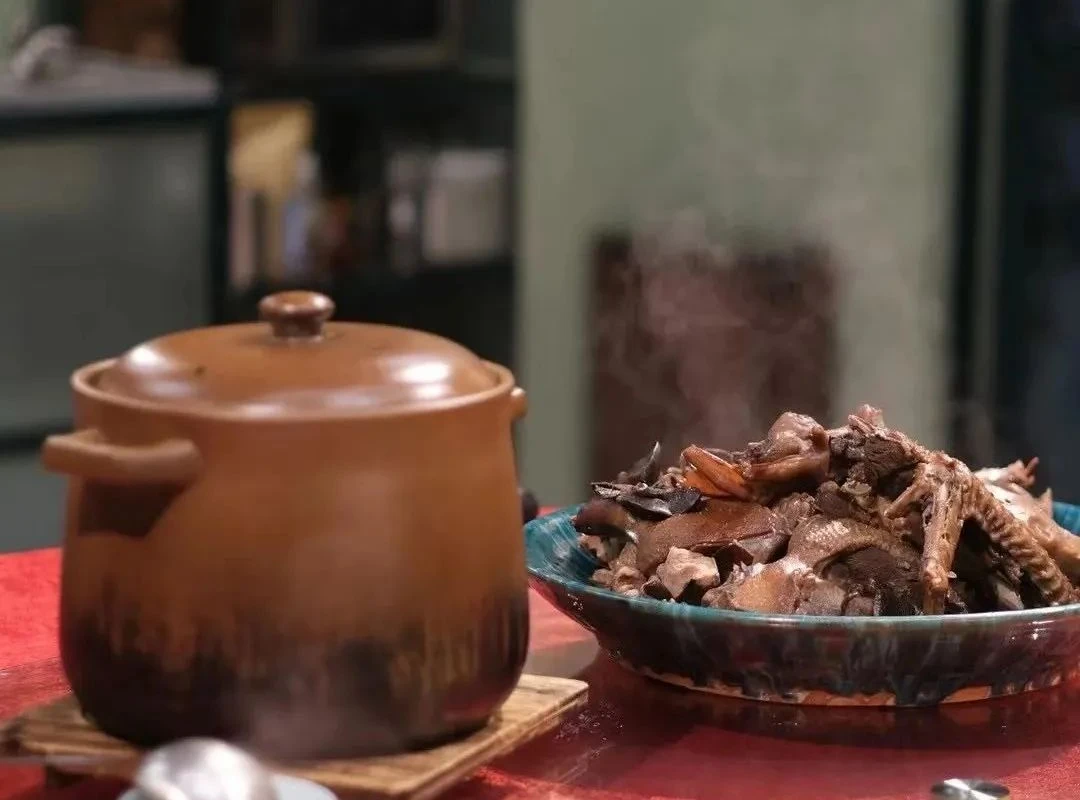
Before the meal, a cup of mandarin embryo tea—anti-inflammatory and cough-suppressing—brought calm. Then, a soup of 40-plus-year-old Xinhui Dongjia tangerine peel with an eight-year-old duck: yin-nourishing and spirit-soothing, leaving me drenched in comfort. It turned out you can fill up on liquid alone! Two cups, two bowls, and I was thoroughly hydrated. Not only did I recover from Covid more quickly, but I had no chance of losing weight!
Every meal is a once-in-a-lifetime encounter. In these special times, for each guest at the table, 'a thirst' seems to outweigh 'a hunger'. Good broth soothes everything.
'Nowadays, old ducks are hard to find—sometimes months go by without one, and they can weigh twenty pounds. We add smilax glabra, which is excellent for dispelling dampness.'
With that first sip of soup, the umami fragrance rose even higher with a second bowl. It was extraordinarily supple, causing my mouth to water continuously.
A platter of duck and tangerine peel 'medicinal dregs' was served in a Zhongshan ancient-architecture pottery-ridge-tile basin crafted by non-heritage inheritor He Zhanquan—a sight both grand and imposing. Chenpi Chen quickly reminded us: don't eat it; save room. Ah, tangerine peel was already around in the Song dynasty, and Song banquets used 'look dishes'—this is one of those, too. How refined!
This was my first ever tangerine peel feast. Since we were in Zhongshan, the famous squab had to be on the menu. Among countless tangerine-peel squab versions, none left a more wonderful aftertaste than what I had now. The peel flavor was deep, rich, and mellow. Chenpi Chen uses only the legs of 30-day-old Zhongshan Shiqi squabs: springy and tender, thoroughly steeped in the peel's mellow aroma—a pure delight.
It turned out the master stock for braising these squabs was out of the ordinary: eight years old, rejuvenated every week with three taels of tangerine peel to anchor the flavor. I did the math: that's 1,152 taels, about 115 catties of peel—heavier than me! Though after this meal, I'm not sure I weighed any less than the peel in the stock.
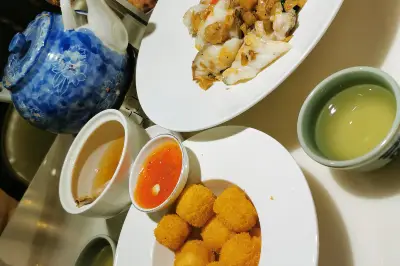
'Rising Sun Golden Flower' featured the swim bladder of Min Dong Yi Yu and coral trout from the Huangyan Island waters. Dipped in a soy sauce infused with that year's big red mandarin, it was fragrant, silky smooth, with a hint of sweetness.
'Hengmen Golden Sand Generals' were actually immature female crabs, paired with a gorgeous tangerine peel vinegar made from green peel, aged peel, and ginger shreds. These two creations gave tangerine peel an official title in the world of condiments.
Sipping a glass of Cai Hao's selected Chenpi Chen whiskey, I resolved to explore even more wondrous possibilities of peel in cooking—all flavors of time. Chenpi Chen told me that only after 2013 did his peels receive strict vintage grading.
'Soft Jade and Jadeite Platter' was a steamed trio of hairy gourd, baby cabbage, and dace fish paste, in which that year's green peel lifted the dish as a little spirit of freshness.
Steamed Splendid Lobster with Chaozhou-Style Aged Peel Powder used a blend of 20-plus-year-old mixed peels, combined with 20-plus-year-old aged peel ink, crab roe, and dried radish from Chaozhou to create a sauce that balanced spice and sweetness, amplifying the lobster's richness.
'Harmonious Lotus Duo' followed: a spicy stir-fry of pig's stomach tip and small-intestine end. I felt the aged peel powder worked almost like MSG, heightening the umami while adding a layer of fruity fragrance.
The 20-plus-year-old Meijiang peel brought mellowed sweetness to 'Endless Sea of Love'—lamb shank and oysters cooked in a clay pot, as if a touch of sugar had softened every bite. 'The front-shank lamb is the tenderest, and Taishan oysters are plump. The peel-braised sauce is intensely fragrant,' said Chenpi Chen. Tasting it, the 'harmonizing' herb indeed worked as a flavor harmonizer.
'Chenpi Honey Jade Cup' married five-year-old Changbaishan old honey with 50-year-old tangerine peel, finally drizzled gently over bird's nest—and my husky voice.
Tangerine peel is not just a gentle prescription for food and medicine alike. In Chenpi Chen's hands, it morphs into an artful spice that remarkably brightens flavors. Every piece of peel commands respect. He insists on using copper pots crafted by another Guangzhou non-heritage inheritor, Wu Guoqiang. Copper pots have long been known to detoxify; after the meal, they steep the peel so thoroughly that you feel utterly refreshed. From this day on, even if tangerine peel did nothing for my health, I would still collect different vintages simply for their wonderful taste and my own pure enjoyment.
What have you been enjoying eating lately?
'All beautiful things
Approach their goal in a roundabout way,
All straight lines are deceptive,
All truths are curved,
Time itself is a circle.'
Food Bless You!
Consultant for 'Flavorful Origins 3'
Host of 'Table Like God'
Producer of 'Wild Eats China'