Blooming Guangzhou, Basking in the Sun: A Two-Day Spring Getaway in the Flower City
When travel meets Guangzhou, I found myself in the Flower City once again. While the north still shivered in winter, Guangzhou had already stepped into spring, with countless blossoms bursting open under the warm sun. I wasted no time in witnessing the city at its most beautiful. My first stop was Sun Yat-sen Memorial Hall, where I waited for the kapok flowers to bloom. I've been to Guangzhou many times and passed by the hall just as often, but this was my first time stepping inside.
I heard the kapok here was about to burst into bloom. Two large kapok trees in the garden were poised to erupt, with little red buds already dotting the branches. I must have arrived too early—most were still tightly closed buds. In just another week, the memorial hall will be a sea of fiery red kapok blossoms.
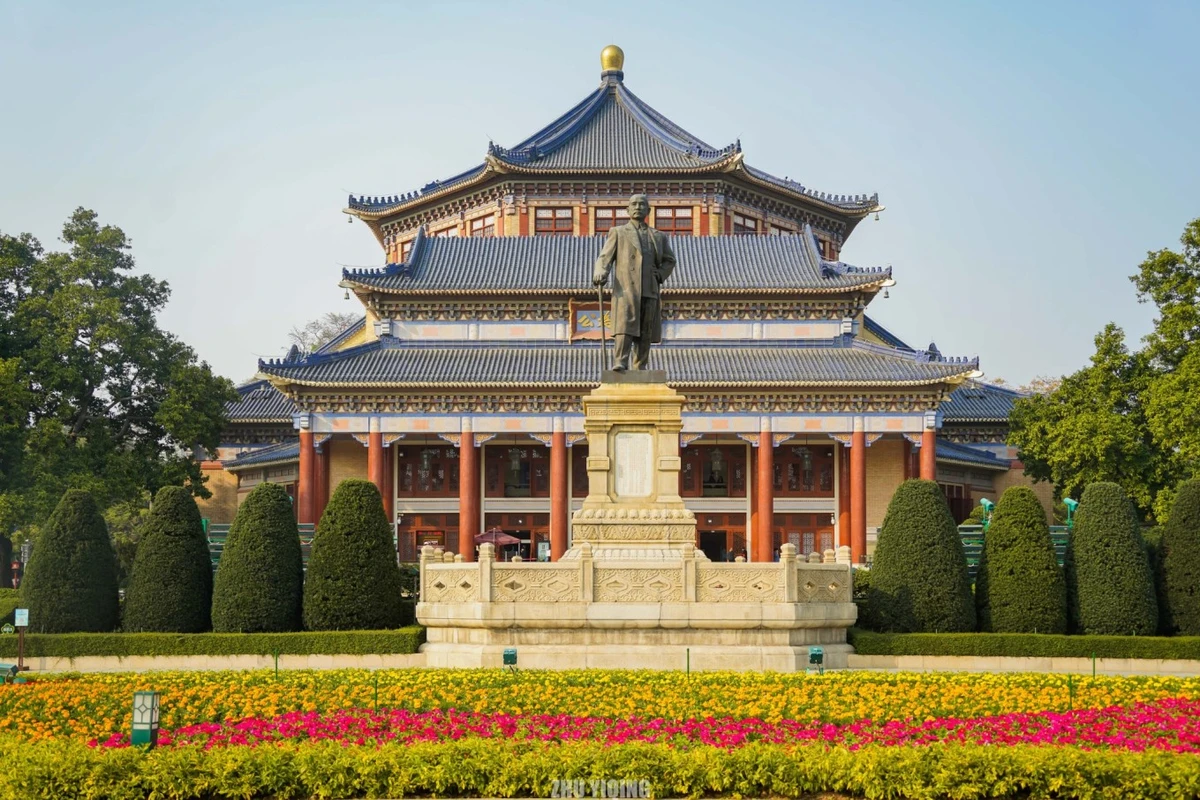
These flowers set off the grandeur of the historic building. Nearly a century old, Sun Yat-sen Memorial Hall has witnessed Guangzhou's rapid development. It was financed by the people of Guangzhou and overseas Chinese to commemorate Dr. Sun Yat-sen, the great revolutionary forerunner. The magnificent octagonal palace-style structure stands tall, with the powerful characters "The World Belongs to All" exuding strong national character, inspiring reverence.
Stepping inside, under the dome, the former assembly hall has been transformed into a performance venue, hosting all kinds of shows. It remains an important site for large gatherings and cultural events in Guangzhou.
The hall's construction is ingenious: the architect skillfully applied structural mechanics, utilizing a steel frame and reinforced concrete hybrid structure so that the 71-meter span has not a single pillar.
In front of the memorial hall lies a square, where a towering statue of Sun Yat-sen stands, perfect for photos. Looking out from inside the hall also creates a deeply atmospheric shot.
The architecture of Sun Yat-sen Memorial Hall itself is a sight to behold. It consists of four palace-style buildings with double-eave hip-and-gable roofs arranged around the central space, like four layers of folded dragon spines, embracing the enormous octagonal pointed roof at the center.
My second stop in Guangzhou was Shamian. Here I found a clever fusion of old Cantonese and Western styles. The main draw of Shamian is its diverse architecture—42 distinctive buildings in neo-Baroque, Gothic Revival, arcade, neoclassical, and Sino-Western hybrid styles.
This area showcases Guangzhou's 19th-century European charm and is a must-visit photo spot for the artsy crowd. Whether strolling under the shade while admiring the eclectic buildings, or settling into a café with a view of White Swan Pool, there's a unique atmosphere.
Shamian was once called Shicuizhou, a sandbank formed by the Pearl River's alluvial deposits. Later, it became an important commercial port. Over a century, more than ten countries set up consulates here, nine foreign banks and over forty trading firms operated on Shamian, and institutions like the Canton Customs Club and Guangzhou Club were established.
Shamian has witnessed the changes of Guangzhou's modern history, bearing the footprints of Dr. Sun Yat-sen and Premier Zhou Enlai. It has become a microcosm of China's modern history and the history of foreign concessions. The European-style buildings on Shamian Island form a unique open-air architectural museum.
One of the major sights is Lourdes Catholic Church, located within the former French concession. Originally called Shamian Catholic Church, it got its name from a Lourdes grotto with a statue of Our Lady built south of the church garden. It was established for the religious life of the French consulate community.
Exuding exotic charm, Shamian is also incredibly pleasant, with flowers blooming and lush lawns.
The island is well-greened with over 150 ancient trees, fresh air, and excellent hygiene—truly a serene oasis in Guangzhou. That's why it's always bustling: not only tourists photographing the scenery, but locals who enjoy a leisurely walk and a breath of fresh air.
There are also many sculptures on Shamian. The lifelike, beautifully shaped bronze works are worth admiring. Among the dozens of sculptures, some reflect distinct national features, like a Qing Dynasty mailbox or an old man with a birdcage. Others highlight Western art and lifestyle, like a foreigner playing the violin. Some embody the blending of Chinese and Western cultures, such as Chinese and foreign girls exchanging greetings, or a female violin teacher with kindergarten children—all very engaging.
Not far away, the White Swan Hotel is one of Guangzhou's earliest five-star hotels, with its indoor waterfall "Hometown Water" cascading down. For many overseas Chinese returning to Guangzhou, it's a place of deep emotional connection.
That pink-blue European building on Shamian, at No. 50-52, was once the French patrol station. Today, it's the most beautiful Starbucks in Guangzhou. The old banyan trees lining the road are almost a hundred years old.
Beijing Road is almost always on my itinerary whenever I'm in Guangzhou—it's just too lively. This 1.2-kilometer pedestrian street in the city center is not only Guangzhou's but also one of the largest commercial pedestrian streets in China. Renowned for its rich Xiguan charm and deep historical and cultural heritage, it rightfully earns its title as "Asia's No. 1 Commercial Pedestrian Street."
While shopping, you can also see the Millennium Ancient Road floor museum, which reveals the layout of Guangzhou a thousand years ago. A steady stream of visitors makes this the city's most famous walking street, a favorite bustling spot for both old and new Cantonese, and a traditional shopping destination.
Although the New Year festivities have passed, Beijing Road still buzzes as if the celebrations were ongoing. Red lanterns hang high, shops line the street, and crowds surge.
The architecture on Beijing Road fully embodies Lingnan culture, creating a multi-functional commercial zone that integrates shopping centers, food plazas, and entertainment. Modern techniques are used to shape the Lingnan style, blending contemporary and traditional methods to showcase Guangzhou's commercial culture while reflecting its profound cultural heritage and economic strength.
Beyond shopping, Beijing Road is also the place to sample local snacks and delicacies.
On Beijing Road stands the Dafo Temple, a quiet sanctuary amid the hustle and bustle, with thriving incense. The temple's tiered structures resemble the bathhouse in the Japanese anime Spirited Away, or Chongqing's Hongya Cave.
Canton Tower (Xiaomanyao) – a trip to Guangzhou is never complete without seeing the Canton Tower, also called Little Waist. The best time is at night when it lights up in all its dazzling glory.
The tower body rises 454 meters, standing 125 meters from the south bank of the Pearl River—a prime location. With a total height of 600 meters, it's a landmark symbol of Guangzhou and reputedly China's tallest tower.
There are many photo spots for the tower; I recommend the flower city square in Zhujiang New Town and the Haixin Bridge, both popular for capturing the Little Waist.
Boats cruise back and forth on the Pearl River, and the graceful arch of Haixin Bridge looks especially enchanting against Guangzhou's nightscape.
My love for Guangzhou probably comes from a deep fondness for its cuisine. From high-end Michelin-starred meals to humble local flavors, Cantonese food is wonderfully varied. And my top choice was, of course, the Michelin-recommended Taoyuan Pavilion at the Garden Hotel.
The restaurant's name comes from the Oath of the Peach Garden of Liu, Guan, and Zhang. The decor has an ancient, elegant vibe, with murals of the Three Kingdoms heroes, as if you've traveled back in time.
The appetizers included black pepper caviar mushrooms, lemon-scented razor clams, and pickled pepper chicken feet jelly. The mushrooms were slick, the caviar delicate—a noble and romantic treat. The spicy pickled pepper chicken feet turned into jelly offered a refreshing kick wrapped in heat.
The foie gras and suckling pig with dried fruit featured crispy, thin roast pig skin layered with foie gras seasoned Chaozhou-style in a spiced brine—sweet, sour, and rich, blending Cantonese and Western flavors.
Kung Fu aged tangerine peel and ginseng fish maw soup. Soup culture has a long history in Guangdong. This fish maw soup, made with Xinhui aged tangerine peel (one of Guangdong's three treasures), is presented in a unique kung fu teapot and poured out ritually. That piping hot spoonful was intensely savory, nourishing and warming to the stomach.
Black truffle crystal Xinghua chicken. No meal in Guangdong is complete without chicken. Xinghua chicken, one of Guangdong's three great chicken breeds, has tender, smooth flesh and delightfully springy skin.
Flame-seared Shangri-La morel mushroom and snowflake beef. Prime A5 snowflake beef was salt-crusted and roasted before wrapping around wild morels. Each bite of beef, chased with a sip of tea, was so tender it almost melted in the mouth.
Other delights were the two-flavor lobster, traditional Cantonese pine mushroom and air-dried sausage rice, exquisite seafood, and unusual desserts. At Taoyuan Pavilion, I savored a truly exceptional high-end fusion Cantonese cuisine experience.
To eat well in Guangzhou, beyond Michelin establishments, I prefer seeking out street food loved by locals. The alleys hide all kinds of culinary treasures.
Cantonese adore soup—rain or shine, winter or summer, a good bowl of soup is a must. Now, Cantonese soup has become creative. At Dayang Original Stew, I tasted soup served in a coconut. The coconut stew with silkie chicken or free-range chicken: once the coconut lid was lifted, the fragrance hit. The coconut's sweetness and the chicken's umami complemented each other perfectly, with perfect timing, the broth was rich. Combining Hainan ingredients with Cantonese cooking methods in a delightful twist.
Besides soup, locals love sweet soups. Traditional Cantonese desserts keep innovating. At the popular Xinfu Desserts, the caramel custard with a vanilla ice cream ball blends genuine Cantonese custard with Western caramel and ice cream—East meets West in a richly textured delight. The signature sugar-dusted glutinous rice balls (tangyuan) with sesame filling are a limited-time treat.
Blooming Guangzhou, basking in the sun. At the Guangzhou Tourism Super Destination Annual Gala held at the InterContinental, I truly saw why Guangzhou is called the Flower City. When the spring flowers bloom, come to Guangzhou and enjoy the blossoms together!