A 3-Day, 3-Night CityWalk in Guangzhou with Parents and Kid: A Free & Easy Trip #Guide #Guangzhou #Citywalk #Family
A 3-day, 3-night in-depth free-and-easy trip in Guangzhou, centered on strolling through Haizhu and Yuexiu districts where the Canton Tower stands. The planned walking themes fall into three main parts: visiting museums, viewing architecture, and checking out parks, bookstores, and the anime scene.
Before the trip, half a day was spent booking tickets, accommodation, and making reservations (during summer vacation, I booked just 7 days in advance, and regretted not booking a dozen days earlier, which made the journey less comfortable and convenient – but more on that later). Another half day went into planning the itinerary, so in total, a full day was used for all trip preparations.
For booking, I’m used to a certain third-party platform that handles train, flight, hotel, and attraction tickets all in one place, no need to switch apps. It interfaces with 12306, so you just log in with your existing account. For the outbound train, the system automatically matched two connecting trains; I chose 3 hours on a hard seat + 14 hours in a sleeper berth. The actual journey from home to Guangzhou took 19 hours (Day 1, 11:00 – Day 2, 6:00), with a 2-hour wait in the transfer lounge. The return trip was a direct high-speed train, taking only about 7 hours but costing twice as much. Overall, if time isn’t a huge constraint, a connecting train is worth considering – cheaper and you can lie down. But if the noise of an old green train bothers you, stick with the high-speed rail.
Day 1: We arrived in Guangzhou a little after 6 a.m. Everything felt fresh. From the train station, we took the metro, then walked to the hotel, showered, dropped off our bags, and headed to a nearby Yinji rice noodle roll shop for breakfast, costing about 17–20 RMB per person (after a night of bumpy travel, we were honestly quite hungry).
Then, following the itinerary, we kicked off Day 1’s CityWalk with an art theme. The plan: from Xinghai Concert Hall on Ersha Island to Guangdong Museum of Art (reserved 9:00–12:00) → walk along the river to Ersha Island Art Park (18 minutes) → walk to Haixinsha Asian Games Park (11 minutes) → walk to Guangdong Museum (reserved 13:00–14:00) → Guangzhou Library → enter through Opera House Exit A to take the APM line to Canton Tower (7 minutes, weather permitting for going up the tower) → tram (service hours 10:00–22:00) to Wanshengwei and back.
In reality, we largely followed this route, though we only passed by Xinghai Concert Hall, Ersha Island Art Park, and Guangzhou Library. Considering the elders’ legs, we added extra rest time near the Asian Games venue, where there were tables, chairs, and delicious coffee under the shade of trees with a view of the Canton Tower across the river. Actually, from the moment we left the art museum and walked along the river, the tower was always in sight.
First stop: Guangdong Museum of Art. The sky was very blue that day, temperature 33–35°C. Walking indoors was much cooler, and we soaked up the Lingnan artistic atmosphere. It had been a while since I’d been to an art gallery. At the entrance, they checked the reservation code; water bottles and cups had to be stored on the rack outside, but backpacks could be carried in after security. Let me share a few photos so you can feel it too.
[Above: overall atmosphere of Guangdong Museum of Art]
[Above: Artist Huang Dayou’s ‘Prescription’ series and other solo exhibitions. The exhibition was divided into nine parts: Lost City, Behind Time, Tower of Babel, Migration, Natural Selection, Reverse Side of Cigarette Paper, Pills, Powders & Ointments, Medicinal Wine Series, and Jungle Revelations. It was a comprehensive show blending mixed-media painting, multimedia images, installations, and independent projects, touching on poetry, painting, archaeology, Chinese medicine, biology, winemaking, tobacco, antiques, and more – a real-life artist’s whimsical imagination.]
The museum was showing solo exhibitions of three artists at that time. Besides Huang Dayou’s impressive ‘Pharmacy Series,’ Grandma Azi painted various plants, and Dr. Zhang Ping painted a girl curled up on an old sofa. The three are apparently a family. An unexpected delight was the poetry of Hong Shisi, which collaborated with Zhang Ping’s illustrations to create a more accessible new form.
Inside the art gallery, there were quite a few young couples and families of three. One well-dressed couple walked around, quietly discussing in low voices. A young guy with a DSLR was taking photos of a girl – maybe his girlfriend, maybe incubating an influencer, who knows.
Next stop: Haixinsha Asian Games Park. We walked along the river. Ersha Art Park, which we had intended to visit, blended into the surrounding green spaces; large lawns had people camping. Along the riverbank, we took many shots of the slender, elegant Canton Tower. With the fine weather, the photos turned out really well.
After 20-plus minutes of riverside walking, still a bit hot, we arrived at the Haixinsha Asian Games venue. Turning a corner, we discovered a gem of a coffee shop, PAIX COFFEE. Under a large patch of tree shade sat a cute silver tin-can truck. Our family sat down for a rest. The shop had many kinds of coffee drinks; the young owner recommended the summer watermelon series. Watermelon coffee – a first for me, and my parents and kid all said it was delicious. There was a second cup at half price, and a croissant could be added for 9 RMB, which the kid loved. The owner was very young; while waiting, we chatted briefly. I complimented him on the great location with a full view of the Canton Tower (I forgot to take a single photo of it). He agreed, and then casually complained that his shop was very hot inside, even with the air conditioning on. Watching him bustling about alone, occasionally needing to fetch things from what might be a storage area beneath the Asian Games venue opposite, it did seem tough. But then, where in the world is work not tough? Being your own boss in a big city like Guangzhou with such a prime spot and lovely scenery is still very worthwhile.
While we rested, my dad jogged around the Asian Games venue to clock a run as a personal souvenir, leaving his own unique footprint in Guangzhou.
Around 12:40 p.m., I asked the owner where the museum was. I kept misreading maps in Guangzhou (maybe my sense of direction is rapidly degenerating). The owner said it was right behind the Asian Games venue. He pointed: ‘That black building is it.’ We turned around – the so-called building was actually quite large (ha!). Before reluctantly leaving, we remembered to snap a photo with the little tin truck.
Next stop: Guangdong Museum. The reservation time was 13:00–14:00, and we entered just after 1 p.m. Doing indoor ‘tourism’ during the hottest part of the day was very nice. Important reminder: Guangzhou has two museums; be careful when booking. One is the Guangdong Museum, right opposite the Canton Tower. The other is the Guangzhou Museum, in Yuexiu District. Don’t book the wrong one or go to the wrong place.
Inside the museum, besides jade, ivory, and animal and plant specimens, there were also Lingnan-style ancestral shrines.
After the museum, we hit Huacheng Square. There wasn’t much shade, so we quickened our pace. By 4 p.m., everyone was getting hungry and we needed to find a place to eat. (We passed the Grand Theatre and the library along the way; I’ll save those for a proper visit next time, a little leave-behind for future travels.) Huacheng Square’s underground level was full of shops. We saw Wentong Ice Room recommended online and ordered their signature dishes. It was very tasty – the kind you’d want to eat again, and not pricey. Their Little Bear Lemonade was visually charming, refreshingly thirst-quenching, and arguably the ‘MVP’ of our Guangzhou food experience.
After a satisfying meal, we headed from Huacheng Avenue Station to Canton Tower, just two stops on the APM line. APM (Automated People Mover systems), officially the Zhujiang New Town Core Area Municipal Transport Project, uses two-car trains with rubber tires and third-rail power, fully driverless. Though only 16 meters long, it’s wide-bodied with few seats, most of the space for standing passengers, and oversized windows offering a broad view. The line mainly serves the traffic dispersal of Zhujiang New Town’s core area and Tianhe business district. The ride feels similar to light rail, starts at 2 RMB, and I heard it’s a flat 2 RMB all the way – very reasonable.
Around the Canton Tower, the Starbucks was packed. After a short break, we set off to board Guangzhou’s famous tram nearby. Each ride costs 2 RMB, or an unlimited day pass is 6.9 RMB. We rode from Canton Tower to Wanshengwei and back. Standing by the tram’s big glass doors, photos and videos came out fine; the windows worked too. On the way out, we captured the scenery along the Pearl River and the high-rises. On the return, we happened to hit the evening rush and couldn’t get shots of the other side. A round trip on the tram is definitely a must-do in Guangzhou, especially since the ‘chubby head’ tram looks adorably cute.
On the way back, we saw the Canton Tower’s lights beginning to light up. Should you do a Pearl River night cruise? I’d recommend trying it. I asked my family if they wanted to, but nobody was interested. So, instead, we took the metro to the nearby Grandview Mall for a stroll. The Lego store on the first floor was the biggest physical one I’d ever browsed – so much fun.
Apart from the Lego, wandering the mall turned out to be a bad idea for us directionally challenged folks; getting lost in a mall is like meeting your doom – countless stairs, corners, not a straight path in sight, spinning in circles instantly, and the elevators were impossibly slow during peak hours. At least we stumbled on the Lego store, the largest I’ve ever visited, with a spectacular Lego tree in the center.
After a full day of walking, both legs and brain were starting to give out. Time to head back and rest. Day 1 ended on a high note.
Day 2: The next morning, everyone was fully revived. We set off at 9 a.m. sharp. To sample more local specialties in limited time, we split breakfast into two rounds. Passing through Shufang Street, we first ordered two bowls of Chaoshan soup noodles. A young lady next to us ate two bowls by herself and looked a bit embarrassed when she saw us – but we completely understood. If it’s good, eat more; no need to be shy. The second round was Huahui rice noodle rolls, which were tastier than Yinji, especially their signature sampan congee and century egg & lean pork congee – we ate there two days in a row. Their fried dough sticks were crispy and fresh.
Well-fed and hydrated, Day 2’s itinerary kicked off. The original plan was: Sacred Heart Cathedral → Chen Clan Ancestral Hall → Shamian Island → Yongqing Fang → Liwan Lake Park. Reality proved that when measuring land with your own two feet, don’t be too greedy. It’s called ‘CityWalk,’ not ‘Special Forces’-style, so the final stop, Liwan Lake Park, was pushed to Day 3 morning.
First stop: Sacred Heart Cathedral, on Yide Road in Yuexiu District. The entire structure is magnificent, instantly evoking a sense of solemn reverence in anyone who approaches. Baidu Baike notes that the Sacred Heart Cathedral is the largest church of the Guangzhou Diocese of the Catholic Church, one of the grandest existing twin-spired Gothic buildings in China, and one of only four all-granite Gothic churches in the world. Because its walls and columns are all built with granite, it is also called the ‘Stone Chamber of the Sacred Heart of Jesus.’
In summer, those wearing short skirts or revealing clothing need to take a printed wrap cloth at the entrance to cover exposed legs or shoulders before entering. Once inside, I was instantly awestruck, eyes darting everywhere, wishing I had a dozen more eyes to take in the scenes that normally exist only in movies and TV dramas. Wandering inside, my heart cried out ‘magnificent!’ Everyone was quietly taking photos, moving from the doorway toward the white altar within the railings, then to the statue of a holy angel with a stoup by the arch.
Passing rows of long benches, people sat in twos and threes, quietly gazing in veneration. The arched doorways, vaulted ceilings, large stained-glass windows depicting Bible stories, oversized chandeliers, stone carvings, and rose windows – all simply breathtaking. Outside, several jackfruit trees made one imagine the Garden of Eden.
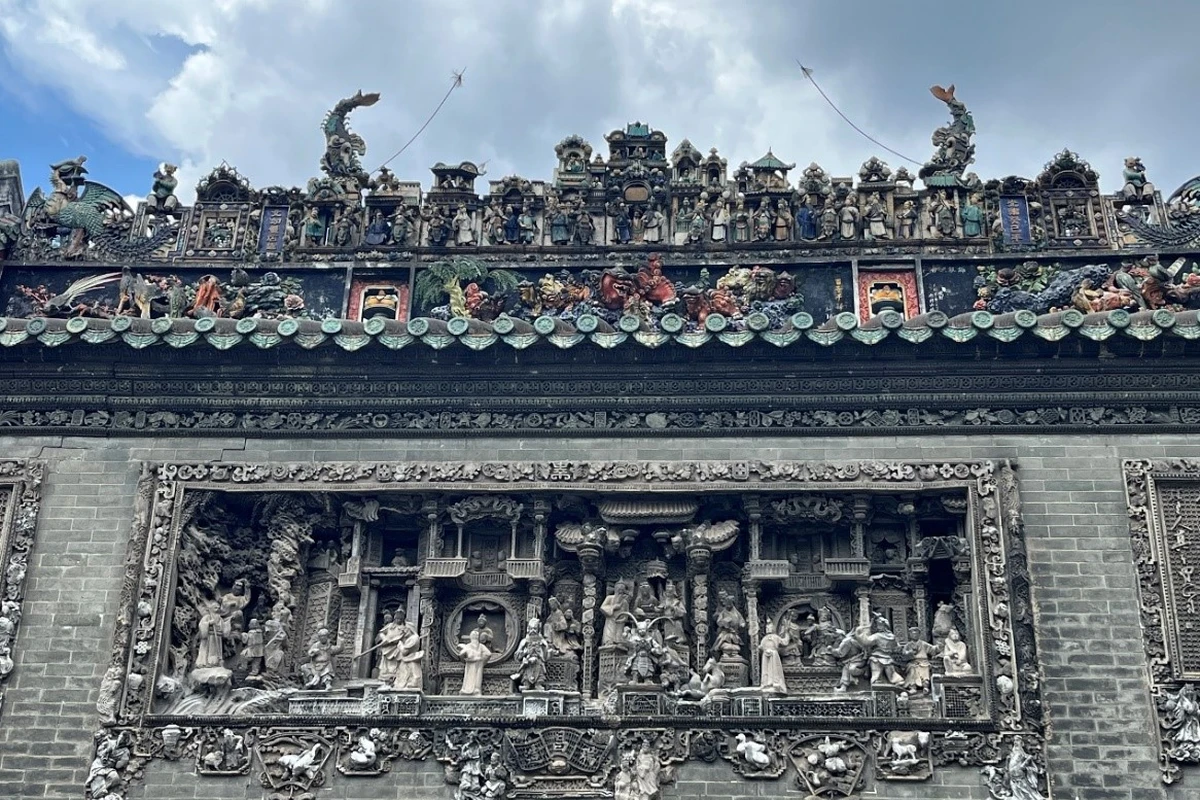
After paying homage to Western religious architecture, we switched gears to a classic Chinese building – the Chen Clan Ancestral Hall, also known as ‘Chen Clan Academy,’ located on Zhongshan 7th Road. Built during the Guangxu period of the Qing Dynasty, it was a ‘joint clan hall’ funded by various Chen clan branches from across Guangdong, mainly to provide temporary lodging for their descendants coming to Guangzhou for the imperial exams.
Just look at this grandeur – doesn’t it stir up national pride? This is one of the largest surviving traditional Cantonese-style buildings, and I was once again blown away. The wood carvings, brick carvings, porcelain carvings, bronze and iron castings, and colorful paintings on the eaves alone – featuring dragons, phoenixes, flowers, birds, auspicious beasts, landscapes, historical tales, and figures – display superb craftsmanship, exquisitely gorgeous! Friends, this is absolutely worth seeing. Admission was about 10 RMB per person, or maybe it was free; I’ve already forgotten. Most attractions in Guangzhou are free, and buses and metro are cheap – perfect for CityWalk.
Continuing with architecture: the buildings on Shamian Island weren’t quite as impressive as I’d imagined, but they still had an exotic charm compared to typical local structures. Unfortunately, my directional talent failed again; we walked the same street three times back and forth. The elders grumbled, but I couldn’t help it – I had to apologize to their feet. Restaurants on Shamian were quite pricey, so we staved off hunger by listening to music by the river. Two guitarists and an old man in bib overalls on harmonica and vocals performed; we listened for so long we almost forgot our empty stomachs.
After touring Shamian, a heavy downpour hit. We sheltered on a pedestrian bridge, watching cars pass below, feeling like a scene from another world. Across the bridge was a traditional Chinese medicine trading market; diagonally behind it we found a mall and finally could eat. Looking for food online in advance had been thwarted by my poor sense of direction and tired feet. We ate hastily, then walked to Yongqing Fang. First, we paused at Zhongshuge bookstore for some reading. My kid picked out an extracurricular math book, bought at full price as a souvenir. Before we returned home, the kid had finished the whole thing, so it was worth it. The bookstore had sofas for resting and reading; my parents sat and dozed briefly, very comfortable.
Yongqing Fang is a great weekend leisure spot, where you can browse and eat all day, full of youthful, modern vibes. Coming from the cathedral and academy, we felt we had journeyed into the present and future.
As we walked, we stumbled upon the Cantonese Opera Art Museum inside Yongqing Fang, getting up close with traditional opera and learning about its past and present through costumes, makeup, and props. Having never been exposed to it before, I found it rather interesting.
After the museum, we continued exploring Yongqing Fang. Like commercial streets in other big cities, it had a Cat’s Sky City, second-hand bookstores, snack alleys, etc. The shops were small, but we hopped from one to another with delight. For snacks, we tried ‘intangible cultural heritage’ Ama Beef Offal and Bazhen Fried Dumplings’ pig blood soup. The beef offal had big braised radish chunks, juicy and sweet, fresh and indescribably delicious. The pig blood soup looked plain – a few pieces of blood curd in a clear broth with a few chopped scallions – but once in my mouth, it absolutely stunned me. So pig blood soup is that unadorned beauty. No photos; it would be in vain. You have to experience it in person to appreciate it.
Deep in the alleys, we reached the former residence of Bruce Lee, a three-story small building. A wooden training dummy stood outside. Inside, several display boards recounted Lee’s life and family, and a few figurines and simple furniture were set out. The building is in the traditional Lingnan residential style; at the top was a tiny balcony of a few square meters, surrounded by similar small buildings. I imagined putting up a canopy, sitting in a chair reading and enjoying flowers – wouldn’t that be a divine life? Daydream over, we withdrew from Yongqing Fang and returned to the hotel to rest up for Day 3.
Day 3: We started again from Yongqing Fang. After eating Lingji rice noodle soup (not tasty), we went to the adjacent Liwan Lake Park to admire lotuses. Lotus leaves spread out gracefully, the blossoms delicate and petite. The park is full of banyan trees, many over a hundred years old. Inside, 1200bookshop was recommended in travel tips I’d seen; it’s a youth hostel that integrates a bookstore with accommodation. We lingered there, reading. Then it started raining, so we took it as a sign to stay longer, watching the rain and books alike.
After the rain stopped, we strolled to the Liwan Museum to admire the spiral staircase in the Lingnan-style building and old objects of old Guangzhou.
Then we took the metro to Yuexiu Park. Unexpectedly, the entrance we arrived at required climbing a hill. After climbing the long, tall steps, we were all exclaiming how tiring it was; suddenly all the lovely greenery in the park lost its charm. After seeing the Five Rams Sculpture and Ming Dynasty city wall, a male student told his friend that to ‘figure out’ all of Yuexiu Park, you’d need to visit at least ten times. So I left this park as another ‘leave-behind,’ to explore properly another time.
Next, we took a park shuttle out to the main gate and metro to Beijing Road Pedestrian Street. Even before exiting the metro, we stepped directly into the ‘Anime Planet’ themed mall. The mall was packed with young cosplayers – golden and pink hair everywhere – and tiny anime shops clustered tightly together, as if we had entered a two-dimensional world. Two bowls of Chongqing noodles, a couple of egg waffles, and some sushi – all scavenged in under twenty minutes – filled our stomachs with immense satisfaction.
Figures were priced close to retail, so we didn’t buy any. Then we walked down Beijing Road until we came upon the Grand Buddha Temple opposite Guangbai Department Store, its towering presence soaring into the sky, unstoppable in its momentum.
As dusk fell and lights came on at the Grand Buddha Temple, many visitors paused in front. Entering from the front gate, we saw a giant screen carved with countless religious stories and figures. Circling behind it, a Buddhist ceremony was underway. A monk in robes held a microphone, chanting sutras, and a crowd below sat on meditation cushions, reciting along. The entire scene was solemn and harmonious, mysterious and serene. On the morning of Day 4, we grabbed a bite on Beijing Road before heading home.
Thus ended our Guangzhou trip, a huge satisfaction for the whole family. Overall, doing homework before traveling is a must, and Guangzhou isn’t just Chimelong Resort for families. In three days of CityWalk, we tasted both the humanistic and the natural. I’m already looking forward to the next Guangzhou visit, to fill in the ‘leave-behinds’ and to space out in every precious bookstore. Guangzhou, until next time!