A Serendipitous Journey in a Paradise on Earth: Encountering Yangshuo's Most Enchanting Instagram-Worthy Hotel
On the weekend of April 18, a marathon-running friend messaged me, saying that since Chinese New Year, they had been stuck in Shenzhen without moving and wanted to come out to relax. I happened to see an inn in Yangshuo I had visited before posting on WeChat Moments, showing a very tempting empty Yangshuo. I said, why not go to Yangshuo together to unwind?
1. Yangshuo County. Inn. West Street
So we drove 450 kilometers and arrived at Yangshuo County around 5:30 PM. Upon entering the central intersection—Shima Roundabout—we reached the nostalgic inn: Huanghe Boutique Hotel. The hotel is only about 700 meters from Yangshuo High-Speed Rail Station and the county bus station, making it the best choice for both high-speed rail travelers and self-driving visitors. The hotel is close to the Shili Gallery Scenic Area, West Street, Impression Liu Sanjie, and the Yangshuo Opera House tourism-commercial complex, offering tranquility amid the bustle. It is the ideal first stop for hiking and cycling to enjoy the landscape.
The hotel features a post-modern style of decoration, simple yet back-to-basics, with flashes of designer inspiration. Guest room facilities are equipped to standard, with building materials, furniture, and bedding made from eco-friendly natural materials. Every room has a balcony and tea set, with beds designed ergonomically to provide a high-quality sleep. Brand-name bathroom fixtures and complete toiletries, 24-hour hot water supply, and seamless Wi-Fi coverage are provided.
The first floor of the hotel is a coffee and music bar, with its own roasted coffee, German beer, freshly squeezed juices and yogurt, and local seasonal fruits gently perfumed. It creates a lazy leisure space and a bohemian atmosphere. Unexpected encounters with music, food, travel, photography, design, and IT enthusiasts savoring slowly may lead to a beautiful story.
After a day of sightseeing, you can completely relax here, or if you don't want to go anywhere, you can gaze at the mountain views from the balcony or enjoy a coffee on the first floor, reading, daydreaming, or having afternoon tea—all are nice choices for a pleasant journey.
In the evening, the coffee and music bar offers lyrical music and various drinks to accompany you late into the night. This small inn is a door to the most beautiful landscapes, mixing tranquility and liveliness, culture and everyday life, letting you leave worldly noise behind and let time flow slowly, enjoying a pleasant and lazy journey.
After checking in, my friend and I strolled to West Street. Outside, we noticed that locals didn't wear masks; only tourists from elsewhere were fully masked. This place was truly a paradise!
A leisurely ten-minute walk brought us to West Street. Unfortunately, the street where the old West Street bars were located was lined with bamboo scaffolding, with old signs being dismantled for renovation. Walking toward Yitian West Street, under the dim night lights and hazy glow, a handsome young man playing the hand drum and singing still conveyed warmth and dreams, making us linger.
Listening to the music, we dove into shops with exquisite accessories, examined them carefully, and marveled at novel little trinkets. By the time we sat down to order food and drink local Guilin beer, it was already past 8 PM.
2. Xingping Ancient Town. Twenty Yuan RMB Scenic Area. Laozhai Mountain
The next morning was misty. After I moved around and did my standing qigong, my friend had already returned from a 16-kilometer run along the Shili Gallery. Excitedly, she showed me the photos she had taken, saying it was exhilarating—the trail was empty, and halfway she met a tourist runner coming from the Yulong River, and they ran together for a stretch. The greenway was beautiful, with rivers and river views so stunning that words failed; just look at the pictures. Right at the inn's doorstep was a rice noodle shop: two liang (100g) for six yuan, three liang for seven, with pickled vegetables, chili, and fried soybeans available to add freely. Regrettably, the shop hadn't fully "resumed work," so there was no lu cai fen (mixed meat rice noodles), only soup noodles. But that didn't stop us from enjoying the deliciousness of Guilin rice noodles; we left a little regret for next time.
After finishing the noodles, we headed to Xingping Ancient Town, the famous check-in spot for the 20-yuan RMB bill.
Leaving the county, it took only about 20 minutes by navigation to Xingping Ancient Town. Along the road were all pink-flowered Bauhinia trees, combined with the misty rain, making us feel almost ethereal. The car glided lightly among the mountain flowers—it was simply too beautiful. Later we realized we forgot to take pictures. Fortunately, the closer we got to the ancient town, the lighter the rain, and it stopped by the time we arrived.
The ancient town had clear road signs. As soon as we entered the memorial archway inscribed with "Ancient Town," we saw signs pointing to the bamboo raft dock and parking lot. We parked our car in the free underground lot opposite the police station, under the market. Later we found that this might be the only free parking lot in the ancient town, with plenty of spaces, though a bit dark—drive in carefully and watch out for electric bikes around the market when exiting. From here, the dock was only about 600 meters away, no need to drive in.
The ancient town was quiet in the early morning. Early risers had already opened their shops. The flagstone streets, flying eaves, and shop signs were all interesting. Crossing the ancient town streets, we arrived at the Li River bamboo raft dock. The river was clear, the mountains close—the hills from the 20-yuan note stood across the water. A gentle breeze and moist air beckoned us. Raft rides currently implemented a quarantine rule: people not coming together couldn't share a raft (the smallest raft holds 4 people max); solo travelers had to charter the whole raft, buying four seats. So we gave up on the raft and climbed the mountain.
At the foot of the mountain on the left side of the dock, a stone brick about 30-40 cm wide had a red arrow pointing upward, inscribed "Laozhai Mountain this way." Laozhai Mountain is a limestone pinnacle near the boat dock in Xingping Town, adjacent to the Li River, with an elevation of over 300 meters.
In 1996, a Japanese man named Lin Kezhi arrived in Xingping Town. A travel enthusiast, he was deeply captivated by the beauty of Laozhai Mountain standing by the Li River.
Anyone who has visited Yangshuo knows that the mountains here are steep and almost unscalable. Lin Kezhi borrowed ropes and equipment from a local construction crew and spent a day climbing to the top of Laozhai Mountain. When he summited, he was stunned by the view before him. After descending, he decided to live in Xingping Town and guard this great mountain. He returned to Japan and raised 100,000 yuan. In 1996, 100,000 yuan was not a small sum, but it was still insufficient to build a mountain road. So over the following year, he and workers carried cement, sand, stones, and other materials up the mountain on their shoulders, trip after trip, smashing stones with hammers, laying 1,159 steps section by section, and building a pavilion at the summit, which he named Friendship Pavilion. He opened the Laozhai Mountain Inn at the foot of the mountain, with a second sign reading "Xingping Sino-Japanese Cultural Exchange Center, Yangshuo County, Guilin." This international brigade soldier who "travels the world to help the poor" eventually settled in Xingping, married a Chinese woman, and had a son named Lin Xiduolao.
People in Xingping all know about this stubborn old Japanese man and his lovely Chinese son. However, in recent years, the Laozhai Mountain Inn business has not been good. Since the path up the mountain was built by Lin Kezhi himself, he would go up the mountain every few days to collect the garbage left along the way, each cleanup taking more than five hours, while the average person takes just over an hour to go up and down.
Many visitors stayed at his inn and left messages on stone tablets before leaving. Lin Kezhi would carve these messages into the tablets and keep them. Years later, many people could still find their own memories when they returned.
It was thought that Mr. Lin would stay in Laozhai Mountain for his retirement. However, when visiting him again four years ago, he wanted to sell the home he had painstakingly built over 19 years. Due to competition from the explosive growth of tourism and the increasing number of inns in the town, and because of his age (69), he needed to return to Japan for medical insurance and retirement care.
Now Mr. Lin no longer lives here, but the mountain, the paths, and the carvings on the stones remember the old man's wishes.
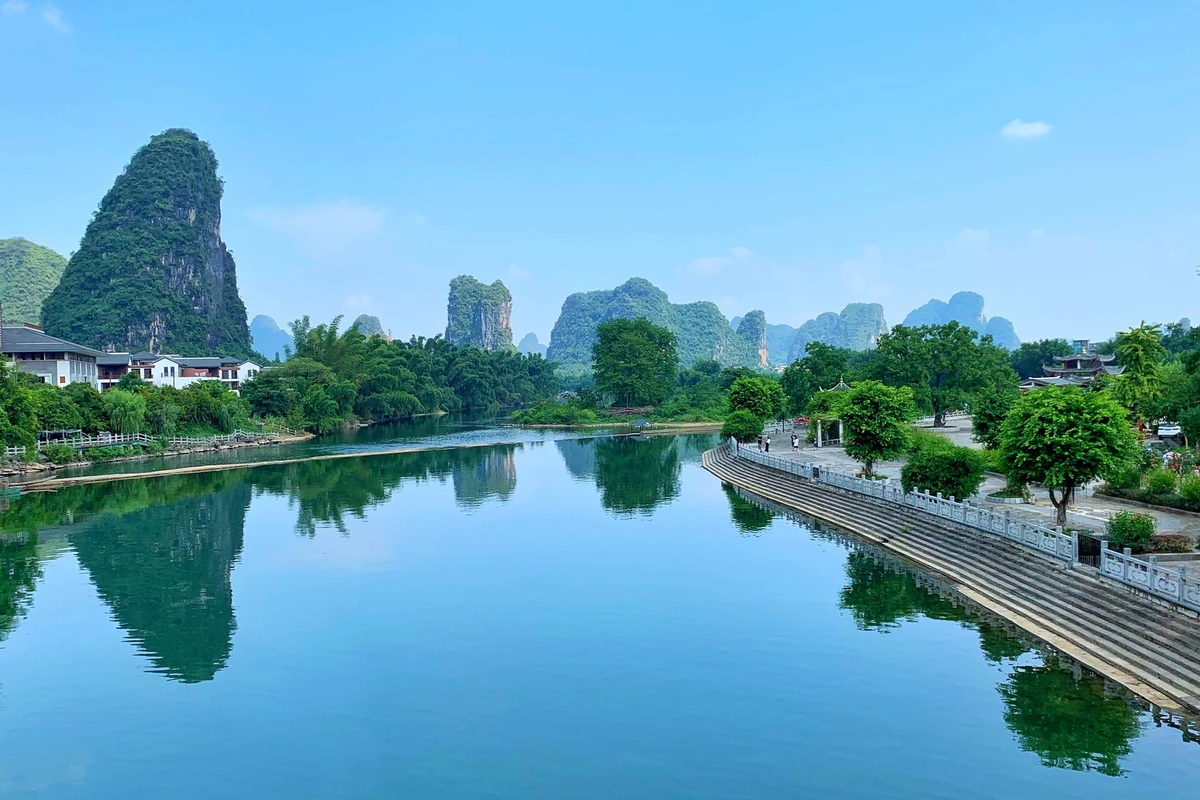
Climbing Laozhai Mountain, you will see the mountains, the delta, the convergence and divergence of the Li River, and the most beautiful karst landscape.
At noon we descended, had a clay pot rice in the ancient town, bought five or six kinds of chili sauce and beef sauce. The ancient town's prices were lower than those in Yangshuo county, and the locals were simple and honest—extremely enjoyable.
3. Xitang Village, Xingping. Tianhu Lake
After a short rest, we navigated to Xitang Village in Xingping, wandering along the east bank of the Li River, to find the Tianhu Lake hidden among the mountains.
Xitang Village is a small village on a karst depression on the east bank of the Li River. The newly built Yang-Xing Highway passes by its side; although remote, transportation access is relatively convenient. In front of the village, three natural lakes join together, covering an area of nearly 1,000 mu (about 66 hectares), with depths up to 8 meters. The village is surrounded by towering mountains and dense peak forests. Tianhu Lake is about 4 kilometers from the Li River, a karst lake suspended 100 meters above the Li River. Such a rare geological landscape is not often seen even in Yangshuo, where karst landforms are most developed.
Since we enjoyed the scenery along the winding mountain road with little physical exertion, the car reached a viewing platform that had been built, which was very beautiful and convenient. Looking down from a height, the scenery was exceptionally magnificent and lovely, and the surrounding peak forests further highlighted the lake's elegance and tranquility.
These off-the-beaten-path routes are perfect for outdoor enthusiasts and interesting friends to explore together.
Starting from Yangshuo county town toward the Xitang Tianhu line (now called East Bank of the Li River), worth seeing include the essence section of the Li River, Caoping Tourism Town, Daxu Ancient Town, Gudong Waterfall, Guan Rock, etc. Not far beyond Xitang, just entering Caoping Township, there is a high mountain gorge that looks quite majestic and grand at a glance.
We returned late with high spirits, completely leaving behind the gloom of isolation. By the next day on the return trip, we were already revitalized warriors.


![Mountains and Waters Meet Again [Guilin Yangshuo] Let's Rock the Boat of Friendship](/img/624178c28a221adb_s.webp?src=https%3A%2F%2Fdimg04.c-ctrip.com%2Fimages%2F0104n120009cnhkrdD720_W_320_0_Q80.jpg)


