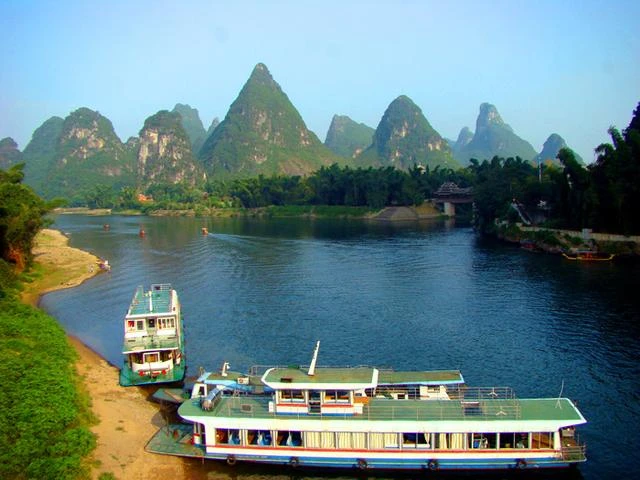
Guangxi Tourism: Yang Shuo's Paradise Tour of Li River (Photo)
In addition to the stunning scenery of Guilin, known for its landscapes that are the finest under heaven, the Li River cruise from Guilin to Yangshuo is another highly alluring travel option. I remember on the afternoon of October 1, 2012, during the free time in Guilin for the "National Car Enthusiasts Gathering in Green City - Self-Drive to Cheer for the Ten-Thousand-Mile Journey" fleet, which was supporting the "2010 China-ASEAN International Car Rally and China-ASEAN Media Car Rally," the reporter and a few car enthusiasts arranged to tour the Li River.
Li River Scenery (Photo by Feng Ganyong)
The reporter had toured the Li River in Guilin before, but the typical classic travel method, especially for domestic and international tourists, mostly starts from Mopanshan Pier. This is because it is an excellent "Li River Essence Tour" route. The Li River, stretching over 50 kilometers of waterways from Mopanshan to Yangshuo, resembles a green silk ribbon winding among myriad peaks, with bizarre cliffs lining the banks, clear waters meandering, steep cliffs dipping into the river, green mountains floating on the water, and picturesque scenery, like a hundred-mile scroll.
Fishing Boat at Sunset (Photo by Feng Ganyong)
However, since this route departs in the morning and takes over four hours in total, it conflicted with the fleet's schedule in Guilin, so the car enthusiasts could only choose a more ideal route with a shorter duration within their limited time. After inquiring, they found such a short essence Li River tour in Xingping.
Paradise Pier (Photo by Feng Ganyong)
On the afternoon of October 1, the reporter and his party drove to Xingping. On the way, they suddenly spotted a national 4A-level scenic area called "Paradise," so they decided to explore it. Little did they know that the feelings after the Paradise tour went far beyond mere "exploration"; more precisely, it should be described as "sighing over the seclusion."
2.5 Kilometers of Waterway (Photo by Feng Ganyong)
At that time, Manager Liu Haifang of the Guilin Yangshuo Landscape Tourism Yangshuo Paradise Scenic Area introduced to the reporter: The Paradise Scenic Area was founded in 1997, developed based on the artistic conception depicted in "The Peach Blossom Spring" by Tao Yuanming of the Jin Dynasty, combined with the local pastoral landscape. Because it is located on the golden route from Guilin to Yangshuo, it has attracted numerous domestic and international tourists in recent years.
Photo with Tour Guide (Photo by Feng Ganyong)
Entering Paradise, what catches visitors' eyes is a screen wall-like archway inscribed with Tao Yuanming's "The Peach Blossom Spring." Walking past the archway straight into the scenic area, there is a set of water-operated tube wheels and a corridor landscape. Following the corridor, a young girl named Yi Jiahui, who served as our guide, began to vividly narrate the story.
Winding Waterway Leading to Seclusion (Photo by Feng Ganyong)
"Paradise" in the East is synonymous with an ideal realm of human life, equivalent to the Western Pure Land or heaven. For thousands of years, perfectionists have tirelessly sought and deliberately created their own imagined "paradise." And in the kingdom of Guilin's landscapes, in the place closest to the city, we have such a "Paradise."
Waterside Scenery (Photo by Feng Ganyong)
Following Xiao Yi's guidance, we passed through the corridor, and a melodious tune drifted into our ears. It turned out that at the corner ahead of the corridor, several young Zhuang ethnic men and women in national costumes were playing a beautiful folk song. Then, we strolled to the pier, boarded a small boat, and began to drift along the 2.5-kilometer-long serene waterway of Paradise.
Pastoral Landscape (Photo by Feng Ganyong)
According to records: Paradise stands quietly on the edge of the city like a simple village girl, neither ostentatious nor artificial, entirely natural and full of true charm. If it were the season of "apricot blossoms drizzle that moistens clothes, and willow wind that doesn't chill the face," stepping into "Paradise" would reveal a scene of beautiful pastoral landscapes.
Dong Ethnic Wind-Rain Bridge (Photo by Feng Ganyong)
Inside Paradise, the clear and rippling Swallow Lake is embedded in stretches of green fields, like the bright eyes of a maiden full of affection. Weeping willows along the lake shore gently brush the water surface. Looking out from the small boat on the lake, distant mountains are layered in green, village trees are shrouded in mist, paths crisscross, and houses are scattered, resembling the poetic painting in Tao Yuanming's description: "fragrant grass is lush and beautiful, fallen petals are numerous," and "there are fine fields, beautiful ponds, mulberry trees, and bamboo groves."
Crossing the Wind-Rain Bridge (Photo by Feng Ganyong)
At that moment, swaying in Swallow Lake felt truly like an immortal's enjoyment. As the small boat cut through the waves and glided leisurely on the green silk-like lake surface, the tourists' hearts felt as carefree and joyful as a bird "long caged, now returning to nature." With the sky wide and clouds near, the shore wide and waves calm, nature's fresh and vast embrace makes all worldly concerns vanish and mundane thoughts disappear. Suddenly, a clear song floated over, coming from girls on the song stage and dance floor by the shore. They were singing and dancing in vibrant ethnic costumes, welcoming distant guests with folk songs and dances full of rich ethnic flavor.
Boat Entering Swallow Cave (Photo by Feng Ganyong)
Turning past the song stage, the small boat entered a narrow waterway. It was hard to imagine that behind Swallow Lake there was such a winding and secluded path. The pastoral landscapes, roads, bridges, and villages seamlessly merged, encompassing all the beauty of heaven and earth. The waterway grew narrower. After the small boat passed through the completely dark Swallow Rock Cave, like sailing at night, and the narrow pass "so narrow at first that only one person could pass," it seemed like "hills and streams without end, leaving no way out." Unexpectedly, the view suddenly opened up, and Peach Blossom Island, with its bright willows and blooming flowers, appeared. The island was not large, surrounded by water, but lush with vegetation and various trees in bloom, with red peach blossoms smiling brilliantly. What a poetic scene of "sunrise river flowers redder than fire, spring river water green as blue."
Field Scenery (Photo by Feng Ganyong)
After passing Peach Blossom Island, Xiao Yi reminded everyone to prepare because we were about to reach the primitive tribe. We needed to be mentally prepared not to be frightened by the well-intentioned enthusiasm of the indigenous people. No sooner had she spoken than a "strange cry" came from the grass on the shore, where a burly man covered in grass greeted us.
Indigenous Tribe (Photo by Feng Ganyong)
Then, alarm whistles sounded, and drums beat. It turned out that the primitive indigenous people had discovered strangers from outside. They rushed down the hillside brandishing spears and fishing forks, dancing joyful ethnic dances. These indigenous people were covered in bark, feathers, and leaves; they were sturdy, strong, and dark-skinned, clearly a tribe with tenacious vitality. Through them, one could imagine how intelligent and resilient the ancestors of the Chinese nation were.
Zhuang Girls Weaving Cloth (Photo by Feng Ganyong)
Passing through the waters of the primitive tribe, the small boat slowly sailed back along scattered villages. This was true countryside, with blue tiles and mud walls, bamboo fences and vegetable fields, and the sounds of chickens and dogs clearly audible. Occasionally, village women could be seen washing clothes by the river, their wooden clubs beating out ancient rhythms on the bluestone slabs. Barefoot farmers carrying buckets walked through the fields, mischievous children played in open spaces in front of houses, and an elderly fisherman, pipe in mouth, sat leisurely on a bamboo raft, drifting with the current among the clouds. From the primitive tribe to the village before us, history had leaped across hundreds of thousands of years, creating a surreal feeling as if one didn't know what era this was.
Tao Yuanming Villa (Photo by Feng Ganyong)
After landing, we arrived at the Dong ethnic water village. Enthusiastic girls first offered a few cups of rice wine to distant guests before allowing them to enter the villa. In the village, visitors could see Zhuang youth performing lively songs and dances, and scenes of girls and older women weaving cloth and spinning thread. Exiting the village and crossing the Wind-Rain Bridge, one could also sing folk songs at the "Embroidery Ball Tower," catch embroidered balls thrown by Zhuang girls, explore folk customs in the folk custom garden, visit distinctive buildings like totems, and watch or buy handwoven fabrics of ethnic minority women. After leaving the village, we arrived at Tao Yuanming Villa.
Xingping Li River Tour (Photo by Feng Ganyong)
Tao Yuanming Villa is mainly built in the style of northern Guangxi residential architecture and is another fine spot that introduces Tao Yuanming's life and poetry. Here, people can appreciate the garden scenery with local characteristics, with connected pavilions and towers half-hidden among green trees and colorful flowers; flowing water and lotus flowers complement each other, and fish swim in clear ripples under green bridges and strange rocks.
A Single Boat (Photo by Feng Ganyong)
The villa integrates the essence of Chinese gardens—pure and natural, elegant and magnificent—with the rustic and simple northern Guangxi architectural style of green bamboo, blue tiles, and layered eaves, further enhanced by Tao Yuanming's plain and natural pastoral poetry, showcasing its unique charm. The Paradise tour allows one to deeply experience the poetic realm it constructs, not only brimming with natural wild charm but also perfectly integrating the essence of traditional Chinese refined culture and northern Guangxi folk customs. The "sighing over the seclusion" at Paradise was truly a worthwhile trip.
Reporter Touring Li River (Photo by Ying Zengxuan)
After leaving Paradise, we continued driving southeast for over half an hour to reach the Xingping Li River pier. Boarding a sightseeing boat from here, the reporter and car enthusiasts enjoyed a stretch of the Li River's natural beauty. The beauty of the Li River scenery not only fully displays the characteristics of "green mountains, clear waters, strange caves, and beautiful rocks," but also features "deep pools, dangerous shoals, flowing springs, and waterfalls."
Li River Sunset (Photo by Feng Ganyong)
In the Caoping area, the water turns and peaks are peculiar, with lotus-shaped peaks and emerald cliffs. On the left bank of the river, Crown Cave got its name because the peak resembles an ancient golden crown, enjoying the reputation of "the pearl of the Li River." Passing through Xiushan, Half Crossing, "Peach Blossom Moon Viewing," "Stone Man Pushing Mill," Bamboo Shoot Mountain, and other scenic spots, we encountered the five great beauties of the Li River: Yangdi Waterfall, Langshi Misty Rain, Nine Horses on Huashan Mountain, Huangbu Reflection, and Xingping Perfect Scenery.
Li River Scenery (Photo by Feng Ganyong)
The most famous mountain on the Li River is Huashan (literally "painting mountain"), and the most beautiful scene is the Huangbu Reflection. Huashan is 416 meters high. On the cliff facing the river, mainly due to the calcification of low-level organisms like algae, colorful bands of varying shades have formed on the cliff surface. These biological pigments, combined with the natural colors of various minerals in the rocks, have painted the famous Nine Horses of Huashan in different poses, as well as natural cliff paintings on the Li River such as "Carp Hanging on the Wall," "Embroidered Mountain Painted Colors," and "Zhang Guoguo Riding a Thousand-Mile Horse Backwards." Under the blue sky and white clouds, the mountains resemble jade bamboo shoots and jade hairpins, and the peaks look like black hair and indigo eyebrows. The reflection near Huangbu Beach creates the artistic conception of "clearly seeing the green mountain tops, the boat sailing above the mountain tops."
20 Yuan Li River Pattern Scenery (Photo by Feng Ganyong)
Of course, some of the scenes mentioned above can only be appreciated when cruising from Mopanshan Pier, but the cruise from Xingping also offers many Li River views. The most captivating among them is the pattern on the 20 yuan note, whose actual landscape is located on the Xingping Li River cruise.
Reporter's First Visit to Yangshuo (Photo by Huang Zhiguo)
When we reached this scenic spot, the reporter suddenly remembered to take out a 20 yuan bill. Seeing it, the car enthusiasts immediately grabbed the money from my hand and took photos with the real Li River landscape as a backdrop. At that moment, everyone was immersed in indescribable delight, enjoying the immense pleasure and fun brought by nature.
Yangshuo West Street at Night (Photo by Feng Ganyong)
If you come to Guilin and don't visit Yangshuo, it's as if you haven't been to Guilin. So after finishing the Xingping cruise, although it was dusk, we still drove in the night to the brightly lit Yangshuo town. Five years ago, the reporter had been here after the Li River cruise, and unexpectedly, in just a few years, Yangshuo had changed so much! The scenes in my memory seemed to have disappeared. Only when I saw the old street sign of "West Street" now extended deeper into the street did I vaguely recall some of the scenes of West Street from that time.
SWAT Officers Patrolling (Photo by Feng Ganyong)
During the National Day holiday, Yangshuo was immersed in an ocean of joy, peace, and warmth. Everywhere was crowded with people, especially on West Street, where the crowd was so dense it was almost impossible to squeeze in. But the joy of sighing over the seclusion at Paradise and the Li River cruise at Xingping was still lingering, so the car enthusiasts, completely unaffected by the noisy night atmosphere of West Street, happily wandered and strolled through this famous "Foreigner Street," truly experiencing a joyful night celebrating the National Day holiday in a foreign land. (Text and photos: Feng Ganyong)


![Mountains and Waters Meet Again [Guilin Yangshuo] Let's Rock the Boat of Friendship](/img/624178c28a221adb_s.webp?src=https%3A%2F%2Fdimg04.c-ctrip.com%2Fimages%2F0104n120009cnhkrdD720_W_320_0_Q80.jpg)


