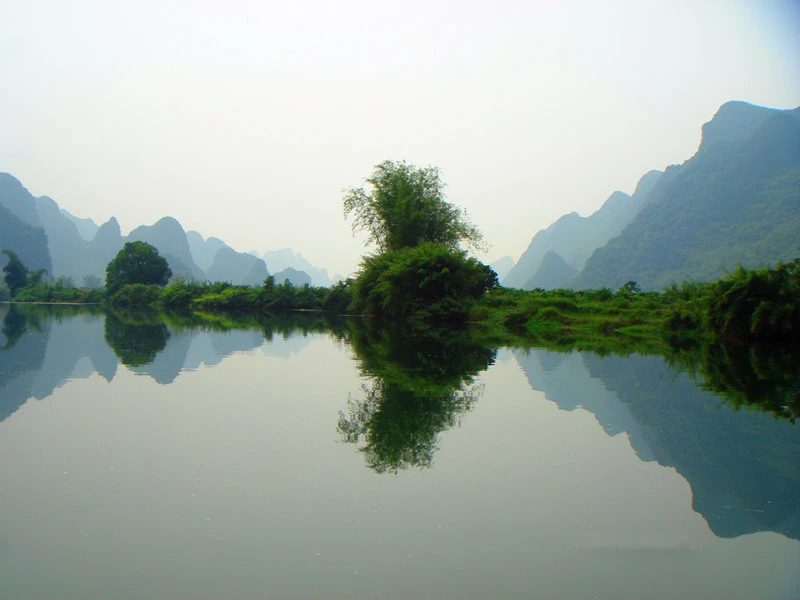
Guilin 11 Years Ago, Us 11 Years Ago
In 1994, Guiyang singer Han Xiao became an overnight sensation with his song 'I Want to Go to Guilin.' Two lines from the lyrics became widely popular and are still memorable today: 'I want to go to Guilin, oh I want to go to Guilin, but when I have the time, I don't have the money; I want to go to Guilin, oh I want to go to Guilin, but when I have the money, I don't have the time.' This song made Guilin a household name overnight, inspiring many people to yearn for a visit. This was likely the most famous city tourism branding campaign 26 years ago. Fast forward to August 20, 2009, a Thursday. After some preparation, my wife and I headed to the Capital Airport, embarking on a 6-day independent tour of Guilin. The itinerary was as follows: Day 1: Departure. Stroll along the Li River, Sun and Moon Pagodas; Day 2: Diecai Hill, Elephant Trunk Hill Park; Day 3: Longji Rice Terraces; Day 4: Li River rafting (Yangdi—Xingping), Silver Cave, Yangshuo West Street; Day 5: Cycling, Yulong River rafting; Day 6: Yangshuo vegetable market, return trip. Day 1: Li River, Sun and Moon Pagodas. August 20, 2009, 14:26, Guilin Liangjiang Airport. Walking out of the airport, the humid southern air greeted us. We had booked a flight+hotel package. Our hotel was near Elephant Trunk Hill Park, convenient for transportation and close to both the city center square and the Li River. After checking in and unpacking, we couldn't wait to stroll to the Li River. August 20, 2009, 18:47, Li River bank. It wasn't a weekend, just a weekday evening. The Li River bank was already filled with tents, with locals everywhere playing in the water. This lively scene was something we, who had lived long in the north, only saw by the sea. I've always felt that water is the soul of a city, like the Huangpu River in Shanghai, the Haihe River in Tianjin, the Yangtze River in Wuhan, the Xiangjiang River in Changsha. A river flowing through a city adds much vitality and joy to life. August 20, 2009, 21:43, the brilliantly lit Sun and Moon Pagodas at night. After strolling along the Li River, we went to see the Sun and Moon Pagodas under the night sky. The pagodas were first built in the Tang Dynasty, connected by an 18-meter underwater tunnel at the bottom of the lake. They stand in Shan Lake; the Sun Pagoda is bronze, the Moon Pagoda is glazed. Bathed in lights, they shimmer in gold and silver, reflecting dazzlingly in the lake. Day 2: Diecai Hill, Elephant Trunk Hill Park. We got up early and had Guilin rice noodles at a small shop across from our hotel. We added our own condiments like chili, pickled bamboo shoots, and pickled beans. I poured directly from small jars; it was spicy and sour, very satisfying. This self-service method, with no supervision, is a favorite for many food lovers. The morning plan was to visit Diecai Hill Park. August 21, 2009, 9:20, Guilin from Diecai Hill. Diecai Hill Park, bordering the Li River, is popular with photographers. We climbed to the highest peak, Bright Moon Peak, and enjoyed a panoramic view of Guilin. The top of Crane Cave on Diecai Hill is said to be the best spot for viewing and photographing the sunrise over Guilin. Due to our tight schedule, we had to miss it this time. August 21, 2009, 11:12, Lunch: Celery beef rice in a wooden bucket. After Diecai Hill, we found a small restaurant nearby for lunch. It specialized in rice served in wooden buckets, similar to a rice bowl set but presented in a small wooden bucket, enhancing the visual experience. I ordered celery beef rice, made with beef, celery, and chili, lined with lotus leaves; it was delicious. August 21, 2009, 11:32, Elephant Trunk Hill Park. After lunch, we entered Elephant Trunk Hill Park for the afternoon tour. Elephant Trunk Hill is Guilin's city icon. Ming Dynasty travel enthusiast and food connoisseur Xu Xiake also visited and wrote about it. The hill stands at the confluence of the Li River and Taohua River, resembling an elephant drinking water with its trunk, while water flows through an arch formed between the trunk and legs. August 21, 2009, 11:57, Folk performance at Elephant Trunk Hill Park. When we entered the park, we caught a folk performance and stopped to watch. (Looking at the photo now, the second girl from the right has a very large hat.) August 21, 2009, 11:32, Minority girls performing. After the performance, we wandered around and cooled off in the Bright Moon Cave at the base of the elephant trunk. My wife wanted to climb up the hill for a better view. The thought of climbing made my head ache because I was already exhausted from the morning hike at Diecai Hill. I knew well the consequences of arguing with my wife, so I resolutely supported her idea. Luckily, Elephant Trunk Hill is not very high; we trudged to the top. August 21, 2009, 12:45, Puxian Pagoda stele at the top of Elephant Trunk Hill. The Puxian Pagoda at the summit was built in the Ming Dynasty. The stele is weathered, clearly old. August 21, 2009, 12:46, Puxian Pagoda on Elephant Trunk Hill, built in the Ming Dynasty. In China, there are only two pagodas dedicated exclusively to Samantabhadra Bodhisattva: one at Mount Emei in Sichuan, and this one on Elephant Trunk Hill in Guilin. Puxian Pagoda on the summit of Elephant Hill corresponds to the tradition of Samantabhadra riding an elephant. The elephant carrying a precious vase symbolizes peace, beauty, and happiness in many legends. Day 3: Longji Rice Terraces Tour. Getting to the Longji Rice Terraces wasn't convenient, so we bought a local one-day tour. Combining a one-day tour with an independent trip is a great way to save money and enhance comfort. August 22, 2009, 15:04, Entrance to Ping'an Zhuang Rice Terrace. The Longji Rice Terraces were first built in the Yuan Dynasty and completed in the early Qing, over 650 years ago. The most famous are Ping'an Zhuang Rice Terrace and Jinkeng Hongyao Rice Terrace. Ping'an was developed earlier with better facilities, suitable for first-time visitors and day trips; Jinkeng was developed later, less accessible, suitable for backpackers and photographers. We went to Ping'an Zhuang Rice Terrace. August 22, 2009, 12:41, Farmhouse bamboo chicken at Longji. After nearly 2 hours of driving, we arrived at Ping'an Rice Terrace around noon. Our guide led us winding through the Zhuang village, draining our energy. Many were hungry. The guide suddenly stopped in front of a farmhouse and said it was our lunch spot. Everyone cheered. For lunch, we ordered the local specialty, bamboo chicken, served with water spinach. The price was high, but worth it. The tender chicken carried a faint fragrance of bamboo, creating a unique and delightful taste. Every time I eat well, I reflect on what I truly care about: the scenic views or the food. For a foodie, this is a thought-provoking question. August 22, 2009, 12:58, Making bamboo chicken. After lunch, we saw bamboo chicken being prepared in the yard. The process seems to involve opening a bamboo joint, stuffing it with chicken, ginger, scallions, and other ingredients, adding water or broth, sealing it, and roasting over fire. To ensure the chicken is tender, it takes at least 2 hours. After eating, we recovered quickly and continued for about 40 minutes to reach the No. 1 viewing platform. August 22, 2009, 13:43, No. 1 viewing platform of Longji Rice Terraces. August 22, 2009, 13:45, No. 1 viewing platform of Longji Rice Terraces. From the platform, the terraced fields unfolded like an oil painting. The wisdom of the ancients is truly admirable—planting rice on ridges, watering from top to bottom, with ample sunlight. However, water supply could be a problem; if there is no stream or river on the mountain, water must be drawn from below. I heard some terraces rely solely on rainwater, sparing the trouble of irrigation. We chatted with locals, who said it wasn't the peak season yet. The most beautiful and crowded time is during National Day, when all accommodations are booked. By then, the rice is ripe and golden. The golden waves of rice on the hillsides remind one of Li Jian's 'Wind and Wheat Waves.' Among famous terrace landscapes, Yunnan's Yuanyang Rice Terraces, Hunan's Shibadong Village, and Ziquejie Terraces are also masterpieces of nature, but I haven't had the chance to visit. August 22, 2009, 14:23, Ping'an Zhuang Village. August 22, 2009, 14:22, A girl selling passion fruit with my wife. On the way back, we passed a souvenir area. The little girl in the photo, in her free time from school, sells passion fruit alone. She pursed her lips and smiled shyly for the photo, leaving a lasting impression. Based on her age, she should have graduated from university by now. I wonder if she has left Longji for the city. Day 4: Li River Rafting, Silver Cave. 'Guilin's landscape is the best under heaven, and Yangshuo's landscape is the best in Guilin.' Few people take a bus from Guilin to Yangshuo, because taking a boat down the Li River not only offers a full view of its beauty but also directly reaches Yangshuo. There are two water routes: one by cruise ship, fast and comfortable; the other by bamboo raft, allowing spontaneous stops. We chose the bamboo raft. The Li River rafting section from Yangdi to Xingping is the most scenic part, offering close contact with the landscape. Highlights include 'Fish Hanging on the Wall,' 'Guanyin Sending a Child,' 'Nine Horses Painting Wall,' and the 20 RMB background scenery. We had arranged the raft in advance. We took a bus from Guilin to Yangdi, walked to the village ferry, where the raft master was already waiting. August 23, 2009, 8:59, Yangdi Ferry with flourishing bamboo. Roasted shrimp and fish bought during Li River rafting. The boat master, experienced with tourists, explained each scenic spot and helped take photos, providing excellent service. Such high-quality service made us extremely satisfied; if we ever return, we would definitely contact him again. August 23, 2009, 10:27, A cruise ship from Guilin to Yangshuo. While we were enjoying ourselves, a cruise ship horn sounded. Turning around, we saw a cruise ship heading to Yangshuo speeding along the center of the river, with tourists on deck taking photos and chatting noisily. Seeing our bamboo rafts, the crowd seemed surprised, probably unaware of this option. We felt a bit smug: taking a big ship is too ordinary; experienced travelers prefer bamboo rafts. August 23, 2009, 10:56, Photo with the boat master. August 23, 2009, 10:57, Photo during Li River rafting. August 23, 2009, 10:59, The boat master's handsome son. August 23, 2009, 12:02, Water spinach. Around lunchtime, the boat master docked, secured the raft, and led us up steps to a farm restaurant. The place was packed, mostly with other rafting tourists. We barely found a seat. On recommendation, we ordered Li River sword-bone fish and water spinach. The water spinach came quickly, but the fish took a while. August 23, 2009, 12:25, Li River sword-bone fish. Sword-bone fish is a specialty of the Li River, usually living in the bottom waters and feeding on small fish, shrimp, and snails. It has no spines, only one backbone, and tender, flavorful meat. Many people ordered this dish; we waited over half an hour. Eagerly, I picked up a piece and tasted it—tender and incredibly fresh. The 30-minute wait was absolutely worth it. This is probably the best fish I've ever eaten. Looking at the photo, the ingredients are just ginger shreds, goji berries, scallions, and chili. Unlike Wushan grilled fish or boiled fish, which use heavy seasonings that mask the fish's freshness, this preserved the original flavor, achieving perfection. August 23, 2009, 13:03, Nine Horses Painting Wall on the Li River. After nearly 4 hours of rafting, we reached the endpoint, Xingping Ancient Town. We waved goodbye to the boat master at the ferry, took a bus to Yangshuo (about 40 minutes), checked into our accommodation, and then headed to Silver Cave. August 23, 2009, 16:41, Stalactites in Silver Cave. Silver Cave is a typical karst landscape, with caves running through 12 peaks. Inside, there are stalactites developed from different periods, crystal clear and varied in shape, hanging on rocks with strange forms—some very sharp, some very bulky. August 23, 2009, 16:50, Stalactites in Silver Cave. After visiting Silver Cave, we returned to our inn to rest briefly, then headed straight to Yangshuo West Street. West Street is the oldest street in Yangshuo, with a history of over 1,400 years. The number of foreigners who come here to stay and relax each year is three times the local population, earning it the nickname 'Foreigner Street.' Almost all signs on West Street—restaurants, cafes, internet bars, bars—are bilingual in Chinese and English. Before shopping, we found a recommended restaurant on review sites and tried the famous local dish, beer fish. Unfortunately, I couldn't find a photo of it in my folders—maybe we ate it too quickly? Which is better: beer fish or sword-bone fish? I think beer fish is slightly inferior. Beer fish is made from fresh Li River carp, first deep-fried in raw tea oil, then braised in beer. It uses soy sauce, dark soy sauce, oyster sauce, ginger, scallions, chicken bouillon, MSG, etc. Too many seasonings ruin the fish's natural flavor. After dinner, we strolled along West Street, browsing in shops we liked. There was no particular goal; we just wanted to relax, forget ourselves, and temporarily feel like a local, experiencing life here, stopping and going. Day 5: Yulong River Rafting. Following our researched guide, we rented bicycles to ride to Chaoyang Pier, then took a bamboo raft rafting to Gongnong Bridge. The Yulong River is the longest tributary of the Li River in Yangshuo, known as 'Little Li River.' The section from Yulong Bridge to Gongnong Bridge has clear water all year round, a gentle current, and no modern buildings or artificial traces—perfect for rafting. In 2002, Zhang Yimou's first martial arts film 'Hero' featured a scene where Flying Snow angrily fights Broken Sword, filmed right here on the Yulong River. August 24, 2009, 8:03, Cycling to Yulong River rafting. Around 7 AM on August 24, we rented bicycles in Yangshuo and rode along the route. August 24, 2009, 8:33, A pond full of ducks by the roadside. We passed a pond filled with ducks and stopped to watch. My wife probably saw a serene pastoral scene; I, on the other hand, was thinking whether the local ducks would be better braised or stewed—this thought made me realize I easily lose my moral compass when it comes to food. Arriving at the pier, we contacted raft master Chen and asked about handling the bikes. He said they would be transported to the endpoint, Gongnong Bridge, and we could continue cycling after the rafting. Photo before Yulong River rafting. Raft master Chen, who poled the Yulong River raft. Handsome and young, Master Chen was already waiting at the pier. We boarded the raft, and with a push of his pole, we moved forward slowly. Yulong River rafting differs from the Li River; it relies solely on poles to move, requiring considerable physical effort. August 24, 2009, 9:03, The calm Yulong River. Since it was early, there were few rafters, and the Yulong River was very calm. As the pole dipped into the water, we could clearly see its path. The bamboo along the banks reflected in the water, creating a unique pastoral landscape of Yangshuo. August 24, 2009, 9:06, Scenery along the Yulong River. August 24, 2009, 9:18, Fuli Bridge on the Yulong River. August 24, 2009, 10:31, Scenery along the Yulong River. August 24, 2009, 10:36, Scenery along the Yulong River. August 24, 2009, 10:37, Scenery along the Yulong River. August 24, 2009, 10:46, Scenery along the Yulong River. Rafting on the Yulong River is a delightful experience. The raft moves slowly amid the reflections of hills and bamboo on both banks; the water is calm, making you feel that the river belongs only to you. Such an environment easily makes you forget everything, as if giving your soul a spa. This was the Yulong River 11 years ago. I wonder what it's like now—if it's crowded and noisy, it would lose that atmosphere. After about 3 hours of rafting, we reached the endpoint, Gongnong Bridge. Yangshuo rural scenery. After disembarking, it was lunchtime. We entered a farmhouse restaurant in a nearby village and ordered a few dishes. Lunch after Yulong River rafting - water spinach. Lunch after Yulong River rafting - Lipu taro. Lunch after Yulong River rafting - free-range chicken. Water spinach appeared frequently, almost a daily staple. Besides my wife's love for greens, it really was always tasty. Taro is a Guangxi specialty, especially Lipu taro, which is steamed and simply sprinkled with scallions. Day 6: Yangshuo Vegetable Market, Return Trip. The Yangshuo vegetable market is a popular check-in spot mentioned in many guides. We went to the market early in the morning. I've always felt that markets are the most down-to-earth places, with vendors calling out, haggling, and colorful fruits and vegetables reflecting the truest local life. We walked around and finally bought a few Lipu taros. Those taros traveled with us through mountains and rivers, and finally flew back to Beijing by plane. Looking back on these 6 days in Guilin and Yangshuo, we gained a lot: delicious food, beautiful scenery, and we met the boat master and Master Chen of the Yulong River, leaving many wonderful memories. A slight regret is that due to the tight schedule, we missed many places. If we have another chance, we will definitely come to Guilin again. If the boat master and Master Chen are still operating, our family of three would love to take their bamboo rafts again. We would show them this article and reminisce about that unforgettable Li River and Yulong River trip over a decade ago!


![Mountains and Waters Meet Again [Guilin Yangshuo] Let's Rock the Boat of Friendship](/img/624178c28a221adb_s.webp?src=https%3A%2F%2Fdimg04.c-ctrip.com%2Fimages%2F0104n120009cnhkrdD720_W_320_0_Q80.jpg)


