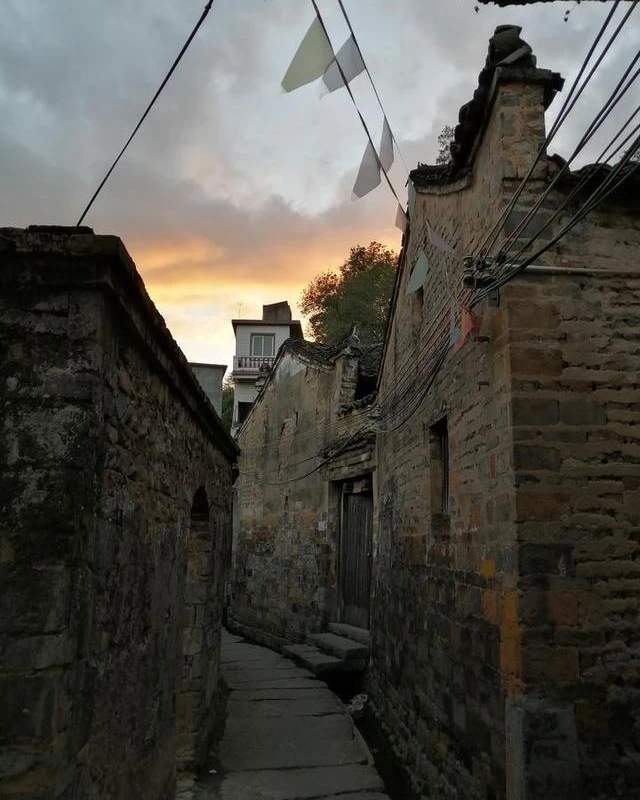
This ancient village in Guanyang County, Guilin, has a drainage system that even modern cities can't match—very advanced
Tai Chi Well, also called Snail Well.
This is a pond beside an old house.
Moon Ridge ancient dwellings in the sunset.
Walking in Moon Ridge ancient dwellings, I discovered a unique Tai Chi Well with a history of over 200 years. Text and photos by Liu Guoxiong.
During the National Day road trip, the first stop was Yueling Village in Guanyang County, Guilin. Some of the ancient dwellings here are quite well preserved.
On the evening of October 3, I strolled through Moon Ridge ancient dwellings along long, winding bluestone slab alleys. Suddenly, I found a pond inside a blue brick gate, surrounded by wooden railings. It did not lead to any household; the walls of surrounding houses enclosed it, giving the impression that the houses were built over water. The reflections of the southern Hunan-style dwellings shimmered in the pond. It was just sunset, and the atmosphere was truly serene and beautiful. But the question arose: what was this pond used for? Was it to ward off evil spirits, or for fire prevention? Was it for fish farming, or part of the village's water system?
Apart from the ancient dwellings, there were several old wells. One of the more famous ones is called Tai Chi Well. As we walked on, we saw this well. A villager over 70 told me that because it has twelve spiral steps leading down, resembling a snail, it is also called Snail Well. The well was originally built in the 12th year of the Qianlong reign of the Qing Dynasty (1747) and rebuilt in the 11th year of the Jiaqing reign (1806). In the 21st year of the Jiaqing reign (1816), a stone tablet titled "Record of the Restoration of Tai Chi Well" was erected inside the well. The inscriptions are still clearly legible. The old man said the well water is now used for washing clothes.
Later, we saw two more large wells, which are also likely used by villagers for washing clothes. Thinking about the smooth, orderly bluestone slab roads with open drains along the way, all of this must form the village's advanced drainage system. It is said that the village has experienced no flooding or drainage blockages for hundreds of years. This is truly something that even modern cities cannot rival.
Continuing on, we found a large mansion. Unfortunately, it was getting dark, so I couldn't take photos. We walked to the back of the village and saw that the village was quite large, so we decided to come back the next morning to explore further, especially since we also wanted to go up the back hill.
In Moon Ridge ancient dwellings, there are open drains beside the bluestone slab paths.
Inside the archway, it's a hidden paradise.
There was originally a pond inside.
The railings are all new; presumably they were not there before.
I can't figure out what this pond was used for.
I happened to see the sunset, but unfortunately there were new houses in the background.
The shape of the sunset was very beautiful.
Continuing on, there were still open drains for drainage.
This is a stone slab used for washing clothes.
Looking back, seeing the stone slab, you know there is a water source.
Sure enough, behind this wall is a well.
This is the famous Tai Chi Well.
It is named for its shape, resembling both a tai chi diagram and a snail.
An old villager passed by and told us that this well has a history of over 200 years and is used for washing clothes.
The ancient well is protected by a wall.
The tile eaves behind the wall are very beautiful.
These are all old houses here.
This should be one of the six major courtyards of Moon Ridge ancient dwellings. The characters "万岁" (long live) on the wall are still clearly visible.
Unfortunately, it got dark, so I couldn't examine it carefully.
Found two more wells, along with stone basins for washing clothes.
On the hillside behind the village.
This is a century-old tree.
Villagers are drying rice here.


![Mountains and Waters Meet Again [Guilin Yangshuo] Let's Rock the Boat of Friendship](/img/624178c28a221adb_s.webp?src=https%3A%2F%2Fdimg04.c-ctrip.com%2Fimages%2F0104n120009cnhkrdD720_W_320_0_Q80.jpg)


