Self-Drive: From Guangdong All the Way to Fanjing Mountain
Foreword:
Fanjing Mountain—a pure land of Brahma, has always been a sacred place I dream of. I planned to go in the autumn of 2019, but while preparing the itinerary, I learned that the Red Cloud Golden Summit was closed for maintenance. So I decided to wait until the next spring when the azaleas bloom. However, in the spring of 2020, the COVID-19 pandemic raged, becoming another obstacle to my visit to Fanjing Mountain. Finally, when the autumn weather was crisp and the virus was under control, people started to travel again. Thus, our trip began. Considering the high risk of infection on public transportation, the four of us decided to take a self-driving tour. The itinerary is as follows:
Day 1: Jiangmen - Xing'an County, Guilin; visit Xing'an Water Street
Day 2: Xing'an - Ziyuan County, Guangxi; visit Lingqu Canal and Ziyuan River Lantern Scenic Area
Day 3: Ziyuan - Langshan Scenic Area; visit Tianyi Alley and Zixia Cave
Day 4: Langshan Scenic Area; visit Bajiaozhai and La Jiao Feng (Pepper Peak)
Day 5: Langshan - Zhenyuan Ancient Town, Guizhou; visit Zhenyuan Ancient Town
Day 6: Zhenyuan - Tongren Shiqian - Fanjing Mountain; visit Shiqian county town, soak in Laotang Hot Spring, and Zhaisha Dong Village
Day 7: Visit Fanjing Mountain
Day 8: Visit Yamugou and Yunshe Village
Day 9: Visit Zhusha Ancient Town and Miao King City
Day 10: Tongren - Border Town Scenic Area; visit Border Town
Day 11: Border Town - Furong Town, Hunan; visit Shibadong Village, Aizhai Bridge, and Furong Town
Day 12: Furong Town - Fenghuang Ancient Town; visit Fenghuang Ancient Town
Day 13: Fenghuang Ancient Town - Yongzhou, Hunan; visit Yongzhou Ancient Town
Day 14: Yongzhou, Hunan - Ningyuan County; visit Yongzhou Dongshan Scenic Area and Ningyuan County town
Day 15: Visit the Jiuyi Mountain Scenic Area (Shun Emperor's Mausoleum, Zixia Rock), and Xiaguan Village (the first village of mahjong)
Day 16: Ningyuan County - Jiangmen; return to the warm home
Day 1 (October 16, sunny to cloudy, 33°C/16°C): Jiangmen - Xing'an County, Guilin; visit Xing'an Water Street
At 7 am, we set off towards Xing'an County, Guilin, under the brilliant morning glow. The total distance was about 600 km, and the road conditions were good. As we entered Guangxi, the sky turned overcast. Upon arriving in Xing'an, we checked into the Xiwu Boutique Hotel. The first feeling in Xing'an was coolness, even cold! The local temperature was only 16°C, while it was 33°C when we departed. After dropping off our luggage, we started the first stop of our trip: Xing'an Water Street (free admission).
Guilin Xing'an Water Street refers to a section of the ancient Lingqu Canal that runs through Xing'an county town, commonly called Water Street, about 1 km long. The Water Street scenic area consists of five parts: ancient architecture culture, ancient bridge culture, ancient stone and wood carving culture, Lingqu history and culture, and Lingnan market customs. It is a unique historical and cultural street in Guangxi that inherits Qin and Han culture while blending Central Plains Han culture with Lingnan Baiyue culture. Entering Water Street, we were陶醉 by its rich cultural atmosphere. Everywhere we saw mirror-like clear water, towering ancient trees, pavilions, rockeries, weeping willows, small bridges and flowing water, couplets and inscriptions, literary charm, and market customs, vividly recreating a thousand years of history, as if we were strolling leisurely in ancient times...
The Qin Imperial Palace is the entrance to Water Street, evoking a sense of ancient Qin dynasty history. According to historical records, after the unification of the Central Plains, Emperor Qin Shi Huang sent 500,000 troops south in five routes to conquer the Baiyue tribes. The Qin army at Yuechengling was stubbornly resisted by the Yue people, and due to the steep mountains and impassable waterways, the supply of military grain was cut off, putting them in trouble. In 217 BC, Shi Lu was ordered to build a dam at the closest point between the Xiang River tributary Shuangnvjing Creek and the Li River tributary Shian Water in what is now Xing'an County, opening a canal linking the Xiang and Li rivers, connecting the Yangtze River and Pearl River systems—the Lingqu Canal.
The street-side shops on Water Street have an ancient feel.
Water Street has many bridges, the famous ones being Niangniang Bridge, Wanli Bridge, and Masi Bridge. Niangniang Bridge, also known as Tianhou Bridge or Canglang Bridge, was first built in the 7th year of Kangxi (1668) and rebuilt in 2004. It has double pavilions on the bridge, and the name was inscribed by the great Qing calligrapher He Shaoji.
Wanli Bridge: Built in the 1st year of Baoli of Tang Dynasty (825) by Li Bo, the inspector of Guiguan Circuit. It is named because it was said to be 10,000 li (5,000 km) by water from the Tang capital Chang'an. It is the oldest stone arch bridge in Guangxi, with a history of exactly 1,200 years. Historically known as the "Key Passage between Chu and Yue", the bridge pavilion was rebuilt in 2004. On the south bank, there are two steles: one with the article "Record of Wanli Bridge" written by Wu Yu of the Ming Dynasty, and another with the inscription "Wanli Rugui" (ten thousand li like returning home).
Masi Bridge: It is said that this spot originally had a small wooden bridge. When Ma Yuan led his troops south to pacify Jiaozhi, his horse reared and neighed, refusing to cross. Ma Yuan dismounted and found the bridge rotten, so he raised funds to rebuild it, a story passed down through the ages, hence the name. Originally two parallel bridges crossing the Lingqu Water Street north-south road, in 2004 it was rebuilt, adding a connecting bridge across the Lingqu, creating a spectacle of "three bridges spanning two waters". The bridge pavilion is in Han dynasty architectural style.
These ancient wood carvings tell ancient stories.
Xing'an: The birthplace of Guilin rice noodles!
Clear, murmuring water, weeping willows, small bridges and flowing water—the people of Xing'an on both sides of the river guard this peace and happiness.
Ancient Stage: Also called Tianyun Pavilion, located at the intersection of the county center square and Water Street, 12 meters high, divided into two floors, with performances above and pedestrians below, in Anhui-style architecture. This stage echoes Wanli Bridge and is a good place for residents to relax and watch operas.
Walking through the entire Water Street, I couldn't help but deeply sigh: the ancient and tranquil waterway, the bridges from north to south, must have recorded countless touching stories and glorious times. Water Street has a unique artistic conception, a unique ancient tranquility and harmony. The most beautiful thing about Water Street is the water. The water winding out from the ancient Lingqu Canal is like a green ribbon, pulsating with the thousand-year charm of the Qin dynasty, carrying modern people's pursuit of ancient style, flowing out the magical ancient charm of Water Street.
Day 2 (October 17, overcast, 20°C/12°C): Xing'an - Ziyuan County, Guangxi; visit Lingqu Canal and Ziyuan River Lantern Scenic Area
After breakfast, we hurried to visit the Lingqu Canal (ticket 45 yuan, half price for 60+). The Lingqu was built by Qin Shi Huang in 214 BC for the unification of China. It has a history of over 2,000 years and is one of the oldest canals in the world, known as the "Pearl of Ancient Water Conservancy Projects". It flows from east to west, connecting the Haiyang River in the east of Xing'an and the Darong River in the west. The Lingqu, together with Dujiangyan and Zhengguo Canal, are known as the "Three Major Water Conservancy Projects of the Qin Dynasty". In 2011, the application for World Cultural Heritage status was initiated, and finally in 2018, the Xing'an Lingqu was inscribed on the "World Heritage Irrigation Structures" list. The Lingqu is 34 km long. Everywhere it pleases the eye. The design and construction of the canal's head, the Hua Zui (plow mouth), and the 36 dams of the Big and Small Balance are breathtaking.
Since Xing'an is the birthplace of Guilin rice noodles, we had to taste them for breakfast.
The herringbone dam of Lingqu.
We took a boat around the Hua Zui and then climbed onto it to watch. (Boat rental fee: 80 yuan)
The herringbone dam of Lingqu.
Ancient level measuring instrument.
Ancient Tree Swallowing Stele: This spectacle is one of the "Three Unique Steles" in the Four Worthies Shrine, and also a wonder of the world. A 780-year-old chongyang tree is swallowing a stele from the 12th year of Qianlong (1747). The tree continues to swallow the stele at a rate of 1 cm every 3 years. Perhaps in 200 years, people will no longer see this Qianlong stele.
Feilai Stone: Legend says this stone flew from Mount Emei in Sichuan. During canal construction, a pig demon caused trouble, destroying the dam during the night after it was built during the day, causing delays. Workers were killed and laborers suffered. The Flying Crane Immortal flew a cushion stone from under his seat to suppress the pig demon, and the dam was finally completed.
Xing'an Lingqu Exhibition Center is located across the road from the Lingqu entrance.
There are many Hunan cuisine restaurants in Xing'an. We had lunch with Hunan dishes. The spicy chicken was made with mild spiciness and tasted very good.
After lunch in Xing'an, at 3 pm we arrived at Ziyuan County, Guilin, and checked into the City Express Hotel. The hotel is located in the center of the Zijiang Lantern Valley Scenic Area, convenient for sightseeing. During a leisurely walk in the afternoon, we found few tourists, quite quiet. The scenic area is newly built, designated as a national AAAA-level tourist attraction by the Guangxi Tourism Resources Planning and Development Quality Rating Committee in November 2018. On the wide embankment of the Zijiang River, there are many elegant pavilions, towers, and covered corridors. The long corridor centers on the theme of river lantern culture, decorated with various colorful lanterns. At dusk when the lights come on, many citizens come to the scenic area for walks and dancing. Many tour groups arrived at that time, coming for the Zijiang Lantern Valley. At night, there is a dazzling light show. The entire scenic area is brightly lit with melodious music. A brilliantly illuminated ancient city appears in the night sky. You can also enjoy unique ethnic performances and personally experience the folk custom of releasing river lanterns. It was a very fun activity, and everyone enjoyed it! It was completely free!
Day 3 (October 18, light rain to overcast, 16°C/10°C): Ziyuan - Langshan Scenic Area; visit Tianyi Alley and Zixia Cave
At 7:30 am, we left Ziyuan County for Langshan Scenic Area in Xinning County, Shaoyang, Hunan. We arrived at Wucun Village in Langshan Town at 9 am and checked into Jingxiangju Guesthouse. After settling in, we decided to visit in the rain. Langshan is a typical Danxia peak forest landform, a scenic treasure known for its beautiful water, mountains, and caves. Langshan Scenic Area has six major scenic spots: Tianyi Alley, La Jiao Feng, Bajiaozhai, Zixia Cave, Fuyi River, and Tiansheng Bridge. Among them, the famous "Six Wonders of Langshan" are world wonders located in these six areas. You can buy tickets for any scenic spot. We bought B-ticket for 136 yuan + 5 yuan insurance (half price for ages 60-65), covering Tianyi Alley, La Jiao Feng, Bajiaozhai, and Zixia Cave, valid for 3 days. According to the plan, we would spend two days at Langshan. First, we visited Tianyi Alley scenic area in the rain. Langshan's first wonder is the No.1 Alley under Heaven, located in Tianyi Alley, 238.8 meters long, with stone walls 120-180 meters high, the widest part 0.8 meters, the narrowest 0.33 meters—a world-class skyline wonder. In 2009, it was listed by the World Record Association as the First Alley under Heaven, setting a world record. It took us about 15 minutes to struggle through the narrow stone crevice—Tianyi Alley—seeing only the sky. Going through it, we realized that losing weight was urgent! The narrow and steep stairs of Yuxian Alley were also a thrilling test of physical strength. We spent 3.5 hours in this scenic area.
Ready to enter Tianyi Alley.
This is Langshan's first wonder: No.1 Alley under Heaven, 238.8 m long, walls 120-180 m high, widest 0.8 m, narrowest 0.33 m—a world-class skyline wonder.
Yuxian Alley in Tianyi Alley scenic area: This alley is wider than Tianyi Alley by one person's width, so you can turn around easily, but we didn't meet any immortals.
Yuxian Alley: 178 m long, average width 2.1 m, wall height over 60 m. On sunny days at noon, sunlight cuts into the alley at an angle, creating a strange spectacle of distinct yin-yang and light-dark contrast. Legend says that Yang Zaixing, a famous anti-Jin general, got lost here as a youth and was guided by an immortal, hence the name.
Qicenglou (Seven-Story Building) scenic spot in Tianyi Alley.
After lunch, we visited Zixia Cave scenic area. This "dong" is not a cave; Zixia Cave is a winding, secluded gorge. Because of the surrounding reddish-brown bare cliffs, when the setting sun shines, it radiates myriad rays of purple light, hence the name. The weather was bad today, so we couldn't see the purple mist rising. Zixia Cave scenic area includes over twenty scenic spots such as Zixia Palace, Wanjingcao, Ziwei Peak, Honghua Chibi, Wuyun Stockade, Liu Guangcai's Tomb, Zixia Xuan, Xiangbi Stone, and Hongwa Mountain. Since we were tired from Tianyi Alley, we didn't climb to the top and finished in two hours. Seeing that it was still early and the rain had stopped, we drove to the Fuyi River to gaze at General Stone.
Ziwei Peak in Zixia Cave: Due to differences in lithology of Danxia rock layers, it was formed by various geological processes such as water erosion, gravity collapse, and spherical weathering along rock fractures. It looks like an elephant protecting Buddha or a sharp knife suppressing demons, with exquisite and realistic shapes.
Zixia Palace, originally built during the Jiajing period of Ming Dynasty, was a Buddhist holy site in southwestern Hunan. The rebuilt ancient temple houses a 6-meter-tall Guanyin Bodhisattva, the second largest Buddha statue in Hunan after Nanyue. Throughout history, countless pilgrims came to burn incense and pray, making it very famous. (Closed due to disrepair.)
Danxia collapse cave: Xiangquan Cave.
Naturally piled up by Danxia collapse rocks of various sizes and shapes, about 20 m long, 4-5 m high, such a natural through cave formed in a "rock pile" is a rare collapse geological relic.
Langshan's third wonder is General Stone: Located in Fuyi River scenic area, 399.5 m above sea level, the stone pillar is 75 m high, 40 m in circumference. Viewed from afar beside the Fuyi River, General Stone stands against the blue sky, overlooking the river with head held high, like a mighty general. We stood by the river, gazing at General Stone.
Day 4 (October 19, overcast, 17°C/13°C): Langshan Scenic Area; visit Bajiaozhai and La Jiao Feng
Early in the morning, we were awakened by the chirping of birds and crowing of roosters. The early bird catches the worm, and today we witnessed it. The persimmon tree in the guesthouse courtyard was full of yellow persimmons, and a group of birds were having a persimmon feast without hesitation. The landlady brought a tool for picking persimmons, and we had fun picking them ourselves. The persimmons we picked were sweet to the heart. The landlady was very generous and gave us a large basket of persimmons to eat on the road. Thankful!
Look, how happy T and Sister C were picking persimmons!
The persimmons we picked ourselves are really sweet!
There was a little episode this morning. Our main destination for this trip was Fanjing Mountain, so we paid special attention to its weather forecast. Every step forward brought us closer to Fanjing Mountain. The forecast said October 22 would be sunny. According to the official website of Fanjing Mountain Ecological Tourism Zone, the number of visitors each day is limited, and real-name, time-slot reservations are required. Tickets must be booked three days in advance, so we needed to book online at 8 am today. At 7:55, we logged into the Fanjing Mountain website for quick purchase, but the screen kept showing "queuing". At first, we thought it was normal, believing that many orders were flooding in and the backend needed time to process. But after half an hour, the tickets for the first two time slots were already sold out. We became anxious and immediately tried to contact the Fanjing Mountain official website, but couldn't get through. What to do? We quickly sought help from the guesthouses we had preselected near Fanjing Mountain. The first call was unanswered, but the second finally connected. The owner of Xiaohe Holiday Guesthouse told me to log out and re-enter immediately. Following his guidance, I successfully booked tickets for the 10-11 am time slot on October 22. That is, we obtained a pass to visit Fanjing Mountain on the 22nd. Although we could only book the third time slot, it was still a morning ticket, and we were very happy. It seemed we had a connection with Xiaohe Holiday Guesthouse, so we booked our accommodation there for the nights of the 21st and 22nd.
Today, although it wasn't raining, the sky was not clear. At 10 am, we arrived at Bajiaozhai scenic area in Langshan and took the cable car up (cable car one-way ticket 55 + 5 yuan insurance). The mountain was shrouded in mist and clouds, with low visibility. Langshan's second wonder is "Whales Playing in the Sea", located in Bajiaozhai. We tried hard to find the little whales: looking down into the valley, floating clouds and misty, strange peaks and rocks vaguely resembled thousands of whales frolicking in the sea. Bajiaozhai is a national 4A scenic area, covering 125 square kilometers, with the main peak at 818 meters above sea level. It gets its name because the main peak has eight protruding corners. This scenic area is co-owned by Guangxi (Guilin) and Hunan (Xinning County), and visitors from both sides meet at the summit. Bajiaozhai is characterized by large, round, dense Danxia peak clusters and peak forest landform. It is praised by domestic and foreign scholars as "the outstanding representative of mature Danxia peak cluster and peak forest landform" and "the model of main types and basic characteristics of China's Danxia landforms". It is known as "the soul of Danxia, the treasure of the nation". Major attractions include Bajiaozhai, Longmen, Bazhang Rock, Yuntai Temple, Longtou Xiang, Whales Playing in the Sea, Yixian Tai, and Yaowang Hall. We started walking down at 12 pm. The scenery along the way was beautiful, allowing us to view the Danxia peak clusters from different angles up close. It took an hour to reach the foot of the mountain.
At the exit of the cable car is a viewing platform. We were greeted by a sea of mist and mountains, strange peaks and rocks. I thought of the famous poet Ai Qing's praise of Langshan: "Guilin's landscape is the best under heaven, but Langshan's landscape rivals Guilin."
Standing on the summit and looking into the distance: on one side are the Danxia peaks of Xinning, Hunan; on the other side are those of Ziyuan, Guangxi. Of the eight peaks extending in all directions, six are in Hunan and two in Guangxi. Visitors from both provinces meet at the summit. Personally, I think the view of the Guangxi side from the summit is more impressive.
Yuntai Temple is named for its "sea of clouds supporting the sun, looking like a lotus platform". It was first built in the late Northern Song Dynasty and expanded during the Jiajing period of Ming Dynasty, with a history of over 1,100 years. The temple's bells ring continuously, incense is perpetual, and followers come from Hunan, Guangxi, Sichuan, and Guizhou. It is known as one of China's "Twelve Famous Buddhist Mountains".
Bajiaozhai, also called Yuntai Mountain, consists of separate but connected rock masses, with peak elevations from 450 m to 818 m. The valleys between peaks are often narrow U-shaped or V-shaped. The peaks are characterized by "sloping tops, steep bodies, and gentle bases", appearing as square mountains, stone walls, stone pillars, steep cliffs, or relatively smooth conical or tower shapes. Like castles and trenches hiding thousands of troops ready to strike, they are grand and inspiring.
The area is often shrouded in thick mist, with strong mountain winds. Surrounding cliffs are perilous, and deep valleys drop away. On the extremely dangerous protruding corner, there is a small temple to the mountain god. The ridge path leading to the dragon's head is only one foot wide; worshippers must crawl on hands and knees. This is the famous "Longtou Xiang" (Dragon Head Incense). It is thrilling! Only the brave and sincere dare to burn incense on the "dragon head".
In the misty sea of clouds, the undulating mountains and hundreds of reddish strange peaks and rocks rising from the ground look like a group of giant whales frolicking, sometimes swallowed by clouds, sometimes revealing their heads and tails, hence the name "Whales Playing in the Sea".
Walking down the mountain, you can touch the reddish strange peaks and rocks up close.
Looking into the distance, the peaks that looked like whales playing in the sea from above are tall and majestic.
From the foot of the mountain, looking up at the cable cars, they look like colorful balloons hanging in mid-air.
For two days in Langshan scenic area, we had lunch at the same farmhouse restaurant, eating sour fish soup. Perhaps due to the good water quality, the fish was fatty, tender, and delicious!
After lunch, we visited La Jiao Feng scenic area. Langshan's fourth wonder is Camel Peak, located in La Jiao Feng area—the peak is 187.8 m high and 273 m long, with two depressions forming the camel's head, back, and tail, very lifelike. The sixth wonder is Pepper Peak, also in the same area, 180 m high, with a large head and small feet, resembling a huge pepper. Before the trip, I learned from my research that Pepper Peak itself is not very special; it is recommended to climb Camel Peak and view Pepper Peak from a distance. So we just checked in at Pepper Peak and headed straight for Camel Peak. In the afternoon, the sky cleared up a bit. Climbing to the top of Camel Peak, we looked far into the distance and felt we could see the whole universe. All the red rocks formed a scene of "lotus emerging from the ground, steep cliffs pointing to heaven", refreshing the mind. The undulating Danxia peaks, well-arranged Danxia summits, exquisite Danxia bodies, and rough Danxia cliffs complemented each other with simplicity and firmness. Along the way, we viewed Pepper Peak from different heights and angles, admiring this huge red pepper, commonly known as "Immortal Pepper Drilling into the Ground", very lifelike.
Check-in at Langshan's sixth wonder—Pepper Peak: 180 m high, with a large head and small feet, like a huge pepper.
Langshan's fourth wonder—Camel Peak: Composed of four stone peaks forming head, body, back, and tail, well-proportioned and very lifelike. Camel is 273 m long and 187.7 m high.
Candle Peak: Like a red candle pointing straight into the sky, 199 m high, 400 m in circumference, with a conical top and cylindrical body, steep cliffs all around, red cliffs, tall and majestic. It is a rare and unique Danxia landform.
Walking on Camel Peak, viewing Pepper Peak from various angles.
We walked on the camel's back.
Holding the big pepper in hand! Is this pepper big enough?
We were getting farther away from Pepper Peak.
The dynamic Danxia peaks, ancient village houses, traditional farming activities, and idyllic countryside scenery blend harmoniously, creating a beautiful picture of harmony between man and nature.
A word about the Jingxiangju Guesthouse in Langshan Town where we stayed for two nights: it was quiet, clean, and most importantly, the landlady cooked delicious meals, giving it a homey feel.
One chicken prepared two ways with fresh farm vegetables was enough to satisfy our stomachs.
Day 5 (October 20, light rain to overcast, 13°C/10°C): Langshan - Zhenyuan Ancient Town, Guizhou; visit Zhenyuan Ancient Town
Because today's destination was Zhenyuan Ancient Town, far away (nearly 400 km), we left Jingxiangju at 7:15 am after a full breakfast. The landlady also prepared a large bag of dry food for us to eat on the road. At 12:30 pm, we arrived smoothly in Zhenyuan and checked into a river-view room at Yuanteng Theme Inn outside the ancient town, not far from the New Bridge. The ancient town does not allow cars. Sitting on the balcony, we could see Zhenjiang Pavilion, Shiping Mountain, and boats coming and going on the Wuyang River—green mountains and clear water, very beautiful.
In the autumn of 2016, I first visited Zhenyuan Ancient Town (see travel notes "Leisurely Travel in Guizhou"). This time was a revisit. In my previous travel notes, I said I fell in love with this ancient town and would often come as a guest. And today, I really came again! One reason for coming here was that it is on the way to Fanjing Mountain; the main reason was to rest. After climbing Langshan for two days, we were very tired.
Zhenyuan, located on the banks of the Wuyang River, surrounded by mountains, with the river winding through the city in an "S" shape. The north bank is the old Fucheng (government city), and the south bank is the old Weicheng (garrison city). From afar, it looks like a Tai Chi diagram. The mountains are the same, the water is the same, the ancient houses are the same, but they are used more for commerce now. Four years later, there are many more tourists, many hotels and inns, the bus fare has risen from 1 yuan to 2 yuan (deservedly, as national income has significantly increased). The night scenery is more beautiful with twinkling lights. The climbing path on Yuping Mountain is now lit at night, making it convenient for visitors to climb to the top and overlook the "S"-shaped Wuyang River and the night view of Zhenyuan Ancient Town. In a word, it has become more commercialized. No matter how it changes, I am still fascinated by the ancient architecture of this town.
This Huang Family Courtyard was where I stayed when I first came four years ago. Through this gate, let's get to know the "crooked doors and slanted paths". This is a unique feature of Zhenyuan's ancient residences: the gates of houses on small alleys are never parallel or perpendicular to the alley, and the alley is never directly opposite the main hall. The door is intentionally slanted towards the street. Old residents say this follows Feng Shui principles—"respecting the south as the honored direction" signifies wealth, and also has the implication of "not revealing wealth". It makes it difficult for passersby to see the owner's status, seeking safety.
The ancient alleys of Zhenyuan made me linger. These alleys have the quietness of Beijing's hutongs but without rigid rules; they have the water town beauty of Jiangnan lanes but without flat layouts; they have the style of Chongqing's "mountain alleys" but without the noise of the city. These alleys can take you back to Zhenyuan of 50, 100, 300, or 600 years ago, recreating the town of Ming and Qing dynasties.
Fu Family Courtyard, also called "Liangbi Mingjia", was built during the Jiaqing period of the Qing Dynasty. It was the official residence of a good minister who assisted the emperor. It has been lived in by the Fu family descendants since then and is the only well-preserved ancient house in Zhenyuan passed down through generations. Notice the door: typical "crooked door and slanted path".
Tired from walking in the ancient alleys, we could taste Zhenyuan snacks: soft, delicate, sweet or salty tofu pudding.
The Qinglongdong (Green Dragon Cave) ancient building complex is located on one side of Zhonghe Mountain in the ancient town, consisting of six parts: Zhusheng Bridge, Qinglongdong, Wanshou Palace, Ziyang Academy, Xianglu Rock, and Zhongchan Temple. It is large-scale and exquisitely constructed, a famous scenic spot in Zhenyuan with high tourism value. Four years ago, the night scenery here was beautiful. This time, the lights were off. Upon inquiry, because the buildings are wooden structures, to prevent lightning fires, they do not turn on colorful lights at night.
Zhusheng Bridge is the landmark of Zhenyuan Ancient Town, locally known as the Old Bridge.
Zhusheng Bridge is a seven-arch blue stone arch bridge. In the center of the bridge, there is a three-story, three-eave, octagonal pyramid-roofed pavilion called "Zhuangyuan Tower" or "Kuixing Pavilion". It is said that ten years after the pavilion was built, Guizhou produced two top scholars for the first time.
The Fucheng and Weicheng ruins: Guizhou has a saying, "Anshun's memorial arches, Zhenning's city walls." In fact, Zhenyuan's Ming dynasty city walls are no less impressive. Both Fucheng and Weicheng were built in the Ming dynasty, following the mountain contours. Fucheng stands on the steep top of Shiping Mountain, 1.5 km long; Weicheng crosses Wulao Mountain in the south and faces the Wuyang River in the north, 3 km long. The Wuyang River serves as a natural moat for both cities, making Zhenyuan Ancient Town particularly imposing. Even today, locals still call the north bank "Fucheng" and the south bank "Weicheng". The Fucheng ruins on the north bank are relatively dilapidated but genuine; the Weicheng ruins on the south bank are more regular and grand, later restored.
The most distinctive food in Zhenyuan is the red sour soup. This time, we wanted to taste the rice noodles here, and there was a surprise: the noodles were smooth and chewy, and whether with beef or lamb, the broth was rich and the meat was savory.
Day 6 (October 21, overcast to sunny, 21°C/11°C): Zhenyuan - Tongren Shiqian - Fanjing Mountain; visit Shiqian county town, soak in Laotang Hot Spring, Zhaisha Dong Village
To avoid traffic restrictions in Zhenyuan Ancient Town, we left at 7:15 am and arrived at Shiqian County, Tongren, Guizhou at 8:30 am. This small county town began to surprise us from a bowl of pot-sticker rice noodles.
We had breakfast at a restaurant across the street from this building.
We tasted Shiqian's lamb pot-sticker rice noodles, lamb mung bean noodles, and lamb steamed rice noodles for the first time. The chewy noodles paired perfectly with the lamb broth, incredibly delicious. After eating the noodles, we even finished the tasty soup!
We knew very little about Shiqian before, only that it was a mountain town not far from Fanjing Mountain, with hot springs. But walking on the land of Shiqian, the natural scenery along the river, the clean and ancient houses, the multi-ethnic treasure land, the humid and fresh air, and the long history all made us want to understand this quiet ancient city. In the 28th year of Qin Shi Huang (219 BC), Ye County was established in the western part of the current county, belonging to Xiang Commandery. In the Han Dynasty, it belonged to the Yelang Kingdom. This was the ancient Yelang Kingdom. There are many cultural relics. The Chinese Workers' and Peasants' Red Army passed through Shiqian twice during the Long March. Revolutionary relics include the "Former Site of the General Headquarters of the Second and Sixth Red Army Corps - Shiqian Catholic Church", which is a provincial protected cultural relic. There are also ancient building complexes such as Wanshou Palace, Wen Temple, and Shiqian Old Bridge. If time permits, a detailed visit to Shiqian is a good choice. It is a virgin land for independent travel, with few tourists, and the locals go about their daily lives. Everything here is so peaceful and harmonious.
Shiqian county town is located on both banks of the Longchuan River. Since the Wanli period of the Ming Dynasty, town bridges have been built. As of 2011, the urban area had 9 bridges with a total length of 1298.7 m.
Qiling Bridge is located on the Longdi River in the northwest of the city. In the 10th year of Wanli of Ming (1582), Prefect Yuan Liang built stone piers and wooden beams for crossing, naming it "Qiling Bridge". In the 20th year of Qianlong of Qing (1755), Prefect Shi Ting'ai advocated fundraising to change it into a stone arch bridge, which took 7 years to complete. In the 1st year of Tongzhi (1862), floods destroyed three arches on the west bank. In the 4th year of Guangxu (1878), Prefect Chen Zhu'an and Xiahua advocated fundraising for restoration.
The water of Shiqian River is crystal clear.
Quandu Bridge: Located in the city center, spanning the Longchuan River, 309.74 m long, with a maximum span of 110 m, width 15 m (9+3×2).
On the Shiqian River, ancient and modern bridges and houses silently tell stories of old and modern civilization.
A cat, a fishing rod, an old partner. Enough...
In Shiqian, many houses have workshops making handmade bitter buckwheat noodles. The entire street along the river is drying noodles. The noodle aroma is so tempting! This grandmother is over eighty years old, very kind and talkative. She said she has been making noodles all her life and enjoys her current life.
The market next to Yuwang Palace had abundant vegetables and relatively cheap prices.
During our trip, we saw for the first time a girl doing live-streaming sales in the farmers' market. The civilization of the ancient city! Must give a thumbs up.
Yuwang Palace: Located on the north side of Wanshou Road, Tangshan Town, Shiqian County, within walking distance in the county town. Also known as Huguang Guild Hall. Facing south. First built in the 16th year of Wanli of Ming (1588). Renovated and expanded in the 55th year of Kangxi of Qing (1716), the 45th year of Qianlong (1780), and the 20th year of Jiaqing (1815). Symmetrical layout, including a memorial arch-style gate, stage, side halls, crossing hall, bell and drum towers, main hall, etc. Covers an area of about 1540 square meters, building area 1428 square meters. Free admission.
Shiqian's "Wanshou Palace" is a public building built by Jiangxi merchants outside their province. It is also called Jiangxi Guild Hall or Yuzhang Guild Hall, located on Chengbei Road, Shan Town, Tongren Prefecture, within walking distance in Shiqian county. The Wanshou Palace was first built in the 16th year of Wanli of Ming (1588) and renovated in the 32nd year of Qianlong of Qing (1767). It has a strict layout, grand project, unique design, exquisite planning, and sophisticated architecture, ranking first among similar buildings in the province. In 1984, it was listed as a county-level key cultural relic protection unit and partially repaired. In 1985, it was listed as a provincial-level key cultural relic. In 2001, it was listed as a national key cultural relic protection unit by the State Council. (Not open)
Fu Wen Temple (Prefectural Confucian Temple) is located on Yuecheng Road in the southeast of Shiqian county, within walking distance. The Shiqian Fu Wen Temple was first built in the 11th year of Yongle of Ming (1413) by Prefect Li Jian. It was built in the same year as the establishment of the prefecture, hence the name. It is a national key cultural relic protection unit.
The Fu Wen Temple, also known as the School Palace, covers an area of 1958.4 square meters. Built against the mountain, the foundation rises from west to east, forming a three-courtyard layout, majestic, with strict layout and grand scale. (Free)
Shiqian Catholic Church is located in Shiqian County, Tongren City, Guizhou. It was built in the 27th year of Guangxu of Qing (1901). The church is a brick-wood structure with a memorial arch-style main facade and herringbone gable walls, a Catholic church with strong Chinese characteristics. In 1936, when the Second and Sixth Red Army Corps passed through Shiqian during the Long March, the general headquarters was set up here. During the Republic of China period, smallpox and malaria were highly prevalent in Shiqian, and Western medicine was more effective than traditional Chinese medicine. The Catholic Church purchased medicines from Shanghai, Wuhan, Chongqing, etc., and provided free treatment to locals, saving many lives, making a great contribution to the people of Shiqian.
Former Site of the General Headquarters of the Second and Sixth Red Army Corps, a provincial-level cultural relic protection unit in Guizhou.
Shiqian Intangible Cultural Heritage Museum (free)
The museum covers an area of 900 square meters. It uses modern technologies such as sound, light, and electricity to perfectly reproduce Shiqian's well-protected intangible cultural heritage projects, fully demonstrating the essence and charm of Shiqian's intangible cultural heritage. It is also the first comprehensive county-level intangible cultural heritage museum ever built in the province. Shiqian's long historical and cultural accumulation has given birth to three national intangible cultural heritages: puppet show, Gelao Mao Dragon, and Shuo Chun, as well as nine provincial intangible cultural heritages represented by "Qiaoqiao Nian" (Quiet New Year). You can learn about these splendid Shiqian cultures here.
For lunch, we had an all-you-can-eat beef offal hot pot at a restaurant near Yuwang Palace in Shiqian, 25 yuan per person. It was cheap and delicious! The offal was cooked just right and the flavor was pure. We tasted tofu made with sour soup for the first time. It had a strong bean flavor with no sourness at all. It was the best tofu I have ever eaten. Everyone praised it and recommended it.
Shiqian Ancient Hot Spring is one of the oldest hot springs in China, with a history of over 400 years.
We soaked in the old hot spring for a full two and a half hours, very comfortable. (Ticket 248 yuan for two, booked on Ctrip as a couple ticket)
At 4:45 pm, we left Shiqian for Zhaisha Dong Village, arriving at 6:30 pm. On the way, we saw a brilliant sunset glow, which gave us a beautiful anticipation—tomorrow would definitely be a sunny day.
Zhaisha Dong Village is located on the banks of the Taiping River at the foot of Fanjing Mountain. It is a natural Dong ethnic village in Jiangkou County, Tongren City, Guizhou, 15 km from Jiangkou county town and 2 km from the gate of Fanjing Mountain scenic area. It has beautiful natural scenery and strong Dong customs, especially the unique ethnic charm of Dong stilted houses, making it a bright landscape under Fanjing Mountain. Many tourists visiting Fanjing Mountain like to stay here.
At dusk, a bonfire was lit in the drum tower, and villagers gathered around to chat. It is said they often dance around the bonfire.
We were getting closer to Fanjing Mountain. At 8 pm, we checked into Xiaohe Holiday Guesthouse at the foot of Fanjing Mountain. The owner asked us to sleep early and rise early. According to his experience, even though we had booked tickets for 10 am, we could enter before 8 am when there are fewer tourists.
Day 7 (October 22, sunny, 24°C/10°C): Visit Fanjing Mountain
The landlady prepared a large bowl of steaming hot egg and shredded pork noodles or rice noodles for each of us early in the morning, and also gave us two local eggs to eat on the mountain. At 7:30, the owner drove us to the entrance of Fanjing Mountain for free (we would take the cable car up from Jiangkou). We also bought dry food for the mountain on the way. The trip from the guesthouse to the scenic area gate took only 2-3 minutes by car. Since it was early morning, the major tour groups had not arrived yet. Although our reservation time was 10-11 am, they generously let us in (the owner's experience was accurate!). Entering the gate, security check, taking the shuttle bus, and boarding the cable car took a total of 45 minutes, all requiring ID card swipes. At 8:45, we arrived at the cable car station on the mountain and began the physically demanding climbing activity. Of course, many people chose to take a sedan chair from the cable car station to Cheng'en Temple; round trip cost 800 RMB. According to our plan, we would spend a whole day at Fanjing Mountain, so we had plenty of time. In the morning, we visited Mushroom Stone and Old Golden Summit. At 2 pm, we visited Red Cloud Golden Summit and Cheng'en Temple. Today's weather at Fanjing Mountain was excellent, with blue sky and white clouds. All scenic spots shone brilliantly thanks to the favorable weather. Grateful! (Ticket + cable car: 210 yuan)
Queuing at the cable car station.
Taking the cable car up, we arrived at the mountain soon.
Those with poor physical strength could take a sedan chair from the cable car station to Cheng'en Temple, round trip 800 RMB.
The colors of Fanjing Mountain in autumn are rich and varied.
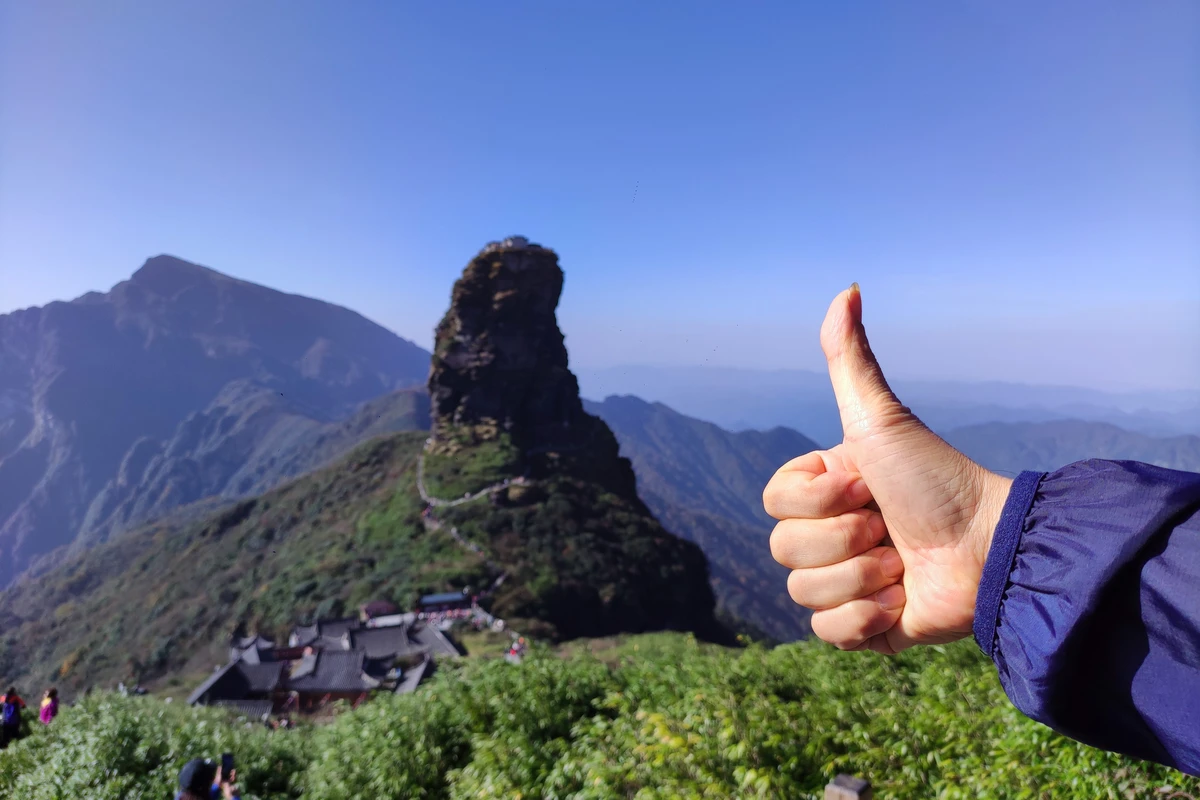
Fanjing Mountain gets its name from "Brahma Pure Land". It is a rare Buddhist sanctuary and nature reserve in China, ranking alongside Mount Wutai in Shanxi, Mount Putuo in Zhejiang, Mount Emei in Sichuan, and Mount Jiuhua in Anhui as the five famous Buddhist mountains in China. Fanjing Mountain is the most unique landmark in Guizhou. It combines the wonder of Mount Huang, the beauty of Mount Emei, the steepness of Mount Hua, and the grandeur of Mount Tai. All landscapes are masterpieces of nature. The main peak's "Mushroom Stone" is a wonder. Major attractions: Mushroom Stone, Ten Thousand Books, Red Cloud Golden Summit, Old Golden Summit, Old Eagle Rock, and Flipped Seal.
The Old Golden Summit scenic area is most notable for its grotesque stone cliffs, regarded as a rock wonder garden. Old Golden Summit, anciently called Yuejing Mountain, is 2493 m above sea level. Folklore says the compassionate moonlight of Maitreya Bodhisattva on the Red Cloud Golden Summit shines on the stone wall, resembling a bronze mirror under the moon.
Red Cloud Golden Summit is a stone peak 94 m high, steep and straight, like a huge sky-pillar rising from the ground. It stands opposite Yuejing Mountain to the north and south, forming a confrontation of two peaks, a magnificent sight. The upper part of Red Cloud Golden Summit is split into two, connected by a sky bridge. A temple is built on each side: one enshrines Sakyamuni Buddha, the other Maitreya Buddha. This symbolizes the transition from the present Buddha (Sakyamuni) to the future Buddha (Maitreya). In the morning, red clouds and auspicious air often surround it, hence the name Red Cloud Golden Summit.
Mushroom Stone: As its name suggests, it is large on top and small at the bottom, resembling a mushroom. About 10 m high, standing gracefully, seemingly precarious but actually steadfast (it has stood for over 1 billion years in wind, frost, rain, and snow). Mushroom Stone is a unique surrealist classic sculpture of nature. Many painters and photographers have used it as a subject, creating countless artistic masterpieces. It has become the image ambassador of Fanjing Mountain, going to the whole country and the world, and even entering the magnificent Great Hall of the People.
Flipped Seal: On the top of a cliff, there is a flat stone platform, and a huge rock like a giant seal placed upside down on the platform, called "Flipped Seal". Since ancient times, those seeking official positions have worshipped here to fulfill their wishes.
Nine Emperor Cave is the relic of a female Pratyekabuddha's practice, and legend says it is where Empress Dowager Li became an immortal. It is known as the Home of the Fanjing Goddess.
Looking at Red Cloud Golden Summit from the direction of Old Golden Summit.
Old Eagle Rock: A rock on top of Fanjing Mountain that resembles an eagle's beak.
Climbing Old Golden Summit with hands and feet.
Scenery on the way up Old Golden Summit.
Scenery on the way up Old Golden Summit.
The Old Golden Summit is most notable for its grotesque stone cliffs.
Fanjing Mountain's Old Golden Summit, 2494 m above sea level, is the highest point for visitors. The terrain is steep, requiring climbing iron chains to reach the top. On the summit, there is the Lamp-Burning Hall, enshrining Dipankara Buddha. Dipankara is the past Buddha of the Three Buddhas of Time in Buddhism, before Sakyamuni. According to Buddhist doctrine, Dipankara represents the past, Sakyamuni the present, and Maitreya the future. Dipankara is the past Buddha of the Three Buddhas of Time.
We reached the top of Old Golden Summit!
View of Red Cloud Golden Summit from the top of Old Golden Summit.
Zoomed-in view of Red Cloud Golden Summit from Old Golden Summit.
Descending from Old Golden Summit was not easy either; our legs trembled! The route to Old Golden Summit is twice as long as to Red Cloud Golden Summit. Red Cloud Golden Summit is climbed vertically, so it is relatively easier.
Ten Thousand Books: The layered cliffs look like sutra books stacked up to the sky. Legend says these are the sutras brought back by Monk Xuanzang from the West and hidden here.
Ten Thousand Books: The layered cliffs look like sutra books stacked up to the sky. Legend says these are the sutras brought back by Monk Xuanzang from the West and hidden here.
Scenery encountered while descending Old Golden Summit.
View of Old Golden Summit while climbing Red Cloud Golden Summit.
View of Old Golden Summit while climbing Red Cloud Golden Summit. The Old Golden Summit is most notable for its grotesque stone cliffs.
The stone steps to Red Cloud Golden Summit are steep.
Climbing Red Cloud Golden Summit.
On the way up Red Cloud Golden Summit, there is a Guanyin Cave in a rock crevice.
From the summit of Red Cloud Golden Summit to the mountainside, there is a crack dividing it into two halves. This is Jin Dao Xia (Golden Knife Gorge). It is said that Red Cloud Golden Summit was originally a single whole, but both Sakyamuni and Maitreya wanted this beautiful place for meditation. They argued, and Dipankara saw this. He took a golden knife and split the peak from the top, dividing it into two. Sakyamuni occupies the left side, Maitreya the right. The crack is named after the golden knife. The distance between the two peaks is at most over 20 m, at least only 2-3 m, so it is also called "Line of Sky". On each peak, there is a temple: Sakyamuni Hall on the left, Maitreya Hall on the right, connected by the Golden Summit Bridge. Looking down from the bridge, visitors see a bottomless abyss.
On the Red Cloud Golden Summit, there are two halls: Sakyamuni on the left, Maitreya on the right. All beings live under Sakyamuni's grace today and will be taught by Maitreya tomorrow. The small golden summit is divided into two, representing half present and half future. Worshipping the present Buddha brings peace and good luck in this life; worshipping the future Buddha plants good roots for future lives, benefiting thousands.
Cheng'en Temple's Heavenly King Hall. Cheng'en Temple is located between the new and old golden summits of Fanjing Mountain. It was first built in the early Ming Dynasty, rebuilt on the original site in 2009, and completed in 2011. It is the main building of the temple complex on the summit.
Looking up at Red Cloud Golden Summit from the square of Cheng'en Temple's Heavenly King Hall.
Scenic views from the observation deck on the way down to the cable car station.
We queued at the cable car station for more than an hour before boarding the cable car down. The weather was good today, and the afternoon tickets were sold out. We descended at 4 pm, relatively early.
A word about the Xiaohe Holiday Guesthouse we booked on Ctrip for two nights: it is at the foot of Fanjing Mountain, surrounded by mountains, with fresh air, clean and tidy rooms, and the landlady cooked delicious and affordable meals. This large pot of clear stewed chicken was a reward for climbing Fanjing Mountain. So delicious, I still recall it often.
Day 8 (October 23) Sunny, 23°C/10°C: Visit Yamugou and Yunshe Village
We were tired from climbing yesterday and slept early. Early to bed, early to rise. Surrounded by mountains, could we see the sunrise? Out of curiosity, we went out at 6:30 am to the river near the village entrance to try our luck. However, due to the tall and dense forests around, we only saw a sky full of red morning glow, still beautiful.
After breakfast, we bid farewell to Xiaohe Holiday Guesthouse. At 9 am, we arrived at Yamugou Scenic Area at the foot of Fanjing Mountain. This scenic area consists of two parts: a Tujia ethnic culture garden displaying local Tujia history, culture, and customs, and the natural, beautiful, and mysterious Yamugou itself. (Online ticket: 70 yuan/person, including 20 yuan for shuttle bus.)
Yamugou is located in Jiangkou County, Tongren City, Guizhou, at the foot of the main peak of the Wuling Mountains, Fanjing Mountain, beside the Taiping River. It is an important and essential part of the Fanjing Mountain ecotourism area. Total area 26 square kilometers, the gully is 50 km long.
Yamugou's Tujia Ethnic Culture Garden's Totem Square: The garden's treasure—Tujia Jade Ox. The jade ox is carved from a single piece of xiuyan jade, 5 m long, 2.3 m high, weighing 12 tons, known as "Asia's First Jade Ox".
Yamugou's Tujia Ethnic Culture Garden: At the Red Stone Bridge head, there is a Tujia drum tower with "China's Biggest Drum". Each side is covered with a whole cowhide, diameter 3.39 m, weight over 1000 jin (500 kg), made by a famous drum master over nearly a month. The drum sound can be heard ten li (5 km) away. According to Tujia custom, striking the drum three times brings health, freedom, and happiness respectively. Many tourists come specifically to strike this big drum three times.
After visiting the Tujia Ethnic Culture Garden, we took the shuttle bus to the scenic spot at the top of the mountain, then hiked down through Yamugou.
Legend has it that this was the retreat of Liu Bowen, the founding strategist of the Ming Dynasty, who was also known as a divine fortune-teller. Years ago, developers spent a large sum and five years building this ancient courtyard based on local descriptions. The courtyard is in late Yuan/early Ming style, large, with ancient trees, many rooms, and antique furnishings; doors and windows are carved with dragons and phoenixes, elegantly decorated.
Yamugou's welcoming pine.
It takes 40 minutes to walk down from the Ming Dynasty ancient courtyard to Yamugou.
We hiked down from the dam waterfall of Yamugou. Yamugou Waterfall is over 20 m high, over 30 m wide, with a wavy surface, falling in three folds onto a large rock three zhang square, splashing water like blooming lotuses, forming curtains of lotus water.
Green mountains, deep valleys, clear water, and rugged stones are harmoniously connected.
Water moves, mountains are still, stillness and motion complement each other, combining strength and softness. Wind rustles the forest, birds sing in the valleys, spring water drips, returning to simplicity and nature. Trees embellish, pavilions dot, waterfalls splash, and the forest is shady.
The gully twists and turns, with layers of water and mountains.
Yamugou has primitive vegetation with many rare species, such as yew, tree fern, rosewood, nanmu, and dove tree.
The water of Yamugou is as agile as a spirit.
Yamugou is a wonderful place to cleanse the mind and cultivate the soul.
The rocks in Yamugou are strangely shaped like ghostly carvings, and the cliffs are steep and elegant like divine works.
Yamugou is full of purple robe jade belt stone, with distinct layers, warm and smooth like jade.
We enjoyed the natural scenery of the entire Yamugou scenic area, taking in the mountains, water, trees, and everything. If you enter from outside in the hot summer, it feels like two seasons, like changing worlds, washing away dust and dirt, refreshing the lungs. Truly, "One mountain, one spring, one ancient village; inside and outside the gully are two different worlds. Cool in summer, warm in winter, a fairyland; beautiful mountains and clear waters, Yamugou." It is the best place for exploring scenery and leisure travel. We spent four hours here cleansing our lungs. At 1 pm, we drove half an hour to Yunshe Village.
At the foot of the majestic Fanjing Mountain, beside the serene Taiping River, lies a natural village like a paradise: Yunshe Village in Taiping Town, Jiangkou County, known as "China's No.1 Tujia Village". Upon entering the village, we were captivated by this beautiful, peaceful, and tranquil mountain village and decided to stay here for the night. The accommodations were economical (80 yuan per standard room). According to the landlady, during Golden Week, prices double or triple. The free-range chickens and ducks and vegetables grown in the village are all organic. For lunch, we had local duck at Jiajiale Farmhouse next to the guesthouse. The dishes were large in portion and very delicious, the duck meat tender yet firm. Since we ate after 2 pm, we were very hungry, and when the big pot of duck was served, we couldn't resist the temptation and feasted heartily, forgetting to take photos to share. Ha ha ha.
Yunshe Village's name comes from the Tujia language, meaning "place where monkeys drink water". It is an administrative village under Taiping Town, Jiangkou County, Tongren City, Guizhou, a traditional Chinese village located within the Fanjing Mountain Taiping River Scenic Area, 7 km from Jiangkou county town, 23 km from the southern gate of Fanjing Mountain. The total area is 4 square kilometers, with 439 households and 1,717 people, 98% of whom are descendants of the Yang clan. It is the largest village in Jiangkou. The Tujia people of Yunshe still retain their own ethnic customs, hence called "China's No.1 Tujia Village".
A corner of Yunshe Wetland Park.
Longtang River: Formed by the flow from Shenlong Tan (Divine Dragon Pool), it is one of the shortest rivers in the world. The rare fish species in the spring and river, and the spectacle of river fish swimming upstream to Shenlong Pond in June and July every year, add to the mystery of Shenlong Tan. Truly, "Under Fanjing Mountain, Divine Dragon Spring, mysterious and magical, pure nature."
In the center of the village, there is a deep pool about ten meters wide and 30-40 meters long, called Shenlong Tan. Shenlong Tan is at the east of Yunshe Village, flowing about 1 li (500 m) into the Taiping River. It has been recorded in history for thousands of years. The "General Gazetteer of Guizhou" says: "Yunshe Spring is ten li north of (Tongren Prefecture City) Shengxi. If there is a drought, pray and it will rain." The "Tongren Prefecture Gazetteer" of Daoguang era says: "Yunshe Spring (Shengxi Department) ten li north, if drought, smear blood on it, then rain." Shenlong Tan has three wonders: first, it is unfathomably deep; second, it can predict the weather; third, the spring water occasionally flows backwards.
Homing Sound Spring: About 30 meters left of Shenlong Tan, there is a spring controlled by sound. If someone wants water, they shout "water come" and water comes; when done, the water recedes.
Shenlong Tan looks like a piece of blue sky. The sky in the water is so blue, with white clouds drifting gently... The pool water is clear, sweet, warm in winter and cool in summer, directly drinkable. The water color varies with season and weather, sometimes deep blue, sometimes green, sometimes green with purple, crystal clear like jade.
After a day's work, the hardworking villagers prepare a hearty dinner to reward themselves.
Yunshe Village—a beautiful, peaceful, and tranquil mountain village.
Day 9 (October 24, sunny, 22°C/11°C): Visit Zhusha Ancient Town and Miao King City
Last night, we chatted with the landlady of the guesthouse. She suggested we climb the Wanbaoyan observation deck in Yunshe Village to see the panoramic view. We set out at 7 am and reached the top in just 8 minutes. Overlooking the small village, the houses were scattered in an orderly manner, the bluestone paths winding, the village smoke curling upward, full of life. Shenlong Tan looked like a swimming fish. What a beautiful rural painting! When we came down, we visited the ancient, fragrant barrel-shaped houses in the maze-like village.
Yunshe Village morning: a vibrant small mountain village. The hardworking Tujia people rise with the sun and lead a prosperous life.
Mottled bluestone paths wind around every house. These winding alleys are like a maze, connecting every household in Yunshe.
Ancient alleys: the alleys of Yunshe are deep and quiet, giving a sense of winding paths and changing scenes.
Yunshe Xiangchou Hall (Nostalgia Hall), converted from a typical Yunshe Tujia barrel house, themed "Spring Willows and Spring Flowers Fill the Painted Tower—Tujia Wedding Customs Exhibition", showing Tujia culture and wedding customs through the three parts: love customs, wedding ceremony, and crying marriage.
The ancient houses in Yunshe are mostly stilted buildings such as barrel houses, three-section compounds, and four-section compounds, with upturned eaves, white edges, connected corridors, dark green tiles like scales, magnificent and simple.
Yunshe barrel houses are generally square in shape, with high north and low south. The upper part is the main house, divided into central hall and left and right wing rooms; the lower part is the building. Some are connected on all four sides with an open center, forming a four-corner courtyard.
Tujia barrel house is the most distinctive ancient Tujia building in Yunshe. Its structure generally consists of main house, side house, wooden tower, and courtyard gate, with walls on four sides, also called fireproof barrel.
This is the guesthouse we stayed in at Yunshe Village.
This is a rice tofu stall at the entrance of Yunshe Village, a local delicacy. The rice tofu here is different from the one we later had in Furong Town. The young girl skillfully cut two pieces of steamed light yellow rice cake into small cubes with a string, then mixed them with chili sauce, soy sauce, rice vinegar, etc. The rice tofu had a chewy texture.
After eating the egg noodles the landlady cooked for us and taking the sweet potatoes she prepared, we left Yunshe Village. At 10:30, we arrived at Tongren's Zhusha Ancient Town (Cinnabar Ancient Town), the first mountain leisure nostalgic town in China themed on mountain industrial civilization. It makes people travel back to the passionate era and lets young people experience that period of planned economy.
After visiting for over two hours in that passionate era, we arrived at Miao King City at 2:30 pm. Miao King City, a national AAAA scenic area, is the only well-preserved ancient Miao village in Southwest China that integrates politics, economy, culture, military, and architecture. It covers an area of 10 square kilometers. According to the mountain and water terrain, six ancient military stockades were built around it. There are 11 lanes in the ancient village, with 11 village gates. The lanes are shielded by stone walls and connected to the courtyard walls of each house. There are also special "right-angle lanes" to confuse enemies, leading them into dead ends for annihilation. It forms an effective military defense system. The outer wall of the ancient village is 3 m high and 80 cm wide, allowing soldiers to patrol on top. The stilted houses inside are typical Miao characteristics, and the "crooked doors and slanted paths" are a unique architectural style. Through the administration of dozens of Miao kings, Miao King City had a certain scale during the Ming Dynasty. (Ticket: 52 yuan)
At dusk, we arrived at Tongren city and checked into the City Express Hotel near the train station. After dinner, we strolled towards the train station. At Tongren Railway Station Square, citizens danced in orderly steps to cheerful music. The scale of this scene opened my eyes!
Tongren—a city full of vitality.
Day 10 (October 25, overcast, 23°C/12°C): Tongren - Chadong Border Town Scenic Area; visit Chadong Border Town
Our trip to Fanjing Mountain in Tongren, Guizhou, had us arrange four days in Tongren. Today we started our return journey, and the distance to home shortened each day. Our coming to Chadong was entirely because of Shen Congwen's "Border Town". The beginning of "Border Town" goes: "From Sichuan to Hunan, there is an official road to the east. This official road, near the border of western Hunan, reaches a small mountain town called 'Chadong'. There is a stream, with a white pagoda on the streamside, and a solitary household under the pagoda. This household has only an old man, a girl, and a yellow dog. The stream flows down, winding around the mountain for about three li, then joins the big river at Chadong. If one crosses the stream and goes over the small mountain, it is only about a li to the town of Chadong." So today we came, by car, on highways, provincial roads, and village roads!
At 10 am, we drove to Hong'an Town, Xiushan City, Chongqing, drove around, and took photos at the junction of three provinces.
At 11 am, we arrived at Biancheng Town, Huayuan County, Xiangxi Prefecture, Hunan, originally called Chadong, located at the junction of Hunan, Guizhou, and Chongqing—"one step crosses three provinces". Shen Congwen's famous novella "Border Town" integrated Chadong's beautiful scenery, kind customs, and simple humanity, sketching a pastoral border town charm, attracting countless literary enthusiasts from home and abroad to sightsee and gather inspiration, thus boosting local tourism. In 2005, Chadong was officially renamed Biancheng Town. To distinguish it from other places named Biancheng, the media often refer to it as Chadong Border Town. It borders Xiushan County, Chongqing to the west and Songtao County, Guizhou to the south, separated by a river. The population is mainly Tujia, Miao, and Han, with strong ethnic minority customs. (Free admission)
Chadong Border Town is at the junction of Hunan, Guizhou, and Chongqing (three provinces/municipality), known as "one step crosses three provinces", and is one of the four famous towns in western Hunan. The ancient town was first built in the 8th year of Jiaqing (1803), with city walls made of huge stones, solid and majestic. The town is surrounded by mountains, with a city within the mountains and mountains within the city.
This is the Beimen Inn where we stayed tonight, located by the Youshui River. Standing on the balcony, we could see Cuicui Island, the white pagoda, the Lala Ferry, and the new bridge.
Stilted houses: Along the Youshui River, the small town of Chadong lies quietly. Its appearance appears in Shen Congwen's memory: "Chadong is built against the water and mountains. On the side near the mountain, the city wall climbs like a long snake. On the side facing the water, space is left outside the city for docks, sheltering small boats... Through each dock, there is a river street. Most houses have half on land and half over the water, because of limited space; those houses all have stilted buildings." To this day, the stilted houses remain ancient and unique. Such a human and natural environment of graceful charm still attracts many tourists.
The main specialty food of Border Town is "jiaojiao fish", which is the yellow catfish we know. Because the border town is at the junction of three provinces, the flavors combine Chongqing's numbing, Guizhou's sour, and Hunan's spicy. This boiled fish is also locally called "one bite eats three provinces"! At noon, we tasted jiaojiao fish and bacon. The owner, considering we are from Guangdong, made a modified version of jiaojiao fish, which was delicious. After lunch, we felt we could blend in here. This modified jiaojiao fish let us experience the warmth of eastern Chongqing people, the intelligence of northern Guizhou people, and the forthrightness of western Hunan people.
Today was overcast; the mountain town was shrouded in rain and mist. The movie "Border Town" from beginning to end also had few sunny scenes.
Above is Cuicui Island, built after Shen Congwen's "Border Town" became popular, as part of local cultural tourism development.
Cuicui Island faces the white pagoda. These elements let you understand a poignant love story.
The white pagoda is an element from Shen Congwen's "Border Town". But the original pagoda collapsed; this one was rebuilt for the film "Border Town".
Chadong, accompanied by green mountains and clear waters, has students from art colleges sketching everywhere with concentration. They bring modern atmosphere and vitality to the ancient town. I like this peaceful ambiance. The scenes of human and nature blending together feel wonderful.
Today is the Double Ninth Festival. The villagers of Chadong presented a wonderful cultural performance for the elderly and tourists.
Everywhere in the ancient town, time can be recalled.
The characteristic ancient houses of western Hunan still retain the blue walls, black tiles, and upturned eaves. The streets are lined with Ming and Qing architectural style, brick-wood structures. The doors of these houses are made of thick cedar wood, coated with tung oil, brown-black, very grand. The row of upturned eaves is symmetrical and naturally harmonious.
The ancient town is not entirely a tourist attraction; it is also a town where local residents live. So it is very down-to-earth. Walking on the ancient street, you can see the most authentic life of the town's residents.
Taking the Lala Ferry to Hong'an Town in Xiushan, Chongqing is very convenient. Hong'an Town has a bit of mountain city flavor. On the main street, there are many old brands and the Second Field Army Memorial Hall. Near the dock, there is also a "Sanbuguan" (Three No-rule) Island, said to have been a bandit lair, now a resort.
Lala Ferry: A single wire across the Qingshui River connects Chadong in Hunan and Hong'an in Chongqing. No oars or poles; the ferryman only uses a wooden stick to pull along the wire. In "Border Town", Cuicui's grandfather was the ferryman of Lala Ferry, and Cuicui's poignant love story unfolds around this ferry...
Lala Ferry at Hong'an Town dock.
Fuxing Bank, the former site of the Headquarters of the Second Field Army of the Chinese People's Liberation Army. Fuxing Bank and the headquarters are linked; it is not only a symbol of the prosperous water transport era when merchants gathered, but also a historical witness of the Liu-Deng Army's arduous campaigns to liberate the Southwest. It seems to require an admission fee, but it was closed due to the pandemic.


![Mountains and Waters Meet Again [Guilin Yangshuo] Let's Rock the Boat of Friendship](/img/624178c28a221adb_s.webp?src=https%3A%2F%2Fdimg04.c-ctrip.com%2Fimages%2F0104n120009cnhkrdD720_W_320_0_Q80.jpg)


