A Traditional Yet Niche and Wild Fun Itinerary: 3 Days and 2 Nights in Guilin's Scenic Mountains and Rivers
"Guilin's landscape is the best under heaven." I still remember the first time I heard this phrase, it was in a primary school textbook. The peculiar karst landforms that shape Guilin's scenery were deeply etched into my mind back then. Guilin has always been a popular tourist city in China, renowned for its mountains, waters, local customs, and leisurely, comfortable lifestyle. The mountains here rise abruptly from the ground in various shapes; the waters of the Li River wind gracefully, clear and mirror-like.
In fact, a 3-day, 2-night itinerary can certainly be fulfilling, but a rushed schedule always means missing something. My trip to Guilin this time was rather rushed. If time allowed, I would have liked to stay an extra day or two to explore more places that delve deeper into Guilin's scenery and culture.
On the afternoon I arrived in Guilin from Shanghai, I felt the moist air as soon as I got off the plane. On the taxi ride from the airport to the city center, I could see all kinds of layered and overlapping mountain forms in the distance—quite amazing. I found a guesthouse to stay by the Li River, and across the river I could see the Xiaoyao Tower, bustling with noise and crowds. It happened to be meal time, so I planned to find a place to eat some authentic Guilin cuisine, and headed straight to the Yan Street Market next to Xiaoyao Tower.
As soon as I arrived at Yan Street Market, I felt a sense of familiarity. Its design style is similar to that of Shuangta Market in Suzhou. While preserving local traditional characteristics, it incorporates many trendy and internet-famous elements to attract more visitors.
Yan Street itself is a famous old street in Guilin, originally specializing in the salt business, hence the name. Yan Street has long been a lively and bustling place full of everyday life, and it remains an indelible memory for the older generation of Guilin locals.
This street market continues the flavor of those days by bringing together all kinds of traditional foods. Everyone says that when you come to Guilin, you must have rice noodles (fen)! So the most popular spots here are the rice noodle shops. Someone told me that because Guilin is very humid, especially in summer when it's muggy and damp, people's appetites often decrease. Guilin locals have found a way to eat something smooth, refreshing, delicious, and filling! Just hearing the word "suo" (to slurp) makes it sound very smooth!
Guilin rice noodles are usually served with a secret brine and braised dishes, either with soup or without, generally satisfying most people's tastes and leaving a lasting aftertaste. Some might not be used to the flavor of pickled bamboo shoots and sour beans, while many others absolutely love them!
What’s more fun is that at the Yan Street Market, you can watch the manual pressing of rice noodles right on site. Nowadays, many rice noodles are factory-made, and while they are tasty, seeing this process makes you appreciate the magic and deliciousness of these noodles even more!
Originally, I only knew Guilin had rice noodles, but after coming here, I realized there are so many traditional Guilin delicacies! For example, "Shi Ba Niang" (Eighteen Stuffed Things). Some might think it means exactly eighteen kinds, but actually "eighteen" is an approximate number meaning many varieties. I was too busy eating to remember all of them. There are stuffed tofu, stuffed eggplants, stuffed lotus roots, egg dumplings, stuffed peppers, etc.—all kinds of ingredients filled with meat, offering a richer variety of textures.
In addition to rice noodles, Guilin people drink oil tea (youcha) all year round, morning and night. It is also called "da youcha" (beaten oil tea). You’ll understand why it's called "beaten" when you see how it's made. Oil tea is mainly made from old-leaf Guyu tea, often boiled with ginger and garlic. During the boiling process, the ingredients are first pounded in a pot to release and blend their flavors, then salt and water are added and brought to a boil to make oil tea.
Oil tea is usually served with some toppings, such as fried glutinous rice flowers, roasted peanuts or soaked soybeans, corn, fried rice, etc., with chopped green onions and salt for seasoning. It must be drunk while hot, right after being poured. However, if you’re not used to the taste of ginger, you might find it hard to drink because the ginger flavor is indeed strong. Why drink it hot? Because when oil tea cools down, it tastes more bitter, and when it's hot, it helps dispel cold and dampness.
If you want to try different kinds of rice noodles, this place can also satisfy you. For example, horse meat rice noodles are served in small bowls—you can eat them dry in one bite or add soup. There’s also colorful basket rice noodles made from purple cabbage, spinach, and dragon fruit—pretty amazing, right? You dip them in three different sauces, and they are delicious and nutritious.
As a lover of pastries, I saw something here that looked a lot like Suzhou-style cakes, but it was called "baba" (cake). It comes in both sweet and savory flavors, and having one portion can make you quite full. If you want some dishes, be sure to order the local specialty double duck tea soup! The ducks are organically raised, carefully braised for over an hour, and paired with fine green tea—so fragrant!
Anyway, there were so many kinds of food here that I ended up eating two bowls in a row, because there’s no way to try everything at once unless you have a huge appetite! If you still want more, there are souvenir shops where you can buy your favorite rice noodles, chili sauce, taro strips, oil tea, and other specialties to take home!
After eating and drinking your fill, you can take a stroll nearby at East West Alley (Dongxi Xiang) to digest. East West Alley is a historical and cultural district in Guilin, with many old houses and city wall structures. It's an old street that integrates tourism, folk customs, culture, shopping, dining, and leisure. So there are also various food snacks here, though many are not traditional Guilin fare.
You can also walk along the Li River, to the Liberation Bridge, or up to Xiaoyao Tower. This area, in my opinion, has the strongest local vibe, with many people walking, resting, singing, performing live shows, and so on.
Hongxi: A Wild and Fun Water Play Spot
About 40 km from downtown Guilin, there is a scenic area called Hongxi (Red Creek), named for its reddish-purple sandstone creek beds. The area is surrounded by mountains and water, lush forests, layered waterfalls, and full of rustic charm. It’s a popular weekend getaway for Guilin locals who enjoy driving there for outings.
After the Shang Dynasty, the ancestors of the Shui people migrated south from the Sui River basin in the Central Plains, gradually merging with the Baiyue ethnic groups. They lived in the Hongxi area for over a hundred years, leaving behind many Shui script sites. Later, due to war, they migrated northwest upstream. This is the story of the Shui people—a noble clan from ancient times.
Hongxi has high concentrations of negative oxygen ions, making it a natural oxygen bar. Walking along the mountain paths in the scenic area, the air is fresh and comfortable, and it’s very quiet, allowing you to enjoy the sounds of birds and the fragrance of flowers.
Moreover, there are various places for blessings and prayers in the scenic area—a bronze bell you might catch sight of, a railing covered with prayer ribbons, and an ancient bridge designed in the shape of copper coins. Truly a place blessed with fortune.
Actually, the main attraction of Hongxi, and why we hiked all the way up, is the waterfalls. Since it’s full of rustic charm, the scenic area has a special water channel for climbing the mountain. You enter through the mouth of a dragon head, pass through its body and skeleton, and as you go up, you can enjoy the scenery and also feel the thrill of exploration.
There are many waterfalls in the Hongxi waterfall group, such as the Hongxi Long Waterfall, which falls in three tiers, the Dragon Palace Waterfall where a lady combs her hair, the inseparable Mandarin Duck Waterfall, and the Fairy Ladder Waterfall that rises step by step.
During the wet season, the waterfalls are truly majestic and spectacular. Recently, it’s been the dry season, so the water flow is smaller, giving a gentler feel. In summer, locals come here to play in the water, having a great time.
Hongxi has distinct seasonal features and a variety of leisure activities: high-altitude zip lines and forest glass slides are special attractions. When you reach the top, if you don’t want to walk down, you can take the zip line and then the glass slide. In just a few minutes, you’ll be at the bottom, experiencing speed and excitement.
For the glass slide, you must pay attention to safety. The scenic area provides raincoats. The speed depends on the water flow. On the lower half, there are some curves where it feels like you could be thrown off easily—very thrilling!
Oh! By the way, tourists from outside Guangxi Province can visit the scenic area for free from November 1, 2020, to January 31, 2021. Come quickly!
Buni Terraced Fields Full of Flowers
When it comes to terraced fields in Guilin, many people first think of Longji Terraced Fields. They are indeed famous for their beauty. However, over the years of development, they have become increasingly commercialized and overcrowded. So this time I found a niche terraced field—Buni Terraced Fields, planted not with rice but with spider flowers (Cleome spinosa).
The Buni Terraced Fields scenic area is located in Zhoujia Village, Sishui Township, Longsheng County, 26 km from Longsheng county town and 115 km from Guilin. The altitude ranges from 400 to 1600 meters, covering nearly a thousand mu (about 66 hectares), with flower sea terraces and ethnic minority folk culture as the main attractions. So at Buni Terraced Fields, you can see not only the flower sea terraces but also authentic Yao villages. The combination of beautiful scenery and ancient villages is truly irresistible.
If you want to take beautiful photos among the flowers, the best time to visit Buni Terraced Fields is early morning or late evening. In the early morning, a layer of mist surrounds the area, making it feel like a fairyland. In the evening, the sunset gently warms the sea of flowers.
The usual way to explore is to walk up the mountain from the entrance, which takes about an hour. The best places for photographing the flowers are along the climb and at the top, but the mountainside tends to be more crowded. So I suggest taking the cable car directly to the top, first taking in the panoramic view from the observation deck, then finding some less crowded paths through the villages to go deeper into the flower sea for photos—more beautiful and fun!
There is also the Jiawu Waterfall here. From the top observation deck, you go through a Yao village and walk a mountain path to reach it. On the way, I also went into a Yao house to have a look. Walking on such stilted buildings was a bit scary. The village is very quiet and isolated. Cars basically can't get up here, so they use horses for transport.
As I got closer, I could hear the sound of the waterfall. Due to the dry season, the water volume was smaller, making it somewhat cute.
Zhizhou Island: The Best View of Elephant Trunk Hill
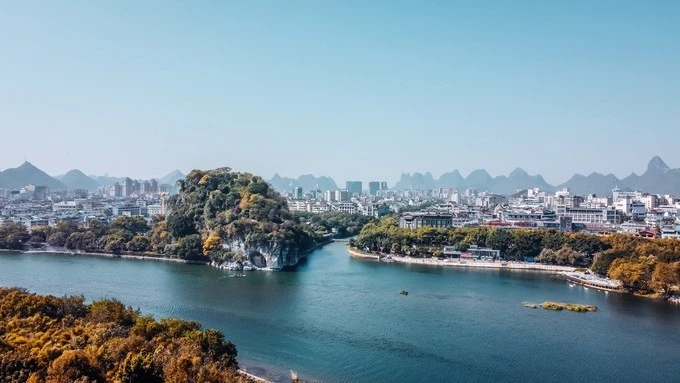
Zhizhou Island is located in the core area of the Li River's hundred-mile gallery, the most famous islet on the Li River. Together with the Li River and the scenery of Elephant Hill reflecting in the water, it has complemented each other for a thousand years.
The development of Zhizhou's scenery has a long history. In the Tang Dynasty, Pei Xingli, the governor of Guizhou and inspector of Gui, built Yan Pavilion on the island. He pioneered the overall planning of Guilin's landscape gardens by erecting pavilions and planting flowers and trees. The famous Tang Dynasty writer Liu Zongyuan, after being exiled here, was invited to visit Zhizhou and wrote the famous essay "Record of the Zhizhou Pavilion," vividly describing the scenery of Zhizhou. Therefore, in the Zhizhou Island scenic area, you can see statues and poems of Liu Zongyuan, as well as writings by other literati, reflecting the island's long history.
Zhizhou Island is indeed the best place to view Elephant Trunk Hill, offering the best panoramic perspective to see its shape vividly. This viewing area attracts many tourists taking photos.
Besides being the best spot to view Elephant Hill, Zhizhou Island is also known for the stunning sights of "Zhizhou Misty Rain" and "Autumn Red Leaves at Zhizhou." To see the red leaves, you probably need to come around late November to early December. I came a bit too early, which was a pity.
In fact, Zhizhou Island is also a popular leisure and vacation spot for locals. The scenic area is rich in vegetation and has many quiet paths, perfect for walking. Along the way, I saw many locals practicing tai chi.
If you come in the afternoon, besides exploring the scenic area itself, you can enjoy a fresh and comfortable afternoon tea at Fangye, surrounded by towering trees. It’s not only isolated from the noise but also enveloped by green vegetation, very pleasant. Maybe you’ll even encounter a lost tree frog like I did.
The afternoon tea here is also a good deal—68 yuan includes the entrance fee, and you get fruit tea, desserts and cakes, and local specialties. You can choose your favorite seat, bask in the sun, and chat—how cozy.
They also offer equipment for urban picnics on a secluded lawn, where you can lie down, enjoy the sun, have afternoon tea, and spend a happy weekend. The environment is so beautiful that many couples come here to take wedding photos—stunning!
If you bring children, besides afternoon tea, there are stone painting activities suitable for kids. After seeing the stones painted by children, I found them so innocent and imaginative—I don’t know how to create on stones anymore.
The scenic area is not only rich in vegetation but also has various pavilions, towers, and ancient buildings, making it the best place to appreciate literary atmosphere. Walk along the bamboo paths, listen to the rustling leaves, and rest at Zhijiazhou Pavilion or Liufang Pavilion when tired. You can also find a large lawn to lie down and bask in the warm sun.
Because of the abundant vegetation, watering is needed daily. Look, I even encountered this lovely rainbow by chance.
3-Day, 2-Night Itinerary:
Day 1: Depart for Guilin - Yan Street Market - East West Alley
Day 2: Hongxi Scenic Area - Buni Terraced Fields
Day 3: Zhizhou Island Scenic Area - Return trip
This route of mine is indeed traditional, niche, and full of rustic fun.
Transportation:
- From Guilin Airport to the city center: take a bus or taxi, about 1 hour (traffic jams possible during rush hour).
- If you stay near Liberation Bridge, Yan Street Market and Zhizhou Island are walkable, or you can rent a shared bike easily.
- To reach Hongxi, there is a special scenic tour bus; from Qintan Bus Station, take the Guilin–Wantian bus line directly to the gate.
- Buni Terraced Fields are quite far. It is recommended to drive yourself or hire a car/carpool.
Accommodation:
In Guilin, I stayed at a guesthouse designed as an old Western-style building near Liberation Bridge and the Li River. I didn’t expect to experience such retro charm in Guilin. This guesthouse, Yinxiang No. 9 Villa, is a high-quality, light-luxury Republic of China-style property. Each room has a different style. The top floor even has a river-view restaurant, making breakfast special.
Looking at the photos on the living room wall of the owner's travels, I could tell the owner is a true traveler. You can ask any local questions.
However, since it's by the roadside and the building is wooden, soundproofing is poor. If you are a light sleeper, bring earplugs. If you want a quieter stay, they have another guesthouse in a residential complex called Yinxiang·Spring. When I first saw the photos, I couldn’t believe it was in a complex—with such a garden view, I thought it was a detached villa.
This guesthouse is much quieter, with new facilities and good lighting, perfect for lying in and resting after a tiring day.
Photography Equipment:
Main camera: Sony a7m2 with Zeiss 35mm f/2.8 lens.
Secondary camera: Sony ZV-1.
Drone: DJI Mavic Mini.


![Mountains and Waters Meet Again [Guilin Yangshuo] Let's Rock the Boat of Friendship](/img/624178c28a221adb_s.webp?src=https%3A%2F%2Fdimg04.c-ctrip.com%2Fimages%2F0104n120009cnhkrdD720_W_320_0_Q80.jpg)


