An 8-Day Autumn Palette in Guangxi | The World Grows Late, Mountains and Rivers Are Autumn.
Originally, I wanted to use 'Since ancient times, autumn has been a season of sorrow and solitude, but I say autumn surpasses spring morning.' as the title of my travelogue, because in my eyes, autumn also contains vibrant vitality. I love the golden ginkgo leaves and red maple leaves; autumn seems to be the time when plants dress up the most. I enjoy eating hot roasted sweet potatoes while basking in the warm autumn sun, the sunlight gently falling on my face.
Using 'The world grows late, mountains and rivers are autumn' is purely because I like this phrase. Since I am still young and not yet at the stage of 'the world growing late,' I don't feel sorrow at looking back on the past or watching time pass.
On the contrary, I want to express that people should take advantage of their youth to see more beautiful scenery, rather than waiting until they reach that age to sigh, 'The world grows late, mountains and rivers are autumn.'
'My map of China is almost fully colored,' I said, sitting in front of the computer, looking contentedly at the map that I had almost fully checked off.
'Then where are we going for National Day?' George asked me.
'To Guangxi!'
Going to Guangxi was simply because I had never set foot there before.
This year's weekend flying goal was to visit all the provinces I hadn't been to yet.
Guilin often appears on the 'tourism blacklist.' Just before the trip, George saw a ranking of the 'Top 10 Worst Tourist Cities for National Day.'
Guilin 'proudly' took third place, and my heart sank.
Looking down at the reasons: too many tourists, expensive tickets, and rip-offs.
Domestic travel during holidays inevitably has these issues, so I breathed a sigh of relief.
Since we were traveling by car during off-peak times, as long as the scenery was beautiful, I could accept it.
Over these 8 days, we traveled from the southwest to the northeast of Guangxi, fully immersing ourselves in the mountains and waters of Guangxi.
The entire trip covered both popular and lesser-known attractions. Although the weather wasn't cooperating, we still took many great photos.
'Guilin's scenery is the best under heaven, and Yangshuo's scenery is the best in Guilin' – that saying didn't lie.
We visited the 20-yuan banknote scene on the Li River, watched a misty sunrise at Xianggong Mountain, experienced bamboo rafting on the Yulong River, cycled leisurely through golden rice fields, and tasted delicious beer fish on West Street – these are all classic must-dos in Yangshuo.
The Longji Rice Terraces were the biggest surprise of the trip. In October, the thousand-layer terraces, alternating yellow and green, seemed to scatter from the clouds and cover the land.
In the morning mist and sunrise, the terraces appeared veiled, making them even more enchanting.
Many people only know about Guilin's mountains and waters, but the scenery in Chongzuo, a border city, is even more captivating.
Here you find the Detian Transnational Waterfall, the largest in Asia; the Goose Spring, one of the 'Three Famous Springs in Southwest China'; the He-Na Expressway, known as 'China's Most Beautiful Highway'; and the ubiquitous fairy-tale-like karst landscapes.
When the plane arrived in Nanning, the car rental shop was near the airport. After checking the car, we couldn't wait to set off.
The weather in Nanning was excellent. Driving on the 'Most Beautiful Highway' of Guangxi, the He-Na Expressway, the sky was blue with white clouds all the way, and the end of the road revealed karst landforms, lifting our spirits.
After about 3 hours of driving, we arrived at Mingshi Pastoral Scenic Area, where the hit TV drama 'The Journey of Flower' was filmed a few years ago.
Within the mountains and waters of Mingshi Pastoral, the fields were full of rice paddies, with rice ears swaying, and everything in sight was green. In the distance, there were peaks of various shapes, surrounded by winding rivers, earning it the nickname 'Little Guilin.' A huge white cloud appeared between two mountains, looking like a snowy mountain mixed in – truly magical.
Our guesthouse was right across from the scenic area, a 5-minute walk to the entrance. In front of the door was a large rice field; we walked into the fields and took a few photos.
Mingshi Pastoral Scenic Area was the least cost-effective attraction of the trip. Before going, we had already seen low ratings, but I still couldn't give up hope – after all, I hadn't seen it with my own eyes, so I didn't know how bad it really was.
At the entrance, the ticket price was 80 yuan; with bamboo rafting it was 110 yuan. The ticket seller strongly recommended buying the rafting ticket, saying the walking loop could be done in just 10 minutes and the rafting was the only fun thing. We declined. As it turned out, the scenic area was very small, basically nothing worth seeing, and definitely not worth taking the bamboo raft.
The image below shows the size of the entire scenic area; the outside scenery was actually better than the inside.
The bamboo raft was on the river below, motorized, and not recommended. There are plenty of other places in Guangxi to take bamboo rafts, so it's better to find a more beautiful spot.
Just as we entered the scenic area, a sudden rainstorm hit. We didn't have umbrellas, and our mood dropped as low as the weather, feeling like the 80-yuan tickets were a complete waste.
We had to take shelter under a pavilion. Just then, the 5 PM Zhuang ethnic folk performance started. The performers were mostly young men and women, showing scenes of young people falling in love, along with a lifelike display of a giant roc. The performance lasted about half an hour.
After the show, the rain had mostly stopped. Suddenly someone shouted 'Rainbow!' We went to the performance stage and saw a faint rainbow on the horizon. After the rain, the rainbow hung between two mountains. As the thick clouds dispersed, the blue sky appeared, and the clouds were dyed golden. At that moment, the beautiful scenery made me feel that the 80-yuan ticket was somewhat worthwhile.
'After the rain, the sky clears as if washed' – the sky became more transparent. 'Peaks cast reflections on the water, and no mountain or water fails to captivate' – this is a true portrayal of Guangxi's landscapes.
The mountain peaks were mirrored in the calm water, like emerald jade. Occasionally, a bird would fly by, creating small ripples that broke the peaceful reflection.
Sitting on the edge of a stone bridge, the scene felt like 'a person traveling within a painting.' Of course, pay attention to safety – don't imitate!
Find a circular hole in the bridge to frame the scenery; an ink wash painting is naturally created.
You can also place a person inside the circular hole to create a portrait using frame composition.
During the most beautiful twilight blue hour, we flew our drone.
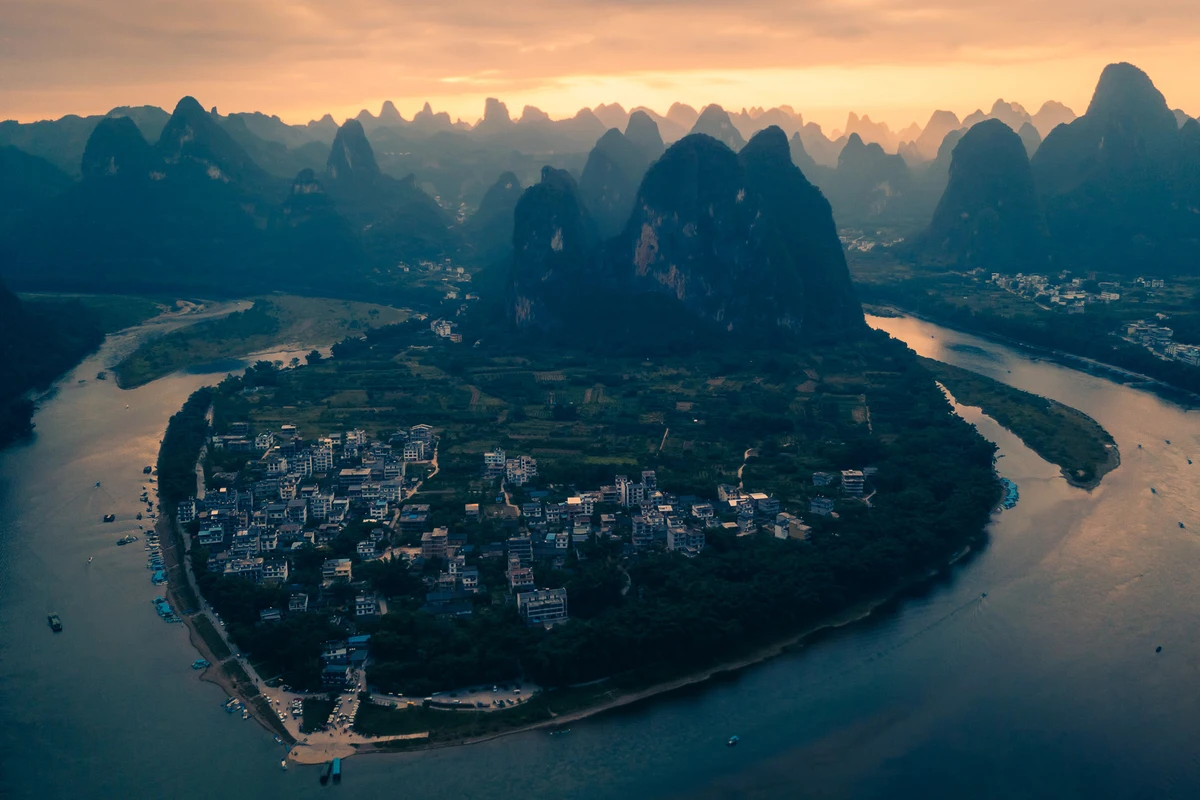
In the afterglow of the sunset, the setting sun peeking through the mountains dyed the river red, and the river surface shimmered with golden light. The sky was like taut pale blue silk, adorned with a few light golden decorations. Layers upon layers of peaks stretched for miles, with mist lingering among the mountains, covering the distant peaks with a thin veil.
Only from above could you see this magical karst landscape, formed through countless erosion and sedimentation of soluble rocks.
We never imagined that today would be one of the rare days we could see the sunset. In the following days, the sunset would play hide-and-seek with us – all cloudy days.
As dusk faded and the lights in the buildings lit up, one side of the mountain was also illuminated, alternating light and dark. Just this small patch of mountains and water gave the feeling of a city lighting up.
The next day, we went to the Detian Transnational Waterfall, which was also the reason I arranged the southwest Guangxi itinerary.
On the way from Mingshi Pastoral to Detian Transnational Waterfall, there was a section of very bad road, all bumpy.
'The torrent plunges three thousand feet straight down, as if the Milky Way has fallen from the ninth heaven.' Although this poem was written by Li Bai to describe the Lushan Waterfall, the spectacular scene of 'the Milky Way pouring down' perfectly describes the Detian Transnational Waterfall on the China-Vietnam border. Just looking at pictures is far from enough to appreciate its grandeur as the largest transnational waterfall in Asia and the fourth largest in the world. We had never seen such a majestic waterfall before; the scene was incredibly震撼 and powerful.
The waterfall spans two countries. The part belonging to China is called Detian Waterfall, and the part belonging to Vietnam is called Ban Gioc Waterfall. During the rainy season, the two waterfalls merge into one, with a total width of 208 meters, making it even more spectacular. The elevation difference between the downstream and the top of the waterfall is about 6 meters, and the water flows in multiple streams.
The source of the waterfall is the Guichun River, the border river between China and Vietnam. It flows into Vietnam and then back into Guangxi, passing through Detian Village in Daxin County, then cascading three times from a cliff over 60 meters high, breaking through thousands of ravines and the blockade of high cliffs and green trees, rushing down for thousands of miles to form this magnificent landscape.
On the opposite side, you can see the Vietnamese flag – probably the closest I've been to going abroad this year. Next to the waterfall is the No. 53 boundary marker of the China-Vietnam border. The old marker is a Qing Dynasty relic, full of historical significance, and tourists can take photos here. Before the pandemic, the row of small shops near the marker was a border trade market where people conducted trade and you could buy some Vietnamese specialties. Tourists could also apply for a visa for a one-day trip to Vietnam, but now it's not open.
We bought tickets online: 110 yuan per person, including the ticket and shuttle bus. Daytime hours: 8:00-17:00, last entry at 16:30.
If you drive, you can only go to the visitor center at the main gate, then take the shuttle bus for about 10 kilometers to the Detian Archway (shown below) at the waterfall entrance. If you stay at a guesthouse inside the scenic area, it's recommended to buy tickets on-site for 80 yuan, and you can drive to the guesthouse. Parking at the scenic area costs 10 yuan, unlimited time, but you pay as soon as you enter.
Once inside, there are two boardwalks. The left one leads to the bamboo raft for a close-up view of the waterfall. The right one is the jungle boardwalk. It's highly recommended to take the jungle boardwalk up to the third-level viewing platform to see the full waterfall, which is better for photos. If you want to take the bamboo raft, go down after reaching the platform, so you don't have to backtrack.
The jungle boardwalk is also the night tour path because the scenic area has a light show. The path is decorated with colorful lights and wall paintings. The night tour consists of 11 scenes (Maguai Festival – Seeking the Frog God – Calling the Frog God – Creating Miracles – Entering the Human World – Love Unfulfilled – Flower's Help – Betrothal – Flower's Blessing – Saving Lives – Praying for Rain). At night, lights also shine on the waterfall, making it beautiful. Night ticket: 228 yuan, open 19:00-21:30, last entry 19:15. If you want to stay all day, the full-day ticket is 340 yuan.
The third-level viewing platform is the best spot. Here you can strike a pose looking into the distance, and the platform's frame acts like a picture frame.
Have the photographer stand on the viewing platform while the model goes one level down, using a top-down shot to capture both the person and the waterfall.
The best time to visit is from June to November, as the rainy season brings abundant water with clear quality, and the waterfall roars like thousands of horses galloping. From December to May, it's the dry season, with more exposed rocks and soil around the waterfall. It's recommended to enter in the morning because the afternoon light is backlit and not good for photos. Of course, 6 PM sunset is the best time. Since it was cloudy when we went, time didn't matter much.
We flew the drone from the viewing platform without any issues. But I heard that it might be shot down because it's a border area with border defense on the mountains. We flew carefully, not daring to cross into Vietnam.
The Vietnamese waterfall was completely different from ours – like a little brother compared to a big brother. And our side had an endless stream of tourists, while theirs saw only about 10 people in a morning. However, there was a bridge on the Vietnamese side that looked very xianxia-style, a great filming location for period dramas. We happened to see two girls in xianxia-style dresses taking photos there.
Going down further, you can take a bamboo raft for an additional fee. Be sure to wear a raincoat; the waterfall's mist sprays very far, and your clothes will get wet. October temperatures are relatively low, so keep warm. The bamboo raft can approach within about 20 meters of the waterfall, giving you a close-up experience of the roaring torrent.
There is no restaurant at the visitor center, but many snacks and fruits are sold in the parking lot. We bought some for lunch at the entrance; a local specialty is zongye ziba (glutinous rice cake wrapped in reed leaves).
On the way to the next stop, we passed a rice field and immediately stopped the car. Due to more rainfall this year, most of the rice in Guangxi was still green, but one field had already turned slightly yellow, creating a clear boundary between yellow and green.
Once named 'China's Most Beautiful Highway' by the British Mirror newspaper and also dubbed 'China's First Fairyland Road,' this is the He-Na Expressway.
The He-Na Expressway refers to the highway between Hepu County and Napo County. During our two-day road trip, we spent most of the time on this expressway, truly experiencing its beauty and uniqueness.
Since the road passes through karst mountainous areas, weaving through Guangxi's stunning landscapes, you can enjoy the strangely shaped rocks unique to karst landforms all along the way. On days without sunlight, we were accompanied by light mist and clouds, with large rice fields on the roadside, feeling like we were driving through a huge fairyland painting. It is said that the most beautiful section is the Baida Super Bridge, which crosses three large mountains, but we didn't drive that segment.
However, I really liked a section shaped like a four-leaf clover – actually just a highway exit.
While planning the route, I kept looking on the map for the most convenient four-leaf clover exit and finally found the best aerial photo spot.
From the map, it's closest to Jiuxian Scenic Area, and not far from Goose Spring Scenic Area. I recommend taking aerial photos near this exit; from Jiuxian, the drone can also fly here, about 2 kilometers away.
Jiuzhou Scenic Area was a last-minute decision. We originally planned to go to Tongling Grand Canyon, but the weather was bad and the scenery there was average, so we gave up. Also, Jiuzhou is closest to the He-Na Expressway section we wanted to photograph, so we decided to stop by.
Jiuzhou is the hometown of the national heroine Wa Shi, who fought against Japanese pirates, and also the final resting place of Zhang Tianzong, a general of the Yuan Dynasty. The scenery of Jiuzhou is a microcosm of Jingxi's beauty, combining natural and cultural landscapes.
Ticket: 38 yuan per person; buying online a day in advance is cheaper.
Jiuzhou is also famous as the 'Hometown of Embroidered Balls.' Every household makes embroidered balls, with an annual output of over 300,000. Embroidered balls are Guangxi's mascots, conveying love, friendship, and family bonds. Tourists can buy them as souvenirs. The girls of Jiuzhou are affectionate, using poetic and artistic fabric as their canvas and the spirit of heaven and earth as their needle and thread, stitching carefully to create colorful ribbons and threads that embody the deep sentiment of Jiuzhou.
Every household hangs embroidered balls at their door.
Walking through Embroidered Ball Street, you step into a landscape painting. The mountains and water are like mirrors, green bamboos sway, and the Wenchang Pavilion stands with centuries of history.
Wenchang Pavilion is an ancient building from the Ming and Qing dynasties, standing in green water, connected by a small stone bridge. The commercial atmosphere here is not heavy; there is no hustle and bustle of big cities. Every brick and tile quietly tells the history of Jiuzhou.
Learn a bit of the Jingxi dialect and compliment a girl as 'Shaonei.'
Seeing a wall of red flowers by the roadside, of course we took some photos.
When the lights came on at night, Embroidered Ball Street had an even more romantic charm.
The local snack on Jiuzhou Street is fried dough, 2 yuan each – deep-fried flour, quite tasty.
Quyang Lake is a large karst plateau lake and reservoir, 15 kilometers long, with a maximum width of 1 kilometer and a lake surface area of 15,540 mu (about 2,560 acres).
Standing by the lake, you can only see part of the scenery. To get a full view of the entire lake, besides aerial photography, you can also take a boat ride to immerse yourself in the scene, enjoying the beauty of 'sunset clouds and solitary ducks flying together, autumn water merging with the sky.' If you're energetic, you can also cycle around the lake to see different sections.
Unfortunately, it was cloudy, so we couldn't see the sunrise or sunset, which would have been even more beautiful.
Quyang Lake is free, but parking costs 10 yuan.
Electric boat tickets: 68 yuan per person. Mountain bikes: 20 yuan per hour, 10 yuan per hour after 2 hours. If you need a full day, it's 80 yuan (8:00-18:00). Since Quyang Lake is large, cycling requires a full day.
Before reaching Quyang Lake, many people at the intersection were promoting their own farm boats. We ignored them; it's recommended to take the official scenic area boats.
We just walked along the lake embankment near the entrance without taking a boat or cycling. On a cloudy day, the scenery was average, so there was no need to spend much time there.
Goose Spring Scenic Area has a long history and is one of the three famous springs in Southwest China (the other two are Butterfly Spring in Dali and Ruy Quan in Guiping Xishan). Surprisingly, it is also the source of the Detian Transnational Waterfall.
There is a magical legend about the origin of Goose Spring: 'An old woman found two eggs in the wild, covered them with reeds, and two goslings hatched. She raised them in a spring, and the geese stirred the water into a deep, unfathomable pool,' hence the name Goose Spring.
During the Ming Dynasty, Emperor Chenghua, upon learning of the spiritual beauty of this place, named it 'Lingquan Wan Zhao' (Spiritual Spring at Evening Illumination). Although Goose Spring is thousands of miles from the capital, receiving a name from the emperor at that time shows its charm.
Goose Spring Scenic Area ticket: 38 yuan per person, parking 10 yuan. Aerial photography of the spring is not very good because the water is shallow with aquatic plants, so the water color is inconsistent.
Next to the parking lot is the Fifteen-Arch Bridge. Some people here try to sell you boat rides, claiming to take you to the center of the spring. Don't believe them – they only go to the middle of the spring, not into the scenic area. Definitely don't take the boat.
Entering the scenic area, you see a familiar scene: a large rice field with a boardwalk in the middle for photos.
Next to it is a flower sea, which is average.
The center of Goose Spring is the Yixin Pavilion, connected by a stone bridge on one side and lotus-leaf-shaped steps on the other, designed with poetic charm.
Goose Spring is surrounded by green mountains, with water as clear as a mirror and abundant fish and shrimp. Several plump white geese play in the water.
At first glance, it has a bit of a 'budget Jiuzhaigou' feel, as the spring water is cyan and very clear, with a few dead tree branches standing in the water, reflected in it.
On the mountain opposite, the words 'Lingquan Wan Zhao' are carved.
The most magical sight here is at the spring eye, because Goose Spring is an ascending spring in a peak forest valley, a large outlet of an underground river. The deepest point is several tens of meters, and countless black carp gather around the spring eye.
This is the origin of the 'Goose Spring Carp Leaping in Three Layers' scene, one of the Eight Scenic Spots of Jingxi. Legend has it that if people shout loudly by the spring, the fish will be startled and jump out of the water, creating a wonder. Nowadays, the fish are not frightened; they only surface for food.
We had lunch at a farmhouse restaurant outside the scenic area. Their specialty was braised duck with huangpi fruit, but the duck meat was too tough; neither of us liked it.
After leaving Goose Spring, we headed back to Nanning.
Passing by a place, we saw a large area of twinkling lights and thought it was a scenic spot, so we stopped. It turned out to be an aloe vera cultivation factory. Because it was autumn, they had lights on top to provide enough light for the aloe.
In front of the factory was a rice field with signs. When I got home, I looked up the rice varieties and actually found them.
'Zhongzheyou No. 8' is a new single-season hybrid late-season indica rice variety.
'Zhaoyou 5431' is a three-line hybrid medium-season rice variety.
By the time we arrived in Nanning, it was already 9 PM. The traffic entering the city was maddening.
Outsiders should never drive in Nanning!! Too many cars, too many e-bikes, complicated traffic lights, and confusing lanes.
You really need to watch in all directions and listen to navigation. No! Navigation was also unreliable – it made me take wrong turns several times and nearly run a red light. Even an experienced driver like me was furious.
It felt like traveling in Ho Chi Minh City, Vietnam, where the motorbike army is also overwhelming. My Guangxi friend told me that since the subway was built in Nanning in recent years, the number of e-bikes has decreased significantly.
Fortunately, we safely arrived at Tang Gu Gu Hotpot Restaurant, which is a buffet with small portions, allowing us to choose many types – perfect for us.
In the morning, we returned the car and took the high-speed train to Yangshuo.
There is only one direct train from Nanning to Yangshuo: 13:10-16:29. We chose this one because we wanted to sleep in.
Alternatively, you can transfer at a city like Guilin or Liuzhou, which is also convenient and offers more departures, allowing you to arrive in Yangshuo earlier.
At Yangshuo High-Speed Rail Station, most guesthouses near the Li River offer free pickup service. If not, you can take a Didi, which costs about 100 yuan and takes about 40 minutes to Xingping Ancient Town. There are also buses: 5 yuan to Xingping, 20 yuan to Yangshuo county town. There are many unlicensed cabs at the exit; it's recommended to take official transport.
We originally planned to rent a car in Yangshuo, but there are no rental companies. Later, I thought, 'Good thing I didn't drive in Yangshuo.'
Because during National Day, the Li River Scenic Area has traffic controls, and private cars are not allowed in. It's more convenient to ride e-bikes around the Li River, so I strongly recommend staying at a guesthouse inside the scenic area so they can pick you up.
The guesthouse told us that during the first few days of National Day, there were so many tourists that accommodation prices doubled, and even the bamboo raft queues were long. We took two days off this year to travel during off-peak times and avoid the crowds, which would have ruined the experience.
We arrived at the Yangshuo guesthouse around 5 PM, and the only plan for the day was to watch the sunset at Laozhai Mountain.
Laozhai Mountain is a wild scenic spot with no entrance fee. It's located at the highest point of Xingping Pier, offering a view of the 'First Bend of the Li River' and the best spot for sunset. However, the guesthouse strongly advised us not to go, because in October it gets dark early, and since it's not a regulated scenic spot, there are no streetlights or railings. Going up is fine, but coming down in the dark is unsafe.
Although I really wanted to go, we eventually gave in. So we rented an e-bike and drove to Xingping Pier.
Xingping Pier isn't exactly a scenic spot, but the scenery there is quite good and suitable for aerial photography. If you can't go up Laozhai Mountain, flying the drone over the Li River is just as good.
From the pier, you can see the First Bend of the Li River. Directly opposite is a place that looks like a small island with guesthouses; you can take a ferry to the other side to explore.
Behind the pier is Xingping Ancient Town, which is very small – just one street. It takes only 5 minutes to walk through the town. The other end of the town is Xingping Bus Station.
After autumn, it's relatively rare to see sunsets and sunrises in Guangxi. Today, we were lucky to see a bit of the sunset's Jesus light, though I later deepened the colors a bit in post-processing. The peaks on both sides of the river were tall and steep, giving a grand and distant feeling – the Li River's karst landscape is the most beautiful.
From the aerial view, the town around Xingping Pier and the town opposite looked like two fish kissing.
While George flew the drone, I took photos of the sunset at the pier. It was beautiful even without aerial shots – the sun disappeared behind the mountains.
We had dinner at the guesthouse. The owner said their chef was from Sichuan and made great food, not only local dishes but also Sichuan cuisine. After eating, we found it not as good as expected; the best dish was poached baby cabbage in soup.
The guesthouses here all have homemade liquor. If you like drinking, you can try it – it's quite strong.
I hadn't originally planned to go to Xianggong Mountain for sunrise, but since the weather had been bad for days, I checked the forecast and saw it would be sunny, so I decided to get up early for the sunrise.
Last night, we asked the guesthouse to arrange a pickup for Xianggong Mountain, but the owner tried to dissuade us again. They said the chances of seeing a sunrise in the past few days were very slim, even with a sunny forecast – maybe we could see a sea of clouds. And we had to leave at 4:30 AM because Xianggong Mountain is on the other side of the Li River, about an hour away. After much hesitation, we decided to take the risk, thinking that even without sunrise, the sea of clouds would be beautiful.
We woke up at 4:30 AM, quickly put on makeup, and left at 5 AM. It was pitch black. As soon as I stepped out, I didn't see the stairs and fell flat, landing on one knee. I got up, rubbed my knee, and continued despite the pain.
It took about 10 minutes to walk from the guesthouse to the pier, then we took a boat across, then continued by car to the entrance of Xianggong Mountain Scenic Area. After that, we had to climb for 15 minutes to reach the viewing platform. The private car arranged by the guesthouse + ferry + Xianggong Mountain ticket cost 190 yuan per person, and the whole process took over 40 minutes. (I later found out the guesthouse price was much higher; when I asked a private driver directly, it was only 160 yuan per person round trip. For even cheaper, you could buy tickets separately: ferry 10 yuan round trip, shuttle from Xianggong Mountain pier to the mountain 20 yuan one way, ticket 60 yuan – cheaper.)
We thought we arrived early enough, but the viewing platform was already packed – the first layer was densely packed tripods, the second layer was phone-wielding tourists. There are 5 levels of viewing platforms; the highest one had the most people, all occupied by professional photographers. I recommend going directly to the lower platforms, where there are fewer people and you can lean on the railing. Around 6 AM, the lights in the houses below gradually lit up, the sky was still dark, and it was very cold – remember to wear extra layers.
Xianggong Mountain is located on the west bank of the Li River, between the reflections of Huangbu and the Nine Horse Painting Mountain. The sunrise and sea of clouds here attract countless photography enthusiasts.
The scenery at Xianggong Mountain was indeed beautiful. Looking into the distance, you could see peaks like stalagmites standing tall, and the clear Li River winding among them, forming a large hook. In the morning mist, it looked like an ink wash painting. Occasionally, a boat would sail between the mountains, leaving a long wake.
Unfortunately, as the guesthouse said, we didn't see the sunrise. There was a little light peeking through the clouds, but it was quickly obscured. And there was no magical sea of clouds surrounding the peaks – we woke up early for nothing.
By 7 AM, there was still no sign of the sun. Tourists gradually dispersed, and the viewing platform emptied, allowing me to take a few tourist photos.
After descending the mountain, we passed by Nine Horse Painting Mountain, and the driver stopped for us to take photos. If you're not coming to Xianggong Mountain, there's no need to ride an e-bike specifically to see Nine Horse Painting Mountain, as it's on the other side of Xingping Ancient Town, quite far.
If you take the Li River rafting, you could choose the [Xingping – Nine Horse] section, which is the essence of the Li River – you can see the 20-yuan banknote scene, Laozhai Mountain, Xianggong Mountain, Nine Horse Painting Mountain, etc. Since the Li River is deep, the bamboo rafts for rafting are motorized, with loud motors, lacking the poetic atmosphere, so we didn't take them; we preferred the Yulong River with its manual rafts.
The cliff face is as smooth as if cut, with white, yellow, gray, and black colors, forming a painting of horses – hence the name Painting Mountain; at most, nine horses can be seen, hence Nine Horse Painting Mountain. The Qing Dynasty poet Xu Gong praised: 'Since ancient times, mountains have been like paintings; now the painting is like a mountain. The horse picture shows nine heads, a wonder in the world.'
To see all nine horses, you need rich imagination and observation. A folk song says: 'Horse-looker, horse-looker, ask you how many pairs of divine horses? Seeing seven pairs gets you a second-place scholar; seeing nine pairs makes you a top scholar.' Unfortunately, I couldn't even see seven. The driver told us that some tourists claimed to see 13 horses, so they had to explain that the big horse gave birth to a foal.
Where we parked, there was a wine cellar with wine jars buried in the ground.
Back at the hotel for breakfast. In Guangxi, every breakfast must include a bowl of rice noodles. Some hotels put sour beans in the noodles that were so smelly they ruined my appetite; as for luosifen (snail noodles), I'll never acquire a taste for them.
After breakfast, we went to the 20-yuan banknote spot, located between Xingping Ancient Town and our guesthouse. It's very close, with signs along the way and several viewing platforms, so you can't miss it. You can ask the guesthouse for a 20-yuan note; they usually have crisp ones for guests to take photos.
The image on the 20-yuan bill was taken from an aerial view, and the old man in the picture is the same one from the BBC Photography Award-winning photo of Li River fishing lights. However, now the old man poses for photos for a fee of 600 yuan per session. Since he is old, it might be his brother or son doing the posing now.
We had lunch in Xingping Ancient Town at the top-rated restaurant, a small place that required queuing since it was very busy.
For the next two days, we stayed near the Yulong River, which is quieter than the Li River and better for vacation.
We originally planned to take a bus from Xingping Ancient Town bus station to Yangshuo county town, and then have the guesthouse pick us up from there. But it was getting late, so we took a Didi directly to the guesthouse for about 100 yuan.
After checking in, we rented an e-bike to go out. Two-wheeled e-bikes cost 20-30 yuan per day, three-wheeled ones 40-50 yuan per day (three-wheeled is recommended for those with children, as the front has a plastic cover to block the wind).
Our first stop was the Yantu Travel Photography Base. Search for this name on the map; you can either ride an e-bike or take a taxi.
This is a coffee shop with some photo scenes set up outside. You can spend 2 hours here having afternoon tea and taking photos.
Afternoon tea costs 59 yuan per person, with three set options – each includes 2 desserts and a drink, and they taste great. If you don't want afternoon tea, you can pay a 30 yuan entrance fee to access the photo area.
The shop has beautiful dresses for rent, but they are likely to be the same as others and lack personal style; I recommend wearing your own. You can hire a photographer or take photos yourself. Many local photographers and couples come here for wedding photos.
My favorite was the cute green minibus in a fresh style, reminiscent of Chiang Mai, Thailand – you can climb on top for photos. There are many artificial flowers around, making this scene perfect for fresh-style wedding photos.
The Turkish-style carpet was also nice, facing the valley. Take a back-view photo, and if there were a hot air balloon, you could pretend you're in Turkey.
In the back, there is also a horse farm with a separate fee: 130 yuan for horse riding and photo.
Other scenes include a white tent, a piano, a bathtub, a bird's nest, etc. Visiting each spot could take an hour.
In the evening, we went to West Street, the oldest and most bustling street in Yangshuo. Now it's entirely a 'Beer Fish' street, lined with beer fish restaurants. It's very lively at night. If you come by e-bike, parking is scarce; be sure to park in the designated painted spots on the roadside, or the traffic police might tow your bike.
Xie Master Beer Fish and Xie Sister Beer Fish are the most famous. They have branches every few meters. If you don't know which to choose, go to the main store, as the veteran chefs work there.
Although local specialties aren't always delicious, beer fish here is truly tasty – the fish meat is tender, without any fishy smell. Two people could eat a whole fish and still want more.
On the 6th day in Guangxi, I finally got to ride a bamboo raft. Although the previous scenic areas all had bamboo rafts, I saved my only rafting experience for the Yulong River. As mentioned earlier, Yulong River rafting is the only one with manual rafts, preserving the original feel. Tourists can quietly float on the Yulong River and enjoy the scenery on both banks.
Yulong River rafting is the most regulated, as the rafts were bought by the government a few years ago and are now uniformly managed by the scenic area – no private rafts allowed.
Bamboo raft prices are for two people, as each raft can only carry two. You can also go alone but pay the double price or share with someone. On-site and online prices are the same.
The first half of the Yulong River, from Jinlong Bridge to Jiuxian, is a popular route for group tours. But I recommend the second half, which is more peaceful and less crowded. When the weather is cool, you can enjoy a longer ride to appreciate the scenery. But if it's very hot, there's no need to drift for 2 hours – too much sun.
If you just want to experience it like me, I suggest the Shuiedi to Wanjing section, 50 minutes – not too long to get bored, and the scenery on both sides is good.
When I searched online for rafting sections, the information was very confusing – many different names and routes from various docks. The recommended sections I found were not available when I asked on-site. So I've compiled the four official routes currently available.
Wanjing Dock = Gongnong Bridge, Jima Dock = Chaoyang Dock
[Available Rafting Sections]: Using Jiuxian Dock as the boundary: the first two belong to the upper section, the last two to the lower section.
1. Jinlong Bridge – Jiuxian, 255 yuan, 90 minutes;
2. Xiangui Bridge – Jiuxian / Jiuxian – Xiangui Bridge, 145 yuan, 40 minutes;
3. Jima – Wanjing (Gongnong Bridge), 255 yuan, 90 minutes;
4. Shuiedi – Wanjing (Gongnong Bridge), 160 yuan, 50 minutes.
[Dock Operating Hours]:
08:00~16:30 (Jinlong Bridge, Jima);
08:00~17:00 (Jiuxian Dock, Shuiedi, Wanjing Dock)
We chose to board at Shuiedi Dock. Security was strict – we had to wear life jackets. The raft was very stable; our worries were unnecessary.
You can choose whether to put up an umbrella on the raft. I suggest not if it's not too sunny, because it doesn't look good. You can bring your own umbrella for shade.
The rafter would also introduce the scenery along the way, like a mountain shaped like a turtle; without his reminder, we wouldn't have noticed.
The rafter guided us on poses hahaha, very touristy. There was a photo station along the way where staff took pictures; after getting off, you could select good ones.
When I read travel guides, I saw people washing their feet at the edge of the raft, and even some getting off halfway to play – I don't know if that was allowed in the past.
In fact, the raft was very stable; you could stand up and walk without it wobbling, and water wouldn't seep up between the bamboo poles.
We quickly took a few photos in calm water areas – don't imitate!
When going from one level to the next, be sure to lift your feet, or your shoes and pants will get wet. In places like these, you should sit tight in your seat and keep your life jacket on.
The bridge in the image below is Gongnong Bridge; on the right is Wanjing Dock, our destination. After passengers disembark at the dock, the rafter takes the raft across to the dock on the other side, loads it onto a truck, and transports it back to the starting dock, as this route is one-way.
Gongnong Bridge is the starting point of the Ten-Mile Gallery, a great place to watch the sunset. Standing on the bridge, watching bamboo rafts come and go on the Yulong River, I became part of their view.
Most people recommend cycling the Ten-Mile Gallery. After disembarking at Wanjing Dock, you'll see many shops renting e-bikes: 50 yuan per day for e-bikes, 20 yuan for bicycles.
We initially wanted to ride e-bikes to the Silver Cave, which was an hour one way. Halfway there, we turned back because the cold wind was unbearable.
Then we planned to cycle the Ten-Mile Gallery, only to find out it was a total scam!!
I thought the Ten-Mile Gallery was a scenic bike path along the Yulong River, but we ended up riding on a main road full of traffic, couldn't find the riverside route, made many wrong turns, and wasted 2 hours.
Later, I learned that the Ten-Mile Gallery doesn't run alongside the river. It's a busy road lined with small attractions like Moon Hill and Big Banyan Tree. These small attractions are fenced off and charge admission.
The Big Banyan Tree Scenic Area: just one big banyan tree, ticket 20 yuan. It became famous because of the movie 'Liu Sanjie.' It is said that this single tree generates 8 million yuan in revenue for the local area each year.
Moon Hill: a unique ring shape in the middle of the mountain; from different angles, it changes from a new moon to a full moon, hence the name Moon Hill. Ticket 22 yuan. You can see the cave from the roadside; no need to enter the scenic area.
The tickets for these small attractions in the Ten-Mile Gallery can add up to over a hundred yuan, which I think is not worth it.
The worst part was while cycling, aunties would constantly ride up to greet you, keeping pace with you, and try to sell tickets to these mediocre attractions – impossible to shake off.
After this lesson, I've summarized the correct way to do it.
For cycling, I strongly recommend cycling along the Yulong River – that's where you'll find fewer people and beautiful scenery.
After getting off at Wanjing Dock, rent an e-bike, cross Gongnong Bridge, and drive about 1 kilometer along the Yulong River to find a Yulong River walking path.
Check the map below for the location:
This path has the Yulong River on the left and rice fields on the right, with flowers planted on both sides – this is what I consider a suitable cycling route. Here you can constantly see bamboo rafts drifting by, making for great photos by the river.
The following hidden gem spot is absolutely stunning – a perfect location for taking photos in the middle of the Yulong River, right on this path.
Actually, this protruding stone embankment is the dock where the photo staff I mentioned earlier catch shots of tourists.
We were in a bad mood because of the Ten-Mile Gallery, but when we returned to the guesthouse, we suddenly saw a three-wheeled sidecar motorcycle parked in front of the neighboring guesthouse (Mango Hostel·Yueshan Yueshui Family Resort Hotel) – exactly the kind of vehicle I had been longing to rent. They quoted 360 yuan, but I knew the market price was 260 per day, so we turned and left. The front desk chased after us and agreed to rent it for 260. By then it was already evening; we could only use it for at most 2 hours, so renting it to us was a smart move for them.
Finding a retro sidecar motorcycle depends on luck, as very few shops rent them. I know there's one on West Street, and this guesthouse has two. It's worth mentioning that this Mango Hostel is especially suitable for family trips, as they have two alpacas that kids can lead into the rice fields for photos, and they also provide costumes for children to rent for photos.
It was only then that we discovered the truly beautiful cycling path, right next to our guesthouse, near Jiuxian Dock.
Check the map below for the location:
Both sides of the road were lined with colorful flowers. On one side was the Yulong River, on the other large rice fields. The difference from the previous Yulong River path was the retro three-wheeled motorcycle, and here you could drive into the middle of the rice field via a small path.
Luckily, the rice was being harvested today. If we had come a day later, the fields would have been barren and unattractive.
Finally, near the end of the day, we fulfilled our wish to 'ride my beloved little motorcycle.'
The flowers on my head were not picked here; I bought a flower crown from an old lady near Gongnong Bridge for 5 yuan.
When I walked into the rice field to take photos, I almost slipped in the narrow ditch in the middle, but I quickly grabbed a straw of rice to steady myself.
So 'a straw to clutch at' really does exist!
After staying two nights at the Yulong River, we were about to leave Yangshuo when we remembered that our guesthouse had a free photography area. So after breakfast, we hurried over. When I saw it, I was surprised – it was right by the river! Why did we go looking for the Ten-Mile Gallery yesterday? Our guesthouse was a treasure!
The photo area also had a blue retro three-wheeled motorcycle, plus a swing, a bird's nest, and other props. I was about to say they should have a bamboo raft here, so we wouldn't have to take photos during the rafting. As soon as I said that, I saw a bamboo raft in the corner – double the surprise!
The hotel provides free shuttle to the county town, so we asked them to take us to Yangshuo county town, then took a Didi to the high-speed rail station, which cost about 90 yuan and took about an hour.
Yangshuo Station – Guilin North 11:36-12:02. After arriving at Guilin North Station, we still chose to rent a car to go to Longji Rice Terraces.
During National Day, Longji Rice Terraces were also packed with people. Even the highway leading there was jammed. Some tourists said they spent 10 hours on the road; such traffic jams greatly reduced the experience.
This year's scenic area regulations were:
1. From October 1-8, online ticket purchases were not allowed – only on-site.
2. From October 2-6, traffic control: the shuttle bus within the scenic area did not go to the Jinkeng Hongyao Rice Terraces (the most beautiful terraces), only to the Ping'an Zhuang Rice Terraces and the Guzhuangzhai Rice Terraces.
3. Specific regulations depend on the year; these details are provided when buying tickets online.
We went on October 10. It took about 2 hours to drive from Guilin to the Longji Rice Terraces visitor center without traffic jams. Once inside the scenic area, the roads were winding mountain roads, so cars drove slowly, but there were no jams. It took another 40 minutes to reach the Jinkeng Hongyao Rice Terraces.
In previous years, the rice at Longji Rice Terraces was harvested after National Day. If there were many tourists, the harvest would be delayed by a week. This year, it was colder, so during National Day, the rice hadn't fully turned yellow – there was still some green – but it was still fine for viewing. The guesthouse told us that this year the harvest would start around October 20-30. Since the rice at Longji Rice Terraces is mainly for viewing and the terraces are managed by the government, they are planted only once a year for scenery. Miss it, and you have to wait another year. However, the lush green rice in summer is also beautiful, and the transplanting and flooding periods are also great for photography.
The scenic area includes: Jinkeng Hongyao Rice Terraces (largest and most beautiful), Ping'an Zhuang Rice Terraces, Longji Ancient Zhuang Village, and Longji Xiaozhai Hongyao. With one ticket, you can visit all four attractions.
Ticket: 80 yuan per person, valid for 2 days. Online and on-site prices are the same. You need to present the ticket at the main entrance to enter, and there are two more ticket checks inside; keep your ticket safe.
1. We drove ourselves up. You can rent a car from Guilin airport or high-speed rail station and drive directly to Longji Rice Terraces. However, the mountain roads are quite steep. If you're not confident driving on winding mountain roads, go slowly. If you don't mind spending, you can hire a car; even from Yangshuo, you can charter a car to Longji for about 700 yuan.
2. By bus: Take a bus from the New Kaiyue Hotel opposite Guilin Railway Station / Guilin North Station. About 3 hours, 50 yuan per person.
3. There are one-day tour groups from Guilin that depart at 9 AM and return at 3 PM. They are rushed and might only visit one terrace, not giving you enough time for photos.
[Scenic Area Transportation]
If you come by bus from Guilin, you need to take the scenic area shuttle at the entrance. To go to Jinkeng Hongyao Rice Terraces, you need to take the scenic area shuttle + cable car (135 yuan) to reach the highest viewing platform, Jinfo Ding (Golden Buddha Summit). However, if you drive, you can go directly to the guesthouse on the mountain without taking the cable car.
To save time and take great photos, it's recommended to stay at a guesthouse close to a viewing platform, so you don't have to crowd the public platforms.
[Notes]
1. If you're not driving, absolutely do not bring a suitcase. The mountain paths are difficult to walk on. Travel as light as possible. Some guesthouses at the foot of the mountain offer luggage storage.
2. The temperature difference between day and night is large; bring a jacket.
3. The paths in the terraces are not easy to walk on; be very careful. Wear sports shoes. I saw an aunt fall and roll down to the terrace below – very scary.
4. Miao costumes are available for rent: 10 yuan per day, very cheap.
5. It's recommended to bring a drone; then you don't need to go to the viewing platforms at all.
[Recommended Photo Spots at Jinkeng Hongyao Rice Terraces]
Viewing Platform No. 1: Xishan Shaoyue – suitable for sunrise.
Viewing Platform No. 2: Qianceng Tianti (Thousand-Layer Ladder) – suitable for sunset.
Viewing Platform No. 3: Jinkeng Ding (Golden Summit) – the highest point, suitable for both sunrise and sunset.
We planned to stay for 2 days and 1 night to capture both sunrise and sunset, but unfortunately, the weather was bad and we didn't see the sunset on the first day. On the second day, I thought we wouldn't see the sunrise like in Yangshuo, but when I got up around 7 AM and went to the balcony, I saw the sun – I regretted it so much.
In the image below, the thin line is the cable car; the top is Jinfo Ding, the highest viewing platform of Jinkeng Hongyao Rice Terraces (Platform No. 3).
The image showing 8 viewing platforms is Platform No. 2; opposite this platform is the Thousand-Layer Ladder, so this spot is called the Thousand-Layer Ladder Viewing Platform.
After arriving at the guesthouse on the first day, we went to Platform No. 2, a bit over 1 kilometer away. The scenery was average in the cloudy weather.
At night, there weren't many lights on the Longji Rice Terraces. The best time for portrait photos is during the blue hour, with a few lights as background.
The kerosene lamp I brought was a prop – not real kerosene, but an electronic lamp inside. I recommend having a small prop like this.
I had used it before; tonight in the rice field, it added even more atmosphere.
In the evening, we had bamboo tube rice and bamboo tube chicken at the guesthouse. I recommend the bamboo tube rice – especially fragrant, stuffed with cured meat, oily but not greasy, with a hint of charcoal grill aroma.
——————8——————
Waking up in the morning, the sun had already reached the mountaintop. I immediately called George to fly the drone, as we didn't have time to go to the viewing platform. Our guesthouse was right next to the Thousand-Layer Ladder, and aerial photography would yield even better results. With good weather, the Longji Rice Terraces were absolutely stunning – it was the attraction I had the highest expectations for on this trip.
To capture such spectacular terraces, you must come to Jinkeng Hongyao Rice Terraces. A friend of mine came a few days earlier with a one-day tour from Guilin that only went to Ping'an Zhuang Rice Terraces, which are much smaller and the rice was still green. So if you want great photos, either drive yourself or hire a car and stay on the mountain.
The Thousand-Layer Ladder looked like a thousand-layer cake – if it were summer, it would be a matcha-flavored thousand-layer cake. In autumn, turning golden, it gave a warm feeling under the sunlight. I wonder if anyone has counted to see if it really has a thousand layers.
After shooting the sunrise, we went to the rice field outside our guesthouse to take photos – very convenient.
After lunch, we drove down the mountain to catch our flight. The trip was over!
We booked accommodation and car rental through Ctrip.
During National Day, accommodation and car rental in Longji Rice Terraces and Yangshuo were relatively expensive, so we first went to Chongzuo and Jingxi, where costs were a bit lower.
If you can drive, I recommend self-driving. If you can't drive, or if you're with a group or children, you can choose a charter car.
The attractions in Chongzuo and Jingxi are far apart, and public transportation is inconvenient. Public transport from Guilin to Longji Rice Terraces is also inconvenient. Yangshuo has no car rental, so you have to rely on taxis, charters, or public transport. Overall, self-driving or chartering is the most convenient; high-speed rail is best between major cities. Over these 8 days, we traveled from the southwest to the northeast of Guangxi, visiting the most famous attractions, thanks to the convenience of high-speed rail and city car rentals.
?【Total Cost】:5000 yuan per person.
?【Car Rental】:Nanning rental 1172 yuan/3 days; Guilin rental 341 yuan/2 days.
?【High-Speed Rail】:Nanning East – Yangshuo 155 yuan/person; Yangshuo – Guilin North 25 yuan/person.
?【Hotels】:
Mingshi Pastoral Daxin No. 1 Inn 668 yuan/1 night;
Jingxi Wheat Field Hotel 482/1 night;
Li Cheng Rui Xuan Nanning East Station Hotel 200/1 night;
Yangshuo Yanyu Lanwan View Holiday Hotel 731/1 night;
Yangshuo Liangsu 698/2 nights;
Longji Yushan Guesthouse 778, 544/1 night.
?【Scenic Area Tickets】
Detian Transnational Waterfall 100 yuan/person (including shuttle);
Mingshi Pastoral 80 yuan/person;
Jiuxian Ancient Town 38 yuan/person;
Goose Spring Scenic Area 38 yuan/person;
Xianggong Mountain 60 yuan/person;
Longji Rice Terraces 80 yuan/person (valid 2 days).
Many people asked about the guesthouses from my previous Chongqing travelogue. This time, the accommodation in Guangxi was quite good, so I've compiled them for your reference.
I've also written about some unpleasant incidents that occurred. I've listed both the good and bad aspects for you to consider.
1. Yulong River – [Liangsu·Wanghong Lüpa Hotel]
The Yulong River and Ten-Mile Gallery are together. I recommend staying near the Yulong River because it's closer to the bamboo rafting, and the cycling route along the Yulong River has better scenery than the Ten-Mile Gallery.
Liangsu is located near Jiuxian Dock on the Yulong River. The room environment is nice, with a bathtub. There is a very beautiful cycling route nearby, with rice fields, the Yulong River, and flower-lined paths. The hotel entrance also has many photo scenes. Since it's not suitable to stand up for photos during rafting, the hotel has set up a bamboo raft photo scene, which is great for photos. There are also swings, sky mirrors, beds, and other props.
?Price: 300+ per night, including breakfast.
2. Yulong River – [Mango Hostel·Yueshan Yueshui Family Resort Hotel]
Right next to Liangsu, this hotel is super suitable for family trips. The rooms are decorated in children's favorite styles. Although we didn't stay (not suitable for couples haha), we had dinner there and saw that the hotel has two alpacas and children's costumes and toys. You can hire the hotel's photographer for the kids to lead the alpacas into the rice fields for photos. This hotel also rents sidecar motorcycles for 260 yuan per day, great for cycling and photos.
?Price: 300+ per night, including breakfast.
I forgot to take photos, so I took a picture of an alpaca from their social media.
3. Li River – [Yangshuo Yanyu Lanwan View Holiday Hotel]
Located by the Li River, about 2 km from Xingping Ancient Town. This hotel also has a bathtub, but we didn't have time to use it. They offer free pickup from Yangshuo High-Speed Rail Station. The front desk service and breakfast are excellent. Their rooftop has a 'Santorini-style' photo setup and an infinity pool.
?Price: 700+ per night, including breakfast.
4. Longji Rice Terraces – [Longji Yushan Guesthouse]
Located near the Thousand-Layer Ladder viewing platform of Jinkeng Hongyao Rice Terraces. The guesthouse's location and food are good.
However, an unpleasant incident happened. First, I was attracted by their bathtub facing the terraces, so George booked a more expensive room with a balcony. When we arrived, we found that this room had no bathtub, the bathroom was only about 1 square meter, like a container, the shower was above the sink, and the room size was very small.
So we questioned why this room type was more expensive and completely did not meet our expectations. The hotel explained that this room is the only one with a balcony, hence it's more expensive.
But we couldn't accept that, because we felt the scarcity of the balcony couldn't compensate for the extremely basic bathroom, and the bathroom photos were not posted online, which seemed deceptive. If we had seen the bathroom online, we would never have booked this more expensive room. Looking at pictures of cheaper room types, they had nice bathrooms and bathtubs.
We were in a bad mood upon check-in. After complaining to the booking platform about misleading consumers, we went out to take photos. When we returned at night, the front desk said they had reported the issue to the boss and offered us a 30% discount. Initially, I didn't want to accept because it had severely affected my mood – I wanted to leave a bad review. But seeing their relatively sincere attitude, I agreed to the compensation. We requested that they upload bathroom photos (but it seems they still haven't). I think hotel photos can be unattractive, but they must be truthful. Be cautious when choosing a room type that doesn't have complete photos.
?Price: 700+ per night, including breakfast.
Below is a picture of our bathroom.
Below is a picture of our balcony, with poor privacy.
The guesthouse's location is good – at the edge of the village, next to the rice fields.
5. Mingshi Pastoral – [Daxin No. 1 Inn]
Located opposite Mingshi Pastoral Scenic Area, a 5-minute walk away, very convenient. The room environment is also nice. However, the service awareness is lacking.
At dinner, since we ordered local specialties – roast chicken and tofu – and found the portions too large, we asked the waiter if they could make the boiled beef in chili sauce in a smaller portion. The original price was 68 yuan; we suggested reducing it by about 10 yuan. The waiter said they would ask the chef and that it should be fine. When the food arrived, our plate was indeed smaller than the table next to us. But when paying, we were charged the original price. I asked the waiter why we were charged full price for a smaller portion. The waiter replied that the small plate and large plate had the same amount. I was speechless. If the amount is the same, why serve it on a small plate?
In such situations, the service awareness of the hotel becomes very clear. They agreed at ordering time. We didn't ask for a half-price small portion of 38 yuan; we would have been satisfied with 58 yuan for a small portion. But their service awareness is really poor. If we had stayed another night, we definitely wouldn't have eaten at the hotel.
Nowadays, food waste is discouraged. When traveling, everyone wants to taste more local specialties. We're not the type to just fill our stomachs. With few people, it's hard to finish large portions. I suggest restaurants offer more small portions, as the portions of farmhouse dishes are too large.
Apart from the poor service, the food tasted good.
?Price: 600+ per night, including breakfast.
6. Jingxi – [Wheat Field Boutique Hotel]
This hotel was quite a pleasant surprise. We chose it for convenience to visit Quyang Lake, Goose Spring, and Jiuxian.
The room environment was average; our king bed room was similar in size and style to a budget chain hotel. I saw that the room next door had a living room and was quite spacious, suitable for families. However, the public areas of the hotel were tastefully decorated, including the restaurant, which was the best of our trip.
The service was also good – very professional and enthusiastic. They even had handmade mooncakes at the front desk to eat.
?Price: 400+ per night, including breakfast.
But I forgot to take photos, argh!
[Guangxi Food]
I really don't want to talk about it – everything is noodles! I had a bowl every morning, and now I'm sick of noodles.
The most famous luosifen (snail noodles) – I absolutely cannot tolerate it. In Guilin, I accidentally walked into a street full of luosifen shops, and the smell nearly killed me; I completely lost my appetite.
For someone who doesn't like noodles, it felt a bit like a 'food desert.' Also, we didn't specifically seek out food this trip; dinner was mostly at the hotels, with typical local styles like chicken, duck, fish, and handmade tofu. Except for the Yangshuo beer fish, which I still crave, nothing else left a distinct impression.
The only thing I saw that I had never seen before was wild blood vine fruit, but I didn't taste it.
That's it for the Guangxi trip!
Preview of my next travelogue: Guizhou – A Journey of Humanity and Landscape Photography
Stay tuned – there are many stories to tell!
Welcome to follow me on all platforms: [Wangxiongyi]
Travelogue Directory
1. The world grows late, mountains and rivers are autumn
2. First meeting with you
3. ——————1——————
4. Mingshi Pastoral|A field protected by water, two mountains delivering green
5. ——————2——————
6. Detian Waterfall|Flying down three thousand feet, as if the Milky Way falls from the sky
7. He-Na Expressway|Mountain roads hard to travel, sun sets early; smoke village, frost trees desire roosting crows
8. Jiuzhou Ancient Town|Each takes a branch into the deep courtyard, joyful voices win embroidered balls
9. ——————3——————
10. Quyang Lake|Green mountains on both sides stand opposite, a solitary sail comes from the sun's edge
11. Goose Spring|The spring eye silently cherishes a thin stream, tree shadows shine on water, loving the clear and gentle
12. ——————4——————
13. Xingping Pier|Cloudy air hangs late, high forest sends down the setting sun
14. ——————5——————
15. Xianggong Mountain|Brocade stones and strange peaks open one after another, clear river and green rapids twist thousands of times
16. Nine Horse Painting Mountain|Heaven's drunken brush at the right time, layers of powder and ink still crisscross
17. Li River 20 Yuan|The Li River has been clear for a thousand years, only washing green mountains, not washing people
18. Yantu Travel Photography|Elegance hidden in brows and eyes, gentleness revealed in voice and smile
19. Yangshuo West Street|No bird dares to fly over the sea; a carp lies long and fat
20. ——————6——————
21. Yulong River|Clearly see the green mountain top, the boat travels on the green mountain top
22. Ten-Mile Gallery|Water is a green silk ribbon, mountains are like jade hairpins
23. Rice Field Cycling|Guilin's scenery is different; autumn resembles Luoyang spring
24. ——————7——————
25. Liangsu|The painted boat carries away the sorrow of parting; without reason, borrow the wind to send it
26. Longji Rice Terraces|Frog calls at dusk continue into dawn; this year's rice harvest is full in autumn
27. Thousand-Layer Terraces|Water fills the fields, rice leaves are neat; sunlight pierces trees, morning smoke hangs low
28. —————Guide here—————
29. Expenses
30. Accommodation
31. Others
32. —————See you next time—————
Travel Information Hotel Index Strategy Index Ticket Index Website Navigation Travel Index Cruise Index Corporate Travel Index Franchise Cooperation Distribution Alliance Friendship Links Enterprise Gift Card Purchase Insurance Agent Agent Cooperation Hotel Join Destination and Attraction Cooperation More Cooperation About Ctrip About Ctrip Ctrip Hotspots Contact Us Careers User Agreement Privacy Policy Business License Safety Center Ctrip Content Center Intellectual Property Trip.com Group Algorithm Announcement


![Mountains and Waters Meet Again [Guilin Yangshuo] Let's Rock the Boat of Friendship](/img/624178c28a221adb_s.webp?src=https%3A%2F%2Fdimg04.c-ctrip.com%2Fimages%2F0104n120009cnhkrdD720_W_320_0_Q80.jpg)


