The Finest Mountains and Waters Under Heaven – My Travelogue of Guilin City
I first encountered Guilin in primary school Chinese textbooks. The lifelike Elephant Trunk Hill, the crystal-clear Li River, and the lush, dense banyan tree had already taken root in my young heart. In fact, I had talked about wanting to go to Guilin for several years, but plans were always delayed due to the long distance, inconvenient transportation, and time constraints. As 2020 was drawing to a close due to the pandemic, my restless heart could no longer resist the allure of distant places. Moreover, my parents were at home, and I had learned that Guilin and Yangshuo did not require long walks, which would be convenient for my father who had trouble walking. So I hastily put together a simple itinerary and, taking advantage of my vacation, embarked on a week-long trip to Guilin and Yangshuo.
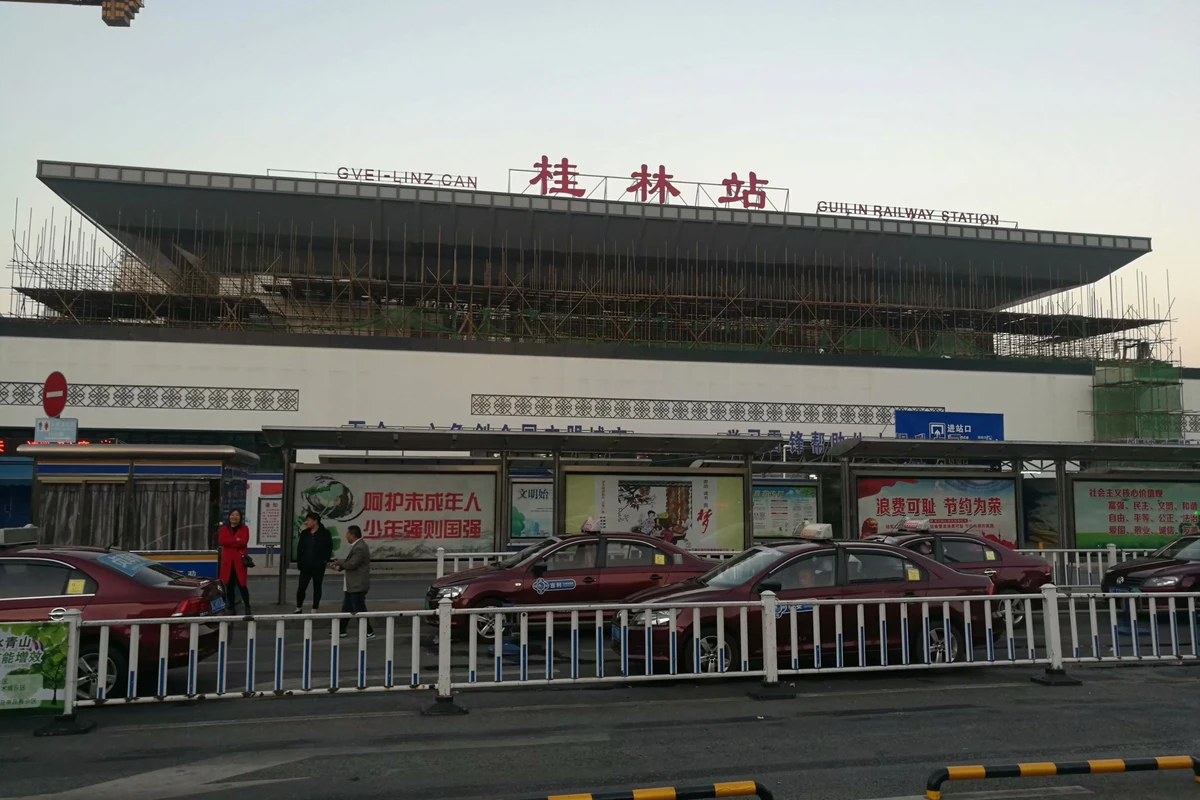
From Kaifeng to Guilin, previously there was no suitable train in the past two years, so the only option was to fly. But now there is a direct train from Zhengzhou to Guilin, which takes 13 hours. Guilin Railway Station is very close to the Elephant Trunk Hill Scenic Area, located in the south of Guilin city. Guilin North Station is in the north of the city, relatively closer to Diecai Hill and Fubo Hill. I got off at Guilin North Station and found multiple bus routes to the scenic area. The unauthorized guides and taxi touts at Guilin North Station were quite persistent; even after I indicated I didn't need a ride, they would still follow me for a long distance, trying to chat and persuade me. If you have already made a plan in advance, I suggest ignoring them and following the navigation to the bus stop.
The scenic spots in Guilin city are mostly clustered together, and two to three days are enough to visit them all. Looking at the map: at the northernmost part are Diecai Hill and Fubo Hill scenic areas, which are not far from each other. They can be arranged for one day. During the pandemic, the south gate of Diecai Hill was not open; only the east gate could be used.
After entering through the east gate of Diecai Hill, you will see a stone tablet inscribed with "Guilin's mountains and waters rank first under heaven". That is the entrance for climbing the hill. Apart from the main peak, Bright Moon Peak, there is also a Crane Cave on another hilltop, but I did not go there. If you have enough time and energy, you can explore the hidden path.
From the climbing entrance, passing through a cave, after about 20 minutes of climbing, you reach Bright Moon Peak, the highest peak in Diecai Hill Scenic Area and also the highest point in Guilin city. You can watch the sunrise and sunset here. The hills in Guilin are not tall, so climbing them is not particularly strenuous. It takes about two hours to walk through the entire Diecai Hill Scenic Area. From Bright Moon Peak, you can overlook Fubo Hill. Fubo Hill Scenic Area is across the river from Diecai Hill. At the entrance of the scenic area stands a statue of a general drawing a bow and shooting an arrow. Legend has it that when General Fubo, Ma Yuan, was on a southern expedition, he negotiated with the enemy, and the place where he shot the arrow became the boundary. The enemy was delighted, thinking about how far an arrow could go, but unexpectedly General Fubo shot through three mountains, sending the arrow directly to the enemy's starting point. Seeing the general's might, the enemy retreated dejectedly.
Inside Fubo Hill Scenic Area, there is a teapot-shaped statue of the God of Wealth, which is quite interesting.
In the belly of Fubo Hill, connected to the Pearl Returning Cave, there is a scenic spot called Thousand Buddha Rock. The Buddha statues inside have various postures and delicate features. You can go up three levels along the escalator. It is a precious Buddhist art treasure.
Fubo Hill is also associated with the famous "Princess Huanzhu" from Qiong Yao's dramas. Pearl Returning Cave was the place where Princess Huanzhu was imprisoned. The large iron bell seen at the entrance and a large iron pot in the corridor that could serve a thousand people were originally stored in Dingyue Temple. During the Anti-Japanese War, the temple was damaged, so the iron bell and pot were moved here. These two objects were also cast by Princess Huanzhu in memory of her deceased father.
Exiting from the Thousand Buddha Rock in Pearl Returning Cave, it takes less than half an hour to climb to the top of Fubo Hill. Overlooking the scenery of Guilin city, I waited at the top of Fubo Hill for the sunset. As the sun set, the mountains layered beautifully, offering a mesmerizing view.
As the afterglow of the sunset slowly faded to the edge of the horizon, I could stroll down the mountain. The entire Fubo Hill Scenic Area takes about an hour to visit.
Leaving the gate of Fubo Hill Scenic Area, walking along the Li River for about ten minutes, you can see Xiaoyao Tower.
Xiaoyao Tower guards the city and moat, offering a broad view of the clear sky. From the tower, you can see the reflection of the Li River horizontally flowing nearby, and in the distance, the blue peaks rise one after another. Climbing the city tower is free, and the night view is indeed very beautiful! Moreover, next to Xiaoyao Tower are East-West Alley and Zhengyang Road Pedestrian Street. After walking to exhaustion, you can directly enjoy delicious food!
East-West Alley, also called "Zhengyang East Alley" and "Zhengyang West Alley", is the only remaining historical district from the Ming and Qing dynasties in Guilin, and it is the birthplace of many time-honored Guilin brands.
I bought a Guilin snack called "Water Chestnut Cake" in East-West Alley, three for ten yuan. It looked crystal clear and tasted soft and chewy without sticking to teeth. Adjacent to East-West Alley is another 5A-level historical and cultural scenic area in Guilin, which is said to be the place where one can understand Guilin after seeing the Royal City — Solitary Beauty Peak and Jingjiang Prince's Mansion. Jingjiang Prince's City was built in 1372, grand in scale, with deep gates and sturdy walls. Today, you can not only appreciate the majesty and solemnity of the former royal city but also touch the vicissitudes of the 600-year-old city wall with your own hands. The home of the only Han Chinese princess of the Qing Dynasty, Kong Sizhen (also known as "Princess Huanzhu"), was within the deep palace forbidden area of the former prince's mansion. It was after visiting the prince's mansion and being inspired by the story of Princess Huanzhu that Ms. Qiong Yao created the re-run drama we watch every summer vacation. The ticket for Jingjiang Prince's Mansion costs 120 yuan, which I personally think is a bit expensive. Actually, there is not much to do inside. Climbing Bright and Beautiful Peak is mainly to learn about the history of the prince's mansion and Guilin itself. This scenic area is within the campus of Guangxi Normal University. It seems that after 6:30 PM, you can enter through the side gate with a Guangxi Normal University student ID. When I was about to leave at dusk, I indeed saw many university students running and studying in the scenic area. After entering Jingjiang Prince's Mansion, there will be a free tour guide provided by the scenic area to lead visitors through explanations. I have never had a good impression of this kind of free tour; in the end, it usually leads to诱导消费. But if you are careful not to fall into the trap, following the guide can be worthwhile. In the ninth year of Shunzhi, the new owner of the prince's mansion, Ming general Kong Youde (father of Princess Huanzhu), committed suicide after defeat, setting fire to the mansion, and it turned to ashes. Several buildings of the prince's mansion could only be viewed from a distance and not entered, which was a pity.
At the Solitary Beauty Peak Reading Cave, you can find the authentic cliff inscription of "Guilin's mountains and waters rank first under heaven" left by Wang Zhenggong of the Southern Song Dynasty 800 years ago. This eternal phrase originated here. Under the guidance of the free tour guide in Jingjiang Prince's Mansion Scenic Area, visitors can personally experience rubbing blessings and participate in imperial examinations. The top scorer in each exam can get discounts on purchasing some souvenirs, photography services, etc. This is a matter of personal opinion; I turned up my nose at it.
Inside Jingjiang Prince's Mansion, there is Solitary Beauty Peak, known as the "Southern Pillar of Heaven". You can climb it with the ticket. The peak is not tall; it takes about half an hour to reach the top.
The top of Solitary Beauty Peak is the best place to view the entire city of Guilin, and it has been sought after by famous scholars since ancient times. The Ming Dynasty traveler Xu Xiake stayed in Guilin for over a month but regretted not climbing Solitary Beauty Peak. I followed the ancient path and climbed to enjoy the beautiful scenery!
If time permits, you can wait for the sunset at Solitary Beauty Peak and see the bustling night scene of Guilin city nestled among the mountains.
According to the map, southeast of Jingjiang Prince's Mansion is Seven Star Park. This park is most famous for Seven Star Hill and Seven Star Cave. The entrance fee is not expensive, but to visit Seven Star Cave, you need to buy an additional ticket. I suggest that if you don't plan to visit other karst caves in Guilin, you can see it here. After all, there are too many karst cave themes in Guilin and Yangshuo.
Legend has it that three camels stopped in Guangxi: one in Yangshuo, one by the Li River, and the third lying in Seven Star Park. Since I had visited other caves and didn't go to Seven Star Cave, the most impressive thing in Seven Star Park for me was the exquisite camel-shaped hill in the photo below. When the glow of sunset spreads, Camel Hill's colors are gorgeous and spectacular, which is also one of the legendary Eight Scenes of Guilin — Hushan Red Glow.
Beside Camel Hill, there is a statue of a famous scholar. He was Lei Jiuren from the late Ming Dynasty. He was good at poetry and prose, drank often without getting drunk. After his death, people buried him at the foot of Camel Hill, surrounded by peach blossoms, to commemorate his helpfulness and loyalty. Today, the peach blossoms still bloom, the osmanthus trees fill the forest, and the red glow on the hill is even more brilliant.
Since ancient times, famous mountains have ancient temples. Although the incense is not strong, the tranquil practice of the monks in the temple is probably the essence of Buddhism. Qixia Zen Temple is located at the west gate of the park. I entered through this gate and walked eastward, crossing the entire Seven Star Park. In this special year of 2020, epidemic prevention and control is a top priority. The cute cartoon prompts at the temple were quite interesting.
Seven Star Park is the largest comprehensive park in Guilin city. Inside, besides many historical sites, there are also a series of patriotic education bases such as the Martyrs' Cemetery.
At the vast Huaxia Light Square, I happened to catch the autumn outing of local primary school students. The joyful and chasing children suddenly brought me back to my childhood memories. At that time, I was also wearing a red scarf, carefree. Near the Crescent Moon Building in Seven Star Park, there are many wild monkeys. After decades of living there, they are now unbridled in the park and not afraid of humans. Although they cannot compare to the wildness of the monkeys in Mount Emei, if you feed them, do not deliberately tease or provoke them.
Flower Bridge is right next to the main gate of Seven Star Park. If you enter from the main gate, you will definitely cross Flower Bridge. Flower Bridge is the oldest bridge in Guilin, originally built in the Song Dynasty, spanning the Xiao Dongjiang River, with a total length of 135 meters. Every year in spring and summer, grass grows and orioles fly, flowers bloom everywhere, the bridge is surrounded by colorful flowers, and both banks are covered with green bamboos, hence the name Flower Bridge. It takes about three to four hours to visit the entire Seven Star Scenic Area. The scenic area has four gates. Due to time constraints, I entered through Qixia Gate and exited through Longyin Road Gate after visiting Seven Star Park, heading to Zizhou Park. Everyone can arrange their routes according to their own itinerary to avoid backtracking.
Exiting from Longyin Road Gate of Seven Star Park, walking about 20 minutes, you can reach Zizhou Park. It is said online that this is the best place to see Guilin's landmark Elephant Trunk Hill. In my opinion, it's just looking at Elephant Trunk Hill from another angle—the right side of the elephant. Zizhou Park is actually an island. During the Tang Dynasty, it was named after a family named Zi living on the island. The shape of the island is like a boat floating in the water, so it is also called Floating Island. Located on the east bank of the Li River, it faces Elephant Hill Park across the river, so you can overlook Elephant Trunk Hill from across the Li River.
Overall, I didn't have a particularly good impression of Zizhou Park, probably because it wasn't very fun. Tour groups came in waves one after another. The blaring loudspeakers urged and introduced. Although the scenic area is not large, the main thing is to take a look at Elephant Trunk Hill from the shore, so either walk half an hour to the viewing platform by the Li River, or spend 20 yuan to take the sightseeing car. It's a bit like Orange Isle in Changsha, but the overall scenery is much worse.
Zizhou Island has many celebrity statues to highlight the historical and cultural feel of the scenic area.
The relief sculpture of Liu Zongyuan below is where tour groups line up to take photos. The staff will take photos of everyone for free, and finally combine them with the photos from the Elephant Trunk Hill viewing platform to make small keychains given free to visitors. But if you want to buy high-definition large photos, you need to pay. In the end, I bought a family photo amid the chaotic persuasion and sales pitches.
Among the few scenic spots, this Zijiazhou Pavilion is where the sightseeing car stops, behind the relief of Liu Zongyuan. The sea of tour groups gathers here again. After a brief explanation by the guide, the tourists are led to a waterfront wooden boardwalk next to Zijiazhou Pavilion. In the middle of the boardwalk, there are several vendors writing and painting on site. I stopped to watch, and some elderly people would happily buy. If you are not following a tour group, you can finish the trip here in less than an hour.
Back to the main topic, a scenic spot that you absolutely cannot miss in Guilin is undoubtedly Elephant Trunk Hill Scenic Area. To avoid meeting tour groups and turning the scenic viewing into a crowd of heads, I chose to enter from Gate 1 of Elephant Hill Park at around 8:00 the next morning.
Gate 1 is closest to the climbing entrance of Elephant Trunk Hill. Gate 2 is the entrance used by most tour groups because it is closest to the best viewing platform for Elephant Trunk Hill. Since I was traveling independently, I had plenty of time, so I took it slow and climbed Elephant Trunk Hill.
After entering from Gate 1, I found several cute little elephants!
Climbing the not-so-high Elephant Trunk Hill took about half an hour. For those who are not particularly mobility-impaired, it is easy to reach the top.
At the top of Elephant Trunk Hill, there is Puxian Pagoda. The interior is no longer open to visitors, but you can walk around the pagoda and worship devoutly. There are only two stupas dedicated to Samantabhadra in China: one at Mount Emei in Sichuan, and one at Elephant Trunk Hill in Guilin. From a distance, it looks like a sword handle stuck on the elephant's back, or an elegant treasure vase, so it is called "Sword Handle Pagoda" or "Treasure Vase Pagoda".
Coming down from Elephant Trunk Hill, you can directly go to the elephant's trunk and appreciate it up close! Viewing it from a distance is better than close up; up close, it's just a weathered hollow. If you are willing to pay extra for a sightseeing boat, that should be the best way to see Elephant Trunk Hill.
After taking photos at the elephant's trunk, you can go in the opposite direction along the path around Elephant Trunk Hill, return to the climbing entrance at Gate 1, cross a floating bridge, and arrive at the opposite bank. After a few dozen steps, the view opens up.
Perhaps the scene I had seen countless times online and on TV was now presented before me. This spot at the confluence of the Li River and Peach Blossom River, where the shape of the mountain resembles an elephant stopping by the Li River to drink water, is regarded as the city emblem of Guilin and is the reason why many people come to Guilin. Raise the camera, ignore the ever-present background crowd, and leave a memory for yourself.
After passing the best viewing spot for Elephant Trunk Hill, you come to Love Island. If you listen to the tour guide's explanation, the distant mountains by the river are said to be lovers in love. Nothing else, just a place to take photos from another angle.
The creative sculptures on Love Island are quite impressive. This scenic area is also a place for local residents to exercise in the morning. It is free before 6:30 am, but after 9 am, the morning exercisers have to leave to make room for tourists from afar.
As for the so-called "Elephant Hill Secret Realm" and "Mysterious Elephant Village," I really didn't find anything interesting. Fortunately, the distance is not far, and you can walk around in five minutes. I guess the purpose of the scenic area is to divert the crowd and allow tourists to exit through Gate 3 after visiting the Mysterious Elephant Village.
Leaving Elephant Hill Park, walking about five minutes and crossing a road, you can reach another landmark scenic spot in Guilin — Sun and Moon Twin Pagodas.
Sun and Moon Twin Pagodas are the tallest bronze pagoda, tallest bronze building, and tallest water pagoda in the world. They are also a cultural landmark of Guilin. Along with Puxian Pagoda on Elephant Hill and Shoufo Pagoda on Tower Hill, they are collectively praised as "Four Pagodas of Equal Beauty."
Walking around the lake to the entrance, the ticket costs 42 yuan. Personally, if you are not interested in Buddhist culture, you can just view from the lakeside. The golden pagoda is the Sun Pagoda, with an elevator inside that goes directly to the top floor for views. The Sun and Moon Twin Pagodas were rebuilt in 2001 on the foundation of a Tang Dynasty Buddhist pagoda. The two pagodas are connected by an underground palace. When the lake water level drops, you can see the beams of the underground palace connecting the two pagodas from the ground.
In the underground palace on the first basement level of the Sun Pagoda, there are many exquisite and precious Buddhist artifacts on display. Since taking photos of Buddha statues is not appropriate, I only took pictures of some stone bricks as souvenirs.
The underground palace passage connecting the Sun and Moon Twin Pagodas is decorated with beautiful Buddhist murals, dignified and solemn.
Sun and Moon Twin Pagodas can be viewed from the shore of Shanhu Lake. The best time to view them is at night. Every night, the pagodas are lit up — one with golden light and the other with silver-white light. The visual effect during the day when the lights are off is not good. The lights at the scenic spot are turned off at 11 pm every night.
It is said that Guilin's night scenery is the most beautiful. The best way to enjoy the scenery of Two Rivers and Four Lakes is by taking a cruise, although it is expensive. Some online guides suggest that if you don't want to spend money on a boat, you can walk by the lake and still see the beautiful night view. However, I tested it at night: the Sun and Moon Twin Pagodas can still be seen with lights from the shore, but the dense trees planted along the bank block the view of Elephant Trunk Hill at night. If you want to see the night view of Elephant Trunk Hill, you probably have to pay for a boat ride.
Exiting from Sun and Moon Twin Pagodas, there are several yellow buildings on the shore — that is the former residence of Li Zongren. Because my father likes Chinese war films, he is interested in this legendary figure of the Republic of China and insisted on visiting Li Zongren's former residence. If you are interested in this place, pay attention to the closing time; you cannot enter half an hour before closing.
My understanding of Li Zongren still comes from the Battle of Tai'erzhuang in history textbooks. In recent years, watching movies like "The Founding of a Republic," I became familiar with his grudges with Chiang Kai-shek and his legendary life.
The main color of the residence is yellow, giving it a sense of wealth and elegance.
I remember in "The Founding of a Republic," Li Zongren was elected acting president, and Chiang Kai-shek coldly refused to shake his hand. But a photo of our leader shaking hands with him is displayed in the first room of the residence. It's truly a reminder of the rolling tides of history and the changing winds.
Li Zongren's former residence was my last stop in Guilin, ending my trip in less than an hour. If you want to see the night view of Sun and Moon Twin Pagodas, you can first visit Li Zongren's former residence in the afternoon, then have dinner, and then you are right at Shanhu Lake and the Twin Pagodas.
After a five-minute walk from Li Zongren's former residence, cross a traffic light, and you can take Guilin Bus No. 3 directly to Reed Flute Cave Scenic Area. Reed Flute Cave is relatively far from the city center among Guilin's scenic spots, but it is actually only 5 kilometers from the city center. However, because other scenic spots are so concentrated, going to Reed Flute Cave seems a bit complicated.
Next to the ticket office of Reed Flute Cave, you can buy an additional ticket to take this small train that shuttles through the jungle and directly to the cave entrance. The small train fare is 35 yuan. Personally, if you don't have children to please or elderly with mobility issues, walking up is also fine. After all, the cave entrance is not far, about a ten-minute walk.
The ticket for Reed Flute Cave is expensive. At the cave entrance, you have to wait for about ten to twenty visitors to gather, and then follow the tour guide into the cave together. It takes about an hour to come out of the cave. Although there are stairs to climb, the safety measures of the scenic area are quite adequate.
The stalactites in the cave are lifelike, and with the tour guide's explanations, they are even more impressive. When visiting, try to follow the guide closely because the lights at each scenic spot in the karst cave are controlled by a magnetic card key in the guide's hand; they only turn on when swiped. It is commendable that the free guide at Reed Flute Cave gave a thorough explanation from beginning to end without pushing any hidden consumption.
This snowman is crystal clear; a real snowman is probably just like this. Another major feature of Reed Flute Cave is the naked-eye 4D movie visual show, which appears directly on the cave ceiling. However, there is a one-hour break at noon, so you must plan your time.
"Lion Bidding Farewell" is the last scenic spot in the cave. If your itinerary also includes Seven Star Cave or Silver Cave in Yangshuo, you can choose one of them. After all, there are many similar karst cave landscapes in Guilin.
Exiting the cave, you can walk along the wooden boardwalk by the water back to the parking lot and bus stop. After spending over an hour visually impacted by the stalactites, stepping out to see the picturesque countryside scenery is very pleasant. At the entrance and exit, many locals sell reed flutes for a few yuan each. Blowing them produces a sound like bird chirps. Reed Flute Cave is located in Guangming Mountain, with the cave entrance halfway up the mountain. It is named because the entrance was once covered with reeds that could be made into flutes. If you have children, you can buy a reed flute as a souvenir.
I spent two days with my parents visiting many major attractions in Guilin city. Personally, I think two to three days are enough for Guilin city, since the scenic spots are not too far apart.
Guilin doesn't have a wide variety of food; the most famous is rice noodles. Locals can eat rice noodles for all three meals, especially breakfast, which we northerners find difficult to adapt to. When eating authentic Guilin rice noodles, don't ask how much a bowl costs; instead, tell the boss how many liang (50g) you want. Generally, men eat three liang and women two liang to get full.
Also, Cross Street is located in the center of Guilin. If you travel, staying here is the most convenient for food, clothing, housing, and transportation. If you want to take a Li River cruise, the bus from the city to Mopan Mountain Pier also departs from Cross Street. The ticket costs 20 yuan per person. During peak season, you need to buy tickets in advance through the official account.
This tourist shuttle runs only once or twice a day, starting from Dingfu Tourist Distribution Center and ending at Mopan Mountain Pier. It passes Cross Street bus stop around 7:30 am. Since many people taking the cruise to enjoy the Li River are tour groups or self-drivers, there are not many people on this shuttle. When waiting at the bus stop, be patient, otherwise you might suspect the shuttle has been discontinued.
There are many ways to travel on the Li River by boat. I took a cruise that goes directly to Longtoushan Pier in Yangshuo, a four-hour water journey. The cruise ships are divided into three-star and four-star. The three-star cruise offers better value for money, costing one or two hundred yuan less than the four-star cruise, but lunch is at your own expense, or you can bring your own food. The four-star cruise departs from Zhujiang Pier next to Mopan Mountain Pier, with better decoration and, most importantly, includes a buffet lunch.
After the cruise departs, you can go on deck and enjoy the visual impact of Guilin's mountains and waters for more than four hours. Whether sunny or rainy, the scenery differs and has its unique charm.
On the Li River, there are also these bamboo raft-style small boats powered by electric motors, but they stop operating from 9 am to 12 pm every day to give way to three-star and four-star cruise ships. Although these small boats look like bamboo rafts, they have roaring motor sounds, which is somewhat disruptive. If you want a quiet bamboo raft drifting experience, it is recommended to go to Yulong River in Yangshuo, which I will describe in detail in my Yangshuo travelogue, so I won't elaborate here.
As the eternal poem says: "Guilin's mountains and waters rank first under heaven; the jade-green ribbon and emerald peaks reveal the essence."
If Guilin is compared to a pearl, then the Li River is the string that ties the pearls together. From the vague knowledge in elementary school Chinese textbooks to today, as an adult, standing in the mountains and waters, I have fulfilled a lingering wish. Having seen Guilin's landscape under clear skies, I greedily yearn to see the city of Guangxi in the mist and rain again.
If there is a chance, I will step into this land of Guizhou again! To be intoxicated once more by these mountains and waters!


![Mountains and Waters Meet Again [Guilin Yangshuo] Let's Rock the Boat of Friendship](/img/624178c28a221adb_s.webp?src=https%3A%2F%2Fdimg04.c-ctrip.com%2Fimages%2F0104n120009cnhkrdD720_W_320_0_Q80.jpg)


