Wandering Through Winter Guangnan, Exploring Dong Villages, Experiencing the Grand Dong New Year Celebration
Mention Guilin, and most people likely recall the primary school textbook essay 'Guilin's Scenery,' the song 'I Want to Go to Guilin,' the saying 'Guilin's scenery is the best under heaven,' and the backdrop of the 20-yuan note...
But this time when I came to Guilin, Guangxi, I didn't go to the crowded trendy Yangshuo, nor did I visit the breathtaking Guilin scenery. Instead, I headed to Guangnan Village, a Dong ethnic village in Longsheng County, to learn about its culture and experience the Dong New Year.
As usual, here's a sneak peek.
Setting off from Guilin Airport, after a long two-hour drive, we arrived at Huangluo Yao Village to experience the charm of the Yao long-haired village.
Huangluo Yao Village sits against the Longji Mountains, facing the Jinjiang River, at the point where the Longji Rice Terraces begin to spiral upward. It is the only Yao village among the thirteen villages of Longji, inhabited exclusively by the Red Yao people. Huangluo Yao Village is famous for the long hair of the Red Yao women, having been recognized by the Guinness World Records for the 'Longest Hair Group,' earning it the title 'The World's First Long-Hair Village.'
Only after crossing the small bridge do you enter the village. The houses look somewhat similar to the stilted buildings in Fenghuang. A small river flows through the village, adding a poetic touch to daily life.
As soon as I entered the village, I saw several elder sisters warming themselves by a fire and chatting, with chickens freely foraging nearby. Instantly, a fresh breath of life hit me. I couldn't help but feel relaxed and forget my worries. Life here in the Yao village is still relatively simple, with elderly Red Yao women gathered around the charcoal fire, chatting about everyday matters.
These ethnic minority women are skillful and have set up stalls along the street to sell handmade crafts, earning a significant part of their livelihood.
Young Yao women typically wear bright red dresses with black skirts and old-fashioned cloth shoes. Married women wear a mix of black and red, while elderly women wear pure black clothes with only a red belt. Without exception, every Yao woman—young or old, married or not—wears large silver earrings. Their hairstyles also differ: unmarried women, married women, and those who have given birth all have their own ways of coiling their hair.
To learn more about the daily habits of the long-haired village girls, a local performance is not to be missed. Join the singing and dancing Yao girls, experience a Yao long-haired village wedding ceremony, and watch the intricate process of hair coiling... Arriving at the long-haired village performance stage with a curious mind will bring far more surprises than you can imagine.
The most touching moment came when watching a daughter help her mother wash her long hair. Because the hair is so long, each wash is a major undertaking. Helping a mother wash her hair has become an ordinary yet heartfelt way for children to show filial piety.
After watching the wonderful folk performances of the long-haired girls and learning many secrets about their long hair from their explanations, I gained a deeper understanding.
'Long hair' not only brings honor but also has become an unexpected source of income for the villagers. The women use their long hair in combination with local customs and performances, hosting tourists from all over the world.
The clothes worn by the Yao people are all hand-sewn, stitch by stitch. The women are skilled with their hands; every stitch and thread is made by their own hands, and the Yao women are no exception. Even now, the colorful knitted goods sold in these villages are still woven by themselves.
The paths in the Yao village are narrow, similar to what I've known of other ethnic minority settlements. But I like it. I like walking slowly along these paths and thinking quietly.
Jinzhu Zhuang Village is rich in history, also located within the Longji Rice Terraces scenic area, about a ten-minute drive from Huangluo Yao Village. Jinzhu Zhuang Village is named for its golden bamboo groves and is known as the 'first village' among Longji's thirteen villages.
Nestled against the mountains and rivers, it is built on the steep slopes at the foot of the Longji Rice Terraces, forming a spectacular 'terraced house' landscape. Many films and TV series, such as 'Heroic Tiger,' have used Jinzhu Zhuang Village as a filming location.
Unfortunately, a big fire in 2017 burned a large part of Jinzhu Zhuang Village. After two years of reconstruction, in 2019, the village welcomed visitors with a new look.
We stayed at a guesthouse in Jinzhu Zhuang Village. The over twenty guesthouses here each have different themes, with standard rooms, king-size bed rooms, family rooms, and viewing rooms with balconies, ranging from 300 to 2000 yuan. The rooms are very comfortable, the beds are comfortable, and the rooms are spacious enough.
The old lock on the ancient wooden door of the building, the vintage wooden chest, the old embroidery full of maternal love on the wall, the old teapot printed with red culture, the festive dragon-phoenix quilt... These special old items might touch a chord in your heart, allowing you to travel through time to a dreamed place. Here, you find both the warmth and security of home and a way of life you can't experience at home.
I like staying in guesthouses, especially quiet ones in the mountains. A guesthouse might be the best place to find a sense of belonging. Here, you can shake off the pressures of urban work and life, give your weary soul precious comfort, and more importantly, rediscover a long-lost sense of belonging and the best version of yourself in your memories.
In the guesthouse, with a cup of tea, you can enjoy a leisurely time—'stealing a moment of leisure from a busy life.' Just sit quietly, and your mind will drift with the mist of the tea, flow lightly with the music in your ears. Spend the entire evening with a cup of tea, and see the starry sky in half a dream.
On the way from Longji Rice Terraces to Guangnan Village, we passed through Jiangkou Village in Lejiang Town. It was bustling with activity—Dong compatriots from Hunan, Guizhou, and local Dong people gathered at the Dong village drum tower to celebrate the annual 'Dong New Year Festival.'
Dong brothers and sisters from Hunan, Guizhou, and Guangxi, dressed in ethnic costumes, set up a 'hundred-family feast' in front of the drum tower, singing and dancing to celebrate the Dong New Year.
A pipa song singing competition was also held, where Dong contestants played touching Dong tunes and praise songs about poverty alleviation on their pipas.
Due to time constraints, we didn't stay long and continued to Guangnan Village.
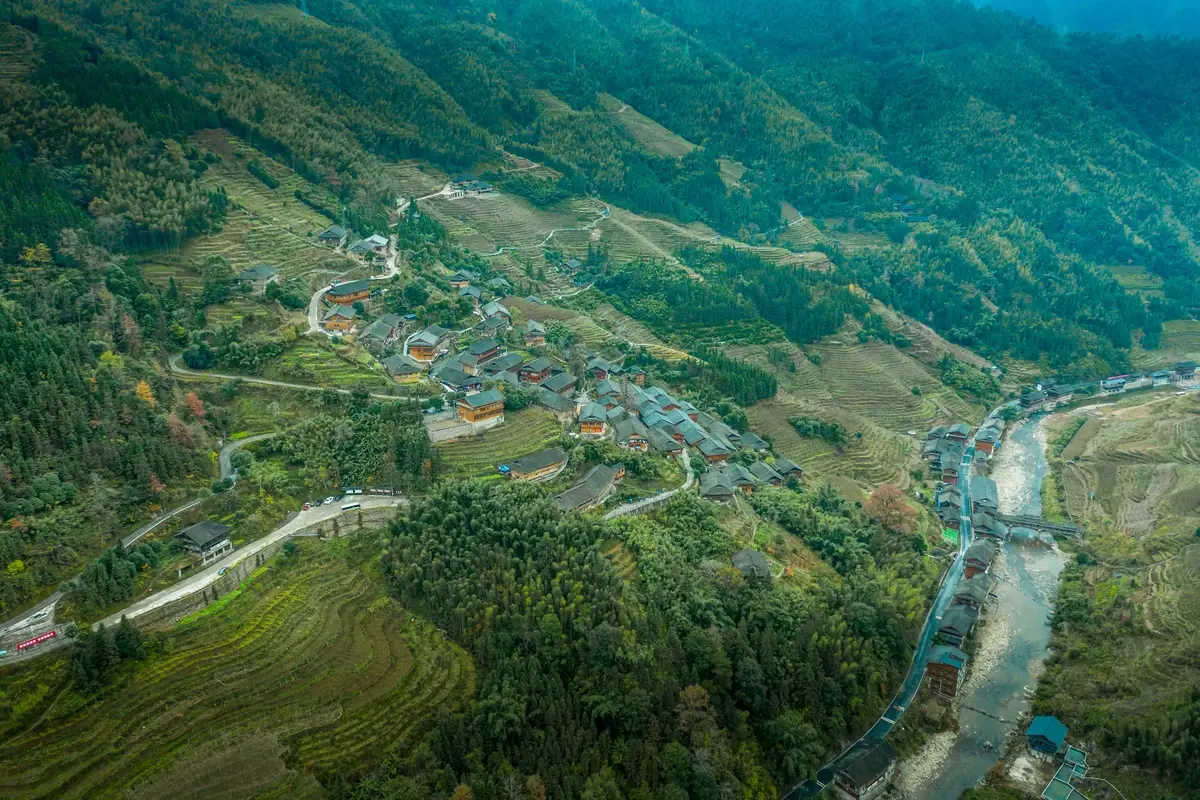
Entering Guangnan Village in Pingdeng Town, Longsheng County, Guilin City—a Dong ethnic enclave listed as one of the fifth batch of traditional Chinese villages in 2019. With the deepening of beautiful countryside construction, many villages have been renovated, and Guangnan Village has become increasingly charming. Every household has three or four-story buildings. Folk customs remain unchanged, and the village still retains traditional Dong customs.
Dong brocade and grass dragons are intangible cultural heritage. Few people in Guangnan Village still practice these crafts, which are the most important to preserve and pass down.
The most distinctive structures in a Dong village built against mountains and rivers are the wind-rain bridges, drum towers, and village gates. Listen to an authentic Dong welcoming song and feel the simplicity and hospitality of the Dong people.
Because the bridge has corridors and pavilions, it provides shelter from both sun and rain, hence the name 'wind-rain bridge.'
The village also has many stilted wooden buildings worth savoring. Most are typical three-story structures: the first floor for raising pigs and cattle, the second for living, and the third for storing grain and miscellaneous items.
The fire pit culture is still preserved. The local fire pit is used for cooking, heating, and lighting. Villagers sit around the fire pit chatting and discussing matters. If you're interested in fire pit culture, when you visit Guangnan Village, be sure to sit with a Dong brother around his fire pit, taste local specialties, and experience Dong culture.
The Dong New Year is the New Year of the Dong calendar. It is as lively as the Spring Festival we know. On this day, people in Guangnan Village wake up early, young and old, dressed in festive costumes, and gather at the drum tower in the center of the village. The drum tower is an important venue for discussions, leisure, and festive gatherings.
Many tourists come to Guangnan Village in Pingdeng Township to celebrate the 'Spring Festival' joyfully with the locals. Dong villagers, dressed in festive costumes, perform grass dragon and grass lion dances, dance the Duoye dance, and sing pipa songs, creating a lively and festive atmosphere.
Today is also the annual ancestor worship ceremony. Large families in Guangnan Village—Meng, Long, Lan, Liang, Hu, Tang, Wang, and others—come together to worship their ancestors, making it a very lively event.
Making glutinous rice cakes (ciba) is a must for the Dong New Year, symbolizing a bountiful harvest. The cakes are made from pounded glutinous rice, mixed with brown sugar and sesame, soft and chewy with a sweet taste—probably the most 'New Year's flavor' food. The first cake made is offered with prepared brown sugar or sesame powder for everyone to taste and celebrate the harvest together.
As dusk falls, the performances end. People carry wine jars and shoulder carrying poles to the drum tower square to start a unique 'hundred-family feast.' Villagers gather together to eat a hundred dishes, drink a hundred wines, and enjoy a hundred blessings. At the feast, people toast each other, chat, sing drinking songs, and enjoy the time of reunion.
The 'hundred-family feast' is a Dong way of entertaining guests and celebrating. Each household brings out their best food to share. Celebrating the Dong New Year is not just about entertainment; it's also a gourmet feast. Pickled fish, glutinous rice cakes, and oil tea are indispensable delicacies on the festive table.
As night falls, the stories of the past year drift away with the melodious Dong grand song. People light a bonfire, sing and dance to celebrate the reunion, and look forward to the new year.
In the hospitable, simple, and honest Guangnan Village, I never felt like a tourist far from home. It felt as if our family was part of their community, cheering and having fun together with the villagers, young and old.
Every time I travel, it's not just the beautiful scenery that attracts me, but also the mouthwatering foods of Longsheng and Guangnan.
As the saying goes: 'In life, only good food and beautiful scenery are not to be let down.' And all the good 'food moments' are always on the road.
For many travelers, food and scenery are equally important. A trip without good food is incomplete.
Tasting delightful food during a journey is truly a joyful experience.
The three must-eats of Longsheng cuisine: bamboo rice, bamboo chicken, and oil tea! Oil tea is made by boiling tea with ginger and scallions, and the ingredients are local grains fried into popcorn rice. The bamboo tubes are freshly cut that day, slowly cooked over a fire!
Bamboo chicken: At first I thought it was something like potato chicken stew with lots of ingredients, but it turned out to be chicken soup. The only 'ingredients' were a few red dates and goji berries. But the soup tasted great, and the price was good too—78 yuan for half a chicken.
Bamboo rice: The most authentic Longji food. Cut a section of bamboo, fill it with an appropriate amount of local rice, water, carrot, and cured meat, then roast it in a fire. When the bamboo is scorched on the outside, the rice is done. Split the bamboo, and the rice is wrapped in a thin bamboo film—soft, fragrant, and delicious, with the aroma of bamboo and the fragrance of rice. This is the famous 'bamboo rice.'
Oil tea: Made with tea leaves, puffed rice, crispy soybeans, and fried peanuts, steeped in oily tea water, and then mixed with pork offal, scallions, and other ingredients. This unique tea drink is a special Dong hospitality drink.
There's also sweet rice wine, Longsheng sour raw fish slices, cured meat, wild fern, canzi cakes, braised pork, Diling flower pigs, and various local specialties—all worth trying and sure to satisfy!
1. Cards: Bring your ID card, bank card, driver's license, and any other relevant documents.
2. Tickets: Confirm your travel dates and choose your transportation in advance—plane or train. It's best to download a travel app.
3. Electronics: DSLR camera, phone, laptop, mobile hard drive, chargers, power bank, and power strip.
4. Clothing: Check the weather forecast and pack appropriate clothes. Summer is hot, so take sun protection. Winter is cold, so prepare for warmth.
5. Medicine: Bring antipyretic and detoxifying medicine or granules, band-aids, etc.
6. Summer is the rainy season in Guilin, so remember an umbrella. In winter, dress warmly when going into the mountains.
Best time to visit Longji Rice Terraces:
- Mid-April: water begins to be filled; late June: water-filled and rice transplanting season. Usually Ping'an Village has water in April, while Jinkeng Dazhai starts filling water in mid-May.
- July to mid-September: lush green scenery.
- Late September to mid-November: golden Longji (bright yellow; Jinkeng Terraces start harvesting about a week after National Day).
- Late December to early February: silver-coated (Jinkeng Terraces scenic area).
As a tourist city, Guilin has convenient transportation with one airport and three train stations.
Guilin Airport is located in Lingui County, about 28 km from the city center, a 30-40 minute drive. The airport shuttle runs all day, costing 20 yuan, traveling between Liangjiang Airport, Swan Hotel (near the train station), and Civil Aviation Building.
Taxi: City to airport express costs 80-100 yuan.
Guilin's three train stations are in different districts/counties. The closest to the city center is Guilin Station, followed by Guilin North Station, and then Guilin West Station. High-speed rail is very convenient.
Huangluo Yao Village and Jinzhu Zhuang Village are both within the Longji Rice Terraces scenic area. Here's how to get to Longji.
Longji Rice Terraces are relatively far. Choose from the following four options based on your situation:
Method 1: Self-drive from Guilin directly on the Baomao Expressway towards Longsheng, reaching the scenic area in about 1.5 hours.
Method 2: From Guilin Railway Station Square, there are 4 daily buses directly to Longji Jinkeng Terraces Dazhai parking lot! Departure times: 8:30, 9:30, 11:30, 15:30.
Method 3: Take an express bus from Guilin Qintan Bus Station (no stops in between) at about 27 yuan/person, 2 hours; then transfer at Longsheng Bus Station to a tourist bus to Dazhai Jinkeng Terraces for 9 yuan/person to the foot of the mountain, about 90 minutes.
Method 4: Take a train from Guilin North Station to Longsheng, then taxi to Longji.
Method 5: Book a one-day tour to Longji in Guilin—saves effort, includes round-trip transport, tickets, and lunch—very convenient.
Guangnan Village: Self-drive there.
For a trip to Guilin with 2-3 people, I recommend self-driving, as scenic spots are relatively far apart. Driving gives you control over time and makes it easier to get around.
Beijing time, 2:00 AM.
After finishing my travel notes, I still can't find any sleep. My mind is full of the happy figures amidst the songs and dances.
There are many mountains there, the food is delicious, and the people are beautiful. Every image makes me want to pour a glass of wine and sit quietly in a daze.
There is no dazzling urban splendor here, only an irreplaceable beauty in the dim light. Sit down and feel the artistic power of dance and song. But what warms the heart the most is the warm and simple hospitality, the smiles, and the humanistic care that should exist universally.
Travel notes directory:
1. [Preface]
2. [The World's First Long-Hair Village—Huangluo Yao Village]
3. [Jinzhu Zhuang Village, Reborn from Fire]
4. [Traditional Chinese Village—Guangnan Village]
5. [Dong New Year, a Village Ethnic Celebration]
6. [Local Cuisine]
7. [Travel Tips]
8. [Scenic Area Transportation]
9. [Afterword] Tourism info hotel index guide index flight index website navigation tourism index cruise index corporate travel index affiliate cooperation distribution alliance friendship links enterprise gift card purchase insurance agency agency cooperation hotel partnership destination and scenic area cooperation more partnership about Ctrip Ctrip hotspots contact us careers user agreement privacy policy business license security center Ctrip content center intellectual property Trip.com Group algorithm disclosure


![Mountains and Waters Meet Again [Guilin Yangshuo] Let's Rock the Boat of Friendship](/img/624178c28a221adb_s.webp?src=https%3A%2F%2Fdimg04.c-ctrip.com%2Fimages%2F0104n120009cnhkrdD720_W_320_0_Q80.jpg)


