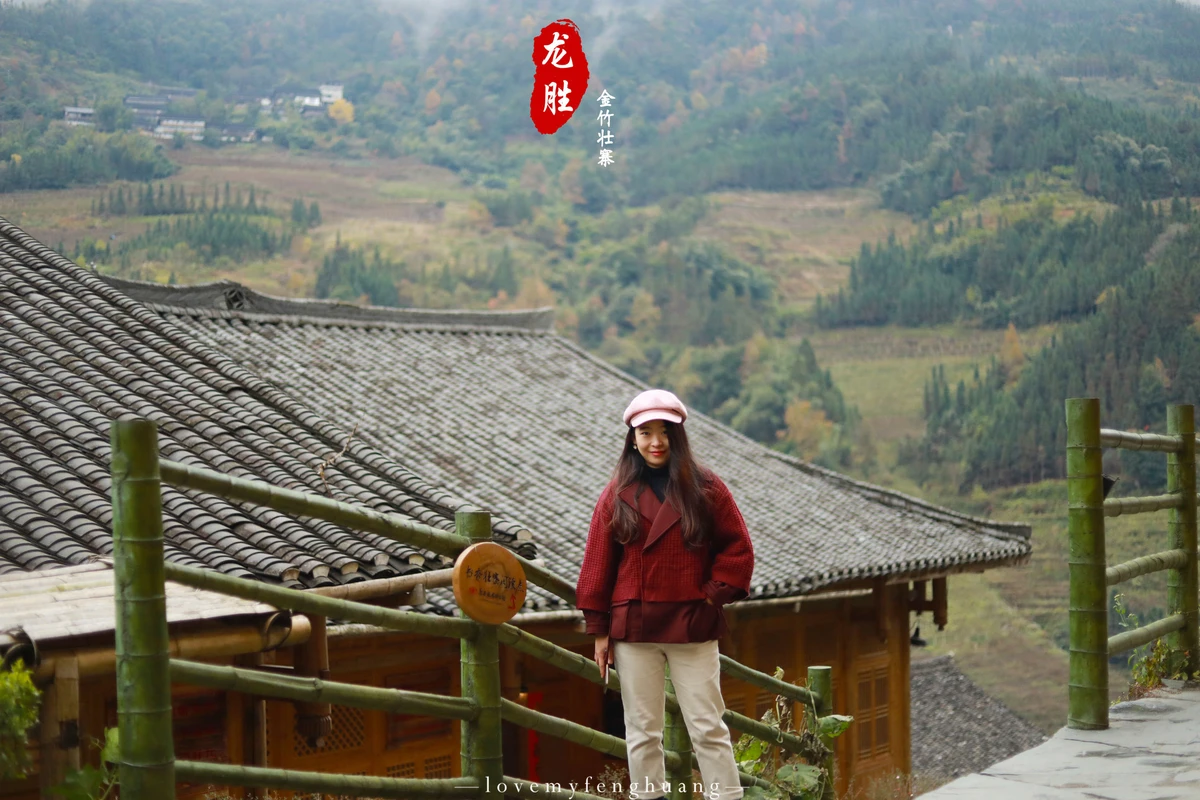
Guangxi Longsheng | Exploring the Ancient and Mysterious Thousand-Year-Old Village, Experiencing the Dong New Year
In the blink of an eye, it's December. As New Year's Day approaches, deep in the mountains of Longsheng Various Nationalities Autonomous County, Guilin, Guangxi, they are joyfully welcoming the annual Dong New Year. It takes nearly two hours by car from Guilin airport to Longsheng. Finally, we arrived at Jinzhu Zhuang Village at the foot of the Longji Rice Terraces. The houses built along the mountainside are like terraced fields, scattered in an orderly manner. Since it was almost evening when we arrived, the quiet village was rarely disturbed by outsiders. Our group decided to rest here for the night and experience the Zhuang village's customs.
Jinzhu Zhuang Village is known as the 'First Village' among the thirteen villages of Longji, named after a grove of golden bamboo in front of the village. It has 98 households and over 430 people, making it a typical Zhuang village in China, known as the 'First Zhuang Village of the North'. The stilted houses (diaojiaolou) have a unique architectural style and are well preserved. Today, you can experience Zhuang-style guesthouses with various room types, including two-story attic-style stilted houses and special extra-large wedding rooms. The large floor-to-ceiling windows allow you to enjoy the green mountains and clear waters without leaving the room.
In Longsheng, there is a traditional custom of making and eating oil tea (yóuchá) that has been passed down for generations. Regardless of the ethnic minority group, this eating habit is still preserved. The tea soup is mixed with cereals and seasonings such as coix seed, sweet potato, and corn, which not only prevents disease but also satisfies hunger and thirst. With a history of over 4,000 years, it has become an intangible cultural heritage snack of Longsheng. I also made a bowl of hot oil tea myself.
Amidst the high mountains and flowing waters, bamboo groves are dense, and bamboo has many uses. We cut bamboo, added soaked rice, an appropriate amount of water, and ingredients like cured meat into each bamboo segment, then sat around the stove, roasting bamboo rice while warming our hands. After roasting, we split the bamboo tube open with a knife. The hot rice emitted a fragrant meat aroma, and it was especially delicious eaten hot.
In Longji, there is also a magical village known as the 'First Long Hair Village in the World'. The girls of the Yao ethnic group all have long hair, with some reaching up to 2 meters, once breaking the Guinness World Record. This is Huangluo Yao Village.
Meanwhile, at Jiangkou Dong Village in Guangnan Village, a Dong pipa song competition was held on New Year's Day. People from Guangxi, Hunan, and Guizhou gathered here. Although it was a competition, it was also an annual gathering. Everyone wore their ethnic costumes. Despite the cold weather, their enthusiasm was unaffected. Round after round, songs like 'Welcome to Jiangkou', 'Beautiful Dong Village', and 'Pipa Love Song' were performed. The climax came when a thousand people sang 'Pipa Sound' together.
Our last stop was finally the long-awaited Guangnan Village. The village was decorated with lanterns and festoons, busy preparing for the New Year. From morning to night, there were wonderful programs, intangible cultural heritage performances, a hundred-family feast, and a bonfire party. When the brilliant fireworks bloomed above the drum tower, I felt so happy! I hope for national peace and family happiness in the coming year!
I had long heard of the 'First Long Hair Village in the World,' where women consider long hair beautiful. Located in Heping Township, Longsheng Various Nationalities Autonomous County, Guangxi, Huangluo Yao Village mainly inhabits the Red Yao branch of the Yao people. There are over 60 women with hair longer than 1.4 meters. The Red Yao have a tradition of keeping long hair. They use treated rice-washing water to wash their hair, keeping it black and shiny even in old age. Red Yao women have generations-old customs of hair care and styling. The best way to learn about the long-haired Red Yao is to watch a performance of their ethnic characteristics. Yao girls in traditional costumes display their unique long hair.
Red Yao women start growing their hair at the age of 12 or 13. When it reaches a certain length, they may cut it and treasure it. Around the age of 30, in Huangluo Yao Village, Heping Township, Longsheng County, Guangxi, there are currently over 400 residents. The average hair length of the 180 women in the village is 1.7 meters, with the longest reaching 2.1 meters, earning it the title of 'First Long Hair Village in the World'. Their woven dances are both life-like and unique. The Red Yao women's hair-combing performances attract a large number of tourists each year, becoming a hallmark of Huangluo Yao Village.
Leaving the 'First Long Hair Village in the World,' Huangluo Yao Village, our attention was caught by rows of single-family villa-style stilted houses—this was Jinzhu Zhuang Village, where we would stay tonight. The ancient, typical Zhuang-style railed stilted houses (lan'gan shi diaojiaolou) cling to the mountainside. Entering each old house, we were delighted by different decoration styles and themed features.
Guangxi is a region inhabited by many ethnic minorities, and the Zhuang are the largest. According to a local friend, there is a thousand-year-old ancient village right next to the First Long Hair Village. So we drove to Jinzhu Zhuang Village, with its strong Zhuang customs.
Entering the home of Zhen'anglan, which in the Zhuang language means 'the best and happiest home,' we stepped up the stone steps and passed a corridor hung with red Chinese lanterns. Before us appeared a glass-painted screen depicting 'feng qiuhuang' (phoenix seeking mate). Opposite the main room, through the window, were green mountains and clear waters. This room is designed for newlyweds, with a study, a large sunken bathtub, a tea table, a private garden, and a fireplace kitchen. With Chinese cultural elements, when celebration meets design, a new house becomes a guesthouse, and an artistic journey unfolds.
Imagine lying in a bathtub filled with warm water, enjoying the view of terraced fields on the opposite mountain, watching clouds rise and fall, green mountains darkening, and quietly observing the changing scenery outside the window from sunrise to sunset. That feeling is truly a rare encounter. In the evening, in the private balcony garden, brew a pot of tea, lean on the spring bench beside the railing, listen to the sound of flowers blooming, and have a dialogue between man and nature.
We stayed at Ajima's home, a single-family stilted wooden building with a large picturesque balcony. In the middle was a main hall, with two rooms on each side. Each room was a duplex guest room, accommodating 2-4 people. Cool in summer and warm in winter, you can stay on the second floor in winter and the first floor in summer. Outside the first floor is a small balcony where you can drink tea while enjoying the scenery outside the window.
Besides the unique guesthouse experience, you can also experience unique folk culture in the village. Activities like large stone mill tofu making, small stone mill tofu making, making ciba (glutinous rice cakes), squeezing ciba, five-colored Zhuang-style glutinous rice, and pounding rice—all these handmade techniques rarely seen in the city—can be experienced here, giving you an authentic taste of Zhuang folk customs.
As soon as we entered the lobby, the warm and hospitable Zhuang girls served us hot oil tea. They added homemade popped rice, chopped green onions, chili, salt, peanuts, and other ingredients, then poured hot oil tea over them. In the cold winter, one bowl warmed our whole bodies.
I had wanted to eat bamboo rice for a long time. After drinking the oil tea, the Zhuang girls happened to be roasting bamboo rice. We could already smell the fragrance of the rice. There were also roasted ciba. Besides cooking, roasting fire is the most important way to keep warm in the winter village. We sat around together, laughing and chatting. Although we couldn't understand what the Zhuang language was saying, we could feel their happiness from the expressions on their faces.
The rich ethnic minority cuisine included Dilong spotted pig, braised pork, tree-growing flying chicken, local-style duck fried with chestnuts, and wild vegetable rolls. My favorite was the pork soup, which is nutritious and warming in winter. You can add pork blood, beef, vegetables, and other accompaniments. There was also the long-awaited cured meat—one bite, and it was full of savory flavor. Finally, you must try the bamboo rice. Compared to ordinary rice, it is softer, stickier, and more fragrant. You must eat it hot—I really loved this dish.
Every year on the first day of the eleventh lunar month, the Dong ethnic minority holds a grand event. Villages host lively New Year activities. In Jiangkou Dong Village, Longsheng Various Nationalities Autonomous County, the 'Guangxi-Hunan-Guizhou' Dong New Year Festival was held, featuring a pipa song competition. More than ten programs were performed, including 'Tianxing Mingyue', 'Beautiful Dong Village', and 'I Love You, Dong Village'. After the first round of pipa competition, scores were tallied and selections made for the second round. Finally, a thousand people sang 'Pipa Sound' together to end the event.
Some came from Hunan, others were from neighboring villages. Each team had its own signboard in front. They wore ethnic costumes and carried handmade wooden pipa. Although the weather was cold and damp, everyone gathered around the bonfire, singing and dancing. The lively atmosphere made us forget the cold, and everyone's enthusiasm was undiminished. We sat offstage, warming ourselves around the stove, eating local tangerines, watching the performance, and experiencing the strong local folk customs—it was a rare experience.
Our last stop was finally the long-awaited Guangnan Village. The village was decorated with lanterns and festoons, busy preparing for the New Year. From morning to night, there were wonderful programs, intangible cultural heritage performances, a hundred-family feast, and a bonfire party. The Guangnan people are good at singing and dancing. Those who can walk can dance; those who can speak can sing. It is known as the 'cradle of opera' and 'land of songs and dances.' Dozens of ethnic musical instruments, songs, and dances are passed down here, including pipa and Yanping tune. Besides performing in their own village during festivals, the folk song and dance teams often go to other villages to perform 'for others,' usually including 'dragon and lion' and 'opera' performances, receiving warm welcomes and hospitality. They also invite other villages' cultural teams to their village to perform, hosting banquets and exchanging culture and arts.
Arriving in Guangnan Village, we caught the annual New Year celebration. The entire village was decorated with lanterns and festoons, filled with a strong festive atmosphere. The celebration began with an ancestor worship ceremony, followed by groups making ciba. While the glutinous rice was still hot from steaming, several people took turns, two from opposite directions exerting force simultaneously. When the glutinous rice fully stuck together into a ball, while the heat hadn't completely dissipated, everyone scrambled to grab the ciba—some using plastic bags, others using bamboo baskets—in groups of two or three, quickly grabbing the freshly made ciba. Glutinous rice ciba dipped in ground black sesame was especially delicious.
The origin of Guangnan Village's grass dragon dates back to the Daoguang period of the Qing Dynasty. Early Dong residents lived in deep mountain caves. Due to low productivity, crops often suffered from locust plagues and droughts. People believed dragons were divine beings that could summon wind and rain, ward off evil, and eliminate locust plagues. Thus, villagers came up with using crops like bamboo strips and rattan to weave grass dragons. On the sixth day of the sixth lunar month, traditionally a day for dragons to sun their scales, they would perform dragon dances. Today, grass dragon dances are performed during major festivals, such as the New Year, New Year's Day, Spring Festival, and Mid-Autumn Festival, allowing people to appreciate the grass dragon's splendor.
Unlike the grass dragons of Wuyuan, Jiangxi, Guangnan's grass dragon weighs over 100 kilograms and is carried by more than ten people. On stage, the dancers vividly express the dragon's spirit and majestic form, fully demonstrating its unique spirituality. The momentum is grand, soaring into the clouds, spectacular. Like the familiar lion dance, the dragon dance movements reveal people's joy in harvest and their pursuit and longing for auspiciousness, health, and happiness.
With a pipa in each hand, male and female voices sang in chorus. The performers were all local villagers—they might usually be mothers, fathers, or grandparents. Setting aside their trivial daily lives, they stood on stage as a different identity, becoming actors performing for everyone. I really envy the Dong people's talent for singing and dancing.
When the brilliant fireworks bloomed above the drum tower, I felt so happy! I hope for national peace and family happiness in the coming year!
After enjoying the songs and dances, it gradually got dark. The next highlight was the hundred-family feast, a unique and ancient traditional folk culture. It can be seen during the Lantern Festival, Mid-Autumn Festival, Spring Festival, and Dong New Year, with a history of nearly a hundred years. It was extremely popular during the Ming and Qing dynasties. At the table, people exchanged toasts, chatted about daily life, and sang drinking songs, creating a lively scene.
When I saw the fireworks blooming, my eyes actually got a little wet. Thinking that 2020 was coming to an end, this year, all of China and the world had experienced things different from previous years. Everyone had gone through some sadness, depression, and pain. I hope all the misfortune and dissatisfaction of 2020 will vanish like the fleeting fireworks, and life will soon return to normal. In 2021, we will get better and better!
The architecture of Guangnan Dong Village features unique Dong styles. The houses are generally three-bay, two-story, tile-roofed wooden buildings with five pillars. The front eaves often have double-layered eaves, and the two ends have double-eaved hanging columns connecting to corridors, forming side sheds. They are arranged in close order. The most typical buildings in Dong villages are wind-and-rain bridges, drum towers, stone pier bridges, and pavilions. The drum tower is a symbol of the Dong village. Guangnan currently has five drum towers. Their architectural features are square multi-layered eaves with upturned corners, tiled roofs, and tower-shaped pavilions, mostly built in the center of the village. In ancient times, a large drum was placed inside the tower. For gatherings or transmitting information, the drum would be beaten as a signal, audible throughout the village, hence the name 'drum tower.'
Over the long course of historical development, the people of Guangnan Village have formed unique customs in production, life, culture, and other aspects. Their ethnic customs mainly include social customs, life customs, production customs, seasonal customs, ritual customs, and cultural customs, all rich in flavor.
The drum tower is a symbol of Dong villages. Guangnan currently has five drum towers. Their architectural features are square multi-layered eaves with upturned corners, tiled roofs, and tower-shaped pavilions, mostly built in the center of the village, with a bluestone rock dam of tens to hundreds of square meters in front. In ancient times, a large drum was placed inside the tower. For gatherings or transmitting information, the drum would be beaten as a signal, audible throughout the village, hence the name 'drum tower.' The drum tower structure is of the lifting-beam or high-post-column type. The entire body is joined by fir wood mortise and tenon joints, with large and small square wood beams crossing and threading through, interlocking, with rigorous structure and no deviation. The entire building uses no iron nails, making it very sturdy. It combines the majesty of a pagoda with the elegance of a pavilion, magnificent and elegant, unique in style. Originally, each of the four surnames in Guangnan Grand Village had a drum tower. On the night of December 14, 1934, when the Red Army passed through Guangnan during the Long March, the drum towers were set on fire by Kuomintang agents following them. In 2006, through donations and contributions of labor and materials, Guangnan villagers built a drum tower facing east, with an octagonal spire, 15 layers of eaves, 28 columns, and a height of 28 meters, making it the second tallest drum tower in Guangxi.
In terms of diet, the Dong people of Guangnan have a saying: 'Dong cannot do without sour.' Many dishes can be pickled into a refreshing sour flavor. Among them, sour pork, sour duck, and sour fish are the 'three treasures of Dong cuisine.' This time, I was fortunate to taste sour fish. The fish meat is sliced thinly and soaked in a large bowl of pickled sour water. It can also be paired with fish mint, fried peanuts, ground sesame powder, chili, and raw tea oil. After a few minutes, when the fish meat turns slightly white, it is ready to eat. This eating method is called 'da yu sheng' (raw fish).
Besides sour fish, pork and duck can also be made into sour products. These three are also called the 'Three Treasures of Dong Cuisine.' Dong people usually use this method to entertain distinguished guests.
Guangnan Village: Located in Pingdeng Town, Longsheng Various Nationalities Autonomous County, Guilin, Guangxi Zhuang Autonomous Region. It takes about 2 hours by car from Guilin airport or train station.
'Huangluo Yao Village, the First Long Hair Village in the World': Located in Longji Scenic Area, Longsheng Various Nationalities Autonomous County, Guilin, Guangxi Zhuang Autonomous Region. Admission: 50 yuan.
From Guilin Airport to downtown by bus:
[1] Guilin Airport → Xicheng Road Entrance → Rongshan Road Entrance → Jinshuiwan Road Entrance → Xiangjiang Hotel → Civil Aviation Building
Operating hours: from the arrival of the first flight to the arrival of the last flight
Frequency: every 30 minutes
[2] Guilin Airport → Guilin West Railway Station → North Railway Station → North Bus Station
Operating hours: 09:00-21:00
Frequency: every 60 minutes
[3] Guilin Airport → Sheraton Guilin Lingui Hotel → Wanfucheng City Terminal → Guilin South Bus Station
Operating hours: 09:00-16:00
Frequency: every 60 minutes
From Guilin to Longji:
Starting from downtown, it is recommended to take a bus from the train station to Longsheng. Buses depart about every half hour, and the journey takes about 1.5 hours. In Longsheng county, take a dedicated bus to Longji, usually only to the entrance of the Longji scenic area. Upon arriving at the Longji scenic area entrance, take a local car to Huangluo Yao Village. If you want to go to Jinzhu Zhuang Village, look for the sign 'Longji Jinzhu Guesthouse' and walk directly there. If driving, continue for one minute and see the blue road sign for 'Jinjiang Village,' then go uphill 50 meters ahead.
Travel Diary Contents:
1. Entering Guangxi Longsheng, Experiencing Ethnic Minority Folk Customs
2. Huangluo Yao Village: The First Long Hair Village in the World
3. Jinzhu Zhuang Village: Living Along the Mountain, Emptying the Mind
4. Jiangkou Dong Village: 'Dong New Year Festival' Pipa Song Competition
5. Guangnan Village: A Thousand-Year-Old Dong Ancient Village
6. About Transportation and Travel Information
Hotel Index
Strategy Index
Airline Index
Website Navigation
Travel Index
Cruise Index
Corporate Travel Index
Franchise Cooperation
Distribution Alliance
Friendship Links
Corporate Gift Card Procurement
Insurance Agency
Agency Cooperation
Hotel Franchise
Destination and Scenic Area Cooperation
More Cooperation
About Ctrip
About Ctrip
Ctrip Hot Topics
Contact Us
Careers
User Agreement
Privacy Policy
Business License
Security Center
Ctrip Content Center
Intellectual Property
Trip.com Group Algorithm Announcement


![Mountains and Waters Meet Again [Guilin Yangshuo] Let's Rock the Boat of Friendship](/img/624178c28a221adb_s.webp?src=https%3A%2F%2Fdimg04.c-ctrip.com%2Fimages%2F0104n120009cnhkrdD720_W_320_0_Q80.jpg)


