Traveling with the Textbook: A 7-Day Family Trip to Guilin’s Landscape
[Travel Time] July 30 – August 5, 2016
During the second semester of my son’s first grade, I started planning where to go for summer vacation. I recalled that when I was a student, I read about many scenic spots in our Chinese textbooks but never had the chance to visit them. So I came up with an idea: to travel with the textbook and take my son along. On one hand, it would deepen his understanding of the texts; on the other, it would make up for my own regrets.
First, I sorted out the scenic spots mentioned in primary school textbooks. There was no ready-made list online, so I had to download e-books and sift through them. Most spots were in Beijing, but we had already been there the year before when he was still in kindergarten.
We initially wanted to go to Taiwan, but since summer is typhoon season, we had to set that aside for now.
A colleague suggested visiting Qinghai Lake to see the rapeseed flowers, but it wasn’t in the textbook, and I was worried about altitude sickness, so I ruled it out. I also thought about joining a tour to Hulunbuir to escape the heat, but the itinerary involved hundreds of kilometers of driving each day, and my son had only experienced free-and-easy travel, never early departures and late returns—so that was out too. My son himself wanted to go to Huangshan, but this year there were heavy rains and floods in the Yangtze River basin and Sichuan area, so that was also ruled out. After much deliberation, we finally decided on Guilin.
Since we were traveling with the textbook, I had to review the lesson first. I printed out "Guilin's Landscape" and went through it several times with my son, so he could connect the text with the scenery and deepen his impression. At the same time, I prepared the itinerary, opting for a combination of a guided tour and independent travel. Most online routes offered a one-day round trip to Longji Rice Terraces, which was too tiring. Fortunately, I found an overnight package on a travel website, so I signed up for that tour.
With everything ready, we set off as soon as the time came. Since plane tickets were expensive, we chose the bullet train. Our journey began on July 30, 2016.
This was the Xiangjiang Hotel booked by the tour group. It wasn’t as good as expected, and the shower wasn’t separated from the rest of the bathroom—whenever someone showered, the entire bathroom floor got wet. Luckily, we only stayed one night.
The weather in Guilin on the first day was scorching hot. After dropping off our luggage, we hurriedly looked for food. We went to a nearby restaurant called Xiao Nan Guo, recommended by the guide.
We ordered a few dishes. The taro and pork belly was quite tasty, especially the taro. The sword-bone fish was also good.
Breakfast at the Xiangjiang Hotel was very simple.
After breakfast, we set off. Our group consisted of eight families, 21 people in total, from all over the country.
After a bumpy ride of over two hours, we finally reached the entrance of the scenic area. We then switched to a scenic area shuttle bus and drove another half hour on winding mountain roads—I almost got carsick.
After walking for nearly another half hour, we finally arrived at the hotel. The hotel had four floors, with rooms available on the third and fourth floors. Since it was hot and we worried the top floor would be too warm, we chose the third floor. Later, we found out that was a mistake. Because the buildings were bamboo stilt houses, those on lower floors were constantly disturbed by noise from people walking on the upper floors.
For lunch, we had some farm-style dishes.
At 4 p.m., when the weather had cooled down a bit, we set out to find the rice terraces. First, we went to the Nine Dragons and Five Tigers viewpoint.
In this season, everything was a lush green, not very beautiful. It’s said that the best seasons are May Day and National Day. During May Day, you can see the water-mirror terraces, and during National Day, the golden terraces.
When we set out, the weather was cool but the sky was already overcast with dark clouds. Soon after arriving at Nine Dragons and Five Tigers, it started pouring rain.
When the rain subsided, we continued and arrived at the Seven Stars and Moon viewpoint. It didn’t seem as beautiful as Nine Dragons and Five Tigers.
Back in 2005 when I went to Huangshan, I was so tired that I only wanted to sleep, so I didn’t get up to watch the sunrise. In 2007, I couldn’t muster the energy to climb Meili Snow Mountain either. I resolved that this time I would definitely watch the sunrise. The day before, a local villager told us sunrise would be around 6:35, but when I checked online, it said 6:06. I thought the villager might be mistaken. The next day, I woke up before five and went to the Nine Dragons and Five Tigers viewing platform. First, I saw a sea of clouds.
As it turned out, the sun rose around 6:35, just as the villager had said—it was truly spectacular! Next time we travel and have the chance to see a sunrise, I definitely want to drag my son out of bed to see one.
After watching the sunrise, we had breakfast and hurriedly set off again.
My son was full of energy along the way, but I was seriously sleep-deprived due to insomnia the night before and the early morning sunrise. On the way back to Guilin, I actually got carsick.
After a four-hour drive, we finally arrived at Yangdi Wharf and had lunch.
The wharf had been closed for quite a while due to a strike and had only recently resumed operations. But the villagers were still in a bad mood and stayed silent on the boat, refusing to speak even for money. They said they would rather earn less and drive the wharf out of business.
Also because of the conflict between the government and the villagers, the bamboo rafts no longer went directly to Xingping Ancient Town; instead, they turned back to Yangdi Wharf before reaching Nine-Horse Fresco Hill. We could only see Nine-Horse Fresco Hill from a distance, unable to count even one horse.
Sitting on the boat, we officially began to appreciate Guilin’s landscape—and of course, we compared it with the textbook. The mountains were indeed peculiar, beautiful, and steep; the water was indeed still and green, but clear? Well, sitting on the boat, we did feel like "sailing on the blue waves, roaming in a painting."
After getting off the boat, we arrived at Xingping Ancient Town. I have absolutely no appreciation for such ancient towns, so later I didn’t want to visit the Dawei Ancient Town, known as one of the four major market towns in Guangxi, nor the Huangyao Ancient Town in Hezhou, which many travel enthusiasts on Ctrip recommend.
In Xingping Ancient Town, the only purpose was to make up for seeing the reflection of Yellow Cloth. In the afternoon, the viewing platform was backlit, so we couldn’t get a good family photo with our phones. We had to pay to have a family photo taken.
Leaving Xingping Ancient Town, we finally arrived in Yangshuo and had our first real meal of Guilin rice noodles.
Then we hurriedly went to see Impressions of Liu Sanjie. The seating area was stuffy and hot.
If you’re hesitating about whether to watch it, and you ask for my opinion, it’s very simple: Don’t go! No matter how the guide pressures you, don’t watch it—unless the ticket price drops below a few dozen yuan. Because you won’t have any idea what’s being performed or which scene is playing. If they added a large screen with explanations, it might be worth watching.
On this day, we first went to the Big Banyan Tree.
It’s nothing special—just a banyan tree.
Then we went to Silver Cave. At first, it felt very ordinary, like any other cave.
But later, it gradually improved, and overall it was quite good—much better than Impressions of Liu Sanjie.
In the afternoon, we had free time. We rented an electric scooter, which saved energy and allowed us to visit more places. We originally wanted to rent a four-wheeled electric car, but couldn’t find one. Riding the scooter, we first toured the Ten Li Gallery, which was quite ordinary. Then we went to Yulong River.
We started rafting again. The bamboo rafts on the Li River were motorized, while those on the Yulong River were entirely manual. There are many sections for rafting on the Yulong River; you can do your homework beforehand and choose one. Of course, if it’s a one-way trip, you also need to consider how to get back to your scooter.
Each bamboo raft could only take two people, so I had to separate from my wife and son. The scenery along the way felt quite similar to the Li River.
After returning from Yulong River, we went to West Street. It started raining, and the rain grew heavier. We happened to be at the entrance of Master Chef Beer Fish restaurant, so we decided to have a meal first.
This was the beer fish—tasty, but the price was a bit steep.
This was stuffed snails, also good. This time we were experienced and only ordered two dishes, yet we almost couldn’t finish them.
After eating, we went to the famous West Street pedestrian street, but felt disappointed because it was just like those "ten yuan for three items" pedestrian streets all over the country. However, we stumbled into a small alley and discovered the bar street, where we realized the real West Street should be here. If our schedule hadn’t been so tight—we had to get up early the next day—I would have liked to find a bar and sit there for a while.
This was the last day of the group tour. Since some group members had to catch flights or trains, we set off very early again and arrived at Huixian Wetland. As soon as we got there, it started raining again.
At first, the scenery was very ordinary. I inwardly complained to the guide: in this awful weather, why bring us to such a remote place?
But, similar to Silver Cave, it gradually improved.
We climbed a small hill, and from the top, we saw a beautiful, misty, rain-drenched Guilin landscape.
After the group disbanded, we went to the hotel we had booked ourselves. After comparing the Waterfall Hotel and the Vienna Hotel (Xiangshan Park branch), we chose the latter. We found we had made the right choice—it was quite comfortable.
After dropping off our luggage, we had to deal with our stomachs. We tried the Chun Ji Roasted Goose near the hotel. Although it was nearby, we still walked about 15-20 minutes with umbrellas.
We knew we shouldn’t order too much, but we never expected that a bowl of noodles costing over twenty yuan would be so, so, so, so huge! Even without ordering anything else, that bowl would have been enough for the three of us. If we had known, we would have just ordered one bowl of noodles and a plate of roasted goose.
The roasted goose was pretty good—better than Beijing’s Bianyifang, and similar to what we have in Shantou. After eating, we went back to the hotel to sleep. We had a nice, long afternoon nap, finally recovering from the insomnia of the previous days.
In the evening, we strolled along Zhengyang Pedestrian Street. Just before 8:30 p.m., we watched the waterfall at the Waterfall Hotel.
Zhengyang Pedestrian Street was similar to West Street, but somehow felt better—maybe because my expectations had lowered.
We had Guilin rice noodles again.
Since it was free-and-easy travel, the schedule was relaxed. Since we had taken an afternoon nap, we found a place to listen to music and have some drinks, and we felt a bit of that Lijiang vibe.
We slept in, then got up for breakfast. The view matched what we had seen in Ctrip reviews.
From the outdoor terrace, we could see the Sun and Moon Twin Pagodas.
We could also see Elephant Trunk Hill. The hotel was generally good, but the soundproofing was poor—we could always hear noise from the hallway, and the river-view room was also bothered by road noise.
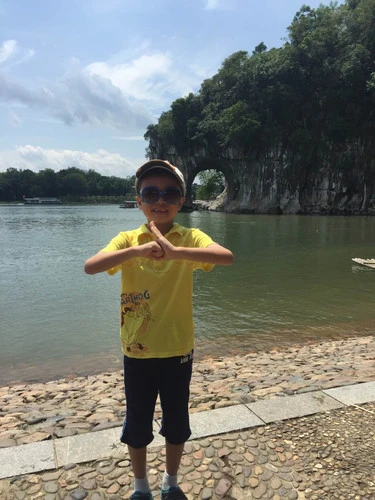
After breakfast, we went to the famous Elephant Trunk Hill. I used to think it didn’t look much like an elephant’s trunk, but when we got there, it really did. In primary school textbooks, the hardest to understand was Sun Moon Lake—I always wondered how it could look half sun and half moon. Recently, I saw a satellite image, and it actually does look like that.
We went into the Elephant Trunk Cave.
Before coming to Guilin, I also listened to the old song "I Want to Go to Guilin"—the music video repeatedly showed Camel Peak, so I wanted to see it too. But after seeing it, I felt disappointed; it looked like a man-made rockery. Fortunately, I confirmed after searching that it was not man-made.
After visiting Elephant Trunk Hill and Camel Peak, it was only noon, so we had to add an afternoon activity. What to do? I thought about playing real-life CS, but it didn’t seem interesting. I searched online and found that Gudong Waterfall was good, so we immediately took a Didi there. When we arrived, we quickly had a simple lunch.
We changed into water gear and started climbing the waterfall. It didn’t rain that day, and the weather was very hot. Playing on the waterfall was a cool way to beat the heat.
The water gear included a pair of straw sandals, which were really nice. While climbing the waterfall, they didn’t slip at all!
The left picture was taken during the winter vacation of 2016 at the Singapore Night Safari. I hope that every time we travel, we can leave a "footprint."
My son also got to ride a zip line. When we came to Gudong, I was most worried about not finding a ride back. Fortunately, we saw a car soliciting passengers when we exited. After bargaining, we reluctantly got in. But actually, the price wasn’t too outrageous—just a bit higher than the Didi fare on the way there.
Back in Guilin, we quickly collected our boat tickets and found a random rice noodle shop on Zhengyang Pedestrian Street.
We had never tried Guilin fried rice noodles, so we wanted to give it a try. As a result… of course, we regretted it.
We boarded the boat for the Two Rivers and Four Lakes. Looking up from the boat, it felt a bit like the underwater tunnel in an aquarium.
No matter which pier you board for the Two Rivers and Four Lakes ticket, the route never passes by Elephant Trunk Hill. I don’t know why—maybe to prevent tourists from skipping the ticket to Elephant Trunk Hill?
This is Diecai Hill. We didn’t have time to visit these two hills, so passing by them on the boat felt like we had been there—our self-consolation. The Taohua River section of the Two Rivers and Four Lakes had no sights; it was just a passage.
After getting off the boat, we waited in a long line to try the local popular grilled oyster shop, but found it no different from other oyster shops.
Back at the hotel, we went up to the rooftop café to see the night view of Elephant Trunk Hill. Hehe, even though the Two Rivers and Four Lakes boat didn’t pass by here to show me, did you think I couldn’t see it?
The next day, we slept in again, had breakfast, and leisurely went to the train station to go home. Originally, we had booked our bullet train tickets for the next day, so we could make up for any missed attractions if the weather was bad, but everything went smoothly. So we rebooked our tickets and came back a day early. This is one advantage of bullet trains over planes (but actually, it was to save money). After getting off the train, we looked for food again. This was a beef offal place recommended online.
The taste was pretty good. This bowl of beef offal rice noodles perfectly concluded our seven-day trip. As for costs: the group tour fee for two adults and one child was 4,220 yuan (adults 1,680 yuan each, child 880 yuan; first order discount plus some self-paid lunches and dinners, about 5,000 yuan in total), bullet train tickets over 1,500 yuan, accommodation over 1,000 yuan, and other dining and activity expenses 4,000+ yuan.


![Mountains and Waters Meet Again [Guilin Yangshuo] Let's Rock the Boat of Friendship](/img/624178c28a221adb_s.webp?src=https%3A%2F%2Fdimg04.c-ctrip.com%2Fimages%2F0104n120009cnhkrdD720_W_320_0_Q80.jpg)


