Three Days in Guangxi: The Guide Was Like a Camouflage Uniform, All Riddles End in Laughter
Three Days in Guangxi: The Guide Was Like a Camouflage Uniform, All Riddles End in Laughter
From Guangzhou South Station, a high-speed train took less than three hours to reach Guilin West Station. After getting off, I saw a handsome guy in camouflage holding a white sheet of paper with names written on it to pick us up. Everyone is sensitive to their own name, and I spotted mine at once. He told me to find a green bus ahead with license plate number XXXX. I dragged my luggage and found the bus easily. There were only a few people on board, and I finally didn’t have to sit in the last row. With the good intention of leaving the front seats for the elderly, I deliberately sat in the middle-back section.
People boarded one after another. After waiting about ten minutes, a large group suddenly came on, filling the bus. I estimated the whole group had over 40 people.
The guy in camouflage came aboard, introduced himself as Mr. Li, the tour guide. His Mandarin was very standard. Judging by his attire and tone, I guessed his parents were demobilized cadres who moved south. He said this group was a joint tour with 43 people total, not just from Guangzhou but also from Chaoshan, Huizhou, Zhongshan, etc.—a Guangdong group. He had been leading Guangdong groups all month, and the entire Guangxi was occupied by tourists from Guangdong because residents of the whole province could enter attractions for free with their ID cards.
He said, “Before departure, I sent a text message to each family asking you to confirm receipt (he read the message aloud). Four or five people didn’t reply.” He actually announced the names of those who hadn’t replied (I wasn’t among them). It felt like being called out by a teacher for doing something wrong back in elementary or middle school. Just then, someone argued they hadn’t received the message. “Didn’t receive it? Impossible. I checked after sending and confirmed it was sent successfully. Okay, let’s drop it. No more mention.”
The camouflage guide continued: “I’ll lead your group for the three days. I won’t babble endlessly, just tell you the important things. When I explain, I hope you listen attentively. Don’t talk loudly or watch videos while I’m speaking. After I finish, you can chat quietly, and lower the volume on your videos so as not to disturb others.”
This really pleased me! Every time I travel with a tour group, the loud voices of older ladies drown out everything, and I often can’t even hear the guide’s explanations, making me annoyed and irritated. No guide had ever managed them. Finally, a guide set demands for the tourists.
So, during the three-day trip, as long as we were on the bus, there was basically no loud noise, and no grating laughter from other videos. The uncles and aunties behaved very well.
On the last day of the itinerary, almost all activities were optional. Most people were originally going to Yaoshan, but because the weather suddenly turned cold and rainy, everyone hesitated.
The camouflage guide said Guilin in the rain has a different charm, but unexpectedly, since we hadn’t brought winter clothes, everyone was shivering with cold. Two group members even walked around wrapped in blankets. Seeing no reaction, the guide told us to think it over.
He first led us to the Silk Museum. There, a young woman (in Guangxi, you cannot call young women “xiaojie” because it’s insulting; only “amei” or “ajie” is acceptable) gave a presentation. I never knew Guilin produced silk, but they explained that due to high labor costs in Jiangsu and Zhejiang, the silk industry moved to Guangxi as part of poverty alleviation—counterpart support. So now Guilin also produces silk. Then we followed the girl to the sales hall to see silk quilts. The hall was made up of rooms one after another. The price of a silk quilt set (four pieces) was discounted from several thousand yuan to about two thousand, with several free gifts. Many people were tempted and bargained with the girl. She even brought in the female manager to lower the price a bit more—all a routine!
Some wanted to leave. The camouflage guide stood at the door looking at his phone and casually said, “Keep looking, it’s not time yet.”
We spent a full three hours in this sales hall. By lunchtime, they finally let us out.
When I got back on the bus, there were only about ten people. Soon I saw group members carrying quilts out.
I asked the lady from Jieyang sitting next to me, “Didn’t you buy?”
She said, “No. We have enough quilts at home. After living several decades, I deeply feel that having a bit more money is fine—it can sit in the bank without taking up space. But having too many things leaves no room. Over 20 years ago, I went to Thailand and bought a lot. Now, looking back, only gold hasn’t depreciated; everything else—latex pillows, mattresses, etc.—I’ve thrown away.”
“Having a bit more money is fine”—her words were classic.
The camouflage guide came on board and said he’d take us to a countryside buffet, 30 yuan per person with a rich variety. “In Guangzhou, where can you find a buffet for 30 yuan?” Before he finished, he came to each seat to collect the fee via WeChat Pay.
During the drive, the sky cleared. The guide said, “It’s not raining now, so we can go to Yaoshan. Take the cable car up and back for 90 yuan. You can see the panoramic view of Guilin, which is quite nice.”
I have a fear of heights. Unless absolutely necessary, I generally avoid cable cars. Learning that the cable car was open-air, just a bench with ventilation on all sides, made me even more scared. I decided not to go.
Everyone said they’d decide after lunch.
We arrived at a large restaurant with ethnic flavor, covering about 500–600 square meters, decorated with ethnic characteristics. There was a wide variety of food: dry and wet, hot and cold. I recognized sweet potatoes, taro, zongzi, grilled fish, Guilin rice noodles, Guangxi lei cha, tangyuan, nian gao, etc. Anyway, I didn’t eat much.
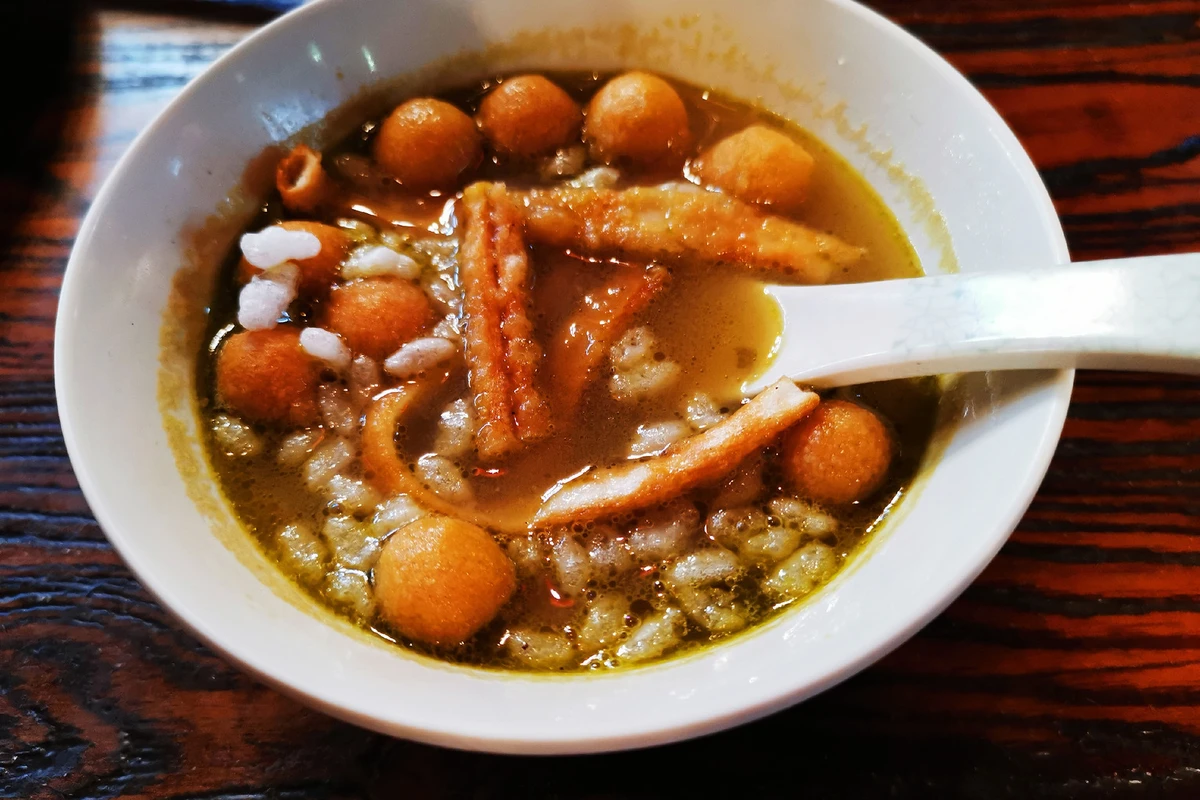
This is lei cha, also called “three-ingredient tea,” a special food. It originated in the Han dynasty and flourished in the Ming and Qing. It contains rice, peanuts, sesame, mung beans, salt, tea leaves, litsea cubeba, ginger, etc., ground into a paste with a mortar, mixed with hot water, and topped with crispy rice—fragrant and delicious.
Before leaving the restaurant, the camouflage guide asked me alone, “Ajie, aren’t you going to Yaoshan?” I replied, “No, I really have a fear of heights.” He told me there was nothing to fear—the mountain is only 900 meters high. I still shook my head.
Back on the bus, the guide introduced Yaoshan again: the cable car takes you to the top, where you can see the panorama of Guilin, and with luck, you can see a large reclining Buddha. If it rains again, they’ll provide raincoats—no need to worry.
About a dozen group members paid.
When we arrived at Yaoshan, the facilities were really basic. The only way up was by cable car; if you wanted to climb for exercise, no way! Strange—why wasn’t there a hiking trail? Just to make money from the cable car?
We had to queue for the cable car. I deliberately looked at it from the line, and horror welled up inside me. It was too crude—just a bench, open on all sides, with a footrest in front and armrests on both sides. Two people per car, slow though it was, still terrifying.
Yaoshan’s surroundings were desolate, nowhere to go. I took a few pictures, including distant shots of Guilin’s peaks.
At the entrance, there was a tank—don’t know its purpose.
The woods at the foot of the mountain were lush.
An hour later, the group members who took the cable car came down. One said in Cantonese, “Frozen to death! Strong wind, couldn’t see anything. Went up, peed, and came down!”
We all burst out laughing.
Online descriptions of Yaoshan go like this: Yaoshan is located in the eastern suburbs of Guilin, 8 km from the city center. The main peak is 909.3 meters above sea level, making it the highest mountain in Guilin. It is named after the Yao Emperor Temple built on the mountain during the Zhou and Tang dynasties.
Yaoshan is famous for its ever-changing and colorful scenery in all four seasons. A sightseeing cable car goes straight to the top. From the summit looking southeast, you can see a huge natural reclining Buddha, as if Sakyamuni is lying on a lotus—the largest natural reclining Buddha ever discovered. Legend says that if you ascend Yaoshan, blessed by the emperor and protected by the reclining Buddha, you will have a peaceful life and good fortune.
Haha, I secretly laughed—good thing I wasn’t fooled this time.
Back on the bus again for the final stop. The camouflage guide wanted to take us to a supermarket. On the bus, he said, “We’re leaving Guilin this afternoon. You should bring back some local specialties, especially those who didn’t go to Yaoshan.” So he started recommending perfume, longan meat, monk fruit, Guilin fish, etc., showing samples. 100 yuan for 4 packs, 120 yuan for 4 bottles of perfume—just a little tip for the driver and himself. Most group members scanned his QR code to pay. The Jieyang lady bought nothing; she said she could get longan meat, goji berries, etc., from the hospital with her medical card. Hearing that, I knew she was a retired civil servant.
At the supermarket, the guide asked the store to prepare our purchases. When we finished browsing, he sat by the checkout counter, handed us our items, and checked them off on a paper.
By bus we were taken to Guilin High-Speed Rail Station, and we said goodbye to the camouflage guide and the driver.
Travel is inseparable from a guiding guide. Guides have their own guiding camouflage, and we don’t need to worry about the riddle behind them. Just as human progress and life’s journey are sometimes guided. Suddenly the scenes from the TV series “Romance of the Three Kingdoms” came to mind, and the theme song lyrics echoed in my ears. Those lyrics come from Yang Shen’s (Ming dynasty) poem “Riverside Daffodils·The Endless River Rolls On”: The endless river eastward flows; With its huge waves are gone all those gallant heroes. Right and wrong, success and failure, all turn empty in the end. The green hills remain as ever; How many times the sunset has glowed red. A gray-haired fisherman on the riverbank, accustomed to the autumn moon and spring breeze. A jug of unrefined wine, a joyful meeting. How many ancient and modern events are all delivered into laughter.
A guide is like a camouflage uniform—the riddle is all left to laughter!
(2843 2021/1/11)


![Mountains and Waters Meet Again [Guilin Yangshuo] Let's Rock the Boat of Friendship](/img/624178c28a221adb_s.webp?src=https%3A%2F%2Fdimg04.c-ctrip.com%2Fimages%2F0104n120009cnhkrdD720_W_320_0_Q80.jpg)


