Stepping into the Misty Rains of Guilin, Staying at Huangyao, Climbing Xianggong Mountain, and Capturing the Scene on the Back of the 20-Yuan Note
I first learned about Guilin from my elementary school Chinese textbook. The line 'Guilin's landscape is the best under heaven' has haunted my dreams for 50 years, filling me with longing for Guilin. When a friend mentioned a 6-day, 5-night tour to Guilin, I signed up without hesitation and joined the photography enthusiast group on a flight to this earthly paradise.
Day 1 (Shanghai – Guilin)
On March 10, 2021, it was cloudy in Shanghai. I left home early at 12:30 PM, took Metro Line 2 to Shanghai Pudong International Airport Terminal 1, reported to the tour leader at Island A before 2:45 PM, exchanged my boarding pass, and headed to Gate 12 to rest, waiting for the 4:45 PM China Eastern Airlines flight MU9635.
At 4:45 PM, China Eastern Airlines flight MU9635 took off on schedule.
I have admired many enchanting sunsets and captured countless twilight glows, but the sunset I saw from tens of thousands of meters above, during the flight, was unforgettable.
Before coming to Guilin, I checked the local weather forecast, which said it would rain for the next few days. As the plane entered Guangxi airspace, thick black clouds appeared outside the cabin. The photography friends joked that coming to Guilin meant experiencing the 'misty rain of Guilin.' Though it was a joke, everyone secretly hoped to both feel the misty rain and see the brilliant spring scenery of this paradise. At 7:45 PM, the plane landed safely at Guilin Liangjiang International Airport. We met the local guide at the airport and took a tour bus to the first hotel (Guilin Xishan Ruiji Boutique Hotel).
After settling in, I felt hungry. The local guide, a Miao man in his early forties, recommended an authentic rice noodle shop called 'Chi Bu Wang' (Eat and Never Forget). The storefront was modest, but the taste was excellent, with customers still coming late at night. In the following days, I never tasted such a pure flavor again—truly 'Eat and Never Forget.'
Day 2 (Guilin – Tianxin Village – Xingping Ancient Town)
After breakfast at Guilin Xishan Ruiji Boutique Hotel, we took a bus to Tianxin Village in Si Tang, Lingui District, for photography.
At 9:30 AM, the bus stopped at the village parking lot. It was still raining. The photography friends got off, wearing raincoats and holding umbrellas to start shooting.
Tianxin Village is about 20 kilometers from downtown Guilin, an ancient village renowned for its culture. The folk rhyme 'Hengshan Mansion, Chitou County; Tianxin Village, Hanlin Academy; one family with nine jinshi, father and son three Hanlin' was once the pride of the villagers.
According to local records, descendants of Zhu Yuanzhang first lived in seclusion here during the late Ming and early Qing dynasties. The village, nestled by mountains and rivers amid rice fields, was named 'Tianxin' (Heart of the Fields). To this day, Tianxin Village retains ancient houses, stone paths, stone walls, and four sturdy stone gates from that period.
Surrounded by mountains, with continuous fields, drifting clouds, deep tranquility, and small bridges over flowing water nestled among golden rice fields, it is a quiet and simple paradise.
The tour group specially arranged for a local model, 69-year-old Old Xu, to appear with his 14-year-old partner, the 'plow ox,' for everyone to photograph.
I saw the highly exposed 'Zhuangyuan Bridge' online. Why it is called 'Zhuangyuan Bridge' has no explanation. Interestingly, this bridge in Tianxin Village has become an 'internet-famous bridge.' Many tourists and photographers come here daily to take photos. The local villagers simply lead their plow oxen to the bridge as 'professional models,' earning several hundred yuan a day!
Not far away is another 'Zhuangyuan Bridge,' said to be younger, so it is called the New Bridge.
At noon, we celebrated birthdays for two tourists at Sister Xie's Beer Fish Restaurant.
At 3:30 PM, we arrived at Xingping Ancient Town and checked into the Xingping Shuiyunjian Countryside Hotel.
Photo of Xingping Ancient Town taken from the rooftop of Shuiyunjian Countryside Hotel.
On the Li River in front of Xingping Ancient Town, a promotional photo was being taken.
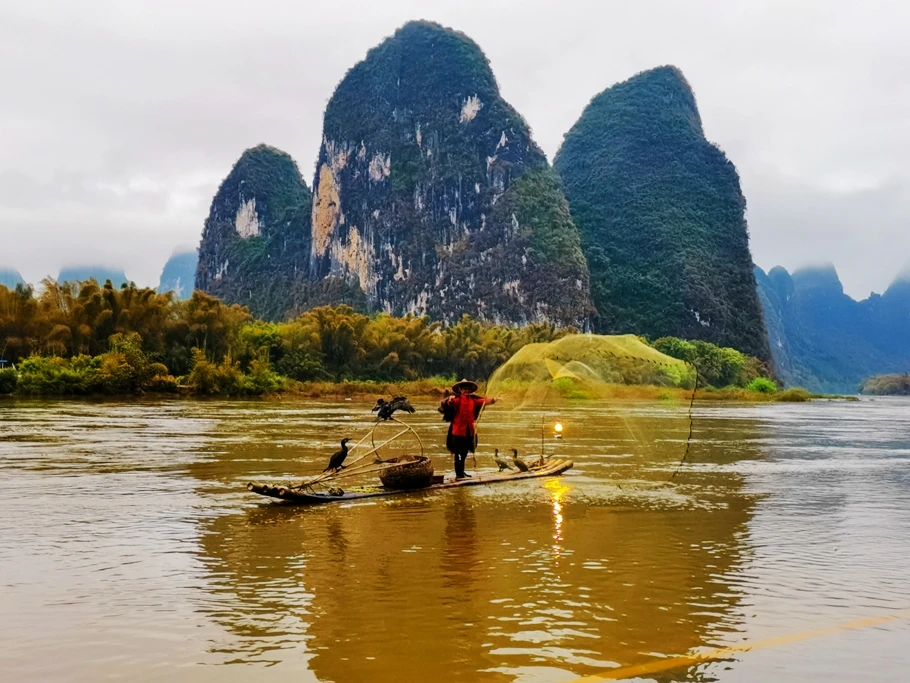
One reason Xingping Ancient Town attracts many tourists is that it is the location for the background of the 20-yuan note. Along the way, you can also enjoy the most dreamy scenery of the Li River.
In the evening, a separate bamboo raft was arranged with fishing lights, cormorants, and a fisherman casting a net.
Day 3 (Xingping – Yangshuo)
At 5:30 AM, we took an electric tricycle to Xingping Huangbu Beach to photograph the sunrise, but the cloudy weather prevented us from capturing it.
A separate bamboo raft with fishing lights and cormorants was arranged.
After breakfast, we toured Xingping Ancient Town. Walking along the stone-slab street, we saw a plaque on the archway at the entrance reading 'Gu Xiping,' which puzzled many tourists. According to historical records, in 265 AD, Xingping was called Xiping County, governing the Yangshuo area. In the Sui Dynasty, Xiping was renamed Yangshuo County, and Xingping came under Yangshuo's jurisdiction. The pronunciation of 'Xiping' is similar to 'Xingping,' and over time it evolved into Xingping.
Guilin's Xingping Ancient Town has a history of over 1,700 years. Entering the town, the first thing you see is a long street, most of which retains original dwellings, with local residents still living there.
Beside the ancient street stands a stage that appears to be a million years old, looking somewhat weathered.
There are five wooden carvings on the railing in front of the stage. Though exquisitely crafted, the faces of the carved figures are too worn by time to be distinguished.
At 1:30 PM, we took a bus to Yulong River to photograph the natural scenery on both banks and the rapeseed flower sea.
The Yulong River is the longest tributary of the Li River within Yangshuo. Its banks feature beautiful, undulating peaks of various forms, lush green grass, verdant bamboo, and dense trees.
The most popular photo spot at the old county pier in Yangshuo.
In the Yulong River scenic area, golden rapeseed flowers blend with mountains and water, creating a beautiful landscape.
In the evening, we stayed at Yangshuo Xishuo Yard Hotel, then walked 20 minutes to Yangshuo West Street for free photography.
Night scene: as lights came on, Yangshuo West Street gradually became lively.
Yangshuo West Street is a pedestrian street in Yangshuo County, Guilin, Guangxi, and a must-visit for every tourist coming to Yangshuo. With a history of over 1,400 years, it is the oldest and most prosperous street in Yangshuo and an important tourist attraction.
My impression of West Street was quite good: 'lively,' 'food,' 'crowded,' and 'bars' are the keywords I would give it.
Day 4 (Gongcheng Si'an Village – Huangyao Ancient Town)
After breakfast, we took a bus to Gongcheng Si'an Village to photograph peach blossoms, but since the blooming season had passed, we didn't capture the blossoms.
Gongcheng Si'an Village in Guilin is predominantly Yao and Han. The Cha Jiang River flows through the village, offering 18 li of waterways. It is an ancient village rich in natural beauty, historical heritage, and Yao customs.
Persimmons have always been Si'an's main industry. Every autumn, every household dries persimmon cakes. The golden persimmons contrast vividly with green trees, creating a beautiful scene.
At noon, we specially arranged an oil tea feast. Guilin oil tea is a popular snack, though first-timers may not immediately accept its unique flavor. It can be accompanied by other snacks, stir-fries, or noodles.
At 2:55 PM, we arrived at Huangyao Ancient Town and checked into Huangyao Dayuan Cultural Theme Hotel.
Huangyao Ancient Town was founded during the Wanli period of the Ming Dynasty. Because the surnames Huang and Yao are most common in the town, it was named Huangyao. After continuous development, it reached its peak in the early Qing Dynasty. It is now one of 'China's Ten Most Beautiful Ancient Towns.'
Entering Huangyao Ancient Town gives a different feeling. The dragon-claw banyan trees in the town create beautiful scenes with lush branches and verdant leaves. This old tree has grown here for over 850 years, witnessing the village's development and prosperity.
In the evening, while dining at a food stall in the square at the entrance of Huangyao Ancient Town, I captured the sunset.
Staying one night here allows you to savor the tranquility of the ancient town.
The streets of the entire town are paved with large bluestone slabs. The worn slabs bear witness to the passage of time, and walking on them gives a sense of reincarnation.
Huangyao's night is indescribably quiet. Nightlife here seems to end early; apart from the shops in the ancient town, most street stalls are empty.
Day 5 (Huangyao Ancient Town – Xianggong Mountain)
The Xianren Ancient Well scenic spot in Huangyao Ancient Town has five wells. The first is for drinking, the second for washing vegetables, and the third, fourth, and fifth for washing clothes and farm tools. The photo shows residents washing vegetables and clothes by the well in the early morning.
In the early morning, the ancient town was very quiet, with a slight chill in the breeze. Shops were not yet open, and there were almost no tourists. At that moment, we encountered the quietest Huangyao.
On May 19, 2016, China Post issued the 'Chinese Ancient Towns II' special stamps, and Huangyao Ancient Town was selected for its long history and beautiful scenery. The stamp design features the town's Dailong Bridge.
At 5:00 PM, we arrived at Xianggong Mountain and checked into Yangshuo Xianggong Mountain Villa. The owner, a photographer named Zhao Wenjun, took us to the rooftop to photograph 'Sky Mirror.' The 'Sky Mirror' involves a large rooftop pool filled with water, with a few model boats placed on it, reflecting the opposite peaks.
Day 6 (Xianggong Mountain – Guilin – Shanghai)
At 5:30 AM, we left the villa and walked to Xianggong Mountain Scenic Area, then began climbing.
Xianggong Mountain has five observation decks, each offering the same shooting effect.
From the top of Xianggong Mountain, you can see orderly arranged peaks and the clear Li River winding through the embrace of the mountains. The light, clouds, sea of clouds, sunrise, and colorful clouds here attract countless photographers and enthusiasts. Unfortunately, the weather was unfavorable—cloudy and rainy—so we didn't capture satisfactory shots.
At 2:15 PM, we arrived at downtown Guilin for free time, then gathered at 4:50 PM to go to the airport.
The Sun and Moon Twin Pagodas in Shan Lake are beautiful, and strolling by the lake is very pleasant.
Elephant Trunk Hill Park is a representative of Guilin's landscape. It looks like an elephant dipping its long trunk into the river to drink water—so adorable. It has always been a tourist attraction.
Zhengyang Street is the busiest and most popular pedestrian street in downtown Guilin, stretching 666 meters. It is perpendicular to the Zhengyang Gate of the Ming Prince City and was the main passage for Ming nobles. Inside Zhengyang Gate lies a blessed dragon vein of Guilin—Jingjiang Prince's Mansion.
Zhengyang Street was an old street in ancient times. It began in the Han Dynasty and flourished in the Qing Dynasty. It was once the political and commercial center of Guilin and a gathering place for officials, nobles, and merchants, rich in historical heritage and stories.
Dongxi Alley is a historical district left from the Ming and Qing dynasties, now transformed into a commercial street for leisure, entertainment, dining, and shopping, while retaining the architectural style of that period.
Over 600 years ago, to consolidate the Ming Dynasty's rule, Zhu Yuanzhang's grandnephew Zhu Shouqian was enfeoffed as a prince in Guilin. Thus, Jingjiang Prince's Mansion, built 34 years earlier than the Forbidden City in Beijing, was born on the beautiful land of Guilin. Locals call it Guilin Prince City.
Guilin Prince City is a city within a city and the most complete remaining Ming princely palace site in China. Its walls and gates are largely original, holding significant historical and artistic value. It was listed as a national key cultural relic protection unit in 1996 and rated as a 4A tourist attraction in 2006.
On the wall of Zhengyang Gate of the Prince City, the four characters '三元及第' (Three Yuan and First Place) are engraved, highlighting the miracles created by scholars of this city in the imperial examination era. The person who achieved this 'Triple First' was Chen Jichang from the Jiaqing period of the Qing Dynasty, a native of Lingui. 'Three Yuan and First Place' is the highest honor in the imperial examination, and in China's 1,380-year history of the system, only 13 people achieved it.
The main gate of Jingjiang Prince's Mansion is Chengyun Gate. The original main buildings include Chengyun Gate in the front, Chengyun Hall in the middle, and living quarters and imperial garden in the back.
After gathering, the tour bus took us to Guilin Liangjiang International Airport at 5:00 PM, ending the Guilin photography tour.
Originally scheduled to depart at 8:30 PM, China Eastern Airlines flight MU9636 was delayed to 9:30 PM due to air traffic control. I arrived home after midnight, but thankfully, the journey was safe.


![Mountains and Waters Meet Again [Guilin Yangshuo] Let's Rock the Boat of Friendship](/img/624178c28a221adb_s.webp?src=https%3A%2F%2Fdimg04.c-ctrip.com%2Fimages%2F0104n120009cnhkrdD720_W_320_0_Q80.jpg)


