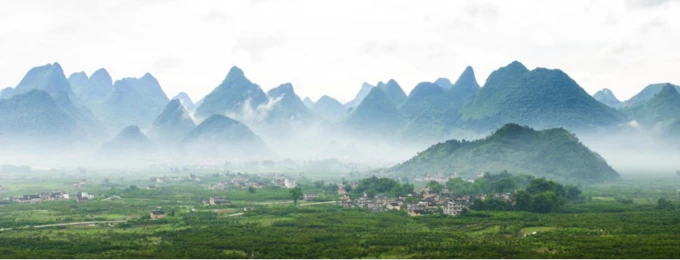
Touring the Landscapes of Guilin: The Li River in Yangshuo, the Leisurely Charm of Gongcheng – Five Days of Tranquil Wandering
The meaning of travel, I think about it seriously. Perhaps it is to see the magnificent mountains and rivers, enrich life experiences, understand oneself, or simply admire the scenery and delight the eyes. That day, the sky was so blue, the mountain flowers were blooming brilliantly. In that moment, my heart was filled with tender emotion, feeling like a child returning to the original innocence. More importantly, facing nature's gifts, the heart becomes transparent, learning gratitude, loving the people around you, cherishing the warmth of life. This trip to Guilin allowed me to see the scenery I longed for, met kind-hearted people, and left beautiful memories. Although there were hardships and regrets along the way, I am still grateful for this journey. After returning, I hope to embrace future life with a positive attitude.
I enjoy browsing various travel websites. By chance, I saw pictures of Guilin. What first caught my interest was not Guilin or Yangshuo, but a place that instantly filled me with longing—such a refreshing sight! Then I planned to see the landscapes in Yangshuo and visit Gongcheng. Let's go!
Well, my husband went on a business trip to earn money, while I went on a spiritual journey with my best friend through the mountains.
Gongcheng Jiujia Scenery
At the exit of Guilin Liangjiang Airport, many tour group drivers and guides are picking up people! Don't follow them.
Day 2: Cruise on Li River – Ten-Mile Gallery – Night Tour of Yangshuo
The first stop is of course the world's enchanting river—the Li River in Yangshuo.
Xingping is an ancient town with a history of over a thousand years, 30 kilometers from Yangshuo. Savor its charm. Here you'll find the famous Li River scenery "Nine Horses Hill," the most natural landscape "Yellow Cloth Reflection," Laozhai Mountain viewing platform, Niubei Mountain overlook, Goupo Mountain panoramic view of the river bend, the old flagstone street, the century-old stage, and the scene on the 20-yuan banknote issued by the Bank of China in 1999.
The ancient bridges, old ferry crossings, grand stages, ancient temples, old villages, and ancient settlements here are all original and authentic. The local people are simple, honest, and friendly.
The Li River belongs to the Xijiang water system of the Pearl River basin, commonly referring to the upper reaches of the Guijiang River tributary, located in the northeast of Guangxi Zhuang Autonomous Region. Traditionally, the Li River starts from Yuechengling Mao'er Mountain, the source of the Guijiang River. Modern hydrology defines its start as the Lingqu outlet at Rongjiang Town, Xing'an County, and its end as the Sanjiangkou in Pingle. The Li River section is 164 kilometers long. The riverbed is mostly covered with gravel, low in sediment, clear in water, and the banks are mostly karst landforms. It boasts rich tourism resources, and the famous Guilin landscapes are along the Li River.
The Li River is truly the lifeline of Guilin tourism. "Guilin's landscapes are the best under heaven" refers to the Li River.
It feels like entering a fairyland, so beautiful, as if walking through an oil painting of mountains and water. On the bamboo raft, a gentle breeze blows on the face, warm and moist.
Here, with green mountains and clear waters, and many pebbles along the riverbank, it's perfect for photos. We started striking various poses, snapping away. The distant mountains, the near turquoise water, the big trees and green peaks on both sides—it's like being in a painting.
The location of the 20-yuan banknote background.
Yangshuo Ten-Mile Gallery is located at Moon Hill in Yangshuo. Because the scenery along the road is beautiful and picturesque, it is called the Ten-Mile Gallery.
It is said that when former U.S. President Carter visited Yangshuo, he...
Arriving in Yangshuo in the afternoon, the night view of Yangshuo is one of the few wonderful sights.
West Street at night is very lively, with many people.
Day 3: Yulong River – Shangri-La – Dong Village.
People say that visiting Guilin without cruising the Li River is a regret; coming to Yangshuo without seeing Yulong River is even more regrettable. Yangshuo Yulong River is known as "Little Li River" and is the essence of Yangshuo's landscapes. It is famous for its green mountains, clear waters, emerald bamboo groves, unique bridges, and quaint villages. It is a rare beauty in Guilin's landscapes and the best representation of Yangshuo scenery.
Yulong River is a tributary of the Li River in Yangshuo, with picturesque scenery. Compared to the Li River, it has a different kind of delicate charm, making it arguably the most beautiful spot in Yangshuo. You can explore Yulong River on foot, by bike, or by raft. Most choose to take a bamboo raft.
Drifting downstream from north to south, you will pass attractions like Fuli Bridge, Jinlong Bridge, Yulong Bridge, Guixian Bridge, and Gongnong Bridge. You can do the full journey or segments, charged by distance. The full drift takes 3–4 hours, and half takes 2 hours.
Compared to the Li River, it's calm and scenic.
Since the Jin Dynasty writer and poet Tao Qian (also known as Tao Yuanming, c. 376–427) wrote the timeless essay "The Story of Peach Blossom Spring," people have been searching for their ideal realm—the Peach Blossom Spring.
In Yangshuo County, Guilin, famous for its stunning landscapes, there is such a Peach Blossom Spring. More than two thousand years ago, this area was an ancient post road district from the Han Dynasty, and there are still many Han tomb groups.
The scenic area mainly offers water tours and walking tours.
The wind-and-rain bridge should belong to the Dong ethnic group, so it seems out of place here, but it blends quite well with the tranquil pastoral scenery.
After getting off the boat, we enjoyed viewing the architecture and lifestyle of the Dong, Zhuang, and Miao ethnic groups, learning about local customs. In the Peach Blossom Spring, we traced Tao Yuanming's artistic conception and experienced the essence of Guilin's landscapes.
Day 4 & 5: Gongcheng – Ancient Camphor Forest Ecological Area – Wen and Wu Temples – Hongyan Village.
If "Guilin's landscapes are the best under heaven" refers to Guilin's status in China, then Gongcheng is like Guilin's own Shangri-La. Here, the term "Shangri-La" is not the scenic area mentioned above, but a tranquil haven amidst dreamlike mountain and water scenery. Unlike other famous scenic spots in Guilin with fixed and highly mature business models, Gongcheng has an incomparable charm of small bridges and flowing waters.
To get to Gongcheng, you can take a high-speed train from downtown Guilin, or choose a chartered car or bus. Transportation is very convenient. We set out at 9 a.m. and arrived just over an hour later.
Ancient Camphor Forest Ecological Area
We arrived soon after passing the county town.
If navigating by GPS, on the left side at the destination is a bridge. Crossing the bridge leads to a primitive village, with no trace of any scenic spot except a concrete road.
The riverbank is full of camphor trees. Though not very old, they are very fragrant.
The sunlight dappled through the forest, creating beautiful color tones—perfect for portrait photography.
Occasionally, we saw flowers called lycoris radiata in the forest.
Hongyan Village is located in Lianhua Town, Gongcheng Yao Autonomous County, Guangxi. With only 103 households and 407 people, it's an ecological tourism village integrating mountain and water scenery, rural farming experiences, accommodation, dining, leisure, and conference business. It was Sunday, and the village was very lively. The rolling dam was the most attractive spot.
The Lianhua River flows slowly, with green bamboo groves and shady trees along the banks. The clear, gentle river is a great place for tourists to go boating and relax.
Many villas have been built in the village, offering accommodation and dining.
Every household sells local products like persimmons, dried persimmons, mushrooms, and peach resin. It is said that in two months, when the persimmons ripen, there will be baskets of sun-dried persimmons by the roadside.
Hongyan Village is Gongcheng's largest pollution-free fruit production base—the Lianhua Tang Lian Ling Pollution-Free Month Persimmon Standardized Cultivation Demonstration Base. The village still retains many hundred-year-old persimmon trees and some ancient buildings, hitching stones, plaques, and other relics, as well as two relatively high viewing platforms.
Walking along the riverside path leads to persimmon groves. This is a great place for photography, with light filtering through the trees and branches heavy with fruit—a scene of abundant harvest.
Gongcheng Month Persimmon is one of Guangxi's traditional export-oriented famous products. The fruit is beautifully shaped and brightly colored; crisp persimmons are sweet and delicious, frozen persimmons are refreshing and sweet, and dried persimmons are soft and sweet like malt. The moon-shaped dried persimmons are red, translucent, and seedless. After frosting, they appear white with a hint of red, crisp yet soft, and sweetly fragrant.
There are many peach trees in the village, and the old trees are full of peach resin. It is likely that the spring peach blossom festival is also quite lively.
If time permits, you can stay overnight in Hongyan Village. In the morning, you can climb Matou Mountain, a karst formation behind the village, where a viewing platform offers a panoramic view of the entire village. We only had half a day, so we had to leave that for next time.
On the way back, before entering the highway, we passed a high slope where we could overlook the beautiful village.
Gongcheng Wen and Wu Temples
In Gongcheng County, there are four major ancient building complexes: the Confucian Temple (Wen Temple), the Martial Temple (Wu Temple), Zhou Wang Temple, and the Hunan Guild Hall, creating rich atmospheres of "culture," "martial," "officialdom," "commerce," and "sentiment." This time, we visited the Wen and Wu Temples.
Gongcheng Square has the Wen Temple on the left and the Wu Temple on the right. Tickets are 13 yuan and 20 yuan respectively, or you can buy a combo ticket for 40 yuan to visit all four ancient complexes. The Wen and Wu Temples, built in the Ming Dynasty, are grand and magnificent, earning Gongcheng the reputation of "Little Qufu in South China." The Wu Temple is 110 meters away from the Wen Temple. Having both temples in one place, one civil and one martial, complementing each other, is unique in the country, creating the only miracle in China where a Wen and Wu Temple coexist.
The left Wen and right Wu layout stems from ancient Chinese tradition: left is east, yang, representing life and honor, so the Wen Temple is placed on the left to show respect for culture; right is west, yin, representing death and humility, so the Wu Temple is on the right to suppress military. The mutual proximity of the two temples symbolizes the harmony of yin and yang, the unity of civility and martiality, honoring both culture and military, placing culture first, fully embodying the Chinese national spirit.
At the Lingxing Gate is the Pan Pond, also called the Moon Pond, built with stone slabs and surrounded by blue stone railings. A stone arch bridge spans the pond, known as the Scholar's Bridge.
Ascending two terraces from the Lingxing Gate is the Dacheng Gate. The Dacheng Gate consists of eleven panels, wooden structure, with vivid carvings of flowers, birds, insects, and fish on the panels.
The Wen Temple, also known as the Confucian Temple or School Palace, was first built in 1477. It is a temple for worshiping Confucius, the best-preserved Confucian temple in Guangxi, and one of the four major Confucian temples in China. The Wen Temple faces south, overlooking the Cha River, with its back against Yinshan Mountain, built on the hillside in layers. The entire temple covers an area of 3,600 square meters, with a building area of 1,300 square meters.
Behind the Dacheng Gate is a courtyard, in front of which is a wide platform called the Apricot Altar, also known as the Open Altar, said to be where Confucius taught. On the Open Altar is the Dacheng Hall, the main building of the Wen Temple, with five bays wide and three bays deep, ten brick columns, eighteen wooden columns, fourteen doors, and doors and eaves decorated with wood carvings. The roof features high flying eaves, double eaves, hip-and-gable roof, decorated ridges, painted clay sculptures, glazed tiles, resplendent and magnificent. What an eye-opener!
Gongcheng Wu Temple is a temple dedicated to the famous general of the Three Kingdoms, Guan Yu, first built in the 31st year of Wanli in the Ming Dynasty (1603). The entire temple has a building area of 1,033 square meters.
The double dragon playing with a pearl here is different from that in the Wen Temple, appearing more majestic.
Gongcheng Wu Temple is a mountain-style building with a brick-wood structure, three bays wide and one bay deep. It has a front porch, with corner and supplementary double-ang five-puzuo dougong brackets, the bracket mouths carved with cloud patterns. The column bases are blue stone drum-shaped, and between the columns and horizontal beams are carved wood panels of dragons and phoenixes with color paintings.
The Wu Temple includes a stage, rain pavilion, main gate, main hall, rear hall, and two side halls. The stage has red walls and yellow tiles, gleaming with gold; the roof is double-eaved and gabled, with high flying eaves, and the ridges feature clay sculptures of dragons, phoenixes, the Eight Immortals, and other figures, vividly lifelike.
The eaves tiles are also beautiful, adorned with lifelike human figures.
After visiting the ancient temples, it was already afternoon.
Yao-Han Health Longevity City mainly focuses on medical and health integration, including health-preserving dining halls, Yao Hospital, Fascia Clinical Base, People's Health System Engineering, Traditional Chinese Medicine Hall, Tea River Academy, Yao-Han Pharmacy, Yao Pool Yao Bath, and other health experiences. It should be very professional for health preservation.
There are also many old Chinese medicine clinics inside.
Yao Bath is an indispensable "divine experience" after coming to Gongcheng.
The reason to emphasize experiencing Yao Bath in Gongcheng is not only for its authenticity but also because Gongcheng itself is a famous longevity town in China, a top recuperation destination, inseparable from its climate and natural environment.
Guangxi Yao Bath is different from the bathing in the north and the scrubbing bath in Jiangnan. Yao Bath is a bathing method passed down from the Yao culture for thousands of years, using natural herbal baths. For the Yao people, it is not only a way to relax but also an external therapy handed down through generations, now listed in the National Intangible Cultural Heritage.
It is said that the herbal packets used in Yao Bath have unique formulas, carefully selected and researched from authentic Yao medicine. Yao-Han Health Longevity City has conducted years of investigation and research on these ancient herbal formulas and, combining common ailments of modern people with the efforts of many Chinese medicine experts, has finally produced the current Yao Bath herbal packets.
Buying these as souvenirs for friends is also an excellent choice.
There are multiple Yao Bath packages. You can first soak in a hot Yao Bath to relax your entire body, then have a Yao face rolling treatment to expel facial toxins, and enjoy a full-body SPA massage.
Yao-Han Health Longevity City also has a Tea River Dining Room, allowing you to enjoy unique health-preserving cuisine while recuperating.
Day 5: Guilin Elephant Trunk Hill – Prince Jingjiang's City – Return Trip
We arrived at Elephant Trunk Hill at eight in the morning.
I first learned about Elephant Trunk Hill from primary school Chinese textbooks. The essay "Guilin's Landscapes" by writer Chen Miao left a deep impression on me about Guilin, and Elephant Trunk Hill gave me infinite imagination as a child. Walking out from the small path between the Sun and Moon Twin Pagodas leads to Binjiang Road, where you can already see the distant Elephant Hill. This is near the Love Island of Elephant Hill Park.
Elephant Trunk Hill is located in Guilin's Elephant Hill Park. It gets its name from its remarkable resemblance to a giant elephant standing by the riverbank, extending its trunk to drink. It is regarded as the symbol of Guilin's landscapes.
After great effort, we finally climbed onto the back of Elephant Hill. From the viewing platform, you can overlook the streets and buildings of Guilin city and the scenic Li River.
Going down further leads to the Water Moon Cave, which is the part of the elephant's trunk.
Just as described in the primary school textbook, the broad mountain mass is like an elephant's body, with a rock structure low in front and high in back, plus a huge trunk slanting out of the water. From a distance, it is truly an elephant drinking by the riverbank.
The 5-day Guilin tour ended like this... What remains are memories and anticipation for the next trip...
I dedicate this travelogue as a memento, hoping more compatriots can come here and experience such beautiful scenery and wonderful life as I did.


![Mountains and Waters Meet Again [Guilin Yangshuo] Let's Rock the Boat of Friendship](/img/624178c28a221adb_s.webp?src=https%3A%2F%2Fdimg04.c-ctrip.com%2Fimages%2F0104n120009cnhkrdD720_W_320_0_Q80.jpg)


