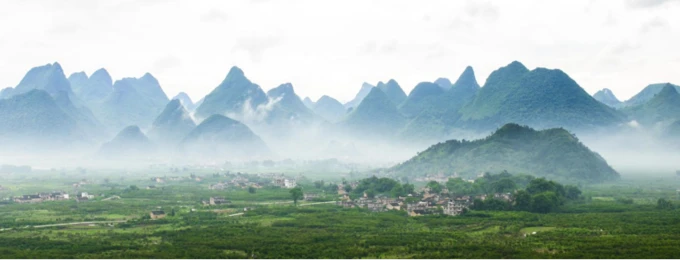
Deep Exploration of Yao Autonomous County — A Trip to Gongcheng: Scenic Mountains and Waters, Tasting Oil Tea, Visiting the Civil and Military Temples
Gongcheng Yao Autonomous County is situated in the northeast of Guangxi, 108 kilometers from downtown Guilin, bordering Hunan to the north and looking toward Wuzhou and Guangdong to the south. Since ancient times, it has been a vital passage from the Central Plains into Lingnan, where Central Plains culture and Lingnan culture blend, giving rise to a unique Yao regional culture.
In October, when the persimmons are ripe, we gathered some friends and excitedly headed to Gongcheng. The reason I came to Gongcheng was purely because I, a foodie, wanted to eat persimmons. Many people have different feelings about persimmons, don't they?
Gongcheng boasts national key cultural relic protection sites: the Civil Temple, the Military Temple, Zhou Wei Shrine, and the Hunan Guild Hall. It is the only place in China where both a civil and military temple coexist.
Gongcheng has moon persimmons, Shatian pomelos, oranges, betel nut taro, and red melon seeds. Local specialties include sweet wine, moon persimmon fruit wine, and yellow bamboo shoots.
The high-speed rail station is quite convenient.
Gongcheng Civil Temple, also known as the Confucius Temple or School Palace, is a temple dedicated to Confucius, an outstanding educator and thinker in ancient China. It covers an area of 3,600 square meters with a building area of 1,300 square meters. It is the largest, oldest, most magnificent, and best-preserved temple in Guangxi, listed as a provincial key cultural relic protection unit. It was first built in the eighth year of the Yongle reign of the Ming Dynasty (1410 AD).
The people of Gongcheng highly value literature, and the Civil Temple holds a significant place in their hearts. Every local child's preschool enlightenment ceremony, known as the "Opening of the Brush" ceremony, is held at the Civil Temple. Moreover, it is well-known that students come here to pray for success in their studies and to hope for high scores in exams. Throughout history, Gongcheng has produced many scholars.
During the Ming and Qing dynasties, the county had academies, community schools, and private schools. From the Tang and Song dynasties to the Ming and Qing dynasties, there were 28 juren (including 22 military juren), 52 en gongs, 39 ba gongs, 12 fu gongs, 299 sui gongs, and 14 lin gongs.
Tourists burning incense for Confucius.
Gongcheng Military Temple, also known as the Temple of Guan Yu, is a temple dedicated to Guan Yu, a famous general of the Three Kingdoms period. It was first built in the thirty-first year of the Wanli reign of the Ming Dynasty (1603 AD). The Military Temple has a history of 400 years. It is now a regional key cultural relic protection unit. The entire temple covers an area of 2,100 square meters, with a building area of 1,033 square meters. It is located to the right of the Civil Temple at the southern foot of Yinshan Mountain.
The Military Temple complex includes a stage, main hall, Xietian Palace, rear hall, and side halls on the east and west sides. The east and west wing rooms display Guan Yu's legendary stories through sculptures, such as the Oath of the Peach Garden, the First Meritorious Deed of Slaying the Yellow Turban Hero, and Slaying Hua Xiong While the Wine Was Still Warm. The stage of the Military Temple is one of the two best-preserved ancient stages in Guangxi (the other is in Huangyao Ancient Town, Zhaoping County). Despite four hundred years of vicissitudes, it retains its charm.
After visiting the historical sites, we arrived at Yao Han Yangshou City.
Yao Han Yangshou City is located in Ping'an Town, east of the county seat. Leveraging Gongcheng's unique natural resources and traditional medical health techniques, it is a smart health and wellness city integrating rehabilitation, health retreats, sightseeing, medical research, cultural experiences, and business conferences... It has become an excellent health and wellness comprehensive center in Guilin and even nationwide.
The ancient-style interior environment features unique all-wood Yao bath designs, adopting traditional Yao ethnic stream-side ecological health baths and bamboo forest aerobic ecological health baths, combined with modern scientific extraction and Yao ethnic secret medicine packs...
Buying this as a souvenir for friends is an excellent choice.
"Characterized by Yao ethnic medicine, based on traditional Chinese medicine, and supported by modern diagnosis and treatment technology," it is a facility integrating medical treatment, prevention, health care, rehabilitation, recuperation, wellness, and the inheritance of ethnic medicine culture...
Meditation can reduce stress, improve IQ, eliminate fatigue, and control anger. Although the state entered through meditation is not yet enlightenment and has not broken through the barrier of ignorance, it is still very good. Meditation brings endless relaxation, and you can discover its joy through careful experience. Illness arises from the mind, and the mind can transform illness. Experiencing health and calming meditation at Yangshou City can reduce stress, calm the mind, heal, and release burdens.
Tai Chi Meridian Therapy
The dean of the Natural Therapy Research Institute is also the contemporary inheritor of the Dong ethnic group's Xuanma Dongmai. Xuanma Dongmai - Natural Therapy is said to have been passed down through thousands of years of Dong medicine. After more than a decade of continuous research and practice, the Natural Therapy was founded and is very famous among local ethnic minorities. They also uniquely created Tai Chi Meridian Therapy, using external herbal plant essential oils. If needed, you should definitely try this.
Lunch! Oh no... it's three meals a day.
The famous Chinese coffee.
Gongcheng oil tea is essential for the local people: "If you don't drink oil tea soup for a day, the whole table of dishes won't be fragrant." When honored guests visit, the people of Gongcheng will treat them with fragrant, crispy, and delicious Gongcheng oil tea. Gongcheng people "beat" oil tea for breakfast every day, and some families even have it for all three meals.
Gongcheng oil tea is not said to be "cooked" but "beaten," which is a common term across regions, though each place has its own unique flavor. The standard method of making oil tea is to use old leaf black tea as the main ingredient, stir-fry it in oil until slightly burnt and fragrant, add salt and water to boil, usually with ginger, resulting in a strong, astringent, and slightly spicy taste. In Gongcheng, they add ground peanuts to mellow the flavor and reduce astringency. Thanks to the perfect cooking time, Gongcheng oil tea is considered the best among all oil teas and is renowned throughout northern Guangxi and the entire region.
A long-lived elderly person skillfully beating oil tea.
The picture below is the Wufuchun Gold Award Oil Tea Restaurant, which has won many gold awards. To be honest, during our two days in Gongcheng, we ate at Wufuchun three times. The taste of Gongcheng oil tea is different from that in Guilin city. Here, the oil tea is smoother and not grainy at all. The toppings are optional. Even now, I'm still savoring the memory!
Drinking oil tea must be accompanied by various snacks, all fried or roasted foods. In Miao, Yao, and Dong ethnic areas, common accompaniments include fried soybeans, fried peanuts, popcorn, fried peanuts, and glutinous rice balls or glutinous rice cakes. In Gongcheng and Pingle county towns, the snacks are more elaborate, with more than a dozen kinds of fried treats. When inviting guests to drink oil tea, they often lay out a whole table of snacks, looking like a full meal.
There is an ancient saying about the seven wonders of persimmons:
The tree lives long, the leaves provide ample shade,
No bird nests, no insect infestation,
Frosted leaves are lovely to admire, the fruit is delicious,
Fallen leaves are thick and can be used for calligraphy practice.
According to a Tang Dynasty record in "Shangshu Gushi":
There was a man named Zheng Qian,
Who loved calligraphy and painting but had no money to buy paper for practice.
Because there were several persimmon trees at Ci'en Temple,
With fallen leaves covering the ground, he borrowed a monk's room to live in.
He spent all day picking up red leaves to practice writing.
It is said that Zheng Qian stored three rooms full of persimmon leaves,
Cherished them, and wrote on both sides.
At the end of the Yuan Dynasty, the literary scholar Tao Zongyi lived in seclusion in Nancun.
While farming, he would pick up persimmon leaves to record notes.
After writing, he would throw them into an urn.
Later, these writings on persimmon leaves
Were compiled into "Nancun Chuogeng Lu."
A small persimmon has boosted this eco-tourism village.
China's only "Moon Persimmon Hometown" title,
A pollution-free fruit base of ten thousand mu of moon persimmons.
A small persimmon has boosted this eco-tourism village.
China's only "Moon Persimmon Hometown" title,
A pollution-free fruit base of ten thousand mu of moon persimmons.
The festive strings of red persimmons during the Persimmon Festival.
Visitors can buy freshly picked crisp persimmons for 1 yuan each.
We were fortunate to witness a Yao wedding banquet. The main family members of both sides wore traditional Yao costumes. The wedding ceremony was solemn and elegant, very lively.
The groom's family carried betrothal gifts to the bride's house.
A full bucket of persimmons picked!
Peeled persimmons laid out on bamboo trays to dry outdoors.
As the sky gradually darkened, we found that our Gongcheng guide had folded two very beautiful persimmons for us. Haha!
Gongcheng's Panwang Festival.
The Panwang Festival is a Yao festival to worship their ancestor Panwang, held on the sixteenth day of the tenth lunar month. On this day, cattle and pigs are slaughtered for a grand sacrifice, and a statue of Panwang is carried in a parade. Taoist priests are invited to perform rituals, along with plays, drum beating, folk songs, grabbing firecrackers, dragon and lion dances, etc.
The Panwang Festival in Gongcheng is a major event each year. Starting with sacrificial rites at the Civil Temple, the entire population of Gongcheng celebrates.
Waking up in the morning is full of positive energy.
The Yao people are skilled in singing and dancing, using songs to express emotions and make friends, which is a major characteristic of the Yao ethnic group. In the process of social and natural development in Hongyan Village, Gongcheng, local Yao songs and dances have evolved with the times, blending traditional simplicity with modern vitality. Yao marriage and love custom performances are classics of Yao songs and dances, including: love song duets, choosing the groom, finding the bride, crying at marriage, carrying the bride, bowing to heaven and earth in wedding, passing the stick challenge, and other Yao village customs, as well as the two-thousand-year-old "Nuo Dance," "Same Joy Dance," "Bamboo Pole Dance," and "Oil Tea Song." The people of Gongcheng are adept at expressing joys and sorrows through folk songs, with countless varieties. The annual "Panwang Festival" on the sixteenth day of the tenth lunar month is a traditional Yao festival, featuring large-scale ethnic song and dance performances that fully display the colorful Yao village culture.
The Yao King Museum in the clouds.
The two museums are adjacent, so I put them together. Coming around from the Yao King Museum leads to the Gongcheng Yao Museum.
The Gongcheng Yao Museum actually has two parts: one introduces the history and stories of the Yao people, and the other introduces the Yao people of Gongcheng. In this museum, you can learn about the Yao people's origins, distribution, migrations, as well as their language, clothing, customs, etc.; the other part, which is the main part of the museum, introduces the history, culture, figures, folk customs, and rich life of Gongcheng's Yao people.
The most abundant Yao cultural ancient scrolls are here: The Gongcheng Yao Museum houses the "Meishan Map."
In the Gongcheng Yao Museum,
You can count the history of the Yao people...
Everything is stored for winter.
Embankments are everywhere to prevent drought and flood.
Sparse trees sway with half green and half yellow.
The north wind blows, bringing a bit of cold.
According to the "Song History," Zhou Wei was a native of Lukou Village (Lukou Village) in Gongcheng County. He was born in the late Tang and Five Dynasties and died in the second year of Xianping in the Northern Song Dynasty (999 AD). He was awarded the jinshi degree and served as a censor. The old county records of Gongcheng state that he cared about the suffering of his hometown people, petitioned the court for tax relief, and worked hard to develop the people's wisdom and establish rural schools. Because of his integrity and achievements, after his death, the court conferred on him the title of "Zhonghu Huilie Wang." The grateful people of his hometown donated money to build a temple and statue for him. Zhou Wei Shrine covers an area of over 1,600 square meters, with a building area of 1,040 square meters, consisting of a stage (destroyed in the 30th year), a gate tower, a main hall, a rear hall, and left and right wing rooms. It is now a regional key cultural relic protection unit.
The people of Gongcheng call it Zhou Wang Temple or Jiaying Temple. It was built in the fourteenth year of the Chenghua reign of the Ming Dynasty (1478 AD) and rebuilt in the first year of the Yongzheng reign of the Qing Dynasty (1723 AD). It is a shrine dedicated to Zhou Wei, an imperial censor of the Northern Song Dynasty. The cultural relics here are well-preserved; even now, we can feel as if we have returned to ancient times.
There are almost no people in the old streets. Naturally, most of the buildings on both sides are old houses from the last century, with blue bricks and ancient tiles, mostly with iron locks and no one living there. Among them is a beautiful European-style building, perhaps from the merchant or official families during the Republic of China. The old house at No. 1 Taihe Street is a rare adobe structure today. Some alleys are very narrow and quiet, with withered leaves from the previous year scattered on the blue brick paths, seemingly only allowing one person to pass, covered with deep green moss. Seeing those rusted iron locks and broken wooden windows gives a sense of time-worn vicissitudes.
Because we had to hurry to the station, we didn't stay long in the old streets. The elderly people living in these old houses seemed peaceful. Although history has changed, the old houses still stand, now somewhat detached from the world!
Gongcheng dried persimmons are famous for their large size, round shape, thick flesh, soft texture, and sweet taste. They are made by peeling high-quality water persimmons and sun-drying them. The flesh is brownish-red and translucent, and the skin is covered with a layer of white persimmon sugar frost. The shape is round, just like the mid-autumn moon, hence the name moon persimmon.
Handmade, isn't it quite beautiful?
As we bid farewell to Gongcheng, how could we forget to bring these things? Every winter, I love eating these little treats.


![Mountains and Waters Meet Again [Guilin Yangshuo] Let's Rock the Boat of Friendship](/img/624178c28a221adb_s.webp?src=https%3A%2F%2Fdimg04.c-ctrip.com%2Fimages%2F0104n120009cnhkrdD720_W_320_0_Q80.jpg)


