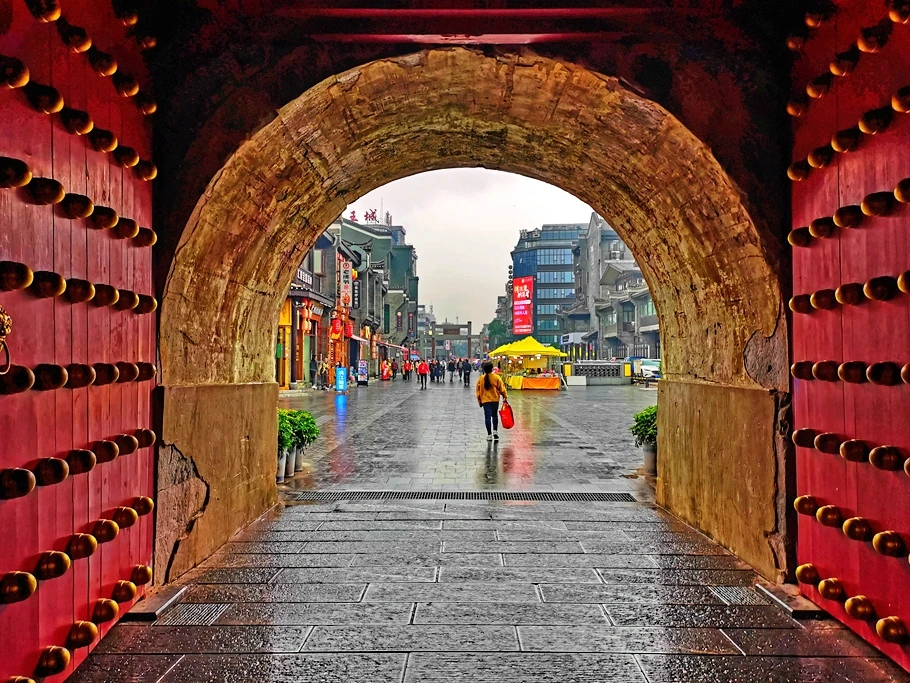
Strolling through Guilin's Zhengyang Pedestrian Street in the Rain, Wandering and Searching, Crossing the Past and Present of Zhengyang Street
In 1995, singer Han Xiao's song 'I Want to Go to Guilin' became a nationwide hit. This song created a character who longed to visit Guilin, longed to be surrounded by its landscapes, but was tormented by the conflict between time and money that prevented the dream from coming true. That song left a deep impression on me that year—I had to see Guilin in my lifetime. Twenty-six years flew by, and I've turned from youth to old age. Now retired with time to spare, I finally arrived at the Guilin I once dreamed of. I fulfilled my dream by visiting Yangshuo, the paradise of landscapes under heaven. On the last day, I came to the city center of Guilin, visited Xiangshan Park and Shanhu Lake Scenic Area, and then stopped by Guilin's Zhengyang Street.
Xiangshan Park is located at the confluence of the Li River and Taohua River in the center of Guilin, Guangxi. Elephant Hill, with its lifelike shape, is fascinating and regarded as the representative of Guilin's landscapes, the symbol of Guilin city, and the central pattern of Guilin's city emblem is Elephant Hill.
Elephant Trunk Hill is named for its shape, which resembles a giant elephant drinking from the river. Look, it looks like an elephant dipping its long trunk into the river to suck up water—how lovely! This place has always been a tourist attraction.
Twin Pagodas Park is located at Shanhu Lake, one of the lakes in Guilin's Two Rivers and Four Lakes system. Two pagodas were built here; they are most beautiful at night with lights. One pagoda is white, the Moon Pagoda; the other is yellow, the Sun Pagoda. The park is free, so it attracts many visitors. The trees by the lake are also lush.
Elephant Trunk Hill is the city emblem of Guilin, and the adjacent Twin Pagodas are the landmarks of new Guilin. The Sun and Moon Twin Pagodas claim to be the world's first bronze pagoda, the world's tallest elevator pagoda on water, and the world's tallest bronze structure. The two pagodas are connected by an underwater passage 18 meters below the lake, allowing visitors to take an elevator up the Sun Pagoda for a panoramic view of Guilin's urban beauty.
Every tourist city has one or two pedestrian streets with a high flow of visitors, and Guilin is no exception. This article is about Zhengyang Pedestrian Street. We entered a side lane of the pedestrian street from the Qu Shui Liu Shang area near Shanhu Lake, then entered the main street, and finally walked straight along the street until we reached Jingjiang Princes' City.
Guilin's Zhengyang Pedestrian Street is said to have a history of over a thousand years. It was raining, but that didn't stop our brisk pace. I took a few photos, at least to say I've passed by and seen it.
Zhengyang Street was an old street in the past. It began in the Han Dynasty and flourished in the Qing Dynasty. It was once the political and commercial center of Guilin and a gathering place for high-ranking officials and wealthy merchants, with rich historical accumulation and stories.
Today, this street doesn't look very old, but its history can be traced back to the Han Dynasty, with its most prosperous period being the Qing Dynasty.
Zhengyang Street is a pedestrian street integrating leisure, shopping, and entertainment, so the buildings on both sides have various architectural styles, offering great aesthetic value. The shop layouts are meticulously designed according to the characteristics of their goods, showcasing their own charm—each with its own appeal, very attractive and enticing. There are many shops with a complete range of goods: everything you might need—food, clothing, daily necessities, entertainment—is available.
The buildings on Zhengyang Road Pedestrian Street feature a northern Guangxi style but incorporate many Western architectural elements.
Zhengyang Street is the busiest and most popular pedestrian street in downtown Guilin, with a total length of 666 meters. It runs perpendicular to the Zhengyang Gate of the Ming Dynasty Princes' City and was the main passage for Ming Dynasty princes and nobles.
There are many brand-name stores on Zhengyang Pedestrian Street, mainly mid-range brands, along with some snack shops and stalls.
Although it was a cloudy and rainy day, there were still many people on the street—men and women in colorful clothes, an endless stream, making it very lively.
Walking on Guilin's Zhengyang Street in the rain has a special flavor.
In history, Zhengyang Road Pedestrian Street was a gathering place for high-ranking officials and wealthy merchants, but now it's hard to feel the ancient charm of the past.
From Zhengyang Street to Dongxi Alley, you have to go through an underground passage.
This is the underground mall of 'Dongxi Alley'.
Dongxi Alley is the only surviving historical street and alley from the Ming and Qing dynasties in Guilin. This area combines traditional culture with distinctive architecture, restoring the ancient Ming and Qing architectural complexes of old Dongxi Alley. It is also the only way to the main gate of Jingjiang Princes' City.
Dongxi Alley, adjacent to Jingjiang Princes' City, is a comprehensive commercial district integrating tourism, folk customs, culture, shopping, dining, leisure, and entertainment.
There is a Catholic church in Dongxi Alley.
This is the south gate (Duanli Gate) of 'Jingjiang Princes' City' at the north end of 'Zhengyang Road'. The outer walls of Jingjiang Princes' City have the best-preserved Ming Dynasty city walls in China. The walls and gates still retain their original appearance, with important historical and artistic value. In 1996, it was listed as a National Key Cultural Relics Protection Unit.
The stone lions in front of the gate of Guilin Princes' City still stand guard, protecting this auspicious site.
Now, entering and leaving the Princes' City is an ordinary matter.
The four large characters '三元及第' (Three Prefectures in the Highest Imperial Examination) carved on the city wall of Zhengyang Gate of Jingjiang Princes' City testify to the miracle created by scholars of this city in the imperial examination era. The person who achieved 'three prefectures' (winning first place in the provincial, metropolitan, and palace examinations) was Chen Jichang from the Jiaqing period of the Qing Dynasty, a native of Lingui. 'Three Prefectures in the Highest Imperial Examination' was the highest honor in the imperial examination system; in the 1,380-year history of China's imperial examinations, only 13 people achieved this feat.
Over 600 years ago, to consolidate the Ming Dynasty's rule, Zhu Shouqian, the grandnephew of Zhu Yuanzhang, was enfeoffed as a prince in Guilin. Thus, a Jingjiang Princes' City, built 34 years earlier than the Forbidden City in Beijing, was born on this beautiful land of Guilin. Guilin locals call it Guilin Princes' City.
The main gate of the Princes' City, the Chengyun Gate, is a yellow memorial-arch-style building with a plaque next to it reading 'Guangxi Normal University'. Now, Guilin Princes' City serves as the campus of Guangxi Normal University.


![Mountains and Waters Meet Again [Guilin Yangshuo] Let's Rock the Boat of Friendship](/img/624178c28a221adb_s.webp?src=https%3A%2F%2Fdimg04.c-ctrip.com%2Fimages%2F0104n120009cnhkrdD720_W_320_0_Q80.jpg)


