Guilin-Lijiang-Yangshuo: An "Awkward" Travelogue
Guilin: A prefecture-level city in the Guangxi Zhuang Autonomous Region, with no severe cold in winter and no extreme heat in summer. Guilin is a world-renowned tourist city, one of China's first National Historical and Cultural Cities, and an excellent tourist city in China. Its mountain and water scenery is famous worldwide, enjoying the reputation of "Guilin's landscape is the best under heaven" for thousands of years. It belongs to mountainous and hilly terrain, typical Karst landform. The limestone distributed throughout the city has been weathered and eroded for millions of years, forming a unique landscape with thousands of peaks surrounding, a river embracing the city, peculiar caves, and beautiful stones.
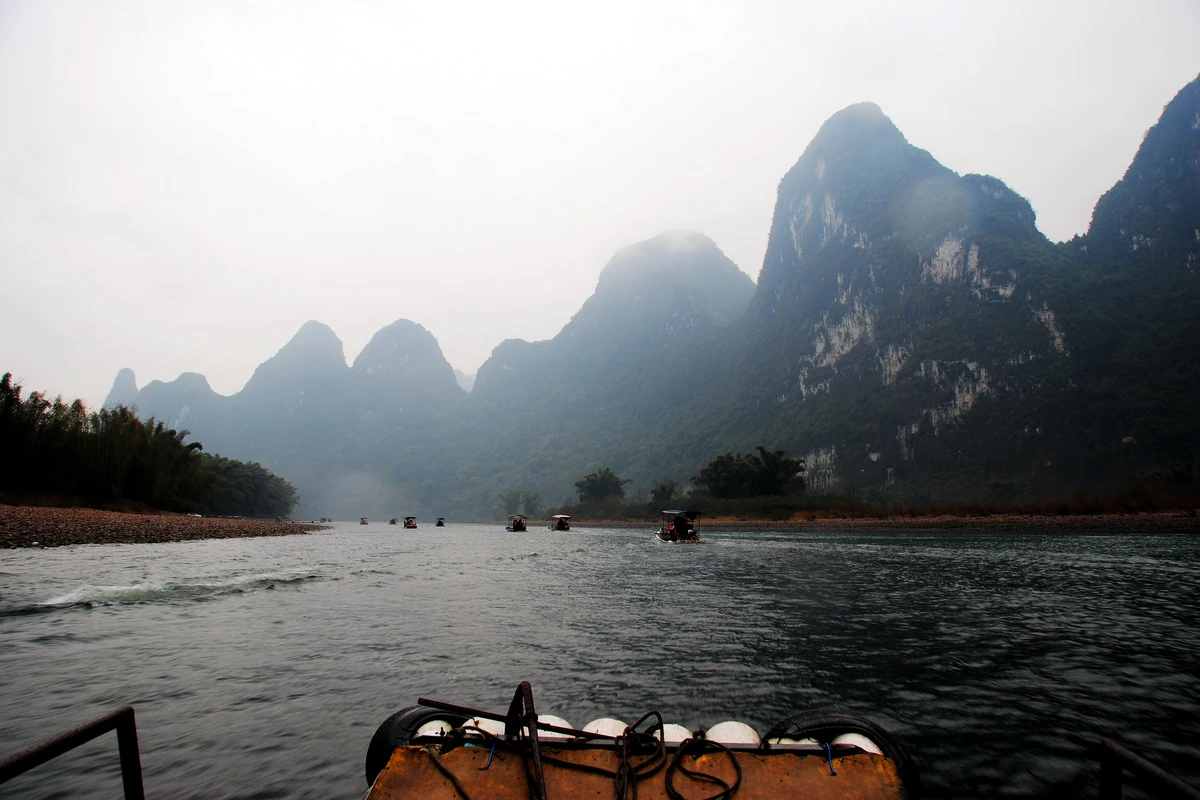
Lijiang River: The Lijiang River scenery is praised for its "four excellences": green mountains, clear water, peculiar caves, and beautiful stones. The 83-kilometer river section from Guilin to Yangshuo is the essence of the Lijiang River, also featuring "deep pools, dangerous shoals, flowing springs, and flying waterfalls." It is a typical, rich, and concentrated area of Karst landform development, gathering the essence of Guilin's landscape, giving people the feeling of "sailing on the blue waves, wandering in a painting."
Yangshuo: Since ancient times, there has been a saying: "Guilin's landscape is the best under heaven, but Yangshuo's scenery is even better than Guilin's."
We booked a 4-day guided tour of Guilin and Yangshuo (4-diamond) on Ctrip from February 12 to 15, 2015, for a family of three.
Unexpectedly, from the very beginning, the awkward journey kicked off!
On the evening of February 12, at Pudong Airport, the flight was unable to take off due to heavy fog in Guilin. We waited until after 2:00 a.m. on February 13, and the flight was canceled. We had to stay in Pudong overnight.
On the morning of February 13, we were woken up at 6:00 a.m., delayed until after 10:00 a.m. to take off, and arrived in Guilin in the afternoon of the second day of the itinerary. By then, the main tour group had already left Guilin in the morning to cruise the Lijiang River.
The driver who picked us up offered two options: 1. Catch up with the main group and complete the remaining itinerary, but miss the Lijiang River cruise; 2. Tour the Lijiang River on our own, cancel a few minor stops, and reunite with the group on the third day.
Our main purpose in coming to Guilin was to see the landscape, so we decisively chose the second option.
We hastily booked a hotel in downtown Guilin, the Guilin Grand Hotel, on Ctrip. The driver dropped us off at the hotel and then took an elderly couple who were on the same flight as us to catch up with the main group.
At the hotel front desk, we signed up for a one-day tour of Yangshuo on February 14, costing 170*3=510 (including bamboo raft ride on the Lijiang River and a few small attractions).
On the evening of February 13, we strolled around downtown Guilin.
Xicheng Road Pedestrian Street:
Luosifen (snail rice noodles): Slices of braised beef, sausage, char siu, etc., mixed with brine, peanut oil, crispy soybeans, and according to personal preference, chili, minced garlic, chopped green onions, various pickled vegetables, etc., without adding soup, stirring to infuse the flavors.
This kind of rice noodle makes a slurping sound when eaten, combining sound, color, and taste.
Feeling like a happy immortal!
The Sun and Moon Twin Pagodas are landmarks of Guilin. The Sun Pagoda is made of copper, and the Moon Pagoda is made of glazed tiles. The two pagodas are connected by a tunnel over 10 meters long under the lake. The surroundings, interior walls, doors, and windows of the twin pagodas are full of colorful patterns. At night, the two pagodas emit golden and silver light respectively under the illumination. You can enjoy the beauty of the twin pagodas along the banks of Shanhu Lake.
This is a connected heart-shaped lake. It is divided by Yangqiao Bridge; the east is Shanhu Lake, and the west is Ronghu Lake, named after the banyan and fir trees growing on the shores. Since the Qing Dynasty, wealthy gentry and famous scholars built houses by the lake, and literati wrote poems and essays here, making it the cultural center of Guilin. The Sun and Moon Twin Pagodas are one of the important night scenes of Guilin's Two Rivers and Four Lakes.
February 14, one-day tour: Morning: Jianshan Temple, Julongtan Karst Cave; Afternoon: Lijiang River cruise.
Jianshan Temple was first built in the early Kaiyuan period of the Tang Dynasty (around 713 AD), at the foot of Yunji Mountain in the Moon Hill scenic area of Yangshuo County. It is one of the oldest temples in Guilin. At that time, the monks in the temple rang the bell and chanted sutras morning and evening. The bell sound was melodious and resounded through the sky, hence it was listed as one of the old eight scenic spots of Yangshuo, "Jiansi Monk Bell." Jianshan Temple went through the Song, Yuan, Ming, and Qing dynasties, with its incense flourishing for over 1,200 years.
The architecture of Jianshan Temple is simple, elegant, and magnificent, imitating the ancient Tang Dynasty architectural style, with a total building area of 5,589 square meters. The building complex faces south to north. The main halls are arranged according to the typical ancient temple layout. On the central axis, there are a screen wall, mountain gate, Heavenly Kings Hall, Mahavira Hall, and Sutra Depository. On the east-west sides, there are Guanyin Hall, Manjushri Hall, Samantabhadra Hall, Ksitigarbha Hall, Bell and Drum Tower, corridors, and stele pavilions. Each hall is a place for tourists to visit, learn about Buddhist culture, conduct Buddhist exchange activities, and offer incense and worship. On the east and west sides of the mountain gate, there are vegetarian dining halls and pilgrims' lodges for Buddhist believers to dine and stay.
The great Tang monk Jianzhen, after his fifth failed attempt to cross to Japan, once came to this temple to preach the Dharma.
The Tang Dynasty poet Cao Ye, before passing the imperial examination, composed poems with the resident monk Zhixian here, which became a much-told tale.
Julongtan Scenic Area is located between the Ancient Banyan Park and Moon Hill, consisting of two large caves, Heiyan (Black Cave) and Shuiyan (Water Cave). It is a place in Yangshuo where you can tour both on land and by water in one cave, and also one of the places with the most "hidden dragons and crouching tigers." The land and water route total one kilometer.
The highest point of the cave dome is 25 meters, the widest about 30 meters. Countless stalactites look like "dragons," including crouching dragons, coiled dragons, swimming dragons, flying dragons, dancing dragons, golden dragons, jade dragons, green dragons, yellow dragons, dragon kings, dragon princesses, dragon sons, dragon grandsons, too numerous to count, vivid and lifelike.
The scenic spots inside Julongtan are dense, such as Dragon Princess Welcoming Guests, Peacock Spreading Its Tail, Moon Palace Laurel Tree, Milky Way Strange Peaks,
Like the Peach Banquet, Dragon Palace Jade Pillars, Imperial Concubine Bathing, Stone Forest Wonders,
Like the Moon on the Sea, Mirage, Water Sprinkling Guanyin, Penglai Fairy Island, etc.
Making people feel as if they are roaming in the Dragon Palace.
The three of us squeezed onto the Dragon King's throne for a group photo.
Lunch was at a restaurant called "Tang Xiaomei Farmhouse Cuisine." We ordered a chicken pot.
Looking out the window, we saw a huge semicircular cave on the opposite mountain in the mist. It should be quite famous, right?
Shopping stop during the one-day tour: a store selling bamboo fiber products.
3. Bamboo raft ride on the Lijiang River – this was the highlight of the trip.
In the past, bamboo rafts were manually punted, more artistic. Although there are still boatmen now, they have been changed to motorized boats.
Guilin Lijiang River Scenic Area: A World Natural Heritage site, a National AAAAA-level Tourist Attraction, a National Key Scenic Spot, and the world's largest and most beautiful Karst landscape area. The Lijiang River scenery is praised for its "four excellences": green mountains, clear water, peculiar caves, and beautiful stones. The 83-kilometer river section from Guilin to Yangshuo is the essence of the Lijiang River, also featuring "deep pools, dangerous shoals, flowing springs, and flying waterfalls." It is a typical, rich, and concentrated area of Karst landform development, gathering the essence of Guilin's landscape, giving people the feeling of "sailing on the blue waves, wandering in a painting."
The Lijiang River, also known as Guishui, Guijiang, Guishui, Dongjiang, flows through Guilin City, Guangxi Zhuang Autonomous Region. It nurtures the unique and world-famous natural landscape of Guilin, described as "the river is a green silk ribbon, the mountains are jade hairpins." Its scenery is beautiful, with clear waters and green mountains, peculiar caves and beautiful stones, making it a renowned scenic spot both at home and abroad.
From an aesthetic perspective, the characteristics of the Lijiang River can be summarized in four words: clear, strange, clever, and varied.
Clear refers to the water of the Lijiang River, which is crystal clear and transparent all year round. Zhang Ziming of the Song Dynasty wrote, "Stones in the Guishui River seem to float," portraying its clarity.
Strange refers to the mountains of the Lijiang River, which are peculiar and majestic. Fan Chengda, a poet of the Song Dynasty, said, "The strange mountains of Gui should be the best under heaven." Chen Yi praised the Lijiang River in his poem: "Everywhere presents wonders, enough for a lifetime to see."
Clever refers to the ingenious scenery of the Lijiang River. Along the way, strange stone mountains have myriad shapes, unlimited comparisons, imitating people and objects. "Immortals Pushing Millstones," "Nine Oxen Crossing the River," "Monkey Hugging Watermelon"... all are vivid and lifelike. The stone patterns and colors on the cliffs are grotesque and gorgeous, forming countless pictures, as if created by nature itself.
Varied refers to the ever-changing scenery of the Lijiang River. Traveling by boat, you see the mountains on both sides, sometimes solitary peaks standing upright, sometimes a stretch of strange peaks, sometimes a sea of peaks and forests, sometimes flat fields and open country. The water of the Lijiang River twists and turns, sometimes slow, sometimes rapid, sometimes calm, sometimes turbulent with waves and splashes.
The Lijiang River is like a green silk belt winding among thousands of peaks, with strange peaks on both sides, clear water meandering, cliffs hanging over the river, green mountains floating on water, and beautiful scenery, like a hundred-mile scroll.
Taking a boat ride on the Lijiang River, you can see the reflections of strange peaks, clear water and green mountains, shepherd boys singing leisurely, old fishermen fishing idly, and rustic pastoral homes.
Nine Horses Painting Hill is one of the famous scenic spots on the Lijiang River in Guilin, a marvel of nature's ink. Located 4 kilometers northwest of Xingping Town, the mountain is over 400 meters high and 200 meters wide, standing by the river with a sheer cliff face of colorful patterns. From a distance, it looks like a huge painting screen. Upon closer inspection, the screen shows a group of horses, some standing, some lying, some raising their heads and neighing, some kicking their hooves and flying, looking back at the clouds, or grazing leisurely... Song Dynasty poet Zou Hao compared it to the masterpiece of a drunken god: "It seems the Heavenly Lord's drunken brushstroke, layers of ink still crisscross." Qing Dynasty poet Xu Gong praised: "Since ancient times, mountains are like paintings; now paintings are like mountains. A horse picture shows nine heads; a wonder exists in the world." The great Qing scholar and Viceroy of Liangguang, Ruan Yuan, once wrote a poem - "Song of the Clear Lijiang Stone Wall Picture."
Throughout history, many visitors have been fascinated by this natural mural. There is a folk rhyme: "Horse watcher, horse watcher, ask you how many pairs of divine horses? If you see seven, you'll be a top scholar; if you see nine, you'll be a number one scholar."
We stopped the raft and went ashore for some refreshments.
Everything was so poetic.
In the evening of February 14, we went ashore and followed the bus to Yangshuo, ending the one-day tour.
After contacting the tour guide, we finally felt like we had found our group. Following instructions, we checked into the Junhao Hotel in Yangshuo.
Behind the hotel, there were high mountains shrouded in mist.
Yangshuo: Since ancient times, there has been a saying: "Guilin's landscape is the best under heaven, but Yangshuo's scenery is even better than Guilin's." Yangshuo County, known for its beautiful scenery, is located in the northeast of Guangxi Zhuang Autonomous Region, south of Guilin City, under the jurisdiction of Guilin. The county seat is 65 kilometers from Guilin city. The county was established in the tenth year of Kaihuang of the Sui Dynasty (590 AD), more than 1,400 years ago.
Across from the hotel, there was a sign pointing the direction to "West Street."
West Street is the most historic street in Yangshuo. First built in 1674, it faces the Lijiang River to the east, directly opposite Dongling, faces Gaoze Peak to the west, and is adjacent to Bilian Peak. The street is about 8 meters wide and nearly 800 meters long, paved with locally produced betel nut pattern marble, dark green and shiny. On both sides are low brick and tile houses left from the Qing Dynasty, with white plaster walls and red windows, exuding the simple elegance of Lingnan architecture.
Because of West Street, the whole of Yangshuo is filled with infinite warmth. Everyone who has been to West Street in Yangshuo feels like they have come home.
As China's first foreigner street, the largest foreign language corner, and a veritable global village, "West Street" has been cloned by many tourist cities and attractions across China.
"West Street" is a Chinese-style town that condenses the essence of China. The Western-style shops on West Street display traditional Chinese ornaments, such as batik with cloisonné blue totems, hand-embroidered pouches, hanging straps, various styles of Chinese knots, and peace charms.
Stone slab roads, northern Guangxi residential buildings, bars, restaurants, inns, folk artists, tourist souvenirs, climbing bars, tourists of different skin colors, etc., "West Street" has everything you can imagine.
Performance of pulling sugar art:
Taiwanese little meatballs founded in 2012:
Internet-famous "Spotted Grouper Hotpot":
Master Chef Spotted Grouper Hotpot Restaurant. Spotted grouper is actually raw fish. Here, the fish is sliced into thin pieces by the chef with fine knife skills and coated with raw oil before serving, making the fish meat more tender. We ordered wild spotted grouper, costing about 240 yuan, I think.
Waiting...
The spotted grouper hotpot truly lived up to its reputation, with a fresh and sweet taste. The thin fish slices are cooked in the pot with a quick swish and then ready to eat.
Let's have a drink to rinse our mouths.
February 15, Found the group, joined the tour.
On the morning of the last day of the original itinerary, we finally met the tour guide. Ctrip was quite generous with the refund, returning 1,588 yuan for two days of hotel, meals, and tickets for a few attractions.
Elephant Trunk Hill Scenic Area is centered on Elephant Trunk Hill, the landmark of Guilin. The shape of Elephant Trunk Hill is very much like an elephant drinking water. Besides Elephant Trunk Hill, the scenic area also includes Water Moon Cave, Love Island, Puxian Pagoda, Sanhua Wine Cellar, and other attractions, each with its own characteristics.
Elephant Trunk Hill, originally named Lishan, also called Yishan, Chenshui Mountain, abbreviated as Xiangshan, is 200 meters above sea level, 55 meters above the water. It belongs to Karst landform, composed of pure limestone deposited on the seabed 360 million years ago.
Water Moon Cave is located between the trunk and legs of Elephant Trunk Hill. 12,000 years ago, the crust rose, the Lijiang River shrank, accelerating the development of Water Moon Cave, forming a through cave from east to west. It is 17 meters long, 9.5 meters wide, 12 meters high, with an area of about 150 square meters. The mouth of Water Moon Cave faces the sun, also called Chaoyang Cave. But the cave is above the water, like a bright moon floating on the water, very vivid, so the name Water Moon has been used until now. "Elephant Hill and Water Moon" is a great wonder of Guilin's landscape. Opposite to the south is the Moon Rock of Chuanshan, one hanging in the sky, one floating on the water, forming the peculiar landscape of "Double Moons of the Lijiang River."
Tourists changing costumes to take photos.
Solitary Beauty Peak and Prince's City Scenic Area:
Includes Solitary Beauty Peak and Jingjiang Prince's Palace. Solitary Beauty Peak is right behind the palace. The phrase "Guilin's landscape is the best under heaven" comes from the stone inscriptions here.
Jingjiang Prince's Palace was originally the palace of Zhu Shouqian, the grandnephew of Zhu Yuanzhang, the founding emperor of the Ming Dynasty. It is one of the best-preserved Ming dynasty princely palaces.
Solitary Beauty Peak is located within Jingjiang Prince's City in the center of Guilin. It is a famous peak in Guilin. Climbing to the top of Solitary Beauty Peak, you can overlook the city scenery in all directions. The stone inscriptions by ancient and modern celebrities on the mountain are also attractions. After reaching the top, you can view the surrounding peaks and the Jingjiang Prince's Palace below, bird's-eye view of Guilin city, and climbing to the top always gives a sense of broad-mindedness.
"Zhongshan is immortal, doctrine is ever new" monument:
Cliff inscriptions in the scenic area: The cliff inscriptions are scattered, with some appearing horizontally and vertically. There is also the world cultural wonder in Taiping Rock – the "Tai Sui" cliff inscriptions.
Including Dushu Rock (Reading Rock), and Crescent Pond, one of the four famous ponds in Guilin, ripples at the foot of the mountain. Green mountains and clear waters complement each other, making it one of the eight old scenic spots of Guilin.
This "Longevity" character is said to be the calligraphy of the Empress Dowager Cixi:
It was the site of the imperial examination for the southern provinces in the Qing Dynasty.
There were more than 5,500 examination cells, each for one examinee, where they answered questions, ate, and slept.
From here, more than 500 jinshi (successful candidates in the highest imperial examination) and four zhuangyuan (top scholars) emerged.
Here, you can participate in a mock exam to experience the hardships of the scholars who studied hard for ten years and the process of passing the imperial examinations.
On display here are the plaques obtained by the zhuangyuan of the time.
After completing all four days of the itinerary, the tour guide sent us to the airport.
This is our return flight.


![Mountains and Waters Meet Again [Guilin Yangshuo] Let's Rock the Boat of Friendship](/img/624178c28a221adb_s.webp?src=https%3A%2F%2Fdimg04.c-ctrip.com%2Fimages%2F0104n120009cnhkrdD720_W_320_0_Q80.jpg)


