A Love for Landscapes: Encountering Guilin
Travel is a magical thing—if you experience a place with the right person, at the right time, and in the right way, it can take on a unique hue and become deeply etched in your heart. Conversely, you might miss out on some truly wonderful things. Guilin was a place I had repeatedly missed in my life. Although I carried a certain fondness for it thanks to my parents' honeymoon memories, the wrong timing and unsuitable itineraries in the past had caused me to miss many opportunities to truly understand its landscapes. That was until Tingzai, a Guilin expert, appeared. She rekindled my curiosity about these landscapes and gave me new aspirations and creative inspiration. Finally, during the golden autumn season, the best weather arrived in Guilin and Yangshuo, and I captured my first-ever most beautiful portrait of Guilin's landscapes. And this was my third visit to Guilin.
From traveling, I have slowly learned to enjoy life and notice the beauty in every detail. Perhaps this is the little happiness that travel brings me. So, follow my perspective and rediscover the essence of Guilin's landscapes.
Let's start with a glimpse of the stunning scenery.
D1 Shanghai to Guilin, Zizhou Island, Diecai Mountain sunset
D2 Dongli Ancient Village, Gudong Waterfall
D3 Shangri-La (World Land of Peace), heading to Yangshuo, staying at Xianyunju
D4 Morning cruise on the Li River, Yulong River ancient bridge, sidecar ride through wheat fields, riding a white horse by the Li River
D5 Sunrise over the peaks, Li River fisherman
D6 Guilin to Shanghai
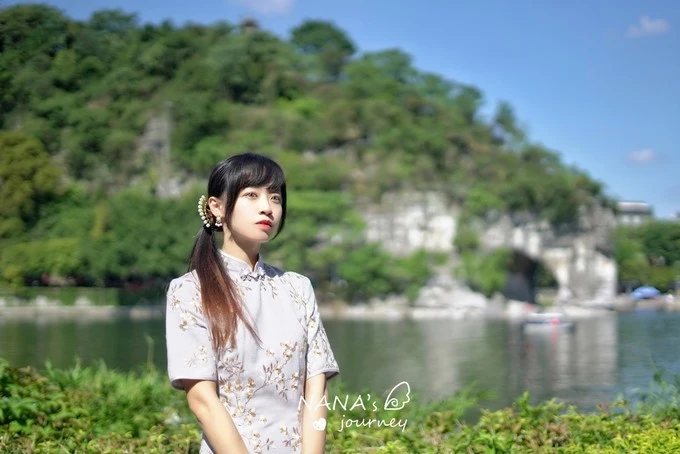
Seeing the 'Elephant' from a Different Angle @ Zizhou Island
"Guilin's landscapes are the best under heaven." When people come to Guilin, they first go to see the famous Elephant Trunk Hill in the city center. There are many ways to view this 'elephant,' but Tingzai recommended an absolutely perfect spot: Zizhou Island on the eastern bank of the Li River. Here, you can photograph Elephant Trunk Hill from any angle—a flawless and stable vantage point. So, as soon as I got off the plane, I couldn't wait to head to Zizhou Island, just to make up for years of missing out on Elephant Trunk Hill. Tingzai said I was lucky—the weather in Guilin recently had been amazing. Compared to our original plan to visit in June, September was perfect for taking photos. With blue skies, white clouds, and beautiful surroundings, Zizhou Island gave my trip a wonderful start.
On the white marble bridge at the entrance, we saw a few stone tablets on one side. Zizhou Island has a long history and was a favorite spot for scholars and poets. Their poems praising the beauty of Zizhou are engraved here. Liu Zongyuan once praised it as "unrivaled under heaven."
In fact, Zizhou Island was originally the official garden of Pei Xingli, the prefect of Guizhou during the Tang Dynasty. It has been the best place to view Elephant Trunk Hill since ancient times and is the core area of the Li River in Guilin. If you're as eager as I was to catch a glimpse of the 'elephant,' a shuttle bus will take you to the viewing platform in just five minutes. As the bus emerged from the woods, I couldn't help but let out a 'wow' when I saw Elephant Trunk Hill. Against the blue sky, the elephant seemed to be leisurely drinking from the Li River—so vivid and lifelike. Indeed, Zizhou Island offers the best angle to see Elephant Trunk Hill!
Tour boats and bamboo rafts passed by Elephant Trunk Hill, while we quietly enjoyed the scenery on the shore, listening to the flowing water of the Li River, savoring the landscape in comfort.
Besides Elephant Trunk Hill, I also loved the view of Guilin city from Zizhou Island. In the distance, layer upon layer of peaks enveloped the city, while up close, Elephant Trunk Hill and the Li River accompanied each other, as peaceful as a painting. Next to the viewing platform, you can rent ethnic costumes. Wearing the traditional attire of the Zhuang ethnic group in Guangxi and taking a photo with Elephant Trunk Hill is definitely a unique local experience.
After seeing Elephant Trunk Hill, don't leave immediately. Zizhou Island, as an oasis on the Li River, is also very beautiful. Spend one or two hours strolling around the island, taking photos, and enjoying the time. At the center of the forest is a large lawn, a favorite playground for children. In the middle stands a sculpture of Liu Zongyuan and his essay "Record of the Zizhou Island Pavilion." Even historical literati loved this place—everyone has good taste!
What girls will love most is afternoon tea time. Enjoying sunshine, greenery, and food amidst the forest is pure romance. It feels like the Emerald City.
Besides afternoon tea, it's also a great place for photos. The wisteria corridor, with its elegant hues, is a delight of late summer.
Walking through the dense forest with friends, listening to birds and flowers, chatting about small matters, the fragrance of desserts delights the palate, and the beautiful colors soften the time.
If you look closely, Zizhou Island has many cultural and historical stories, such as the sculpture of the Three Friends of Winter (pine, bamboo, and plum).
On the way back, be sure to walk through the quiet bamboo grove. The dense bamboo sea blocks the summer heat, swaying in the wind and bringing coolness. This is another highly recommended photo spot—walk gracefully through the bamboo and leave your best silhouette.
Deep in the bamboo grove is a pavilion called Yan Ting, with an ancient architectural style that is both grand and elegant. Many locals practice dancing here. We sat down to enjoy the shade and experience the leisurely lifestyle of the locals.
Finally, let's take a look at the aerial view of Zizhou Island. The entire cityscape of Guilin, Elephant Trunk Hill, and the Two Rivers and Four Lakes are all in sight.
The Li River is the mother river of Guilin, winding through the city, accompanying the lives of Guilin people and the karst landforms of Guangxi.
In the evening, the beauty of Zizhou Island and the Li River ends the day with a tipsy glow.
I Framed a Sunset @ Diecai Mountain
If the weather is good in Guilin, you must go watch a sunset. Recently, a popular sunset spot in Guilin is a cave that frames the city's sunset—Diecai Mountain. Guilin is known for its karst landscapes, and its parks are actually composed of small karst hills. The cave at Diecai Mountain is located halfway up the mountain, and walking through it feels like a time travel. At the end of the cave is the most beautiful view of Guilin city.
To catch this sunset, you have to wait. The park has a fixed closing time, so you need to enter before that. In this season, the sunset is between 6:30 and 7:00 PM, so the wait isn't short. Bring enough snacks, climb to the cave halfway up, and wait for the sunset.
The peaks of Guilin are concentrated in the west, which is also the direction of the sunset. The red glow of the sun dyed the hills, creating a beauty that made me linger. The shape of the cave entrance framed a beautiful Guilin sunset.
Unlike sunsets elsewhere, this one is niche and unique—a different way to see Guilin. I was deeply intoxicated with every photo I took.
Though it's a bit embarrassing to admit, this was my first time watching a sunset in Guilin after three visits. The sunset over the peaks is special: the interplay of light and color among the mountains is full of anticipation and fantasy, lingering in the mind.
This is the best place for sunset silhouettes. You'll get the most creative sunset photos.
Entering the Charm of Northern Guangxi Villages @ Dongli Ancient Village
Along the winding Li River, how many stories have been told here? It seems that one day, we started seeking those memories. Amid the landscapes and on the ancient road between Hunan and Guangxi, we visited a place that evokes past memories—a quiet ancient village called Dongli Ancient Village.
Before coming, I knew that Dongli Ancient Village is a typical ancient residence of northern Guangxi, perfect for vintage photos. So I specially prepared Han elements to immerse myself in the ancient atmosphere. When I arrived, I realized that this ancient town amidst Guilin's landscapes is not only photogenic but also fun. As a city girl, I was captivated by the local artisans and immersed in various traditional crafts—one day wasn't enough!
The village has complete architecture, from the Guandi Temple and ancestral halls to academies, reflecting the comprehensive functions of a northern Guangxi village.
The ancient residential architecture in northern Guangxi is very distinctive: upturned eaves, corbels, horse-head walls, green bricks and tiles, traditional and exquisite mortise-and-tenon structures, and interconnected corridors full of interest.
Walking through the old houses, I saw a fascinating traditional art. On the walls were "house-mates" (door couplets), originally wooden carvings placed on the lintel or on both sides of the door. People in northern Guangxi use these for rubbing—beautiful patterns can be printed on various materials, which is very unique.
First, tie the material to be dyed onto the "house-mate," then tap it evenly with cinnabar. A beautiful red pattern is complete. Apparently, some guests found the patterns so beautiful that they directly used their own clothes for rubbing—how interesting!
Leaving the old houses, we followed the path for a traditional cultural experience tour. Each small house has its own story of traditional craftsmanship. Walk around, listen, and if interested, try it yourself—an experience city dwellers often lack.
We met an elderly woman busy at the door, making straw weaving. She was finishing a small palm-leaf fan. If we tried it ourselves, it might take two hours, as straw weaving isn't easy. Behind her, the shop was full of her meticulously crafted straw products.
A Hanfu dress paired with such a fan instantly creates the right vibe.
Compared to straw weaving, making chopsticks seemed easier. We polished the rough chopsticks prepared by the master, and soon they were smooth and finished. If needed, you could engrave your name on them—very meaningful.
Wandering through the ancient village, we discovered many past stories. This cultural journey delighted us, and we eagerly looked for the next thing to explore.
The natural scenery of the ancient village is also stunning. The characteristic ancient covered bridge is a must-walk. Under the bridge, there are swings near the water, great fun. If you go deeper into the village, you'll find other charming bridges and forest swings—various natural styles, whichever you like.
Crossing the bridge, we arrived at another area of the ancient village, which gathers shops of various traditional craftsmen. Here we witnessed the ingenuity of traditional artisans. A young potter, though deaf, was a master of pottery. He demonstrated the traditional process of shaping clay—in just one minute, he formed a jar, leaving us in awe!
Next to the pottery studio was a place where camellia oil was pressed. We were curious about how the large press worked. An old man lifted a wooden rammer and started a demonstration. Such a heavy rammer had to hit the press accurately to extract oil!
The tie-dye workshop was a surprising place. A whole wall of tie-dyed fabrics shimmered with ink-wash hues under the light—the most artistic spot in the entire village. Although tie-dye is common, the master's meticulous preparation of the fabric before dyeing resulted in exquisite finished products. If you have time, you should experience this fine craft.
From above, the village looked small, but actually it's quite large. Deeper in, we found idyllic rural scenes: drying tofu skin, brewing wine, farmhouse dishes, making tofu—all authentic experiences of northern Guangxi folk customs.
Rural life looks like this: occasional water buffalo carts, cows cooling off in the river, stray little yellow dogs—simple and quiet life is enviable.
Most importantly, if you also love culture and folk customs like us, having a meal of northern Guangxi cuisine here is an extraordinary 'time-travel' experience. The exquisite dishes were brought in on a 'human sedan chair,' and we dined in the main hall of an ancient northern Guangxi residence, with carved furniture. It was my first time having such a magical experience. The enthusiastic locals also performed Caidian (a local opera) for us—so wonderful!
As a curious soul, I was fascinated by this experiential ancient village. Next time, I'll consider staying overnight in one of these ancient houses—it would surely be a unique experience, with more time to play in the water and enjoy rural pleasures.
New Water Play Experience in the Mountains @ Gudong Waterfall
What's the best thing to do in the scorching summer? Playing in the water, of course! But not just by the lake—it has to be something exciting. In Guilin, there are many fun outdoor activities, and climbing Gudong Waterfall is one of them. Combining beautiful landscapes with outdoor experiences makes for a unique adventure.
The park's immersive experience is impressive. Right at the entrance, on a tranquil lake, we got to row a bamboo raft. After some professional 'power analysis,' I actually managed to play the role of a boatman—and got a compliment from the real boatman!
After reaching the other side, the forest journey began. If you want to climb the waterfall, you can rent straw sandals and a helmet here.
The forest path is serene and winding. Following the stream deeper, we came across ancient stone bridges and 'lucky gates,' filling the walk with laughter. What struck me most was the park's philosophy: the displays along the way conveyed both Zhuang culture and environmental awareness, elevating our thoughts.
The mountain air was rich in negative ions, and the towering trees provided cool shade. Rare mandrake flowers bloomed on both sides, guiding the way.
Soon we arrived at the waterfall. We were initially worried about safety, but it turned out to be very safe. The straw sandals are non-slip, and the park regularly cleans moss from the rocks, so everyone can enjoy the water without worry. The first level, 'Turtle Drinking from the Stream,' has the biggest drop. The left side is easier, the right side harder, with ropes to help you climb up. Stepping into the waterfall water was refreshing!
Everyone helped each other climb, and this outdoor activity really fostered teamwork—even among strangers.
Our brave Tingzai charged up the waterfall front, and I recorded her heroic moments from above. Her expression said it all—so much fun, and the cool water was a summer lifesaver. Once you conquer the first waterfall, the rest is easier.
Some corners of the waterfall required a bit of strength to climb, and I couldn't help but feel nervous for her.
Many children also came to play in the waterfall. The later parts are more suitable for them, with built-in ladders that give a sense of achievement while still offering the fun of climbing.
The entire Gudong Waterfall consists of many cascading small waterfalls, with the source being an underground spring—quite amazing. I followed Tingzai's water-play route and admired the diverse beauty of the falls.
Looking closely, each waterfall formed differently. Climbing involved both hands and feet, a good physical workout. No wonder people say they've come many times!
After climbing the waterfall, we still had to hike to the top. Along the way, pavilions accompanied us, waterfalls stretched continuously, and small diversions kept the climb from being lonely.
If you come in late autumn, this place becomes a world of red maples, with colorful forests that would be a photographer's paradise. A suspension bridge spans the hillside, offering both beauty and thrills.
From the bridge, it's all downhill. Along the way, we saw many Zhuang-style buildings, utensils, and displays of Guilin dialect—very interesting.
Not wanting to walk, we tried the thrilling zip line and slide. I preferred the slide—fast, with sharp turns, super exciting. With a 'whoosh,' we slid to the bottom. Once was not enough; it felt a bit like a roller coaster, probably a modified version.
Ethnic Charm Amid Guilin's Landscapes @ Shangri-La (World Land of Peace)
Just like its name, this place is beautiful. We searched and found it—our first impression. It's called Shangri-La, and its landscapes are in no way inferior to those of the Li River. If the Li River's scenery is like a grand lady, then this place is a delicate, charming beauty, leisurely and content. Its landscapes embody idyllic rural life and the ethnic customs of Guangxi.
The scenic area is mainly divided into two parts: a boat tour through the landscape painting and an ethnic folk route. With clear blue skies and white clouds, we captured a perfect painting of Guilin's landscapes. The boat ride began our enchanting journey through this Shangri-La.
We brought our own Zhuang ethnic costumes to better blend into the passionate landscapes. In no time during the boat ride, we took countless beautiful photos—Guilin's mountains and waters truly complement ethnic customs.
As the boat sailed through the scenery, there were performances by various ethnic groups, with songs and dances lifting everyone's spirits and leading to antiphonal singing.
As everyone knows, Guilin's landscapes are typical karst topography, with highlights including mountains, water, peaks, and caves. These four features are all experienced during the boat tour. The Swallow Cave: sunlight filtered through trees, making the river sparkle. Entering the cave, it was pitch black, giving a Tomb Raider vibe, until a light appeared and grew larger as we exited.
After exiting the cave, the river narrowed, and suddenly a peach blossom land appeared, just like in 'The Peach Blossom Spring.' It's a real-life representation of that idyllic paradise, a yearning for a peaceful life in today's busy world.
Beyond the peach blossom land, we discovered the presence of the Wa tribe, with primitive song and dance performances and hunting, full of exotic folk interest.
In fact, the boat route passes through areas where locals live. We passed many ancient bridges and villages. These people live in this beautiful scenery for generations—this is what a real paradise looks like.
The first stop after the boat docked was a warm welcome from the Dong ethnic group, with characteristic instrumental performances echoing through the mountains and rivers. Guangxi is a multi-ethnic region, and only by coming here do we get a chance to get closer to the folk culture of the minority peoples.
Dong sisters had already welcomed us with Dong grand songs in their houses. The Dong people have no written language, but they can tell stories through songs. By imitating various sounds of nature, they compose grand song tunes—amazing and a part of intangible cultural heritage.
From here begins the land-based ethnic experience. Next door, the activity of throwing embroidered balls was already bustling, drawing us over quickly. This is one of the Zhuang ethnic characteristics. Zhuang girls use their specially made embroidered balls to throw and find their lovers. Everyone can participate in this folk experience.
Not just the embroidered balls, but the building itself is full of ethnic features. You can take alluring photos from every angle. If you're also a fan of ethnic culture, why not wear a set of ethnic costumes like I did to complete this 'time-travel journey in Shangri-La.'
Another cherished scenic spot in Shangri-La is the Wind and Rain Bridge. The Dong people treasure this bridge as a precious gem. The distinctive design of the Wind and Rain Bridge is also the essence of Chinese architecture—built without a single nail or rivet, yet sturdy enough to withstand wind and rain.
Walk across the Wind and Rain Bridge, pray for favorable weather, and look at the scenery outside the bridge—it frames paintings of paradise.
Find a place to sit, enjoy the breeze, and gaze at the view outside the window. Farmland and peaks coexist, creating a sense of ease. The minority people live here generation after generation, working from sunrise to sunset, enjoying beautiful scenery every day—a life like immortals. Do you envy them?
Speaking of ethnic folk customs, the creative products in Shangri-La will surely dazzle you. They are full of ethnic characteristics, elevating the ethnic performances. I used to think I couldn't bring ethnic features home, but this time I truly feasted my eyes.
Because Shangri-La incorporates the cultures of the Yao, Miao, Dong, and Zhuang ethnic groups, totems from these cultures have been integrated into various daily items. For example, the Zhuang's Flower God Miluoji, Double Magpies Chirping Spring, Snake and Wolf; the Dong's Sun, Moon, and Stars, Banyan Flowers, Dragon and Phoenix Matchmaker; the Miao's Butterfly Mother, Fish Playing with Lotus, Autumn Harvest Festival; the Yao's Sky-Reaching Tree, Frog Croaking in Rain, Pan Hu. These totems carry the minority people's blessings and aspirations for a better life. From these creative products, I also learned a lot about ethnic culture.
Or take this tie-dye technique: the world-famous Guilin landscapes are imprinted on cloth.
How can girls not fall in love with these cute Q-version ethnic sisters? I hope more traditional Chinese culture can be discovered and integrated into our daily lives.
Encountering the First Sunset on the Li River @ Xingping Dock
The car wound through the mountains of Yangshuo and stopped by the river. When I got out, memories of my visit to Yangshuo years ago suddenly came back. This was Xingping Dock, the disembarkation point for Li River cruise ships, and also the very landscape featured on the 20-yuan RMB note. I was filled with emotion. Meeting again after all these years always stirs the thoughts of a sentimental person. The Li River scenery at the dock was being dyed orange, with sparkling waves reflecting the tenderness of dusk. It looked like another beautiful sunset, my first Li River sunset.
At the dock, waiting for the ferry, many boats were busy shuttling on the Li River. I even saw people standing in the middle of the river. Everyone was seizing the last rays of the day to fulfill a wish.
It was the kind of sunset I love—warm, not dazzling, yet wrapping around every inch of our skin, with a glow that drew us toward it. That was the direction we were heading to our accommodation.
Living Amidst the Li River's Landscapes @ Xianyunju
When it comes to the Li River, it's the essence of the most beautiful Guilin landscapes. And the essence of the Li River is undoubtedly in Xingping. Only when I came to the Li River again did I realize that I shouldn't stay in Yangshuo at all, but directly in Xingping. Travel is also about enjoyment, and accommodation is part of it. Staying amidst the landscapes allows you to better grasp the essence of the scenery. This time, Tingzai took me to a guesthouse by the Li River—Xianyunju.
I love quietness. Although Xianyunju is located in Xingping, you need to take a ferry from Xingping Dock to the opposite bank. It's on the Li River bank on the other side, away from the hustle and bustle of the town, enjoying the tranquility of the mountains and waters. The Chinese-style panoramic room allowed me to push open the door and gaze at the Li River, watching boats come and go day and night—a lively scene.
If you look closely, the owner has truly integrated traditional Chinese culture and landscape charm into the guesthouse. Staying here is like sleeping within the landscapes.
The rooftop was my favorite place. With the Yuanbao Mountains (the 20-yuan peaks) behind, surrounded by the most scenic Li River peaks, I could name each one. Close by, I could directly watch the fisherman's life; far away, I could hike to see the sunrise. Everything I wanted to visit was nearby—very convenient.
The rooftop study and open-air tea area were full of Zen. Amidst the magnificent landscapes, I unconsciously became a part of them. That's the joy of living within the scenery. Actually, enjoying Yangshuo requires understanding and appreciating the meaning of these landscapes. Busy travel is no longer suitable for me; days spent staring at the scenery are what I truly need to relax.
In the evening, Tingzai and I decided to have dinner on the terrace, just in time to watch the egrets return home. Every evening, large flocks of birds fly along the Li River in groups—a beautiful sight. But if you use a drone to film them, be careful not to disturb their safety!
Such a romantic candlelit dinner—who says only couples can be romantic? Even best friends can make each other envious. And remember to take photos of the candlelit dinner! The terrace is so beautiful, with flowers in full bloom, every shot looks like a garden scene.
We turned life among the scenery into an artistic affair—just the kind of thing we'd do. This girlfriends' trip was so much fun!
Morning Bamboo Raft Cruise on the Li River @ Li River
September in Yangshuo is very hot, but the early morning and evening are the most comfortable times. For this reason, I discovered a hidden way to enjoy the Li River: a morning cruise. Everyone knows that the usual Li River boat tour departs from Mopanshan Dock in the morning on large cruise ships, arriving in Xingping a few hours later, taking in the classic scenery along the way. But in fact, the most beautiful parts of the Li River are all near Xingping: the 20-yuan scene, the Reflection of Yellow Cloth, Nine Horses Fresco Hill, etc. So, a bamboo raft tour of the Li River's essence is the right way to go.
If you also come for a morning Li River cruise, you'll truly capture the authentic local flavor. Our small bamboo raft waited for us on a shoal. The locals rise very early and start their day's work by the river.
At this hour, the Li River is serene. Occasionally, a fisherman's raft appears. The entire river surface is as still as a mirror, with a faint reddish glow appearing behind the mountains—everyone eagerly awaits the new day's sunrise. Shortly after departure, we reached the 20-yuan backdrop. There's been talk that the bamboo raft on the 20-yuan note has changed from a single man to a couple returning home together, so I tried to find that specific raft.
Early morning is also the busiest time for birds to forage. If you're a photography buff, this is a good chance to capture them.
To watch the sunrise on the Li River, you need to choose the right spot, as the mountains are dense and the boat is low. But we didn't need to worry—the Li River sunrise appears at the most beautiful place to welcome the morning sun. Shortly after we set off, the sky already boasted a happy orange hue.
In the early morning, the Li River belonged only to us. The only sound was birdsong among the mountains. It was so quiet that our thoughts drifted with the ripples. At that moment, I grasped the essence of a morning cruise.
On the other side, the world had woken up, gradually brightening with gentle colors, like waking from a dream.
At the Reflection of Yellow Cloth, we turned around and waited for the sun to peek out from behind the mountains. I love this peaceful escape from the noise—it's the most beautiful Li River scenery in my heart.
The sunrise on the Li River was truly stunning. It broke the last trace of silence and warmed the entire atmosphere. While the boat paused, my friend flew the drone to make up for not hiking to see the sunrise. The entire Li River sunrise was too beautiful to describe in words.
Nine Horses Fresco Hill was the last stop of our morning cruise. The continuous peaks were vivid, but how many horses you could count depended on your imagination. As we got off the boat, the raft master had already anchored and somehow got a bowl of Guilin rice noodles—we couldn't help but marvel at how authentically local he was!
Finally, I kept a photo of myself by the Li River in the morning, with the mountains and waters—so gentle that it made my heart flutter. This is the most beautiful image of Guilin's landscapes, making up for my past several trips when I didn't fully enjoy them. So, knowing how to travel is important.
Waiting for Sunrise Among the Peaks @ A Mountainside
The magic of karst terrain is the various shapes of hills, rolling endlessly, densely packed, with layers upon layers of mountain shadows stretching as far as the eye can see. And this sunrise among the peaks was what we had been looking forward to—one word: 'magnificent.' Actually, in Yangshuo, you don't have to watch the sunrise over the Li River; the sunrise over the mountains is equally charming. There is more than one such viewpoint, and there's an element of luck, but the reward is surprise.
During the tipsy moment just before sunrise, lighting a lamp was something I had always wanted to do, and fortunately, I fulfilled that wish. Let's enjoy the beauty of China's great rivers and mountains together.
To see such a sunrise, you have to get up early—early enough to watch the entire world slowly take on color. If the scene has a bit more clarity or a wisp of morning mist, it would make the picture even more stunning. But such moments are rare; every sunrise encounter is fate.
Finally, the sun broke out from behind a peak, round and yellow like a salted egg yolk, not dazzling but like new life. We quietly watched it rise, slowly moving across the sky.
Soon, the sun spread its radiance, dyeing the mountains and the sky red once more.
How about a picnic to start the day at this most beautiful moment? It was a great experience. Indeed, the people of Yangshuo know how to have fun; the sunrise-viewing trip was full of interest.
My friend's aerial shot from here captured the entire landscape of the Li River—so beautiful, a fantastic God's-eye view.
If you want to hike to see the sunrise, you can choose Xianggong Mountain or Damian Mountain. Xianggong Mountain charges an entrance fee but doesn't require a long climb; Damian Mountain is free but requires a full hike. Both offer stunning views of the Li River and mountains.
Meeting an Ancient Bridge on the Yulong River @ Yulong River
If the Li River is grand, then the Yulong River is exquisite. As a tributary of the Li River, the Yulong River is naturally simple, rustic, and less crowded—a scenery to be desired. Many people say that when you come to the Yulong River, you must go bamboo rafting. But today, we weren't here for rafting; we wanted to find some ancient architecture to discover the historical flavor of the Yulong River. That is, its bridges. The first bridge we came to was Phoenix Bridge. The unique feature of Phoenix Bridge is its reflection in the emerald water, forming a complete circle.
Phoenix Bridge was rebuilt during the Qing Dynasty as a single-arch pedestrian stone arch bridge. It was named Phoenix Bridge because it looked like a phoenix spreading its wings, but locals still call it by the original bamboo bridge name. On the west side of the bridge, there are seven stone tablets, including the 'Record of Building Phoenix Bridge' and 'Record of Rebuilding Phoenix Bridge,' but now the vegetation is overgrown.
Since the new bridge was built, locals rarely use this ancient bridge. Overgrown weeds and lack of railings make it somewhat dangerous, so be extra careful when taking photos on the bridge. From here, the Yulong River is very quiet and pristine, close to the countryside, a little happiness undisturbed by others.
Local villagers silently watched us take photos. Their lives revolve around the Yulong River. Let's walk onto their small bamboo raft and experience their life.
The second bridge we visited was much more famous than the first. At least its title is 'one of the three ancient bridges'—Fuli Bridge. On both sides of Fuli Bridge are farmland, and the bridge itself is tightly entwined with ancient banyan trees, full of the sense of time.
The scenery at Fuli Bridge is much more beautiful than Phoenix Bridge. It's the landscape of the Yulong River, known as 'Little Li River.' And since this is where bamboo rafting begins, it's full of vitality.
We didn't plan to go rafting again, mainly because we had done it several times in recent days and were a bit tired. So we chose to use a drone to view the scenery through the bridge arches, which still beautifully framed the Guilin landscape painting.
Fuli Bridge is ancient, but its exact construction year is unknown. The bridge is a single arch made of large stones. Walking on the bridge, you can also fully enjoy the entire Yangshuo landscape.
Amid the ancient and authentic charm of the Yulong River, we admired the landscapes and composed poetry like the ancients—a different kind of mood.
Sidecar in the Wheat Fields @ Yulong River Wheat Fields
After seeing the ancient bridges, we naturally wanted to experience local features. Starting from 'General's Mansion' in the old county, we could enjoy the perfect combination of rural wheat fields and the Yulong River. The best part was driving a very special vehicle—a sidecar.
Golden wheat fields are what people long for, and wheat fields amidst the peaks have a unique charm. We drove the sidecar along the Yulong River deeper into the countryside. Here, the Yulong River becomes a rural stream, nurturing the residents.
The wheat fields were so beautiful. If most hadn't been harvested, we could have taken photos all day. This is another kind of pastoral charm by the Yulong River, more like a paradise in life.
We found a dam-like bridge, the most magical stretch of the Yulong River. We revved the sidecar and charged! The sidecar is essentially a motorcycle with a side seat, painted in macaron colors, very artistic.
Don't underestimate this bridge-like road; the beautiful reflections of mountains and water are the most basic and beautiful elements of a painting!
Fireflies of the Li River Fisherman's Light @ Li River
Another sunset arrived. Every day, sunrise and evening were the most fulfilling times for us. Good weather was the greatest gift because you could see different scenery every day. In the evening, we went to a shoal and saw a thin mist rising over the peaks in the sunset direction—very dreamy.
This time was also the busiest for photographing the fisherman. The Li River fisherman is a special sight on the Li River. The bamboo raft in the 20-yuan background is the fisherman's. Nowadays, people flock to hire the fisherman for photos, which has become another Li River attraction. Rather than photographing the fisherman, I actually wanted to take photos of myself.
By evening, the entire Li River bank was very lively. There were even ducks (according to locals) that weren't afraid of people, circling us, probably hoping for food.
After waiting for a long time, the fisherman finally rowed his small bamboo raft over. During peak season, he might have two bookings in one evening. He arranged the other group and came over. On his bamboo raft, we could see fishing nets, oil lamps, cormorants, and his white beard. In fact, when hiring a fisherman on the Li River, you also have to consider his 'look.'
Once the camera was set, the fisherman would start his performance, usually casting nets, cormorant fishing, and splashing water, repeating 3-5 times. Nowadays, fishermen are often photography experts and will discuss light and camera angles with you—perhaps even more professionally than you. But taking photos is all about luck; occasionally, tourists intrude into your frame, as it's hard to control on the shore.
Cormorants usually swallow the fish first, then the fisherman makes them spit it out—amazing. The way to make a cormorant change position is to lift its neck, but I didn't dare.
The cormorants' eyes are green, looking fierce, but they are actually very gentle. When we boarded the boat, they didn't peck or bite us—they were very docile.
These fisherman performances are a feature of the Li River. In the past, you could see fishermen fishing early in the morning. Now, to make it more convenient for photography, this industry has emerged, but it also fulfilled our wish to take photos on a bamboo raft.
When the sky began to turn red, we started our portrait photography—creating the feel of crossing the Li River.
As the sky darkened, the fisherman lit his fishing lamp. But since he had to rush to light lamps for another group, we didn't need him here. He left the boat for us—a simple and honest folk custom.
When the sky began to glow blue, it was our turn. The blue-tinted Li River was so gentle. We lit the lamp and walked into the depths of the Li River. Let's just admire the photos.
Once I Dreamed of Riding a Horse Across the World @ Li River White Horse
As the sun gradually set, it dipped into the peaks of Yangshuo. The last trace of light turned into the world's gentleness, and all living things wore a halo. This was the most beautiful time of day, also the most beautiful time in Yangshuo. Besides the Li River fisherman, there was an even more unique experience on the Li River...
I once dreamed of traveling the world on horseback. Unexpectedly, during the last orange sunset on the Li River in Yangshuo, I realized that dream of riding across the world. The biggest difference from riding a horse in Inner Mongolia was probably the scenery. Riding amidst such landscapes, paired with Hanfu, created a TV drama effect.
The elegant southern landscapes, combined with this handsome white horse, made for a picturesque enjoyment. If the Li River had such a riding activity, it would be a unique experience.
As the sun set, we finally arrived at the Li River bank. Amidst the peaks, we fully appreciated the afterglow of the sunset and listened to the murmuring river.
1. Airplane: I flew from Shanghai to Guilin, about 2.5-3 hours, very convenient. Tickets are cheap outside holidays—I got a one-way ticket for just over 200 RMB. From the airport to Guilin city, there is only one bus to the Civil Aviation Building, with a stop at the train station, roughly every hour. Tip: Recently, Guilin checks vaccination status; you need to fill out a form when registering. Both entering and leaving the airport require it.
2. High-speed rail: People from Guangdong, Guangxi, or nearby provinces can take the high-speed rail to Guilin. Now Yangshuo also has a high-speed rail station, very convenient. Why did we choose to stay in Xingping? Because the high-speed rail station is near Xingping, and the attractions are mainly concentrated there.
3. Car: Local buses are point-to-point. If you want to follow our route, you need to arrange a car, or simply rent a car and self-drive from Guilin.
1. Guilin: Sheraton Guilin Hotel is located next to Elephant Trunk Hill Scenic Area and Two Rivers and Four Lakes, very close to the Royal City and East-West Alley—a perfect location. The hotel is very comfortable, with a photogenic spiral staircase. The buffet dinner includes lobster, which is great.
2. Yangshuo: Yangshuo Xianyunju Resort Hotel—this time we stayed in Xingping, mainly because the Li River scenic spots and places we wanted to visit were near Xingping. The hotel is located in a fishing village on the north bank of the Li River, very quiet with excellent scenery. The Chinese-style design matches the Li River's vibe and is also a popular photo spot.
1. Guilin Rice Noodles: How can you come to Guilin without eating Guilin rice noodles? The noodles here are amazingly affordable. The key is the marinade. The authentic way is to first eat the mixed noodles and then drink the soup. Pickled long beans and other toppings are added by yourself. We tried two famous local noodle shops: Honghuang. The portions at Honghuang are generous, but I personally felt the marinade wasn't strong enough, so I added three spoonfuls. The most authentic local topping is crispy pork, and I added pork intestines—very delicious. Lao Dongjiang: a very famous shop in the city. When crowded, you have to eat standing. Again, I added crispy pork, and two spoonfuls of marinade were enough. It was well mixed and tasted great. At Xianyunju, I had soup noodles with a specially brewed broth. I prefer soup noodles—they are very tasty. If you like fermented bean curd, be sure to try Guilin's treasure bean curd.
2. Beer Fish: The most authentic dish in Yangshuo. It uses big carp from the Li River, fried and then braised with beer—tender and delicious. You must try it once.
3. Stuffed Tofu: A Guangxi Hakka dish. Meat is stuffed into tofu, then stewed. The tofu absorbs the flavor, and the meat is firm and tasty.
4. Fish Baked Tofu: What I recommend here is not the fish but the tofu. I've never had such delicious tofu. It's not just flavorful—the tofu's outer skin is like a bean curd wrapper, but the inside is soft, tender, and juicy, with the fish's freshness permeating the tofu.
5. Snail Beef Steak: The broth is made with snail rice noodle soup, very flavorful. Beef steak is stewed in this broth until soft and fragrant. After finishing the steak, add vegetables and cook—even better. My friend, a snail lover, was already eating them—very authentic cuisine.


![Mountains and Waters Meet Again [Guilin Yangshuo] Let's Rock the Boat of Friendship](/img/624178c28a221adb_s.webp?src=https%3A%2F%2Fdimg04.c-ctrip.com%2Fimages%2F0104n120009cnhkrdD720_W_320_0_Q80.jpg)


