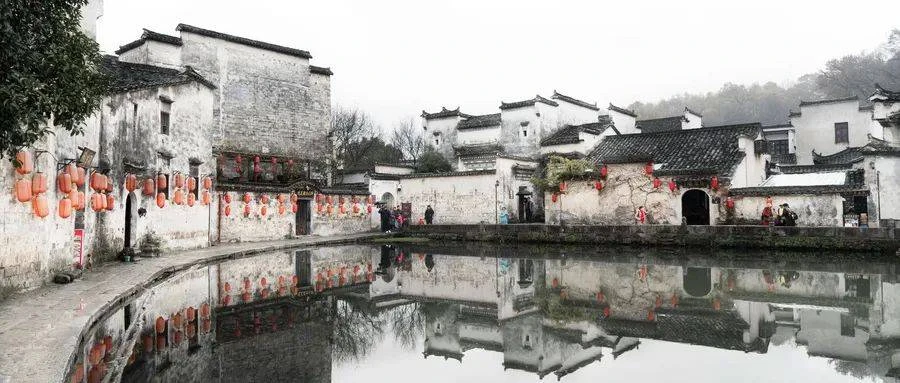
Lvwei Cultural Tourism: How to Renovate and Update Traditional Villages?
Lvwei Cultural Tourism Introduction: The 2022 No. 1 Central Document proposed that rural construction should be based on the existing foundation of villages. It emphasized protecting concentrated contiguous areas of traditional villages, preserving distinctive ethnic villages, and implementing the "Save the Old Houses" campaign. These opinions imply that in future rural cultural tourism construction, large-scale demolition and construction should be avoided, inefficient investment should be prevented, and more rational project construction and management should be carried out with respect for the current state of villages.
In recent years, along with the advancement of urbanization, how to preserve traditional village culture and allow ancient village culture to coexist with modern urban civilization has become a challenge for contemporary society. Most traditional villages are located in remote areas with underdeveloped economies and inconvenient transportation, but their historical features are relatively well-preserved, and they are rich in historical and cultural tourism resources. Therefore, protecting and revitalizing the tangible and intangible cultural heritage resources of villages through tourism has become an option.
So, how can tourism development be used to give traditional village culture the ability to protect and pass itself on? Lvwei Cultural Tourism believes that upgrading traditional villages into rural tourism complexes has become a hot spot for the development of traditional villages. This not only attracts social capital but also, in essence, uses the "transportation effect" of tourism to bring urban consumption power to the countryside, thereby effectively driving employment growth, industrial upgrading, infrastructure improvement, and comprehensive regional development of surrounding villages.
1. Traditional Villages and Rural Tourism Development
— Tourism is one means of realizing the value of traditional villages
Traditional villages refer to villages that were formed early, have relatively rich traditional resources, are still relatively intact, and have high historical, cultural, scientific, artistic, social, and economic value.
Developing tourism is an effective way to protect traditional villages and a special path for their modernization. However, not all villages are suitable for tourism development. Most traditional villages actually lack tourism appeal and require substantial investment to develop tourism, making tourism utilization difficult. Some traditional villages have severely damaged architectural landscapes, with their original features gradually fading and folk culture gradually disappearing, making them no different from ordinary villages and losing their tourism appeal, so they cannot protect village culture through tourism development.
Therefore, the tourism development we discuss here to protect traditional villages originates from three basic characteristics of existing villages: first, the village texture and overall appearance are well-preserved; second, the housing vacancy rate is relatively high; third, the ecological environment is excellent, with good tourism development potential. By developing tourism, such traditional villages can not only drive development to a certain extent, bringing economic benefits to local residents and governments, but also contribute to village protection.
It is worth noting that in the process of tourism development, protection, exploration, and revitalization must be carried out. While actively developing tourism and tapping into the cultural connotation of traditional villages, excessive commercial exploitation must be prevented to promote a positive interaction between protection and development.
— Properly handle the relationship between traditional village protection and development
In the process of rural tourism development, first, protect the ecological environment and highlight cultural connotations; second, implement village planning and enhance village value; at the same time, pay attention to rural governance and promote economic development. Truly reflect the protection principles of "historical authenticity, landscape integrity, and life continuity."
— Tourism complexes activate traditional villages
Under the background of internal circulation and high-quality development, rural tourism consumption is upgrading. The past single forms of agritainment and rural tours can no longer meet tourist demand. Transforming traditional villages into rural tourism complexes has become a development hotspot. This not only attracts social capital but also, in essence, uses the "transportation effect" of tourism to bring urban consumption power to the countryside, effectively driving employment growth, industrial upgrading, infrastructure improvement, and comprehensive regional development of surrounding villages.
2. Rural Tourism Complex
A rural tourism complex differs from traditional rural tourism. Traditional rural tourism only focuses on providing individual or a few industrial factors, such as food and lodging. However, a tourism complex covers almost all elements of the tourism industry. It is based on rural land resources, guided by rural industries such as rural agriculture and rural industry, for comprehensive and rational development and utilization of rural land. It is a regional spatial form that intensively allocates production and living factors such as rural industrial development, rural infrastructure, rural housing, and social construction. It is a large-scale, multifunctional, modern, and open rural aggregation space.
Lvwei Cultural Tourism believes that the key points for developing a tourism complex are: first, establish comprehensive development as the orientation, including comprehensive land development, comprehensive industrial development, comprehensive functional configuration, and comprehensive goal setting. Second, establish positioning breakthroughs as the guide, including regional functional positioning and development theme positioning. Third, establish the functional framework as the core, composed of three parts: core attraction center, leisure gathering center, and extended development center. Fourth, establish operation and management as the support, seeking professional, localized, high-level intellectual support, and choosing distinctive, innovative, high-standard operation models.
01. Characteristics of Rural Tourism Complexes
From the perspective of industrial form, it has four major characteristics:
— Integration of primary, secondary, and tertiary industries:
The rural tourism complex serves not only rural residents but also rural tourists—urban residents. This requires it to have multiple compound functions of both towns and villages.
— Integrated development of industry and village:
Building a rural tourism complex is an effective starting point for combining tourism development with beautiful village construction, rural economic development, and farmers' income increase, conducive to achieving "integration of production and village."
— Cultural creativity as the soul:
The rural tourism complex is a themed gathering space for rural leisure tourism. Through different theme positioning, cultural extraction, and creative implantation, it shapes personality and soul. For example, Yuanjia Village, the first "internet celebrity" of rural tourism. Its soul lies not only in activating culture but also in highlighting the characteristics of Guanzhong folk culture and continuously innovating Guanzhong folk tourism.
— Carrying a new lifestyle:
The rural tourism complex is a product of the upgrade of rural tourism from single sightseeing tourism to comprehensive leisure tourism. It is also a product of the transformation of people's lifestyles. With the rise of tourism and vacation, more and more high-income groups have a "second home." Urban houses mainly meet work and daily living needs, called "first homes." The second home is "not the second house in the city, but the second life in the village ecological commune," used to meet higher-level spiritual needs and enjoyment such as "returning to the countryside and nourishing the soul." Residential products of the rural tourism complex become people's "second homes."
02. Planning Methods for Rural Tourism Complexes
— Add the "human" element in planning
Local culture needs to be conveyed through indigenous people. Their clothing, words, and actions carry a strong rural flavor. Only by personally interacting with them, living with them in the countryside, and experiencing the life of the indigenous people can tourists truly understand rural society.
— Local architecture should be rich in regional characteristics
Rural settlements and their evolution are products of culture, geography, climate, history, and religion. Rural architecture is the carrier of the physical space of rural settlements. Vernacular architecture is also an important part of rural tourism, a unique carrier of rural intangible cultural heritage, reflecting the overall appearance of the countryside, containing strong historical and artistic value, playing a significant role in promoting rural tourism, and being an important guarantee for sustainable rural tourism.
— Build a multi-format rural industry
The singleness of rural industry in rural tourism is mainly manifested in two aspects: on one hand, the limited understanding of rural tourism; on the other hand, the lack of detailed industrial planning.
Rural tourism is片面ly understood as "agritainment" or "rural amusement park." The limited understanding of rural tourism mainly stems from a lack of scientific guidance, insufficient knowledge of rural industries, and lack of appeal in rural development. This also brings problems such as short usage cycles of facilities and hindering the healthy development of rural tourism. From the perspective of rural tourism development, the root cause is the lack of overall layout of rural industries and the lack of detailed division of rural industrial planning. The industrial development of rural tourism should not only rely on local agricultural production but also improve its secondary and tertiary industries, guide the development of diversified industrial integration, and achieve the goal of building a diversified and healthy industry.
— Deeply explore agricultural value
In the development of rural tourism, agriculture is regarded as the main industry. In addition to having a foundational role for the development of other industries, it also has production, living, and ecological values. Production value refers to its agricultural value—all the value generated in the process of producing agricultural products. Living value is mainly reflected in the pursuit of traditional farming methods. Nowadays, urban groups' longing for nostalgia is growing day by day, and the living value of agriculture urgently needs development.
— Professional guidance for rural tourism
Rural tourism planning is both an industry and a professional technology. The planning and design of tourist attractions, industrial layout, and development of tourism products all require control and planning by professionals. Therefore, for the vigorous development of rural tourism, it is necessary to strengthen the professional and scientific planning and management of rural tourism, and strengthen the training and guidance of professionals for the development of rural tourism.
— Landscape environment needs improvement
Rural landscape is a material environment of natural ecology, an ecological complex under the joint action of agricultural civilization form and human ecological environment. The rural landscape environment is a landmark product of regional characteristics, reflecting the regionality and differences of the countryside. However, today's rural landscape environment is affected and polluted by external factors. Domestic environmental problems mainly come from industrial and agricultural pollution. In this context, rural construction should focus on protecting the landscape environment and restoring ecology.
3. Lvwei Cultural Tourism's Traditional Village Renovation Cases
Lvwei Cultural Tourism has been committed to exploring innovative rural planning paths for many years, accumulating rich practical experience, and forming classic cases such as Fuquan Village—a scenic area-type residential reception village and one of the first batch of village planning demonstration villages in the country; Puchang Village—a model of tourism-led new rural construction; Saihan Wusu Village—a model of hollow village transformation and one of the fourth batch of beautiful and livable village demonstrations in the country; and Zhiganglaka Village—a model of Tibetan-style new rural construction.
Lvwei Cultural Tourism proposed practical solutions for the three rural issues. Under the guiding principle of "no large-scale demolition and construction, mainly on-site renovation and upgrading," it protects the original appearance of ancient villages. The renovation not only meets the production and living needs of villagers in terms of building functions but also highlights characteristics in tourism services to achieve the function of tourism reception, protecting the original style of the village, inheriting local historical context, and restoring village value. It helped Fuquan Village become one of the first batch of 28 national village planning demonstration villages, included in the Ministry of Housing and Urban-Rural Development's Village Construction Department's "China New Rural Planning Demonstration Case Collection," and won the National Excellent Urban and Rural Planning and Design Award! (Further reading: Lvwei Innovative Village Planning, Solving the Three Rural Issues on the Ground)
Rendering of Fuquan Mountain Residence
Saihan Wusu Village in Wuhai City, Inner Mongolia Autonomous Region, was a resettlement and expansion project of Hainan District in 2000. The village had a single landscape, single industry, few ways for farmers to get rich, and a strong desire to get rich. It was a hollow village and was designated as a rural (north area) dilapidated housing renovation concentration area and village renovation demonstration village. However, Wuhai City has unique water, soil, light, and heat resources, making it a high-quality grape production base comparable to Turpan in Xinjiang. The local government regards grape planting and related extension industries as an important starting point for agricultural restructuring. Combining with the actual situation of Saihan Wusu Village, Lvwei Cultural Tourism proposed an ecological agricultural development model of "combination of agriculture and enterprise, tourism as a trigger," and adopted a "three centers and four transformations" approach: core attraction center, leisure gathering center, residential center, and industrialization of life, service-oriented production, folk customs, and themed landscaping.
After renovation, Saihan Wusu Village has become a new village demonstration area project in Inner Mongolia Autonomous Region. It has not only been well-received by local governments and villagers but has also been reported and followed by multiple media outlets. It has become a model of tourism-led new rural construction in the "ten full coverage" project of the Inner Mongolia region and has been selected into the fourth batch of nationally beautiful and livable towns and beautiful and livable villages demonstration list. (Further reading: From "Hollow Village" to "Red Wine Town"—Lvwei's Comprehensive Renovation of Saihan Wusu Village Selected into the Fourth Batch of National Beautiful and Livable Village Demonstrations)
Now, Saihan Wusu Village has become a well-known tourist village. The French-style houses are neat and beautiful; straight roads lead to the front and back of residents' houses; the spacious cultural square is surrounded not only by green trees but also by exquisite and unique cloisters; combined with flower beds and courtyard trellises with strong local flavor, and the smiles on the villagers' faces, it forms a happy village scene.
Rendering of Courtyard Renovation
Rendering of Cultural Square
Yimeng Traditional Village: Hometown of Red Sisters
In the traditional village of Hometown of Red Sisters in Yinan, a scientific comprehensive tourism development model has made the previously isolated old area flourish due to cultural and tourism integration. In the "Overall Plan for Shandong Yimeng Red Sister Film and Television Tourism Area," Lvwei Cultural Tourism proposed a five-in-one integrated development model of "culture + tourism + film and television + industry + urbanization construction." Based on the Yimeng landscape ecology, with Yimeng red culture and the spirit of Red Sisters as the core, it carries the training and learning functions of Shandong Party education bases. With the extreme innovative interactive play experience of film and television culture as the trigger, and mountain outdoor sports and health preservation as extensions, through the integrated development of tourism, leisure, and vacation with Yimeng film and television industry, it aims to create a nationally renowned Yimeng Red Sister Film and Television Tourism Resort that integrates red education base, film and television industry base, film and television cultural tourism, ancient village rural tourism, and mountain sports and leisure. (Further reading: Cultural and Tourism Integration, Creating a "Yinan" Model for Red Research)
The Hometown of Red Sisters has filmed nearly 300 films and TV series, receiving over 600,000 tourists annually, becoming a veritable "Redlywood" of China. During the 2020 National Day and Mid-Autumn Festival holiday, the film and television base held the first Red Culture Tourism Festival, welcoming a peak of tourists on the second day of National Day. The comprehensive resort gameplay integrating "red tourism + film tourism + rural tourism + cultural and creative industries" has been recognized by the market.
Renovation and Upgrade of Grape Valley 5A-Level Scenic Area Mainly Composed of Traditional Villages
In the renovation and upgrade project of the Grape Valley 5A-level scenic area mainly composed of traditional villages, Lvwei Cultural Tourism used the folk legend of the frog (Pakka in Uyghur) as an element to build Paka Lane, a local cultural block with strong folk customs. Through overall renovation of the entrance landmark landscape, road environment, and residential buildings, it preserved local architectural features, restored the village's original culture, combined cultural elements to construct tourism landscape space, improved the tourism service functions of the streets and lanes, and created a distinctive, contextual, and experiential atmosphere for residential buildings.
Rendering of Overall Landscape Renovation Design of Paka Lane
Aoshan Fishing Village, Qiandao Lake, Zhejiang
The rural environment is a key factor in driving rural revitalization. In the implemented case of Aoshan Fishing Village in Qiandao Lake, Zhejiang, Lvwei Cultural Tourism started with the "appearance" of the countryside, proposed the concept of "rural tourism complex," and through in-depth design of rural architecture and landscape, carried out a comprehensive appearance renovation and upgrade of Aoshan Fishing Village, driving local tourism development and realizing rural revitalization. (Further reading: Aoshan Fishing Village: Creating a Rural Tourism Complex Starting from "Appearance")
For the creation of the countryside appearance, the project team focused on formal innovation from two aspects: architecture and landscape. First, based on the existing style, buildings were classified, distinguishing buildings that need renovation and buildings that need repair and restoration. For buildings requiring facade renovation, overall renovation was carried out in combination with local materials, architectural colors, and cultural excavation. On the basis of ensuring functionality is not affected, the entire space was unified with the overall architectural style. Second, the landscape was based on the existing ecological foundation, combined with local vegetation and stone for innovative design, adapting to local conditions, reducing ecological damage to mountains, lakes, fields, and plantings, and maintaining the authenticity of the ecological landscape.
Current situation and design drawing of Homestay 1 before renovation
Current situation of Homestay 1 after renovation
Current situation and design drawing of Homestay 2 before renovation
Actual view of Homestay 2 after renovation
Original state of Homestay 3 before renovation
Design drawing of Homestay 3
Current situation of Homestay 3 after renovation


![Mountains and Waters Meet Again [Guilin Yangshuo] Let's Rock the Boat of Friendship](/img/624178c28a221adb_s.webp?src=https%3A%2F%2Fdimg04.c-ctrip.com%2Fimages%2F0104n120009cnhkrdD720_W_320_0_Q80.jpg)


