10 Years Traveling Through 33 Provinces, Majestic Motherland — South China: Guangxi Guide
2. Guilin Scenery
I once mistakenly thought Guilin was the capital of Guangxi, haha. Guangxi features extensive karst terrain, with clusters of peaks and beautiful landscapes—especially Guilin, whose scenery is unmatched! Guangxi is a coastal and border province, boasting the stunning Weizhou Island, several small seaside towns, bustling border trade, the memorial halls of Liu Yongfu and Feng Zicai (reminders of the Sino-French War), and a variety of delicious rice noodles and dog meat.
① Guilin Scenery
The scenery of Guilin is best exemplified by Yangshuo. The stretch from Yangdi Township to Xingping Ancient Town is a classic section of the Li River, perfect for a bamboo raft ride, passing by the Nine Horse Mural Hill and the scene featured on the 20-yuan note. The most beautiful part is along the Yulong River, where the water is clear and flows gently, flanked by verdant peaks. Drifting slowly on a bamboo raft feels like traveling through a painting. Wonderful mountains, waters, and Guilin! In the city, Elephant Trunk Hill is a landmark. Additionally, there’s the Longji Rice Terraces, a vast area that seems endless. I visited during the Qingming Festival in 2013; the terraces hadn’t been planted yet, but the green grass was already vibrant, with layers upon layers of terraces forming charming rings. You can stay in a Zhuang ethnic guesthouse among the terraces, mostly wooden buildings run by local villagers, who can cook you an authentic simple meal—the taste of bamboo rice is unforgettable. At night, the sounds of frogs and insects feel so familiar, like falling asleep in the countryside as a child!
② Noodle Heaven in Nanning
Nanning has a truly muggy climate and is a paradise for rice noodle lovers! There are countless types: old friend noodles, Liuzhou snail noodles, raw-pressed noodles, rolled noodles, and Guilin rice noodles—an overwhelming variety! The flavors are rich and diverse, especially old friend noodles and snail noodles, whose smell might drive some away at first (comparable to stinky tofu), but they taste amazing! Rolled noodles are similar to Vietnamese spring rolls, served with a sweet and sour dipping sauce that’s refreshing and appetizing. Raw-pressed noodles and Guilin rice noodles are tender and flavorful with seasonings. During my week in Nanning, I indulged in noodles everywhere—noodle shops line every street and alley!
③ Beihai Old Town
Beihai and Weizhou Island are reminiscent of Shantou and Nan’ao Island! From one city to another, from one island to another! Beihai has a century-old street, similar to Shantou’s Small Park old district, both being arcade commercial streets that witnessed early 20th-century commercial prosperity. The street is lined with shops offering local snacks like shrimp cakes and pig trotter noodles. Beihai also has Silver Beach, a long stretch of coastline with coconut trees, enhancing its tropical seaside charm. There’s also the Qiaogang Ethnic Style Street, a settlement for Vietnamese华侨 (overseas Chinese), quite old, with even a rooftop pool table still in business, where kids pay to play—reminding me of my own childhood over 20 years ago. There’s a snack street where Vietnamese rolled noodles are delicious, similar to Cantonese rice rolls, with various fillings and a sweet-sour dipping sauce, perfect for the tropical climate!
④ Weizhou Island
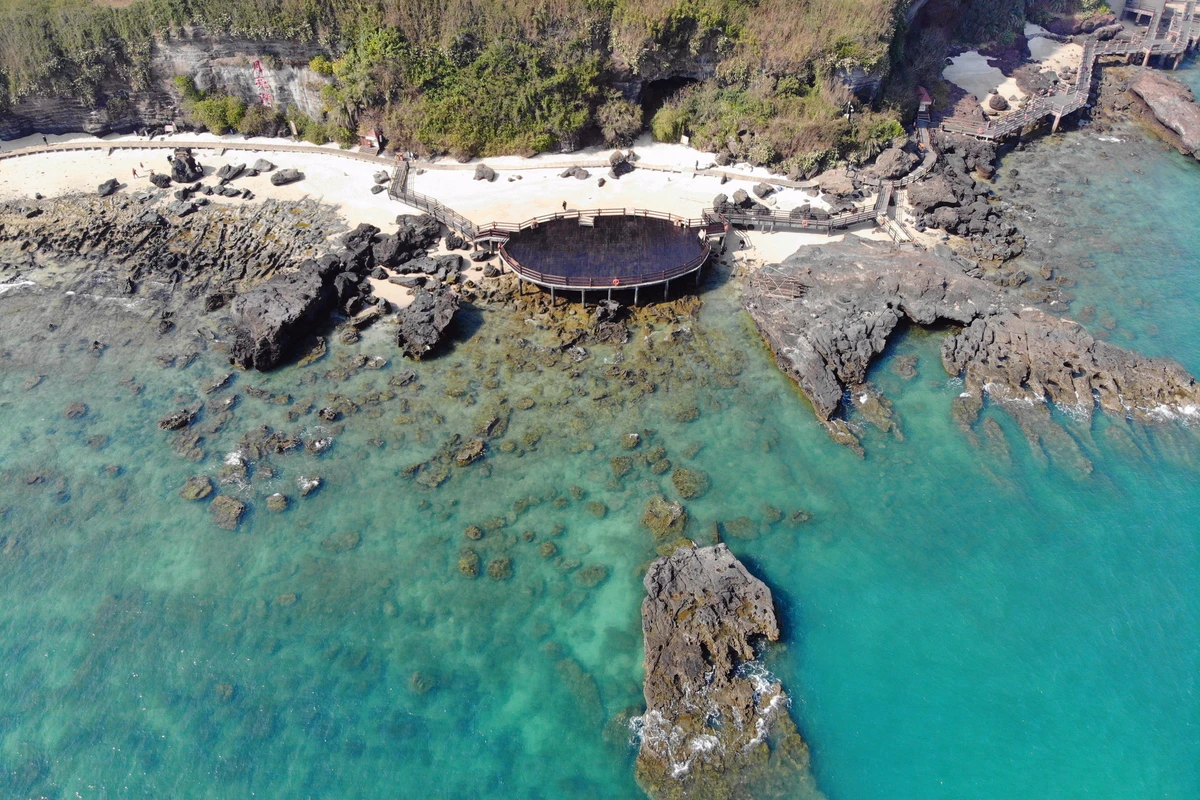
From Beihai, take a ferry to Weizhou Island (1.5 hours, one-way ticket 150 yuan). The island is small; you can rent an electric scooter to circle it. I stayed at a hostel in a northern village. The staff suggested watching the sunset at Muya (Cliff of Dusk), accessible via a small path near a chemical plant. The next day, I rented a scooter and visited the Cathedral of Our Lady, the Catholic Church, Shell Beach, Colorful Beach, Nanwan, Crocodile Hill Park, Dishui Danping (Dripping Water Screen), Shiluo Bay, and Muya Cliff—a full day! The Cathedral of Our Lady is in a village, not very conspicuous; you can just glance at it. The Catholic Church, on this remote island, is a large, ancient church built in 1853, one of the four major Catholic churches of the late Qing Dynasty! Its walls have weathered to a gray-white, and stepping inside evokes a solemn atmosphere, comparable to the Catholic Church in Qingdao. From the church, head directly to Shell Beach on the east side, with beautiful water ranging from azure to emerald! Then south to Colorful Beach, my favorite on the island, with prominent volcanic rock formations. Remnants of lava flows layered into the sea create fine, stratified textures like mille-feuille—high cliffs, low platforms by the sea, and scattered rocks offshore that would be great for low-tide foraging. Aerial views of this area are stunning! From Colorful Beach, go to Nanwan for lunch. Many seafood stalls here cater to Sichuan and Chongqing tastes, with many tourists from those regions. Nanwan Harbor has exceptionally clear, greenish water, so transparent you can see fish! It’s also the island’s water sports center. Ride the scooter to Crocodile Hill Scenic Area—complaint: the entrance is too far from the main sights, the walking boardwalk is long, and you have to take a shuttle, which is a bad experience. Following tips and maps, I found a closer boardwalk entrance in a village, which made access faster. This is the only spot needing a ticket. Pass the lighthouse, descend to the sea—this is also a volcanic rock coastline, but more rugged, with bizarre shapes formed when erupted lava suddenly contacted seawater, pitted all over. Further in is Moon Bay, the scenic area’s highlight. The water is incredibly beautiful and clean, especially from above! From Crocodile Hill, head to Dishui Danping, similar to Colorful Beach with cliff-like mille-feuille volcanic rock, but also a broad, fine sandy beach with many shells. North is Shiluo Beach, another sandy beach great for sunset viewing, with many snorkeling options. Ride back to Muya Cliff for aerial photos—it’s also cliff-type mille-feuille volcanic rock, but with wavy, uneven surfaces; bold people can climb down. I cautiously climbed a few layers, felt it was dangerous, and quickly returned! Back at Shiluo Bay, watch the sunset over the sea—romantic and beautiful. Against the orange-red twilight, I took a commemorative photo of a fishing boat returning home. Weizhou Island is truly worth visiting, with beautiful island scenery, many beaches to explore, and you can circle the whole island in a day on a rented scooter! In the "Most Beautiful Islands" ranking by Chinese National Geography magazine, the Paracel Islands rank first, and Weizhou Island ranks second!
⑤ Qinzhou: Feng and Liu
Qinzhou houses memorial halls for two patriotic generals, Liu Yongfu and Feng Zicai, who bravely repelled French invaders on the southeastern border. Liu Yongfu’s Sanxuan Hall is spacious, with a former residence on one side and a memorial hall on the other, separated by a wide courtyard used as a training ground, with a long shadow wall inscribed with "乡云丽日" (rural clouds and beautiful sun). Feng Zicai’s former residence is quieter, with three courtyards and three paths, and few visitors. It details General Feng’s life, his collaboration with Liu Yongfu to defend the southwest border, and their becoming in-laws—a commendable story. Qinzhou also has arcade streets like Shantou’s Small Park, such as Zhongshan Road, once bustling with commerce, but now mostly dilapidated. During my visit, the road was under repair, so I only glanced. Nearby, I had a bowl of dog meat noodles—dog meat is quite popular in southern Guangxi and the Xuwen area of Zhanjiang, Guangdong.
⑥ Border Town
I have a strong impression of Dongxing, thanks to the TV series "Home Far Away." From coastal travels to border travels, this town is both an endpoint and a starting point—a small border town in southwestern China, with unique geographical significance from coast to border. Dongxing, under Fangchenggang City, borders Vietnam and has a Sino-Vietnamese port. There’s a boundary marker from the Qing Dynasty, next to the border river, offering a distant view of the Vietnamese city opposite. Next to Marker No. 5 is Red Flag Street, which was quite bleak during my visit in 2021 due to the pandemic, with almost no cross-border travel and many Vietnam-focused travel agencies closed. Nearby is the Sino-Vietnamese Friendship Park, lush and pleasant. Most border towns have exotic flavors; here, you can try Vietnamese-style chicken noodles and bread, worth a taste.


![Mountains and Waters Meet Again [Guilin Yangshuo] Let's Rock the Boat of Friendship](/img/624178c28a221adb_s.webp?src=https%3A%2F%2Fdimg04.c-ctrip.com%2Fimages%2F0104n120009cnhkrdD720_W_320_0_Q80.jpg)


