2022 Happy Self-Drive Tour – Guangxi Chapter
Due to the impact of the epidemic, we had not traveled for eight or nine months. From June 25 to July 27, over 33 days, my spouse and I, together with another couple (friends), traveled by car through Guangxi, Yunnan, and Sichuan provinces. Starting from Guangzhou, we headed straight to Guangxi. In nine days, we visited areas including Hezhou, Guilin, Liuzhou, Nanning, and Baise in Guangxi. The landscape and scenery of Guangxi were truly beautiful, and the transportation, food, and accommodation were all very good and reasonably priced, making our trip very enjoyable!
Day 1: Guangzhou – Huangyao Ancient Town
From Guangzhou, we drove directly to Huangyao Ancient Town. Accommodation: Huangyao Ancient Town Jinzun Hotel.
We arrived at Huangyao Ancient Town at noon and checked into the hotel.
Huangyao Ancient Town is located in Zhaoping County, Hezhou, Guangxi, with a history of nearly 1,000 years. The ancient town preserves over 20 temples and shrines, and more than 10 pavilions and towers, mostly from the Ming and Qing dynasties. Famous attractions include the former site of the Guangxi Provincial Working Committee, the ancient stage, and Anle Temple. In 2007, Huangyao Ancient Town was listed as the third batch of China's Historical and Cultural Towns by the State Administration of Cultural Heritage, and it was just approved as a 5A scenic spot by the National Tourism Administration this year.
The former site of the Guangxi Provincial Working Committee of the Communist Party of China was originally Baozhu Temple, built in the third year of Jiajing of the Ming Dynasty (1524 AD). After the July 9 Incident in Guilin in 1942, the Guangxi Provincial Working Committee moved to the countryside, and in the summer of 1945, it moved to Huangyao Town, Zhaoping County, where it secretly carried out revolutionary work in Baozhu Temple.
Surrounding Huangyao Ancient Town are nine mountains: Wine Pot, Zhenwu, Rooster, Stacked Snail, Across the River, Tianma, Paradise, Cow Rock, and Guandao, all converging towards the town. Three small rivers – Yaojiang, Xiaozhujiang, and Xingning – converge at the ancient town. The residents of Huangyao Ancient Town mainly come from southeastern China, and the town's location is deeply influenced by the Han Chinese feng shui culture of the southeast. Huangyao Ancient Town is surrounded by mountains and embraced by green waters, possessing all the elements required by southeastern feng shui theory.
Huangyao Ancient Town now preserves more than 300 ancient buildings from the Ming and Qing dynasties, covering an area of 16,000 square meters. It fully preserves 8 stone-paved streets, all paved with bluestone slabs, totaling over 10 kilometers in length.
After touring Huangyao Ancient Town, we felt it is one of the ancient towns with relatively good tourism quality among those we have visited. A sentiment: Under the scorching sun, we toured Huangyao, with flowing water murmuring coolness; the bluestone streets hold many stories, and each old house speaks its heart. In the town, the worldly烟火, outside the town, green mountains stand alone; predecessors planted shade trees, leaving blessings for future generations!
Dinner at Huangyao Ancient Town
Day 2: Huangyao Ancient Town – Yangshuo
After breakfast, we set off from Huangyao Ancient Town to Hezhou Zhongshan's Ink Wash Landscape – Hundred Li Gallery, and then arrived in Yangshuo in the afternoon, taking a cruise on the Li River. Accommodation: Yangshuo Xingping Xianju Guesthouse.
Hundred Li Ink Wash Landscape is located in Zhongshan County, Hezhou City, featuring karst peak forest landforms. Due to the epidemic, there were almost no tourists, and only the four of us toured around. The scenic area is very large, and walking under the scorching sun is not feasible. We discovered that we could drive into the scenic area from the village beside it, bypassing the main entrance.
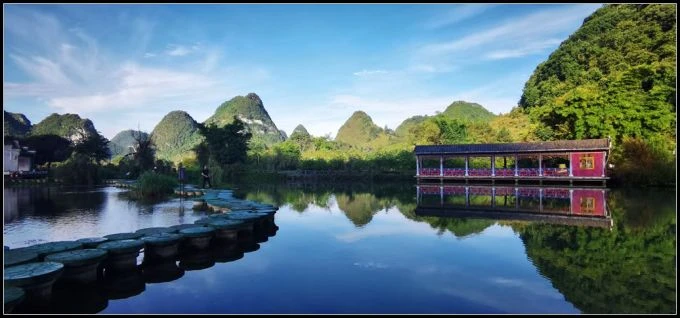
The Hundred Li Ink Wash Landscape boasts serene and charming mountains, lotus ponds, and pastoral scenery. The mountains are green, the water clear, and the lotus ponds verdant. A gentle breeze brings swaying lotus flowers, pure and natural. Because of the epidemic, there were very few tourists, and the area was very quiet.
Arrived in Yangshuo in the afternoon. Yangshuo County is 65 km from Guilin city center. Its unique and beautiful landscape has earned it the reputation of "Yangshuo's scenery surpasses Guilin's."
The gate hole under Nanxun Pavilion at Yangshuo's Nanxunmen Wharf records the highest flood levels of the Li River over the years. This June's flood was only lower than those of 1908 and 1954.
Yingjiang Pavilion Ancient Plank Road.
The character "帶" (dai) written on the cliff by Wang Yuanren, a descendant of the Calligraphy Sage Wang Xizhi, implies the meanings of "a belt of mountains and rivers, unparalleled in the world, hard work in youth, eternal glory." One character can be interpreted into sixteen characters, making it a unique masterpiece of Chinese calligraphy.
Xingping Ancient Town is a shining pearl on the Li River, located 25 km from Yangshuo County. It has eight major scenic areas, including Nine Horses Mountain, Snail Mountain, Lotus Rock, Tianshui Village, and Lingbao Pavilion.
The background image of the 20-yuan note.
We chose to take a boat tour on the river. Coinciding with Sunday, there were many tourists, and every boat was full. The Li River scenery was beautiful, but the experience of the boat tour was not pleasant. The boat operator, to increase revenue, arranged many time-consuming optional paid activities, causing chaos on board. What should have been a one-hour trip was dragged out to almost two hours before returning to the dock.
That night, we stayed at a hotel in Xingping Ancient Town.
For dinner, we went to the most famous local restaurant, "Sister Liu's Beer Fish." After eating, we felt it was just average.
Day 3: Yangshuo – Lipu – Liuzhou
Popular attractions were crowded and overly commercial, so we chose a lesser-known spot – "Shangri-La" (Shiwai Taoyuan), where there were far fewer tourists. To taste authentic Lipu taro, we specially went to Lipu County. After enjoying Lipu taro, we visited the Lijiang Bay Scenic Area. We arrived in Liuzhou in the evening, had dinner on a boat on the Liujiang River, and then took a boat to enjoy the night scenery of Liujiang. Accommodation: Liuzhou Lanting Hotel.
Of course, breakfast was Guilin rice noodles.
"Shangri-La Scenic Area" is located near Baisha Town, Yangshuo County, mainly consisting of Lotus Pond, Swallow Lake, Swallow Cave, Dong Village customs, and primitive tribes. It is a national AAAA scenic spot, one of the first national agricultural tourism demonstration sites, and a recommended destination by the World Tourism Organization.
The "Black-clad Zhuang" of Guangxi.
Performances of Dong Grand Song.
Yangshuo Yulong River Scenic Area.
Arrived at Lipu County at noon and visited the Lijiang Bay Scenic Area. Lijiang Bay is located in the southeast of Lipu County, Guilin City, 100 km from Guilin. It stretches 10 km in length, covering an area of 500 hectares, consisting of the distinctive Yaoying Mountain, Elephant Trunk Mountain, Five Finger Mountain, Dragon Head Mountain, Baishi Mountain, Red Horse, White Horse Mountain, and the Pearl River tributary – Lijiang River, along with the ecological pastoral scenery on both sides.
A glass bridge suspended between two mountains.
The Lijiang Bay Scenic Area was beautiful with few people. Only the four of us were tourists that day, led by a guide. We first took a cruise on the Lijiang River, then switched to a dragon boat that we rowed ourselves. After landing, we visited the "Tiangong Cave" karst cave.
In Lipu, we had to taste the famous Lipu taro. Lipu taro is large and nutritious. Sliced thinly, fried, and sandwiched between pork to make braised pork belly, it has a special flavor, not greasy, and is a famous dish.
We rushed to Liuzhou in the afternoon.
In the evening, at the invitation of friends, we took a boat to cruise the Liujiang River at night and had dinner on board.
Day 4: Liuzhou – Chengyang Eight Villages
There were not many attractions worth seeing in downtown Liuzhou. We took a casual walk to Liuhou Temple and Liuzhou Yaobu Ancient Town, then arrived at the Chengyang Eight Villages in the afternoon. Accommodation: Chengyang Eight Villages Banwu Yueshan Guesthouse.
In the morning, we visited Liuhou Temple. Located in the west corner of Liuhou Park in downtown Liuzhou, it was built by the people of Liuzhou in memory of the famous Tang dynasty politician, thinker, and writer Liu Zongyuan. The current Liuhou Temple was reconstructed following Qing dynasty architecture, displaying many cultural relics and historical materials that reflect Liu Zongyuan's life and achievements.
Liu Zongyuan, courtesy name Zihou, Han ethnicity, one of the Eight Great Prose Masters of the Tang and Song dynasties, a Tang dynasty writer, philosopher, prose master, and thinker, commonly known as "Liu Hedong" or "Mr. Hedong." Because he ended his official career as the governor of Liuzhou, he is also called "Liu Liuzhou."
Liu Zongyuan's tomb of clothes and hat.
We visited Liuzhou's Yaobu Ancient Town, which, despite its name, is actually a newly developed real estate project with little of interest.
In the afternoon, we arrived at the Chengyang Dong Eight Villages Scenic Area in Sanjiang Dong Autonomous County. Located in Sanjiang County, bordering Hunan and Guizhou, eight contiguous Dong villages not only preserve ancient traditions such as Dong wooden buildings, costumes and accessories, song and dance culture, and living customs, but also integrate modern life, successfully developing into a captivating tourism village.
Dong villagers performing a welcome dance.
We took an eco-car into the village.
The Chengyang Eight Villages consist of Ma'an Village, Pingtan Village, Ping Village, Yan Village, Dong Village, Dazhai, Pingpu Village, and Jichang Village, covering an area of 12.55 square kilometers, with a population of 9,701 in 2,197 households. The key national cultural relic protection unit – Chengyang Yongji Bridge – is situated on the Linxi River next to the Chengyang Eight Villages.
Chengyang Yongji Bridge, also called Chengyang Wind-Rain Bridge or Chengyang Huilong Bridge, was built from 1912 to 1924, taking 12 years. Spanning the Linxi River, it is a typical Dong architecture, a stone-pier wooden structure with pavilions. It has 2 abutments, 3 piers, and 4 openings. On the piers, there are 5 tower-style bridge pavilions and 19 bridge galleries, with pavilions and galleries connected. The pavilion in the middle has soaring eaves; the walls, pillars, tile eaves, and carvings are decorated. Chengyang Yongji Bridge is a masterpiece of architecture, combining gallery, pavilion, and tower, unique in the history of Chinese and foreign architecture. It is a representative work of Dong wind-rain bridges, the best-preserved and largest in scale, a crystallization of the wisdom of the Dong people, and an artistic treasure in Chinese wooden architecture. In 1982, it was listed as the second batch of key national cultural relic protection units.
Ma'an Village's stone-paved street.
The guesthouse we stayed at.
Chengyang Eight Villages has many wind-rain bridges of various sizes.
Ping Village's single-pillar drum tower.
The Dong drum tower is a highly regional building in Dong townships, popular in Guizhou, Hunan, and Guangxi. The drum tower is constructed with anti-corrosion wood using mortise and tenon joints, without a single nail or rivet. Due to its solid structure, it can stand for hundreds of years without decay or leaning. The central pillar rises straight from the ground, with beams and rafters interlocking, using lever principles to support layer upon layer. In ancient times, drum towers also served as meeting places and warning bells against enemy invasions.
Day 5: Chengyang Eight Villages – Longji Rice Terraces
Chengyang Eight Villages is not far from Longji Rice Terraces, so we decided to visit them. We had wanted to go to Longji Rice Terraces for a long time. Originally, we thought the terraces with rice paddies might be less spectacular, but unexpectedly, the scenery was breathtaking. Accommodation: Longji First Floor Art Guesthouse.
Arrived at the Longji Rice Terraces in Longsheng County in the afternoon.
Jinkeng Dazhai Red Yao Terraces.
The Red Yao terraces are distributed between 300 and 1,100 meters above sea level, with a maximum slope of 50 degrees. The Thousand-layer Sky Ladder shows layer upon layer of terraces like stairs ascending to the clouds, like a ladder to heaven.
In 2018, China's Southern Rice Terraces (including Longji Rice Terraces in Guangxi, United Terraces in Youxi, Fujian, Hakka Terraces in Chongyi, Jiangxi, and Ziquejie Terraces in Xinhua, Hunan) were officially awarded the Globally Important Agricultural Heritage Systems.
Longji Rice Terraces are a symbol and representative of the diligence, wisdom, and courage of the Chinese working people.
After visiting Jinkeng Dazhai Terraces, we went to stay in Ping'an Village that day.
The guesthouse we chose had good conditions in all aspects, and we could view the terraces from the room.
Dinner at the guesthouse, enjoying delicious food while overlooking the beautiful scenery outside, was truly delightful.
The sun came out in the evening, and the scenery was incredibly beautiful.
Day 6: Longji Rice Terraces – Nanning
In the morning, we went up the mountain under light rain to visit two Zhuang terrace scenic spots: "Seven Stars with the Moon" and "Nine Dragons and Five Tigers." Then we headed to Nanning. Accommodation: Nanning Hotel.
The most famous among the Longji terraces is "Seven Stars with the Moon," the essence of Longji. It consists of seven small hilltop terraces and one large hilltop terrace. The entire mountain is covered with narrow terraces, and the ridges are like contour lines.
Clouds would sometimes cover the terraces and then clear up, allowing us to fully appreciate the beauty.
After seeing "Seven Stars with the Moon," we walked along the stone slab road to see "Nine Dragons and Five Tigers."
During the Qin and Han dynasties, terrace farming had already formed in Longsheng. In the Tang and Song dynasties, Longsheng terraces were developed on a large scale, and by the Ming and Qing dynasties, they had basically reached their current scale. The Longsheng terraces have a history of at least 2,300 years, making them the origin of world terraces.
After enjoying the scenery, we walked back along the path to the guesthouse, checked out, and headed to Nanning.
After leaving Longji Rice Terraces, we arrived at Nanning, the capital of Guangxi, in the afternoon. We checked into Nanning Hotel, a long-established five-star hotel.
In the evening, we went to "Gui Xiaochu," a representative of Guangxi cuisine, to taste authentic Guangxi dishes. The "Old Friend Fish" was really delicious.
Day 7: Nanning – Detian Waterfall
In the morning, we visited Nanning's Qingxiu Mountain Scenic Area. In the afternoon, we arrived in Chongzuo and visited the Left River Leaning Pagoda and Detian Waterfall. Accommodation: Detian No.1 Inn.
In the morning, we visited Nanning's Qingxiu Mountain Scenic Area. Qingxiu Mountain, originally called Qingshan, also known as Taiqing Peak, is located by the winding Yongjiang River. At the top of Qingshan stands a tall pagoda, known as the green lung of Nanning. It is also the location of Nanning Botanical Garden and the top 5A scenic spot in Guangxi.
Left River Leaning Pagoda.
Left River Leaning Pagoda, also known as Guilong Tower, is one of the eight famous leaning pagodas in the world. It is located 2 km northeast of downtown Chongzuo City, built on a stone island in the Left River – Aotou Peak. The pagoda was built in the Ming Dynasty (1621) with three stories, and two more stories were added in the 35th year of Kangxi (1696), making it a five-story brick pagoda. The bottom diameter is 5 meters, the tower height is 28 meters, and it has an octagonal shape.
Detian Transnational Waterfall.
In the afternoon, we arrived in Daxin County, Chongzuo City, to visit the famous Detian Waterfall.
Detian Waterfall is located upstream of the Guichun River in Daxin County, about 50 meters from the 53rd boundary marker on the China-Vietnam border. The clear Guichun River is a tributary of the Left River and also the border river between China and Vietnam. The waterfall is majestic and spectacular, connected to the adjacent Ban Gioc Waterfall in Vietnam. It is the largest transnational waterfall in Asia and the fourth largest in the world, with an average annual water flow about three times that of Huangguoshu Waterfall in Guizhou. It is a national AAAAA-level tourist attraction in China.
Due to the epidemic, the important viewing corridors close to the Detian Waterfall were closed, and tourists could only view it from a distance, greatly affecting the experience.
Across the river is Vietnam. It was rare that tourists could take bamboo rafts to approach our side of the big waterfall freely, while Chinese tourists could only sigh from afar.


![Mountains and Waters Meet Again [Guilin Yangshuo] Let's Rock the Boat of Friendship](/img/624178c28a221adb_s.webp?src=https%3A%2F%2Fdimg04.c-ctrip.com%2Fimages%2F0104n120009cnhkrdD720_W_320_0_Q80.jpg)


