Guangxi Travel Guide | From Guilin to Hezhou, Take You to 14 Unique Attractions
If there's one thing Guangxi is most famous for, it's undoubtedly Guilin, with its landscapes that are the finest under heaven.
From Guangzhou to Guilin, it's just a little over two hours by car. I've always loved going to Guangxi, enjoying a peaceful vacation amidst its mountains and waters, savoring the serenity and leisure of the landscape.
But besides Guilin, Guangxi has many other beautiful places. This time, I'm starting from Guilin and heading east to Hezhou, experiencing different facets of Guangxi's beauty and various ethnic customs.
Day 1: Guangzhou - Guilin
Day 2: Guilin Crown Cave - Jingjiang Prince's Residence - Solitary Beauty Peak
Day 3: Guilin Elephant Trunk Hill - Yangshuo
Day 4: Yulong River Rafting - Linhe Ancient City
Day 5: Huangyao Ancient Town - Fuchuan Yao Museum - Fuchuan Ancient Ming City
Day 6: Fuxi Village - Chashan Village - Xiushui Zhuangyuan Village - Heishan Village
D1: Guangzhou - Guilin
Guilin has both high-speed rail stations and an airport; you can choose your preferred mode of transport.
From Guangzhou to Guilin, the most convenient option is undoubtedly the high-speed train. In less than 2.5 hours, you cross Guangdong Province and enter Guilin's green mountains and clear waters.
(Guilin has three high-speed rail stations; remember to find the most convenient one before booking tickets.)
Day 2: Crown Cave Scenic Area - Jingjiang Prince's Residence - Solitary Beauty Peak
Crown Cave Scenic Area - See stalactites formed over hundreds of millions of years
Everyone says: "Guilin's landscapes are the finest under heaven." In fact, it's nature's karst landforms that create Guilin's beautiful scenery. This landform gives rise to the奇特 mountains on the surface and unique caves underground.
Stalactites, formed over hundreds of millions of years, create strange stalagmites and peculiar shapes.
Crown Cave gets its name because the mountain it's in resembles a crown. Outside Crown Cave, you can see Guilin's iconic landscapes. On the Li River, tour boats pass by, adding vitality and liveliness to the picture.
Entering Crown Cave is a very interesting experience. An elevator over 12 stories high has been built here. Riding the elevator into the cave, you can enjoy a panoramic view of Crown Cave's beauty. The spacious cave gradually unfolds before you, and the peculiar scene is fully presented.
Many dazzling lights have been added to the cave, giving those peculiarly shaped stalactites even more room for imagination.
Like a fairyland, a dragon palace, a treasure hall, or a city—each space here allows for ample imagination, revealing different beautiful scenes.
The most special thing about Crown Cave is the small train inside the cave.
Taking the small train through the cave and seeing the cave's unique splendor from the train is a very interesting and novel experience.
Jingjiang Prince's Residence - Experience the ancient prosperity and grandeur
In the afternoon, we came to the Wangcheng Solitary Beauty Peak in Guilin.
Guilin often gives the impression of a remote southern land, but its history dates back to the Qin Dynasty. Emperor Qin Shi Huang dug the Lingqu Canal here, officially incorporating Guilin into China's territory.
The Wangcheng (Prince City) here was once the residence of Jingjiang Prince, a vassal king of the Ming Dynasty.
The Wangcheng Solitary Beauty Peak scenic area includes the Jingjiang Prince's Residence, Solitary Beauty Peak, the Examination Hall, and the city wall. It is a national AAAAA-level tourist attraction.
The Jingjiang Prince's Residence was destroyed by war, and its former glory is no longer visible. But the ancient trees and city walls here still retain a rustic charm.
High-tech means such as sound, light, and shadow are used here to recreate the glorious scene of the Jingjiang Prince's Residence. In the light and shadow, you can feel the ancient prosperity and grandeur.
Solitary Beauty Peak - Rising abruptly from the ground, majestic in momentum
The Jingjiang Prince's Residence follows a typical Chinese feng shui layout, with water in front and a mountain behind. The mountain behind the residence is Solitary Beauty Peak. Located in the center of the Guilin basin, it stands alone and thus gets its name.
Solitary Beauty Peak rises abruptly, steep and lofty, with a majestic momentum. It has always been known as "the Southern Pillar." On the eastern slope is the Reading Rock of Yan Yanzhi, a writer of the Liu Song Dynasty, the oldest famous historical site in Guilin. Yan wrote the verse, "None is as solitary as this peak, towering above the city walls." Hence the name Solitary Beauty Peak. When the morning sun reflects or the evening glow shines, the solitary peak seems to wear purple robes and golden clothes, so it is also called "Purple Garment Mountain."
On Solitary Beauty Peak, many calligraphic works of literati throughout the ages are carved. These cliff inscriptions also form the unique cultural heritage of Solitary Beauty Peak.
Because Solitary Beauty Peak is in the center of Guilin city, rising abruptly and majestically, it is also called "the Southern Pillar" by many.
And the famous line "Guilin's landscapes are the finest under heaven" that made Guilin renowned is also engraved here.
Day 3: Guilin Elephant Trunk Hill - Yangshuo
Elephant Trunk Hill - Guilin's iconic landmark
"At the bottom of the water is the bright moon; on the water, the bright moon floats. The water flows but the moon doesn't leave; the moon departs but the water still flows." — Poem by a Song Dynasty poet
On the third day, we arrived at Guilin's Elephant Trunk Hill scenic area!
If there is one most iconic landmark in Guilin, it must be Elephant Trunk Hill.
On the Peach Blossom River, there are countless mountains, but none is as famous as Elephant Trunk Hill.
Elephant Trunk Hill gets its name because it looks like an elephant drinking water from the river. Located at the confluence of the Li River and Peach Blossom River in the center of Guilin, it is naturally formed, vividly resembling an elephant drinking from the river.
Looking at Elephant Trunk Hill from afar, the image of an elephant taking water from the river comes vividly to life.
The water moon at Elephant Hill faces the Pierced Hill moon rock to the south, one hanging in the sky, one floating on the water, forming a unique spectacle known as "the Twin Moons of the Li River."
Climbing to the top on foot, you can overlook the beautiful scenery of Guilin city and see the ancient-styled Puxian Pagoda.
Here, you can also take a boat or a bamboo raft to explore the Peach Blossom River and see this elephant that embodies nature's boundless imagination.
Yangshuo Yulong River - Enter a landscape painting that cleanses the soul
From Guilin to Yangshuo, it takes only about an hour by car. If Guilin still retains some urban prosperity, then Yangshuo has more peace and tranquility.
Speaking of Yangshuo's beauty, there is much to say. But even just sitting here, zoning out and cleansing the soul, is a great choice.
Day 4: Yulong River Rafting - Linhe Ancient City
Yulong River Rafting - "Boating on the blue waves, wandering in a painting"
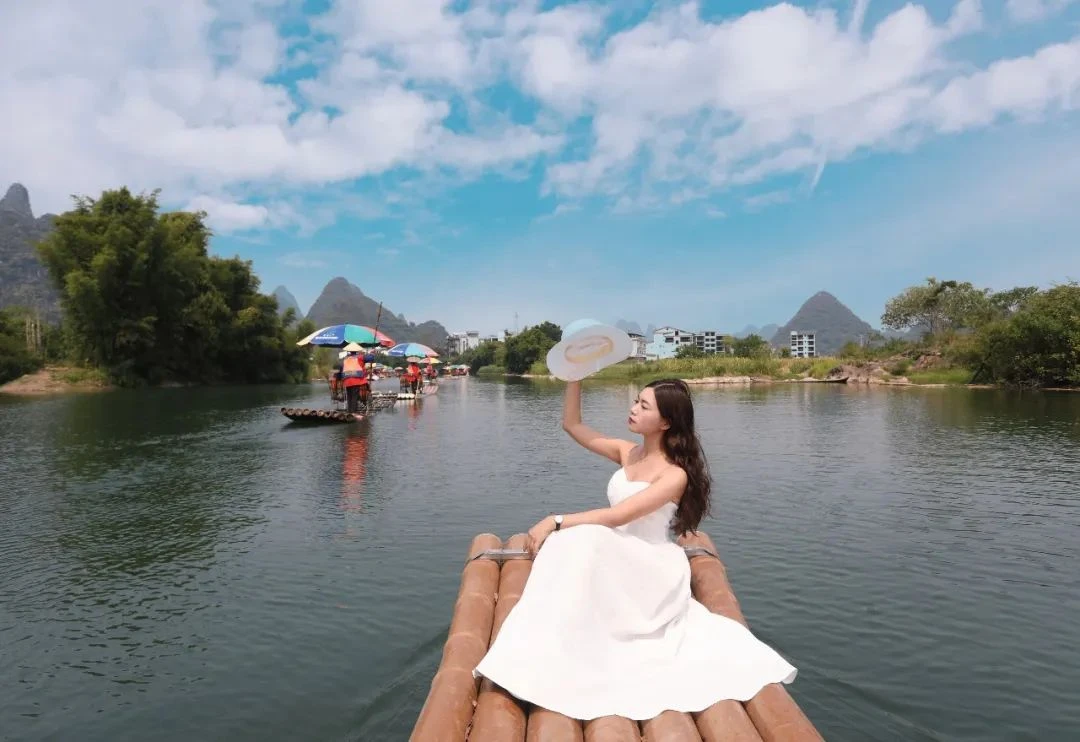
"Boating on the blue waves, wandering in a painting." Visiting Guilin without cruising the Li River is a regret; visiting Yangshuo without seeing the Yulong River is a pity. On the morning of the fourth day, we went bamboo rafting on the Yulong River.
The Yulong River is a tributary of the Li River. It seems to have condensed all the beauty of the Li River. The Ten-Mile Gallery is located here.
The Yulong River rafting is divided into three sections. Different sections like Yulong Bridge and Gongnong Bridge have docks where you can board boats for a tour.
The bamboo rafts on the Yulong River were originally used by local fishermen for fishing. As Yangshuo's beauty became known to the world, these traditional bamboo rafts became the best tool for exploring the Yulong River—with wide views and that rustic charm of old times.
On the bamboo raft, quietly feeling the flow of the Yulong River, this is a beautiful fairyland in a painting. Yangshuo's Yulong River is a scroll. The mountains on both sides are in various poses, the green bamboos along the river are layered, and the river water is crystal clear. Taking a bamboo raft to tour the Yulong River, crossing the dams is thrilling and exciting; boating on the calm lake is relaxed and pleasant.
The boatman's folk songs, the mountains, and the river form Yangshuo's fairy-tale-like picture.
Linhe Ancient City - An ancient city with numerous relics
After enjoying a hearty lunch by the Yulong River, we continued to Hezhou.
Hezhou is a city located at the junction of Guangdong, Guangxi, and Hunan provinces. Therefore, it is home to many ethnic groups, creating a very unique regional culture.
Our first stop in Hezhou was Linhe Ancient City.
Ancient cities I had visited before often wore the guise of ancient cities but were actually commercial areas.
I didn't expect that coming to Linhe Ancient City would be quite surprising.
This ancient city still retains its most primitive, desolate flavor. Without rows of shops, it still has the most ancient taste.
The city wall here was built in the Ming Dynasty and has a history of hundreds of years. Around the well-preserved city wall are pristine farmlands. Standing on the wall and looking out, there is a unique desolate feeling.
The Kuixing Tower on the city wall is now abandoned, but you can still vaguely imagine the feeling of this tower overlooking the world.
Coming down from the city wall, you can see the red wooden door and courtyard wall of the Chen Wang Temple. Through the dust of a thousand years, you can hear the resounding sound of horse hooves.
The stone lions in front of the door have recorded centuries of change, and time has condensed here.
The mottled red wall records the years and stories here.
Day 5: Huangyao Ancient Town - Fuchuan Yao Museum - Fuchuan Ancient Ming City
Huangyao Ancient Town - Banyan trees, stone slab bridges, a quietly flowing stream
There are so many praises for this ancient town. I came here with anticipation, seeking a piece of its beauty.
Huangyao, the name sounds like a woman's name—delicate, quiet, and beautiful.
And Huangyao Ancient Town is exactly such a delicate and quiet ancient town, nestled among the green mountains and clear waters of Hezhou. It has flourished since the Song Dynasty.
My first impression of Huangyao Ancient Town might have come from the TV drama "Tea is the Hometown's Essence." Banyan trees, stone slab bridges, a quietly flowing stream—they form a beautiful ancient city scene.
Finally coming here, I unexpectedly thought of Mr. Shen Congwen's "Border Town," equally tranquil and gentle, with the same peaceful time.
Entering Huangyao Ancient Town, you first pass through its moat. Once, this river protected the tranquility of Huangyao; now it has become a beautiful scenic line of the ancient town.
Huangyao Ancient Town is surrounded by a moat. The river is not wide, and ancient stone slab bridges cross it. Time has polished the stone slabs smooth. Here, under the shade of the banyan trees, time presents its most beautiful form.
Inside the ancient city, the buildings still retain their original appearance. Old brick walls, gray-black tile roofs, and occasional weeds at the corners of the walls are the most beautiful scenes of the ancient city.
Local residents sell local specialties at their doorsteps. The mountains have brought countless treasures, and these have become the livelihood of the local people.
When I came here, some art students were sketching. With my camera and their brushes, we all recorded the most beautiful aspects of the ancient town.
Fuchuan Yao Museum - Savoring the glory and history of the Yao people
In the afternoon, we arrived at Fuchuan Yao Museum in Fuchuan County, Hezhou.
Hezhou is located at the junction of three provinces, so it's a multi-ethnic city. Han, Yao, and other ethnic groups have thrived here, establishing their own cultures.
Legend has it that the Yao people are descendants of Chiyou. After being defeated in the war against the Yellow Emperor and the Yan Emperor on the Central Plains, they migrated southward and settled in Guangdong, Hunan, Guangxi, and other places.
Thus, the Yao people developed their own brilliant culture, with their own language, recording methods, traditional festivals, and customs.
Coming to the Fuchuan Yao Museum, located in Ruiguang Park in Fuchuan, you can see the history of the Yao people—from costumes to architecture, from festivals to customs. Everything about this ethnic group is unveiled in this small museum. Here you can savor the glory and history of the Yao people.
Near the museum, you can see Fuchuan's famous Ruiguang Pagoda. Ruiguang Pagoda is a 7-story hexagonal brick pavilion-style pagoda, 28 meters high, with a base buried 4.8 meters deep. The spire has a heavy copper finial weighing 400 kilograms.
Under the pagoda, there are shady trees and a clear jade spring, making the environment very elegant.
Next to the Ruiguang Pagoda is Ciyun Temple. Ciyun Temple was once destroyed by war and later rebuilt.
It has two halls, with side rooms on the east and west sides. The courtyard between the halls is paved with pebbles. Each hall is supported by six columns with beams. The rear hall has a full-moon door leading directly to Ruiguang Pagoda.
Fuchuan Ancient Ming City - Ascend the city wall, faintly seeing the iron horses of yesteryear
In the evening, we came to Fuchuan Ancient Ming City, located in the center of Fuchuan.
As the name suggests, it was built in the Ming Dynasty and has a history of several hundred years.
The gate towers and city walls are still very well preserved. Ascending the city wall, you can faintly see the iron horses and armored warriors of the past.
Today, the area near the city wall is a residential area. The houses are equipped with uniform lighting. Walking along, the red lights are very special.
Nighttime is the most bustling time in the Ancient Ming City. When night falls and the lights come on, the ancient city is lit by warm-toned lights.
Along the way, lanterns and yellow decorative lights complement each other. Colorful flags flutter in the wind above the streets. The entire ancient city seems to be covered in a layer of light fog, dreamy and real.
Watching the elderly cool off and chat under the wind-rain bridge, and children playing and frolicking there, this is the most authentic local flavor.
When I came here, I encountered a performance.
The Guiju opera on the second-floor stage told the story of Guan Yu sealing the gold and hanging up the seal. The unique singing narrated a story of loyalty that has been eulogized for thousands of years.
The crowded streets are full of lively flavor. The bursts of applause add a lively atmosphere to the night sky.
Along the way, there are many shops in the ancient city, including specialty snacks, handmade workshops, intangible cultural heritage creative products (ethnic costumes, folk craft demonstrations), handicrafts (including tourism products), Yao medicine and health care, Fuchuan specialties, etc. Walking here, you can feel a very strong atmosphere.
Day 6: Fuxi Village - Chashan Village - Xiushui Zhuangyuan Village - Heishan Village
On the last day in Hezhou, we visited the countryside here to savor the special flavor of Hezhou's rural areas.
Fuxi Village - Everything is singing an eternal song
Fuxi Village is a Tang and Song dynasty ancient village in the Yao ethnic area of Fuchuan. It has rich pastoral scenery and karst landform landscapes. It's the most suitable place to savor the traditional flavor of the Yao people.
Fuxi Village has many historical and cultural relics. The historical streets, residences, gate towers, and ancestral halls in the village basically maintain traditional architectural forms. Many buildings, stone carvings, and stone crafts reflect the characteristics of Song Dynasty culture and traditional craftsmanship.
Walking in the village, there is no commercialization like in other scenic spots, only peace. This ancient village, far from towns, is well preserved precisely because of its remoteness.
Lingxi always blesses the people here. The stone slab streets become smoother as they are stepped on. The ancient stage still praises the good things in life. The wind-rain bridge still shelters from wind and rain... Also, there are tofu workshops from the Ming and Qing dynasties, breweries, oil pressing houses, grocery stores, and blacksmith shops. All of this still sings an eternal song.
Here, you can see many traditional Yao performances—dragon dances, Spring Plowing Festival, etc.
The vivid golden dragon was once a performance only seen during festivals. Now, even non-festival days, you can enjoy this lively scene.
And spring plowing is undoubtedly the most important festival for the Yao people, who have lived by farming for generations.
Spring plowing carries the hope for the whole year. A favorable weather is always anticipated. These performances are the Yao people's way of celebrating spring plowing and praying for good weather.
Here, you can even wear traditional Yao wedding costumes and experience a traditional Yao wedding.
Chashan Village - On the mottled ancient road, you can almost hear the sound of horse hooves from the thousand-year-old road
Chashan Village, located in Chaodong Town, Fuchuan Yao Autonomous County, Guangxi, is an ancient Yao village with a history of over 600 years. The Xiaohe Ancient Road passes through the village. As the key entrance from the Central Plains into Lingnan, Chashan Village has the reputation of "the first village on the Xiaohe Ancient Road entering Guangxi."
Arriving at Chashan Village, I amusingly received a text message welcoming me to Hunan.
Although this village is within the administrative region of Guangxi, it is at the border of Guangxi and Hunan. One step is in Hunan, one step is in Guangxi.
Merchants who traveled south and north left countless traces here. The quite high counters in the shops were designed for the convenience of horse-riding merchants, which is very interesting.
Walking on the mottled ancient road, you can almost hear the sound of horse hooves from the thousand-year-old road. The ancient stages, ancient ancestral halls, ancient trees, etc., everywhere, momentarily made me see the prosperity that once belonged to the entire village.
Enjoying a pot of oil tea here and some local shuttle-shaped cakes, the footsteps of merchants from all directions still appear before my eyes.
Xiushui Zhuangyuan Village - Once nurtured one top scholar and several successful candidates in the imperial examinations
"Xiushui has the world's best living environment; first-class clan feng shui of China; the best water town scenery in Lingnan; and first-class pastoral charm in Guangxi."
During the imperial examination era, producing a top scholar or a successful candidate in provincial examinations was a glorious achievement for the family.
Xiushui Zhuangyuan Village nurtured one top scholar and several successful candidates in the Ming Dynasty. These outstanding figures, recorded in history, brought prosperity to the village and also blessed its development and peace.
The ancestral halls here still enshrine the outstanding figures from the village. This is a unique honor and memory for the village.
Heishan Village - Watch the nationally acclaimed Butterfly Song Choir
Folk songs sing about ethnic characteristics and local life.
At the CCTV Folk Song Competition, the Butterfly Song from Guangxi amazed the whole country. And Heishan Village is the birthplace of the Butterfly Song, an intangible cultural heritage.
The walls of the houses in Heishan Village are covered with countless colorful paintings. Vivid butterflies are depicted on the walls, representing the people's expectations and blessings for life.
Here, you can hear the most authentic Butterfly Song. Perhaps you can't understand the local language, but music is always universal. The happiness and anticipation in the songs are the most touching flavors of the Butterfly Song.
During the trip, we also tasted a lot of delicious food. We had the famous Guilin rice noodles and Hezhou snail noodles. Guilin has many other delicacies worth trying.
Fish cooked with beer: Adding some beer to the fish from the unpolluted Li River makes it more tender. Cooked with chili, tomatoes, and other ingredients, the flavor is very rich.
Guangxi has many bamboo forests, so cooking with bamboo tubes is a common method. Bamboo tube chicken soup: Add chicken to a bamboo tube; the fragrance of the bamboo penetrates the soup, adding to its sweetness.
The clear waters of the Li River also produce large field snails. The snail meat is crispy and sweet. Stuffed with pork, the flavors of pork and snail blend together, very special.
A delicacy made from glutinous rice, available in both savory and sweet flavors. The outer skin is soft and sticky, very delicious.
Of course, besides these, there are many more delicious foods waiting for you to taste.
There may still be many beautiful places in Guangxi.
Spending a week here might only be a glimpse of the province.
The beautiful scenery and ethnic customs of Guangxi have enough reasons to attract me. Here, seeing mountains, water, and people, every aspect presents different scenes, different styles, and feelings.
1. Although it's already October, Guangxi's weather is still hot. Just bring a short-sleeved shirt and a light jacket.
2. Remember to take sun protection measures: hat, umbrella, sunscreen, sunglasses, etc.
3. The overall taste of Guangxi cuisine tends to be sour and spicy.
4. Some areas on the itinerary are minority ethnic regions; remember to respect their customs.


![Mountains and Waters Meet Again [Guilin Yangshuo] Let's Rock the Boat of Friendship](/img/624178c28a221adb_s.webp?src=https%3A%2F%2Fdimg04.c-ctrip.com%2Fimages%2F0104n120009cnhkrdD720_W_320_0_Q80.jpg)


