Mid-Summer Leisure Self-Drive Tour of Yichun and Yangshuo (Part 3)
Yangshuo County, Guilin City, Guangxi Province
July 14, 2015 (Tuesday)
Set off for Yangshuo as planned (Wentang Town to Yangshuo County, 700 km / about 8 hours). After getting up in the morning, filled a 5-pound vacuum flask with boiled hot spring water. After breakfast, bought three more breakfast sets (each with one egg, one steamed bun, one fried dough stick, unlimited porridge and pickles) to eat on the road, and also filled our own stainless steel thermal container with porridge.
At 8:30 we left the Shanshui Hot Spring Sanatorium and bid farewell to Wentang Town. Before departure, I compared the route on Baidu Maps on my phone with the original planned route to avoid being directed onto small roads again. On the first 20-plus kilometers before entering the Shanghai-Kunming Expressway (G60), there was a section under construction. Cars with low chassis had difficulty driving, and a careless move could scrape the ground. So we crawled at an extremely slow speed, weaving on the bumpy road surface to find relatively flat patches. Fortunately, this section was short, otherwise the car would have been shaken apart.
After getting onto the Shanghai-Kunming Expressway (G60), we switched to the Beijing-Hong Kong-Macau Expressway (G4), then to the Quannan Expressway (also called Xiamen-Chengdu Expressway, G72), then to the Guilin Ring Expressway (S6501), and finally to the Guiwu Expressway (also called Bao-Mao Expressway, G65). We exited at the Baisha Interchange, drove onto an unknown county road, passed through Baisha Town, and hit the national highway (G321). Finally, at 5:30 PM, we arrived at the Fude Days Hotel in Yangshuo County.
Yangshuo County, under the jurisdiction of Guilin City in the Guangxi Zhuang Autonomous Region, is located in the northeast of Guangxi, south of Guilin city center. In my impression, it should be a small county full of ethnic characteristics and quiet charm. But as soon as we entered the county, it felt different from my imagination. Ethnic features were everywhere, but the commercial atmosphere was heavy, and the whole county was buzzing with noise. There were scouts from various travel agencies everywhere, introducing hotels, peddling tickets for "Impression Liu Sanjie," and touting local products. As soon as our car stopped, several touts would come up enthusiastically. Maybe I had imagined Yangshuo too perfectly, so there was a gap in my mind. Anyway, Yangshuo still has its characteristics. For example, on the streets you can see a pot of wok-shaped mountains; a few steps lead you into the beautiful Li River; every restaurant serves delicious beer fish, etc.
First, let's look at the streetscape of Yangshuo.
After arriving in Yangshuo, due to the hot weather, we changed our itinerary: sightseeing was basically arranged in the morning, with rest in the afternoon or noon.
July 15, 2015 (Wednesday)
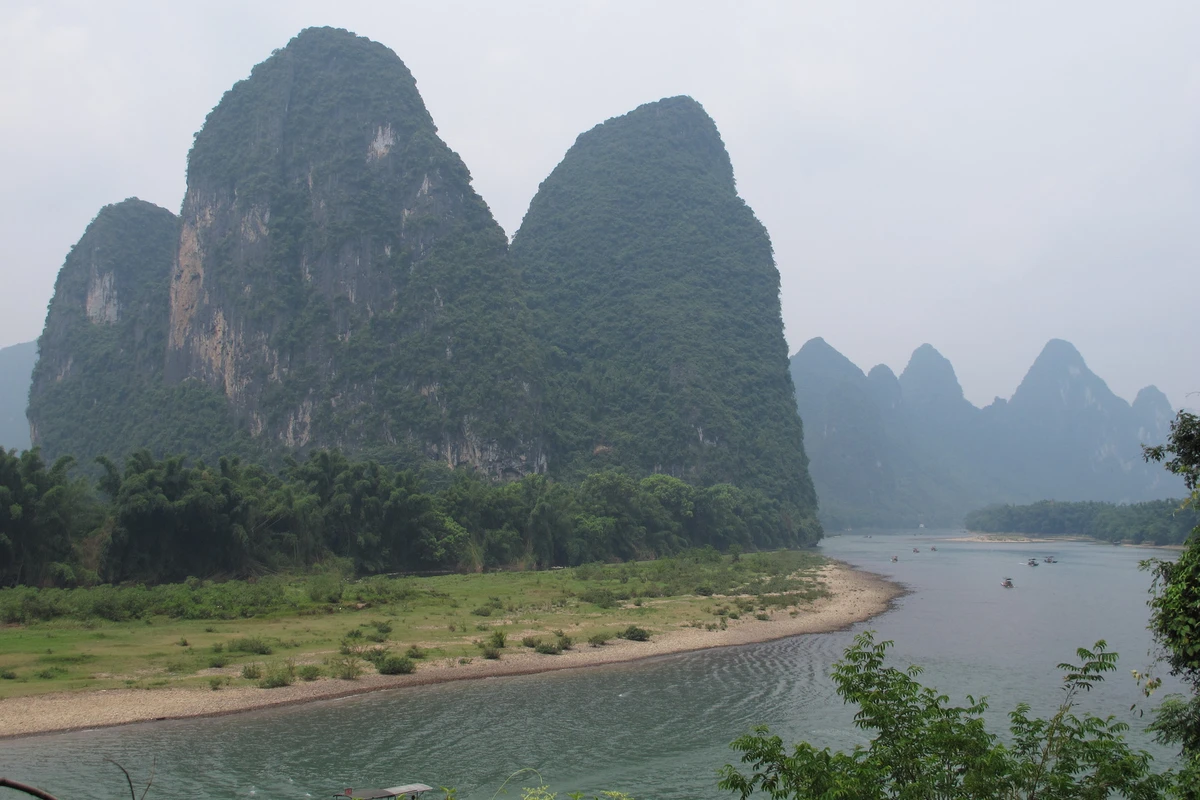
We changed the original plan and first visited Xingping Ancient Town and took a rafting trip on the essence section of the Li River. Yangshuo County is 25 km from Xingping Ancient Town, which took about half an hour. We contacted the boat owner for the Li River rafting, parked the car, and boarded a boat that looked like a bamboo raft. There were many docks in Xingping Town. The so-called bamboo raft rafting was actually a boat made of aluminum alloy shaped like bamboo, with four seats and a diesel engine at the tail for power. This was different from what I had imagined.
After boarding, the boat owner just drove without any commentary, and even if he spoke, it was hard to hear because the diesel engine roared loudly. Looking at the river, all around were similar "bamboo rafts" racing forward as if in a competition. The entire Li River was filled with the smell of diesel exhaust and annoying noise, which really ruined the scenery.
We got off at Yangdi for a short rest, then boarded again and headed back.
Back in Xingping Town, the echo of the engine noise still rang in my head. It was too traumatic.
Xingping Ancient Town originated from the first year of the Ganlu era of the Three Kingdoms Wu (265 AD), then called Xiping County. In the tenth year of the Kaihuang era of the Sui Dynasty (590 AD), Xiping County was abolished and Yangshuo County was established, so Xingping came under Yangshuo's jurisdiction.
Xingping Ancient Town is located in the northeast of Yangshuo County, 25 km from the county seat. The Li River makes a big bend here, making it a shining pearl on the Li River.
The background of the 20 RMB note was taken in Xingping Town. There is a special viewing point where you can hold the bill and compare it with the scene; it basically matches.
Xingping Ancient Town is nestled among mountains and rivers, with beautiful scenery, white walls, black tiles, and stone-paved alleys. Most of the ancient buildings are well preserved, making it the most beautiful ancient town along the Li River.
Because it was too hot, we ended the Xingping Ancient Town tour early and returned to Yangshuo county seat before 3 PM. After a short rest, we went to explore West Street.
Yangshuo West Street, jokingly called "Foreigner Street," has a history of over 1,400 years. Less than 1 km long, West Street is paved with stone slabs in a winding S-shape. The street is filled with various tourist souvenirs. West Street is also the street with the highest concentration of foreigners in China. It is said that the number of foreigners who come here for leisure and living each year is three times the local population.
The restaurants, eateries, internet cafes, and bars on West Street are all a blend of Chinese and Western styles. Almost all signs are in both Chinese and English. From the bosses and waiters to the street vendors and even the elderly ladies, they all speak fluent English. There is no regional difference here. The leisurely and carefree lifestyle makes many tourists reluctant to leave.
West Street is the largest English corner in all of China and is known as China's "Global Village." This phenomenon has attracted attention from both China and the world. Its exotic night scene is particularly charming.
"Stealing a few days of idle time from busy life"—perhaps only here can one truly feel what life is.
West Street was not as good as I had imagined or as described. The noise was too loud; every shop tried to make some sound to attract customers, making it impossible to even eat a meal in peace.
July 16, 2015 (Thursday)
Our itinerary was rafting on the Yulong River. Since the rafting does not return you to the starting point, we didn't drive ourselves. We rented a car at the hotel lobby, which dropped us at the upstream of Yulong River rafting and later picked us up downstream to return to Yangshuo.
The Yulong River is the longest tributary of the Li River in Yangshuo, with a total length of 43.5 km. It is known as the "Little Li River," not the Li River but even better. The Yulong River scenic area has no modern buildings, no artificial traces, and no urban noise. Everything is primitive, natural, simple, and pure. If the Li River is compared to a "daughter of a noble family," then the Yulong River is a "little beauty in a humble home" that makes your heart flutter.
The rafting on the Yulong River uses real bamboo rafts, each carrying two people. The raftsman propels the raft downstream with a bamboo pole. The full Yulong River rafting takes about five hours, divided into an upper and lower section. We chose the upper section. During this rafting, the water flow was slow, and there were a dozen drops.
But there were also rafts going upstream; at the drops, a simple mechanical device lifted the raft up.
Some tourists paid extra to let the raftsmen play in the water.
Local children were also playing on bamboo rafts.
Occasionally, we saw villagers repairing bamboo rafts.
On the river, there were fishermen selling fish and aquatic products.
There were also leisure people fishing by the river.
This is the "Water Photo Studio." Photographers set up at certain spots on the river and take pictures of you without your knowledge. If you want them, you pay; if not, they delete them.
At 1:00 PM, we finished the Yulong River rafting, and the rented car took us back to the hotel. After lunch, we visited the Big Banyan Tree Scenic Area.
The Big Banyan Tree Scenic Area is located on the south bank of the Jinbao River in Chuanyan Village, Gaotian Town, 7.5 km south of Yangshuo county seat. The big banyan tree is 17 meters tall, with a trunk circumference of more than 7 meters, and its dense shade covers an area of over one mu (about 0.17 acres). It is over 1,400 years old. Although the trunk is old and gnarled with intertwined roots, it is still full of vitality.
On the opposite bank of the Jinbao River, there is a small hill with a hollow cave in the middle, like a stone gate that people can pass through freely, hence the name Chuanyan (meaning "piercing rock").
It is hard to distinguish between the Yulong River and the Li River in photos unless there are obvious buildings or other markers.
July 17, 2015 (Friday) – This was our last day in Yangshuo. We mainly rested, and took the opportunity to stroll, shop, eat, and drink, as we were to return the next day.


![Mountains and Waters Meet Again [Guilin Yangshuo] Let's Rock the Boat of Friendship](/img/624178c28a221adb_s.webp?src=https%3A%2F%2Fdimg04.c-ctrip.com%2Fimages%2F0104n120009cnhkrdD720_W_320_0_Q80.jpg)


