A Cantonese Travels to Northeast China
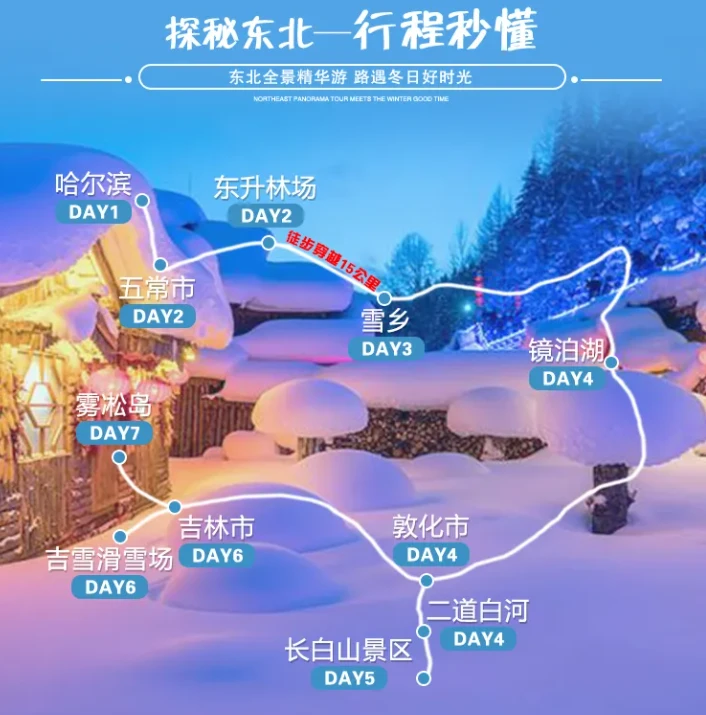
Since childhood, I've always yearned for Northeast China. Especially as a native Cantonese, scenes like thousands of miles of ice, heavy snow, and snowy forests could only be imagined from textbooks. When I was young, conditions didn't allow it – there were no high-speed trains, and flying was just a dream. Now, prices for trips to the Northeast have become very affordable, so I've been trying to form groups, hoping to have more fun with more people and look out for each other, since the cultural differences between Guangdong and the Northeast are huge. I was a bit uneasy going alone. The idea was good, but every year when it came to the critical moment, either Zhang San was busy or Li Si had no money, or various other excuses, so it never happened. This year, my better half got upset and waved her hand, saying if no one else goes, she'll go alone. I did some online research. We both enjoy outdoor activities, so we chose to sign up with "Outdoor Alliance" for a 7-day, 6-night trip: Harbin / Classic Snow Mountain Trek / Traditional Ice Fishing / Dreamy Snow Town / Changbai Mountain / Rime Island. I was still hesitant, but couldn't let her go so far alone, so I had to tag along as a traveling photographer.
This was my first time traveling so far, spanning the entire north-south of China, so I did thorough online research. A friend who had just returned gave me advice: don't bring too many cold-weather gear items; it's best to buy them on Central Street in Harbin, where there's a wide variety, good quality, and importantly, they're cheap (he recommended a WeChat contact). Afraid of the cold, I bought lots of warm packs (which later proved useless, and they're restricted on planes). Outdoors in the Northeast, batteries for electronic devices drain very fast, so bring power banks. For friends who like taking photos with cameras, be careful about condensation from temperature differences. Before entering a warm room from the cold outdoors, it's best to put the camera in a sealed bag.
1. Winter has officially arrived in the Northeast, with large temperature differences between indoors and outdoors. Hotel rooms are very warm, but remember to keep warm when going outside (hat, gloves, mask, scarf, anti-skid snow boots, etc.)
2. When outdoors, always bring a thermos for drinking water. Bottled water left outside for long periods becomes too cold to drink.
3. In low temperatures, digital camera batteries drain quickly, affecting usage time. It's recommended to bring extra batteries or power banks to extend usage time for digital devices.
4. Clothing tips:
Upper body: thermal underwear + fleece jacket + down jacket or shell jacket
Lower body: long johns + thermal wool pants + jeans or shell pants
5. Common medicines, sunscreen, swimsuit, etc. Carry a small backpack at all times for valuables and snacks.
Our tour package didn't include round-trip transportation, so we had to book our flights in advance and notify the leader to arrange airport pickup. We booked on Ctrip: December 16, Guangzhou–Harbin, 09:10–15:30, stopover in Zhangjiakou, ticket price 820 RMB. Return flight: Changchun–Guangzhou, 15:05–21:15, stopover in Yangzhou, ticket price 690 RMB. A small incident at airport security: our trekking poles were confiscated. Online it said they could be carried on, but didn't mention they must be checked in. They must be checked in. Must be checked in. Important things said three times.
After landing, someone picked us up and took us to the assembly hotel in Harbin: Daoyang Hotel, No. 22 Zhaolin Street, Daoli District. Then free time. We thought arriving at 15:30 in Harbin would still be early, so we could drop off luggage and explore nearby. But it was already dark when we arrived. However, Cantonese people like nightlife, and Guangzhou people are known for their love of food. Since we traveled so far, we had to try it. Plan: 1. Buy gear on Central Street, 2. Find food, 3. Visit Sophia Church.
This is Harbin's Central Street. It's about a 30-minute walk from the hotel. Many shops and restaurants are on the left. The friend-recommended gear is there. At the far end in the middle is the Songhua River, where the Christmas ice sculptures are held. Seeing this picture, it's hard for Cantonese to imagine it's only 3:30 PM, and the sky is already completely dark. We found the Northeast sister via WeChat (WeChat ID omitted to avoid advertising). There were several rows of grid shops, mostly selling snow-viewing gear. The sister was very talkative and warm, a typical Northeasterner. I learned a Northeastern phrase from her: everything is "gaga de" (very good/awesome). Everything here is "gaga de." I bought a Lei Feng hat for 45 RMB – it looked a bit exaggerated but was indeed warm. I was freezing. Walking from the hotel here, my ears went numb. The leader said if your ears freeze off, you won't even feel it – seems true. My better half bought a wool hat for 40 RMB, in a bright color for nice photos. Gloves cost 25 RMB. The sister reminded that gloves should not be removed outdoors when playing with snow; waterproof gloves are needed. Down pants cost 100 RMB, all-in-one windproof and warm. Snow boots cost 50 RMB, windproof, slip-proof, and warm. These purchases later proved correct and very practical (more on that later). The sister said not to underestimate these cheap items; the quality is all "gaga de" and she even gave us a few warm packs. I felt satisfied if these could last the whole trip. Buying similar items in Guangzhou would cost about 800 RMB, but I think these are only suitable for the Northeast; no need to buy high-quality ones since they'll only be used once. First, a model shot.
After shopping, we needed to fill our stomachs. "Eating in Guangzhou" is not just a saying. Guangzhou people are particular about food. Traveling so far, how could we not taste local cuisine? But with just the two of us, we couldn't eat much. We wandered near Central Street and found a small restaurant. The owner recommended a few characteristic Northeastern dishes.
Cantonese people can't handle much spice, and Northeastern food isn't spicy. The Guo Bao Rou (sweet and sour pork) was average – far inferior to Cantonese Gu Lou Rou (sweet and sour pork) despite similar preparation. The sauce-braised bones and dumplings were tasty. A necessary reminder: eat less fried food. I ate Guo Bao Rou and got a sore throat from internal heat. Coughing on the bus during the pandemic was extremely awkward and frustrating. (Luckily, a fellow Cantonese traveler had medicine that helped. Bringing some basic medicine when traveling far is necessary.) Forgot the price, similar to Guangzhou spending.
After dinner, on the way back to Daoyang Hotel, we could visit the famous Sophia Cathedral. I won't introduce it here; interested friends can search online.
This beer was very good. After a hearty meal, we slept well. Tomorrow early, we head to Xuegu (Snow Valley) in Wuchang City for one night, then hike 15 km through Dongsheng Forest Farm to meet in Xuexiang (Snow Town).
After a hearty breakfast, everyone packed their belongings. Don't leave anything behind!
At 8:00, we departed on time from the hotel to the next stop: Dongsheng Xuegu (Snow Valley).
On the bus, this street scene was common. The leader said the two most profitable industries in winter are snow shovelers and car repairers.
The drive was long – amidst the white mountains and black waters of the vast Northeast plain. We passed by Wuchang Shanhe, the rice base for Northeast rice. The wind carried the fragrance of rice flowers, the river flowed, and the black soil nurtured our hardworking folks... We had lunch here, tasting the plump Northeast rice. After about 6 hours, we reached the large stone monument of Xuegu. Everyone got off to take photos, the car refueled, and after a one-hour rest, we continued towards Xuegu.
Around 15:00, we arrived at Dongsheng Xuegu. As soon as we entered the village, the Northeast vibe hit us: small bungalows with warm kang beds, chimneys on the roofs. Red lanterns, corn cobs, horse-drawn sleighs – really great. Sheepskin jackets, dog-fur hats, the warm-hearted Northeastern locals. The innkeeper was naturally humorous, with rough yet sincere hospitality that made us feel close. I heard this small village is not allowed to build tall buildings to preserve its local character.
At night, we slept on traditional Northeastern kang beds. The room names were very Northeastern: "Uncle's House," "Auntie's House"... In the old north, every family prided itself on having a big kang – a big kang meant a warm house. I have to complain: for us Guangzhou people, it was hard to accept sleeping with two strangers. Guangzhou people love food and travel too. Here we met fellow locals – what a familiar accent! We adjusted ourselves. After settling in, the leader led us in a Northeast fashion show. The club had sewn custom Northeastern "big floral jackets" for everyone. With a big tobacco pipe, sitting cross-legged on the kang chatting, we became real "big girls" and "real men" – true Northeasterners!
At 17:00, everyone gathered around for a lively "Northeast New Year's Eve Dinner" (complimentary!). Some small liquor too – you'll know what generous portions mean in the Northeast. But don't drink too much.
At 20:30, "Everyone makes dumplings." Northeasterners, regardless of age or gender, can make dumplings. Dumplings are a must for festivals and holidays. So today, we also learned how Northeastern dumplings are made. The inn prepared the filling and dough. Those who can roll dough roll it; those who can make dumplings make them. Northeastern dumplings are known for thin skins and generous fillings – cabbage with meat, pickled cabbage with meat – guaranteed to make you crave them. Several Cantonese folks enthusiastically joined but were far behind in skill and speed. After making and eating dumplings, frozen persimmons were served, and then fairy wands for the evening bonfire. Well-fed and content, we went out for a stroll.
As night fell, we were ready for today's "Bonfire Party." Let's follow the leader's steps, dance to the lively rhythm, and let loose in the snow! Come release yourself in the snow!
Here, ice cream and cones are sold outdoors. Next to them are the Northeast specialties: frozen pears and frozen persimmons.
This is the anticipated bonfire. Maybe the atmosphere wasn't high due to lack of people – somewhat disappointing.
Since the bonfire wasn't fun, we found our own entertainment: trying the legendary "throwing boiling water into ice." The effect wasn't good because we didn't have the right equipment (a bit dangerous for beginners; there will be a video tutorial later). Two groups of older ladies loved this activity and kept doing it tirelessly. Many had gone back to the inn, but they were still having a blast. The innkeeper watched them constantly pouring hot water, with a helpless look.
We stayed overnight at Dongsheng Inn in a farmhouse kang room with 4 beds and private bathroom. We could hit the kang. The kang was very warm, and the temperature difference between indoors and outdoors was huge. Friends, remember to keep warm – don't be like the Cantonese guy in Mohe wearing slippers. Wash up and sleep to recharge for tomorrow's itinerary.
At 8:00, "Start the trek." The leader will lead us on a 15 km snow mountain trek, with an elevation gain of 800 meters and a peak altitude of 1240 meters. We have found a route that truly allows you to enter the snowy mountains, feeling like Yang Zirong crossing the forest and snowy plains. Stay alert, travel in groups, walk through the vast snowy mountains, crossing hills and rivers, watching snow on the trees, listening to birds in the forest. If it snows, the scenery will be even more magnificent. We need to "quickly" follow the leader to have fun and not feel tired.
I've done many hikes but never a snow mountain trek. Crossing the snowy forest was very exciting. This activity is challenging for those without outdoor experience. Important: bring dry food, water (insulated), warm clothing, and slip-resistant gear. If worried about snow blindness, bring sunglasses. Follow the path made by previous hikers. Note: because the snow is deep, don't go where no one has been. Someone tried to take a video, raised their arms, and fell into the snow – fortunately, there was grass underneath; if it were a pit, it would be trouble. The whole trek is 15 km. After the summit, we descend and meet in Xuexiang. There's a rest stop at the top with hot water, so we brought instant noodles and bread.
Ready. Before climbing, we took photos. From the inn to the starting point is about 3 km. If you don't want to walk, you can take a horse cart or even ride up, but there's a steep section where you can transfer to a snowmobile. We wouldn't give up such a rare opportunity to trek through the snowy mountains, especially since a couple in their 60s (later found out they were strong hikers) and a father-daughter pair (father over 70) were ahead. But outdoor activities require knowing your limits. Trying the horse cart or snowmobile is also fine. Prices forgotten, but they were reasonable.
Climbing this snowy mountain tested our gear. Wearing a mask was troublesome – exhaled air turned into mist and then water, which didn't freeze due to warmth, but felt like the mask was dripping. When I pulled it down off my nose, it immediately froze stiff. Clothing not only needs to keep warm but also windproof. Once wind gets inside, it cuts into your skin. So everyone had to wear shoe covers. Two Cantonese locals said they weren't afraid of cold. I compared: they weren't wearing snow boots, their pants and jackets were thick but not windproof, and their hats didn't cover their ears. It's not that I'm not afraid of cold – it's that I dressed correctly: Lei Feng hat, windproof down jacket, wool scarf, down pants, snow boots, windproof waterproof gloves. These items are not only warm but also lightweight – I think it's the best combination.
After a stretch, we reached the first rest stop. If friends who took the horse cart still didn't want to walk, they could transfer to a snowmobile here.
We continued, with light snow falling all the way.
The scenery along the way was beautiful, so I didn't feel tired. I still had energy.
After about 4 hours of hard work, we finally reached the summit. The temperature dropped a few more degrees. Everything was covered in silver, beautiful. The snow was thicker than below. Although beautiful, I didn't dare take many photos. Once I took off my gloves, my fingers froze immediately. So don't complain about blurry photos – even taking off gloves takes courage.
I didn't dare stay outside long. First, we entered a rest station to eat. There was a shop inside to buy things, or you could bring your own instant noodles. But hot water was insufficient (everyone knows why). The temperature difference was huge – inside, take off clothes; when going out, don't underestimate the cold. Put on all clothes before going out.
After eating and resting briefly, we continued. The sky was dim, wind was strong. Some companions said walking was hard because their pants were too thick, and worse, they weren't warm enough.
Not sure what fruit this is.
From the summit to Xuexiang was about another two hours.
At 13:40, we arrived at Xuexiang.
Xuexiang is actually a very small village. The main attractions are a street a few hundred meters long, a museum, dreamy mushroom houses, and a boardwalk all on this street.
As the saying goes: the best snow scenery in China is in Heilongjiang, and the best in Heilongjiang is in Xuexiang. You can walk along Xueyun Street, check in at the Xuexiang Post Office to send postcards with the Xuexiang logo to yourself or friends, and experience the simple life of Xuexiang 20–30 years ago at the Xuexiang Museum. You can also go to the Bangchui Mountain viewing boardwalk to admire the layered snow. Southern friends seeing snow for the first time, find an open snowy area and roll around. Before going out, prepare a bottle of hot water. Under the leader's professional guidance, try the popular "boiling water into ice" (requires -25°C) to create a TikTok-worthy photo. Dinner is a Northeastern farmhouse feast.
Xuexiang isn't very interesting during the day. When lights come on, the simple villagers hang red lanterns at their homes, making the night enchanting. At this time, Xuexiang is a fairytale world bewitched by snow, unforgettable. After enough strolling, remember to go home for dinner.
Well-fed and content, the nightlife just begins. On Xueyun Street, you'll see elderly men and women dancing yangge in colorful cotton-padded jackets, moving passionately to music. They might invite you to join them, letting you fully experience the Northeast's warmth and openness.
Coming this far without a photo would be like not being here. This photo cost 50 RMB but was worth it because it taught me how to do it without hiring a coach next time.
Technique: Must be below -25°C, enough boiling water. The model stands bent over, holding a ladle, and forcefully throws water backward from calf level. Must throw hard; the wider the throw, the better. Never pour it over your head. At night, lighting is needed. If your phone doesn't have burst mode, time it well. Boiling water into ice is available at many spots in the Northeast. If you're a photographer, one ladle of hot water costs 20 RMB; if you fail, you buy another. Daytime also looks good with a blue sky background, and no extra lighting needed.
The dreamy town; the dreamy mushroom house requires an extra fee and has limited entry. I wasn't patient enough. The scenery on the boardwalk was already beautiful. I was too busy taking photos.
At 21:30, washed up and went to bed on time. Overnight at Xuexiang Inn, 4-person room with private bathroom. Another sleepless night – four men sleeping on a farmhouse kang, experiencing life, with a chorus of snoring. This early bedtime explains why Northeasterners are good at chatting – nowhere to go in winter, so they just chat on the kang. Before sleeping, organize your backpack to avoid forgetting anything in the morning.
At 6:00, get up for breakfast. Today we wake up early, pack, and have breakfast.
Opening the inn's door early, a picturesque scene of smoke rising from chimneys among the forest greeted us. Thick white snow covered the small village, rolling endlessly. Under sunlight, the snow hanging on eaves like cream cake was mesmerizing. Since Xuexiang scenic area doesn't allow private vehicles inside, we had to walk about 10 minutes to the bus with our luggage.
At 7:30, we departed for the second largest alpine lava dammed lake in the world – Jingpo Lake.
At 9:45, we reached this service station.
At 12:15, we arrived at Jingpo Lake. Lunch was "Jingpo Lake Cold Water Fish Feast." Replenished energy, then we joined local fishermen in the biting wind to chisel ice holes, cast nets, and experience the millennia-old winter fishing tradition – a dying art of northern fishing culture. The joy and excitement when people saw carp jumping out were uplifting!
We rode "snow flying saucers" over the ice at -20°C, feeling like dragons. What does it feel like lying on blue ice? The wind was strong, especially cold. Even with gloves, my fingers were frozen. Treasures lay beneath the ice, sparking endless imagination. (Jingpo Lake winter fishing is a complimentary activity from mid-December to February; if snow or road conditions prevent it, it's canceled.) Due to some vehicle issues, we lost about an hour.
Even though it was just a demonstration, seeing winter fishing for the first time was exciting. Only 5 fish were caught from a 100-meter net. We envied how northerners fish through ice holes. Now we've seen it in person.
After watching fishing, we played some ice games. Fun, but the vehicle delay cost us time – only played for 10 minutes and then headed back. Then we continued by bus to Erdaobaihe Town.
Around 17:00, we arrived at Erdaobaihe Town. We checked into a five-star hot spring hotel. The club included two nights of hot spring experience! In Erdaobaihe, you can't miss authentic Northeast food. Explore small eateries and try the signature "iron pot stew." After settling in the hotel, I met two Cantonese locals and set out for a food adventure.
This layout is so Northeast – red and purple decorations, lively, with singing, dancing, drums – reflecting Northeasterners' warm and open personality. Their dining tables are on the kang, everyone sitting around drinking and eating meat. At that moment, I suddenly missed quiet, elegant Western restaurants...
The owner said this was one goose's portion (500 words omitted). Taste was just okay, price a bit high but reasonable – still worth trying. I heard of a famous authentic iron pot stew place in the city called "Wula Manchu Hotpot."
After a hearty meal, the highlight of the night – hot springs. The hotel is a 30-minute walk from the hot springs; a shuttle bus is available at the entrance. The springs are indoor and outdoor. Going outdoor takes courage – people wearing only a towel in -20°C weather rush to soak in the warm water, letting every pore be nourished. The day's fatigue melts away. The hotel environment was great. Finally, no more sharing a bed with three others. Slept beautifully, ready for tomorrow's Changbai Mountain trip.
At 7:30, the hotel provided a rich buffet breakfast. We stayed at the same hotel tonight, so no need to pack luggage. Bring only essentials and head to magnificent Changbai Mountain.
At 8:00, we drove to the sacred mountain known as the "Northeast Roof" – Changbai Mountain. It holds countless fascinating stories. The mountain peaks seem like eyebrows gathering, water like ripples in eyes, tree shadows swaying gracefully. Let's explore the legendary Heavenly Lake – the sky's water, water's fire, fire's ice, ice's martial arts – or search for the infinite ultimate beneath the bronze gate guarded for ten years. The 16 peaks of Changbai, like jade dragons hidden in mist, with their myriad forms, complete your journey. The phrase "Long companionship, until white hair" adds a touch of romance to Changbai Mountain. Information about Changbai Mountain is abundant online.
At the entrance, we took photos. The leader said we were very lucky today – the Heavenly Lake was open. Everyone was excited.
Changbai Mountain's Heavenly Lake isn't open often – only a few days per year due to weather. It's said that former President Jiang Zemin visited three times but couldn't see it. Because the temperature on the mountain is extremely low and windy, it's best to rent windproof leg guards at the entrance. But I had confidence in my down pants. The leader bought tickets, and we queued for the park's off-road vehicles. About 30 minutes to the summit.
We saw a sea of clouds – so beautiful, but it was extremely cold and windy. I wanted to take photos, but taking off my gloves for 3 seconds caused piercing pain.
This is the Heavenly Lake in winter. A bit disappointing?
Queue for tickets, queue for the vehicle, hard work to get to the top, then about 30 minutes to see it. Don't expect too much.
Going down, beautiful scenery all the way. Next stop: Green Abyss Pool. There's a rest area here with lunch (self-provided) and free hot water. Learning from last time, we brought self-heating rice instead of instant noodles.
In winter, Green Abyss Pool is covered in ice and snow. Ice stalactites hang at the cave entrance, with the sound of a still-flowing waterfall.
Green Abyss Pool is actually a small park, but the environment is nice. After a short rest, we took a bus to the next stop: Changbai Waterfall.
Walking along this boardwalk leads to the top to see the waterfall. You can also try a snowmobile.
Finally at the top. Did you see the waterfall? There were many scenic spots today, time was tight, rushed and didn't get to see enough. Next, we drove to the Underground Forest.
Following a wooden boardwalk into the dense forest, stepping on thick white snow, we saw the entire valley forest. Ancient trees towered, branches covered with snow, air exceptionally fresh.
After seeing many movies, this forest wasn't that interesting. But safety first: stay on the boardwalk, don't run off for photos because you don't know where it's deep or shallow. At 15:30, exit from the Underground Forest, take the bus out of the scenic area, ending a wonderful day at Changbai Mountain! Back to the luxurious five-star hotel to soak in hot springs again.
At 7:00, awakened by the leader's calls, we had breakfast, packed our belongings, and drove to Jilin City. Jilin is the only city in China sharing its name with the province. The Songhua River flows through it, Manchu culture is unique, surrounded by gentle mountains with suitable temperatures and soft snow – a favorite for skiers.
At 8:00, we drove to Jixue Ski Resort, covering 400,000 square meters, jointly developed with France's MND group. It has multiple trails of different levels, suitable even for children and beginners.
At 14:00, we arrived at the ski equipment hall. Under the leader's help, we got our gear: helmet, skis, boots, poles – very cool. Even if you can't ski, wearing them makes you the coolest guy on the slopes!
They say skiing is addictive – absolutely true. The more you do it, the more you want to. Beginners can hire an instructor for 200 RMB (up to 4 people per group, depending on your bargaining skills). I have rollerblading experience, similar techniques. Started cautiously on intermediate slopes – found it easy, no falls. Then got bold. As the saying goes, "Only swimmers drown." I got cocky and became too reckless, fell twice – but it was really fun. I recommend even beginners try it; it's easy, instructors guarantee success. Several female group members thought I was good and asked me to teach them. They were quick learners – after one try, they could do it. The instructor gave me a resentful look. The difficulty lies in maintaining balance and controlling speed. Slow speed means better balance. When going downhill, spread legs, bend over to lower center of gravity, toes pointing inward (pigeon-toed). The closer the toes, the slower the speed. Keep the leg width constant – don't widen or narrow, or you'll fall. Control the angle of the toes (never point heels outward). Once you learn, go for it – falling a few times makes you the coolest guy. One complaint: every time we took the conveyor belt, we had to take off gloves to swipe the card – not user-friendly.
After thrilling skiing, there's another fun activity – snow tubing. The ski resort has the longest snow tube slide in the Northeast. When you glide down from the top, you feel like a king overlooking everything. That's the charm of snow tubing. It's also called "Snow Flying Saucer" – addictive and unforgettable. You can safely enjoy to your heart's content.
Back in the city, we had to try the most authentic Northeast cuisine.
Slightly expensive, nice environment, seafood not fresh (not recommended), taste okay. After eating, we returned to the hotel. Early to bed, early to rise tomorrow.
As the saying goes, "Watch mist at night, see rime at dawn, enjoy falling blossoms at noon." Jilin rime, together with Guilin's mountains and waters, the Three Gorges, and Yunnan's Stone Forest, is one of China's four natural wonders. Every winter, mist from the unfrozen river condenses on trees, forming rime – legendary jade trees and silver flowers, indescribably beautiful.
At 06:00, we assembled and departed for Rime Island. Rime is a rare natural phenomenon, formed under specific conditions. But the probability of seeing rime on Rime Island is higher. The trees here are uniquely shaped, their branches covered in frost sparkling in the river breeze.
Rime Island is famous for its rime, but not many know that the sunrise over the river city is also a major attraction. The fiery red sun, softened by river mist, loses some brilliance but gains gentle grace.
Unfortunately, we came at the wrong time. After seeing too many movies, it seemed ordinary.
At 09:00, we took a bus back to Jilin city center, arriving around 11:30. Our trip concluded; we disbanded on the spot. But meeting different people, encountering different things, recording the landscape, and finding like-minded friends might be the true meaning of travel.
After lunch and packing, those of us returning to Guangzhou took a taxi to the train station (short trip, 10 RMB), then a 30-minute bullet train to the airport. This unforgettable and pleasant Northeast trip ended.
Simple summary: 1. Don't bring too many clothes; pack light. The Northeast is cold but dry – no problem going a few days without showering.
2. No special gear required; buy in Harbin – cheap and practical. Clothes should be windproof and warm, lightweight. Down pants are very useful.
3. Bring some medicine to avoid acclimatization issues. Cantonese people tend to get internal heat; be careful with hot foods.
4. Indoors have heating, huge temperature difference. Dress properly before going out.
I've rambled a lot. Don't complain about the photos – most were taken by phone. Using a camera is inconvenient in such cold. Imagine having to muster courage just to take off gloves for a photo. But if you have high photo standards, that's different.
Dear friends, looking forward to meeting in Mohe next time, but I won't wear slippers.
Travel Journal Contents:
1. Planning: time, place, people
2. Day 1
3. Day 2: Harbin – Dongsheng Forest Farm (Big Snow Valley) – Snow bonfire (snowball fight, Northeast New Year's Eve dinner + dumpling making + small liquor)
4. Day 3: Dongsheng – Hiking through snow forest – Shuangfeng Forest Farm (Xuexiang) – Night view from boardwalk
5. Day 4: Xuexiang – Jingpo Lake winter fishing – Erdaobaihe five-star hot spring hotel (hometown of beautiful pine)
6. Day 5: Erdaobaihe – Changbai Mountain (Heavenly Lake, Changbai Waterfall, Green Abyss Pool, Underground Forest) – Erdaobaihe
7. Day 6: Erdaobaihe – Premium skiing (skis, poles, boots, cable car, snow tubing)
8. Day 7: Jilin – sunrise viewing – rime viewing – disband in Jilin city
Travel Information:
Hotel Index
Guide Index
Ticket Index
Website Navigation
Travel Index
Cruise Index
Corporate Travel Index
Partnership
Distribution Alliance
Friendship Links
Corporate Gift Card Purchase
Insurance Agent
Agent Cooperation
Hotel Partnership
Destination and Scenic Area Cooperation
More Partnership
About Ctrip
About Ctrip
Ctrip Hotspots
Contact Us
Careers
User Agreement
Privacy Policy
Business License
Security Center
Ctrip Content Center
Intellectual Property
Trip.com Group Algorithm Disclosure


