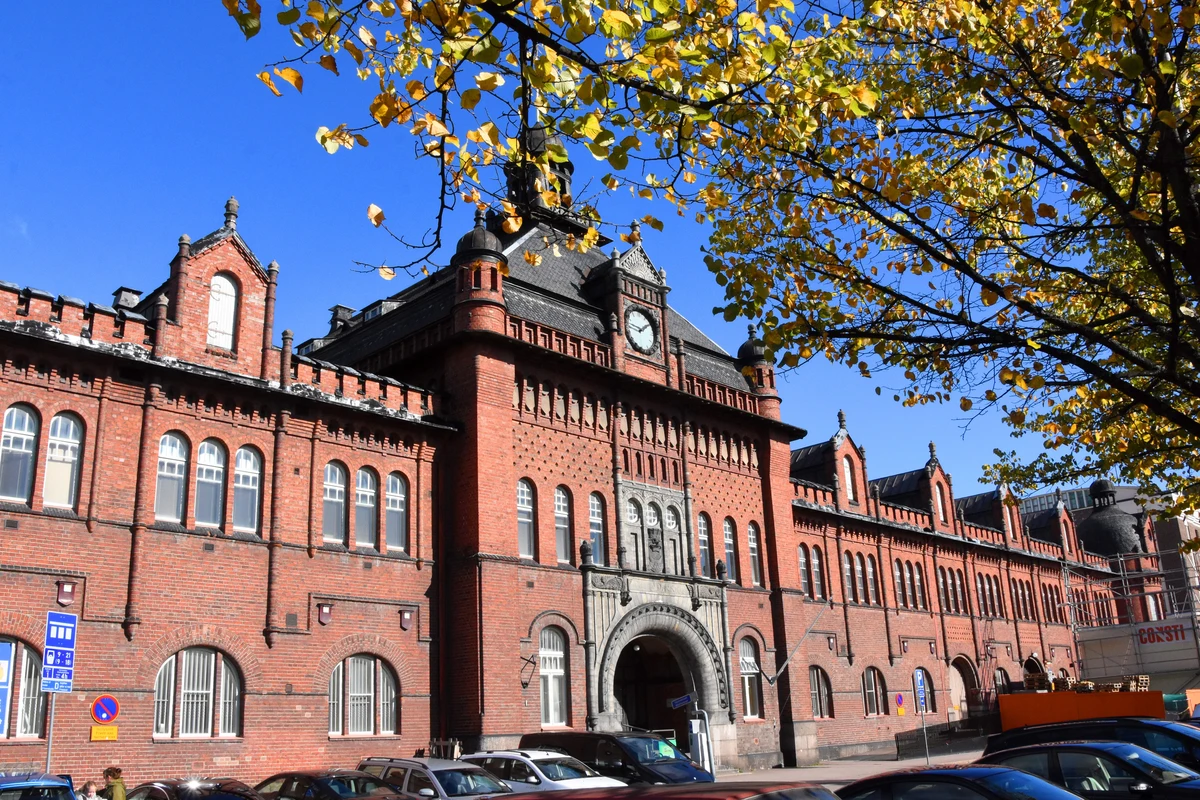
Into Helsinki, the Capital of Nordic Finland (Photos)
Finland, one of the Nordic countries, ranked 16th on the medal table of the 2022 Beijing Winter Olympics, which also reflects its unique advantages in winter snow events. The trip to Helsinki, the capital of Finland, was the final stop on this reporter's 15-day Nordic tour.
A corner of the city (Photo by Feng Ganyong)
At 8:00 AM Finnish time on September 23, 2018, the Nordic tour team began their final itinerary in Helsinki, Finland. The day's schedule included a sightseeing tour of downtown Helsinki, visiting the Statue of the Daughter of the Baltic and the Presidential Palace; taking a ferry to Suomenlinna Fortress, and then returning to the city to visit Sibelius Park, the Rock Church, and Senate Square.
Morning view of Helsinki (Photo by Feng Ganyong)
In the early morning, the streets of Helsinki had very few cars and pedestrians. The reporter noticed that some of the passing trams were completely empty. It was truly a city that was too quiet. Hou Liguang introduced that the Republic of Finland, abbreviated as Finland, is located in Northern Europe, one of the five Nordic countries, bordering Sweden, Norway, and Russia, with the Gulf of Finland to the south and the Gulf of Bothnia to the west.
Seaside scenery (Photo by Feng Ganyong)
Finland has a coastline of 1,100 kilometers, inland waters account for 10% of the national area, with about 179,000 islands and about 188,000 lakes, earning it the name "Land of a Thousand Lakes." Finland has long, harsh winters and short, mild summers, with one-third of the country's land within the Arctic Circle.
Santa Claus (Stock photo)
Finland is the hometown of Santa Claus, and the earliest inhabitants were the Sami people, hence Finland is also called Lapland. After the Finns migrated in, they established the Grand Duchy of Finland. It was ruled by Sweden in the latter half of the 12th century. After the Russo-Swedish War in 1809, it was incorporated into the Russian Empire as a grand duchy. On December 1917, the Republic of Finland declared independence and became a permanently neutral country.
Harbor cruise ship (Photo by Feng Ganyong)
As the capital of Finland, Helsinki is the largest city and the largest port in Finland; it is the economic, political, cultural, tourism, trade, transportation, and shipping center of Finland. It has been repeatedly rated as one of the "most livable cities in the world" and is a world-renowned international metropolis.
Seaside architecture (Photo by Feng Ganyong)
Helsinki, adjacent to the Baltic Sea, is a city that blends classical beauty with modern civilization, a garden city where urban architecture and natural scenery are skillfully combined. The city's buildings are mostly made of light-colored granite, earning it the name "White City of the North."
Harbor market (Photo by Feng Ganyong)
Finland is also a city with classical beauty, with a large number of exquisite Germanic and Russian-style buildings. The lakes in the urban area are dotted everywhere, making it the European city with the highest vegetation coverage, a serene and peaceful garden city. At the harbor market in Helsinki, there is a bronze statue called "The Daughter of the Baltic," which is a symbol of Helsinki.
Statue of the Daughter of the Baltic (Photo by Feng Ganyong)
The team first visited the statue of "The Daughter of the Baltic" in the center of Helsinki. Walking up to the statue, one could see the maiden facing the sea, her left hand resting on her cheek, quietly gazing at the Gulf of Finland. She is dignified and beautiful, small and delicate, gentle and elegant, and people affectionately call her the Goddess of the Sea—Amanda.
Close-up of the statue (Photo by Feng Ganyong)
It is said that when the designer Ville Vallgren completed this statue in 1906, he simply called it "Little Mermaid." But two years later, when the statue was officially installed here, the Finns gave it the affectionate nickname that is now widely recognized—Amanda. It is estimated that because the beautiful girl at the top of the sculpture is actually not a mermaid but has two legs, the Finns felt the name was inaccurate and thus came up with this lovely name.
Street corner view (Photo by Feng Ganyong)
Amanda is completely nude, which was once considered indecent by conservatives in Finland, and it was only preserved with the strong support of university students. Every year on April 30, thousands of young people wearing white graduation caps gather at the South Harbor Square in downtown Helsinki, playing joyful music, washing the statue of the Daughter of the Baltic with water, and then putting a graduation cap on her, beginning an all-night carnival that takes place every year.
Presidential Palace (Photo by Feng Ganyong)
Diagonally opposite the statue of the Daughter of the Baltic is the Presidential Palace, built in 1820. After its completion, it underwent several renovations to serve the Russian tsar.
Photo at the Presidential Palace (Photo by Wang Jue)
After Finland's independence, it has been used as the representative office and official residence of the President of the Republic of Finland. It was also the venue for a meeting between Russian President Vladimir Putin and U.S. President Donald Trump, which had just taken place on September 7, 2018, not long ago.
Photo at the pier (Photo by Feng Ganyong)
The team took a ferry from the pier opposite the Presidential Palace to Suomenlinna Fortress. After about 20 minutes of sailing, the ferry arrived at the pier of Suomenlinna. Upon landing, the reporter discovered that Suomenlinna is built on a string of small islands in the sea off Helsinki. The tour guide introduced that Suomenlinna is a masterpiece designed by Augustin Ehrensvärd. Built over 250 years ago, it is one of the largest existing maritime military fortresses in the world and one of the most important and famous attractions in Finland.
View of Suomenlinna from a distance (Photo by Feng Ganyong)
Strolling on Suomenlinna, one can see churches, barracks, city gates, and other historical sites. To accommodate tourists, the fortress has nine restaurants and cafés, and a visitor information center. As described by UNESCO, Finland has an exceptionally well-preserved complete maritime military heritage site in the world.
Guide sign on the fortress (Photo by Feng Ganyong)
In times of war, Suomenlinna was an important maritime military fortress, playing a crucial military role in Finland's war for independence and liberation.
Corner of Suomenlinna (Photo by Feng Ganyong)
During the Finnish Civil War, there were fierce large-scale conflicts between radical and conservative factions. After the defeat of the radical factions, many of their members were captured and imprisoned at Suomenlinna.
Ruins of the military fortress (Photo by Feng Ganyong)
In 1991, Suomenlinna was designated a UNESCO World Heritage Site. Suomenlinna is no longer filled with the smoke and blood of war; it has become a holy place for tourism, recuperation, and living.
Photo at Suomenlinna (Photo by Feng Ganyong)
Today, in peacetime, the well-preserved gun batteries, fortresses, barracks, and other historical sites have not only brought tourism development to the Finnish people but have also played an indelible role in Finland's economic development.
Church on the fortress (Photo by Feng Ganyong)
After visiting Suomenlinna, the team took a ferry back to the shore and then drove to Sibelius Park, built in memory of the famous Finnish music master Jean Sibelius. The park is located about 1.5 kilometers northwest of Temppeliaukio Church in Helsinki. The park is full of blooming flowers and lush green grass, making it a great place for citizens to relax. The Sibelius Monument is made of iron tubes combined into surrealistic imagery, exuding a strong modern atmosphere.
Sibelius Park (Photo by Feng Ganyong)
According to Hou Liguang, there was a gradual process in the establishment of this park. After Sibelius's death, the Finnish government publicly solicited designs for a monument to commemorate the great composer, and finally, the design by Eila Hiltunen was selected.
Statue of Sibelius (Photo by Feng Ganyong)
However, this statue made of 600 steel pipes was too avant-garde for Finland at the time, so the author was asked to also create a portrait of the composer's head, which displeased the sculptor. Hiltunen believed that the steel pipe statue sufficiently reflected Sibelius's contributions, but she eventually agreed to create another portrait.
Photo with Sibelius statue (Photo by Hou Liguang)
The second statue was completed in 1967, on the tenth anniversary of Sibelius's death. Therefore, there are two statues commemorating the composer in Sibelius Park. The Sibelius statue has a peculiar expression, which evokes many associations for those who know the history of its creation. A small replica of it was presented as a national gift to the United Nations for permanent exhibition.
Photo in the park (Photo by Feng Ganyong)
Since the reporter loves classical music, he is quite familiar with this composer. Among Sibelius's many works, "Finlandia" is undoubtedly the most successful and widely known important work. However, because the reporter is fond of string music, he especially enjoys and is deeply impressed by Sibelius's "Violin Concerto in D minor" in his collection of the Heifetz violin master's album.
Cover of the D minor CD (Photo by Feng Ganyong)
Sibelius was undoubtedly one of the many musical geniuses. A biographical description once read: As a boy, Sibelius was born in 1865 in a small town in Finland, where his father was a regimental doctor stationed there. As a little boy, Sibelius liked to build music on the piano, and later wrote down small pieces for piano and other solo instruments. When he was fifteen, he took violin lessons from the teacher of the regimental band.
Green grass park (Photo by Feng Ganyong)
In the summer, Sibelius liked to take his violin and disappear into the woods for days and nights—during those strange Nordic summer nights when the sun does not set until late and the darkness is never darker than the mysterious twilight. Sibelius tried to express his feelings about the beauty of nature on the violin: the fragrant forest with its tall "whispering" trees, the silent lakes and cheerful streams, and the songs of silver birds.
City Museum (Photo by Feng Ganyong)
He also played the violin with his brother and friends in the school orchestra and in chamber music family concerts. Like many other musicians, Sibelius once wanted to become a lawyer and spent some time studying law at the University of Helsinki in Finland. Finally, he decided to devote his entire life to music.
Pastoral scenery (Photo by Feng Ganyong)
When he first left his country to study music in Berlin, he was only twenty-four years old. Later, Sibelius went to Vienna, where he earned a great reputation. When he returned to Finland three years later, he was already famous for his first great tone poem, "En Saga." The title means "from an ancient legend."
Quiet houses (Photo by Feng Ganyong)
Sibelius was happy because he was loved by the people of his country. Sibelius was lucky because he lived to the age of 91, which is extremely rare among European and American musicians. Jean Sibelius was born on December 8, 1865, in Hämeenlinna, Finland, and died on September 20, 1957, at Ainola, near Helsinki, Finland, at the age of 91. As Finland's greatest musician, the Finnish people held a grand state funeral for him.
Rock Church (Photo by Feng Ganyong)
After the tour of Sibelius Park, the team came to the Rock Church in Helsinki, Finland, to continue the itinerary. This church is located at Temppeliaukio Square in the center of Helsinki, so it is also called Temppeliaukio Church. It is a landmark attraction in Helsinki, built entirely out of solid rock. Completed in 1969, it is the masterful work of the Suomalainen brothers.
Corner outside the church (Photo by Feng Ganyong)
In the entire Temppeliaukio Square, the church is covered by a huge uneven rock, rising 8-13 meters above the adjacent streets, and the Rock Church is hidden inside this huge rock. Isn't that amazing? The church is built directly on the rock highland. To avoid damaging the natural landscape, it was excavated from the top of the rock, so the church is buried in the natural rock, truly living up to its name as the Rock Church.
Old and new architecture (Photo by Wang Jue)
If people do not come from the street facing the church gate, it is hard to find the hidden entrance of the church. The reporter, however, came from the other side and stood right on top of the church, still wondering where the Rock Church was. Only when he saw tourists below walking into the mound did he realize that the Rock Church he was looking for was right under his feet!
City church view (Photo by Feng Ganyong)
Entering the church, one does not feel the solemn atmosphere of traditional European churches. The circular dome inside makes people feel relaxed. An elegant lady was playing the piano, and many visitors sat quietly in chairs, listening, making it feel like entering an elegant music hall rather than a traditional church.
Corner of Senate Square (Photo by Feng Ganyong)
The final stop of the Finland tour was to visit Senate Square. Senate Square is not only a center of activity for Helsinki citizens but also the best place to appreciate Neoclassical architecture, regarded as an important landmark in Finland. In the center of the square stands a bronze statue of Tsar Alexander II, built in 1894, to commemorate his granting full autonomy to Finland.
Statue on the square (Photo by Feng Ganyong)
Standing on the square, one can see three masterpieces by the architect Carl Ludvig Engel: the white Helsinki Cathedral, the Government Palace, and the University of Helsinki. At the southeast corner of the square is the oldest stone building in Finland, the Sederholm House. These buildings cluster around Senate Square, quietly providing a viewing delight for visitors.
White Church (Photo by Feng Ganyong)
The most prominent structure on the square is, of course, Helsinki Cathedral, also known as the White Church. It is the most famous building in Helsinki, not only a symbol of Helsinki but also an important landmark. It is a Lutheran church.
Photo at Senate Square (Photo by Hou Liguang)
Helsinki Cathedral was built in 1852. Its structure is exquisite and its aura extraordinary, making it a masterpiece of Finnish architectural art. In winter, when heavy snow covers the square in front of the church and warm lights are lit, the entire church appears holy.
Building on the square (Photo by Feng Ganyong)
Helsinki Cathedral was designed by the German architect Carl Ludvig Engel. The church sits on a hill more than 80 meters above sea level. At a glance, the main white body supported by Greek columns and the light green bronze domed bell tower are very striking. The magnificent momentum and exquisite structure make it a classic in Finnish architectural history. From Senate Square to Helsinki Cathedral, it only takes a hundred stone steps, but it is these hundred steps that fully show the difference between the church and the secular world. The beauty and sanctity of Helsinki Cathedral leave a deep impression on people.
City sculpture (Photo by Feng Ganyong)
Inside Helsinki Cathedral, there are many exquisite murals and sculptures. Whenever the church bells ring, the entire square becomes quiet, and countless visitors quietly experience this precious moment of inner peace that only religion can bring. It is also the most popular wedding venue for Finns. To hold a wedding here, couples need to book one and a half years in advance. Every year, the Faculty of Theology of the University of Helsinki holds its traditional and solemn graduation ceremony at Helsinki Cathedral.
Buildings in the university district (Photo by Feng Ganyong)
Strolling through the sides of the church, a series of buildings come into view—the Helsinki University district. It is similar to the Oxford University campus in the UK, both being open university district buildings. The University of Helsinki is a world-renowned institution of higher learning located in the Finnish capital of Helsinki. It was founded on March 26, 1640, in the ancient Finnish capital of Turku, and relocated to Helsinki in 1828. The University of Helsinki is famous in Europe for its long history, rich library collections, first-class facilities, comprehensive majors, and outstanding achievements.
Corner of the university district (Photo by Feng Ganyong)
Hou Liguang introduced that the University of Helsinki was originally named the Royal Academy of Turku. At that time, Finland belonged to the Kingdom of Sweden, and the Royal Academy of Turku was an important academic institution of the Swedish Empire. While Finland was still part of Sweden, in order to train more qualified national administrators, the 13-year-old Swedish Queen Christina, on the proposal of the regent, decided to establish the University of Turku in Turku, the then capital of Finland.
Street photo (Photo by Feng Ganyong)
Initially, the academy was established entirely following the European university education system, with instruction in Latin. Students first studied in the Faculty of Philosophy, then majored in theology, law, or medicine according to personal interest. Teachers and students often visited other European academic research institutions for exchange and academic discussions.
Old architecture (Photo by Feng Ganyong)
Historically, the University of Helsinki has produced five Nobel laureates. Lars Ahlfors won the Fields Medal (Nobel Prize in Mathematics) in 1936, Frans Eemil Sillanpää won the Nobel Prize in Literature in 1939, Artturi Ilmari Virtanen won the Nobel Prize in Chemistry in 1945, Ragnar Granit won the Nobel Prize in Physiology or Medicine in 1967. In 2016, Bengt Holmström won the Nobel Prize in Economics.
View from the sea (Photo by Wang Jue)
In addition, the world-renowned music master Jean Sibelius, as well as the very active and influential contemporary logician and philosopher Jaakko Hintikka, and Finland's first female president Tarja Halonen, all come from the University of Helsinki in Finland.
Seaside view (Photo by Feng Ganyong)
At 5:50 PM Finnish time on September 23, 2018, the Nordic tour team finally completed their final itinerary in Helsinki, Finland, and drove to Helsinki Vantaa International Airport. When the reporter's flight, Finnair AY0085, took off from the airport, the reporter looked down at the Finnish landscape through the window and silently said: Farewell, Finland!
Goodbye Finland (Photo by Feng Ganyong)
At 6:40 AM Beijing time on September 24, 2018, the reporter's Nordic tour team, after a flight of more than seven hours, successfully arrived at Terminal 3 of Beijing Capital International Airport. Thus, the reporter's 15-day Nordic tour came to a successful conclusion. (Text and photos by Feng Ganyong)


