Still Craving Your Charms – Blue Turkey
On October 22, 2016, I was about to embark on a trip to Turkey...
For me, October 22 is a very special day,
It marks the two most important moments of the first half of my life – birth and marriage!
Starting from this 1022,
I decided to interpret this moment with every trip,
Even as a birthday gift to myself, not just passing by, but also with memories!
It counts as having both face and cake! Thank you all!
Birth! Marriage! Departure!
October 23: Flying for 8 hours and transferring in Tehran, women are required to wear long robes that cover the hips and wrap a headscarf, only face and hands can be exposed. This is not just a matter of doing as the locals do, but also a country that believes in Islam and has taboos. Iran – serious, restrained, mysterious. For us, such an outfit is so novel! (I also wrote a travelogue about Iran!)
Arrived in Istanbul, nice to meet you, please take care!
Outside the gate of the Blue Mosque, Sultanahmet Square (also known as the Hippodrome of Constantinople). Originally the Hippodrome of Constantine, it was once the sports and social center of Constantinople, the capital of the Byzantine Empire, built by the Roman Emperor Septimius Severus in the 2nd century AD. After thousands of years of baptism, the ancient hippodrome has long lost its original appearance, only the Obelisk of Theodosius, the Column of Constantine, and the Serpentine Column still stand in the center of the square. From the outside, the Obelisk of Theodosius is well-preserved, while the Column of Constantine looks much more dilapidated. In fact, the obelisk is much older than the column.
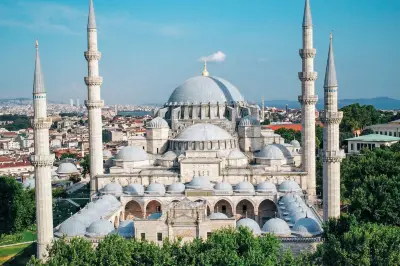
The first stop is the famous Blue Mosque, originally named Sultan Ahmet Mosque, one of the famous mosques in Turkey and one of the world's top ten wonders. It was designed and built in the early 17th century by Mehmet Aga, the proud disciple of the famous classical Islamic architect Sinan. It is an Arabic-style domed building with six minarets surrounding it, symbolizing the six pillars of Islam. Because the walls inside the mosque are entirely decorated with blue and white İznik tiles, it is named the Blue Mosque. It is one of the most important landmarks in Istanbul and the only grand mosque in the world with six minarets.
High interior, huge dome, gorgeous wall decorations – no matter how you photograph, you cannot capture her beauty in the lens. The Blue Mosque is built entirely of large stones, without using a single nail, which is somewhat similar to the mortise and tenon structure in China. The mosque has a total of 21,043 white-based blue-glazed tiles, so the whole mosque exudes a melancholy blue. Unfortunately, my photography skills are not good enough to capture the blue effect.
Two panoramic shots taken – a little flawed, the tips of the minarets were not fully captured.
In the square, I captured the magnificence of the Blue Mosque and the faith in daily life.
The first rule for visiting the Blue Mosque is that whether you are a worshiper entering for prayer or a tourist, you must wash your feet first. Because there are too many people entering, everyone has to take off their shoes, and the smell can be imagined.
Long fishing rods, seagulls hovering low – this is a paradise for anglers and a corner of tranquility amid the hustle and bustle.
Now sitting in a riverside Western restaurant, by the window, ordering a cup of hot black tea, enjoying the scenery outside the window during lunch. It's a bit cloudy, but it presents another kind of monochrome picture, a silhouette painting...
Topkapı Palace is a palace located in Istanbul, Turkey. It served as the official residence and main living quarters of the Ottoman sultans from 1465 to 1853. Topkapı Palace was the venue for state ceremonies and royal entertainment in the past, and today it is a major local tourist attraction. Translated, Topkapı Palace means "Cannon Gate." In the past, cannons were placed in the fortress, hence the name.
In a corner of the Grand Palace, I encountered a playful mother cat with her kittens. I couldn't help but quietly crouch down and capture this warm picture...
Ramada Hotel – truly great! They say it's the best here!
Taste everything – eating is for the body, drinking is for the soul.
October 24: The Bosphorus Strait, also known as the Istanbul Strait, is a narrow waterway connecting the Black Sea and the Sea of Marmara. Together with the Dardanelles Strait and the Sea of Marmara, it forms the Turkish Strait (also called the Black Sea Strait), and it separates the Asian and European parts of Turkey. It is also the only strait in the world that straddles two continents.
Cruising slowly in the fjord waterway, with the azure sky, white clouds within reach, scenery on both sides, and a gentle breeze on the face – at this moment, I don't care where we are heading. Just keep going like this, enjoying the scenery along the way – isn't that wonderful?
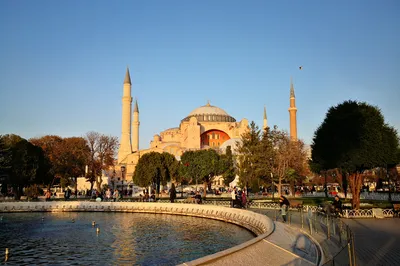
Hagia Sophia in Turkey – a religious building located in Istanbul, Turkey, with a history of nearly 1,500 years. It is famous for its huge dome and is a masterpiece of Byzantine architecture that "changed the history of architecture." Originally an Eastern Orthodox patriarchal basilica, it was once turned into a mosque and is now a museum in Istanbul, Turkey.
Taksim Square and Istiklal Street are the most important city center and the liveliest commercial street in Istanbul. There is also the world's shortest railway. Turkish people say it is equivalent to Tiananmen Square and Wangfujing Street in Beijing.
At this moment, the temptation of delicious food has made me ignore the scenery. In front of me are all sweet happiness. I have already forgotten about losing weight – I just want happiness!
October 25 – Morning! Blue sky, white clouds, sunshine, coastline – a joy on the road!
The Sea of Marmara, historically known as Propontis, is an inland sea in Turkey, part of the boundary between the Asian and European parts of Turkey. It connects to the Black Sea via the Bosphorus Strait to the northeast and to the Aegean Sea via the Dardanelles Strait to the southwest. It is surrounded by Turkish territory and is the only passage between the Black Sea and the Mediterranean, belonging to the Turkish Strait (also known as the Black Sea Strait).
The Gelibolu Strait, straddling Eurasia – this side is Europe, that side is Asia. Seagulls fly freely between the continents, guiding us to the shore – Çanakkale.
Troy – the wooden horse and the massacre. No matter how twisty the story or how complex the human nature, in the end, it's about two men slaughtering a city for one woman. I really don't know what they were thinking, but the extreme classic created eternity.
October 26, 2016: Since I haven't encountered an interesting soul, let me first appreciate a good-looking appearance. Turkish men are really handsome. What left a deep impression on me: well-proportioned figures, chiseled faces, deep eyes, and most importantly, no big bellies. In short, they gaze at you with a fascinated look, but you must not think too much...
Ephesus Ancient City – the ruins of ancient Greek and Roman empires. Piles of collapsed stones and the broken but still towering stone pillars are the best testimony to its glorious history!
Its urban history can be traced back three thousand years. The remains of Ephesus include an open-air theater that could hold 25,000 people, a marketplace, baths, and a Roman road. The most important is the Temple of Artemis, one of the Seven Wonders of the Ancient World – a well-preserved ancient city. The Temple of Artemis was the most important shrine of the goddess Diana. It was one of the Seven Wonders of the Ancient World, with 126 marble columns. It took 120 years to build this temple, while Herod took 46 years to build the Jerusalem Temple.
For example, the Celsus Library.
Every stone carving has been worn down by time, blurring the lines, but you can still clearly see its exquisite beauty.
What is this? The product of civilization three thousand years ago – public toilets and toilets. Surprising or not? Unexpected or not?
Every historical site that has been settled has its guardian spirits, just like the big orange cats in our Forbidden City. In Ephesus, there are also cat warriors guarding, breeding and surviving, just to guard the history they have witnessed!
The theater of Ephesus – even today it looks magnificent!
I think my craving for your charms on this trip may have started from the ancient city of Ephesus!
October 27: Craving your charms, tempted by your mystery.
The main destination of this trip – Pamukkale. Pamukkale is located in Denizli Province in southwestern Turkey. It is called Pamukkale because its shape resembles a castle covered in cotton. The "cotton" is formed by spring water flowing down from the mountaintop, and after thousands of years of calcification and deposition, it forms semi-circular white natural limestone terraces stacked on top of each other. Actually, it is not smooth to step on; it pricks the feet a bit. The water in Pamukkale varies in depth, some only ankle-deep, some up to the waist. It is said that the water temperature remains between 36 and 38 degrees Celsius all year round, with a pH value around 6. We came in the wrong season, and it was a bit cold. But there were fewer tourists. Unfortunately, I didn't see any beauties taking photos in bikinis.
The most beautiful thing is when the sun shines on the white limestone, coating it with a layer of gold, exceptionally dazzling!
A slightly sentimental caption.
Paragliding allows me to fly, feeling the touch of the wind, brushing through my hair, caressing my face...
So I flew over Pamukkale. At this moment, I can not only fly but also look down!
Actually, the waiting time is much longer than the flying time. We need to wait for the wind direction. We sat on the hillside listening to music, waiting for the wind!
October 28: After trying flying, I became addicted to the feeling of looking down and seeing all the small things at a glance. I fell in love with being close to the blue sky and white clouds. Life is a series of ups and downs, twists and turns!
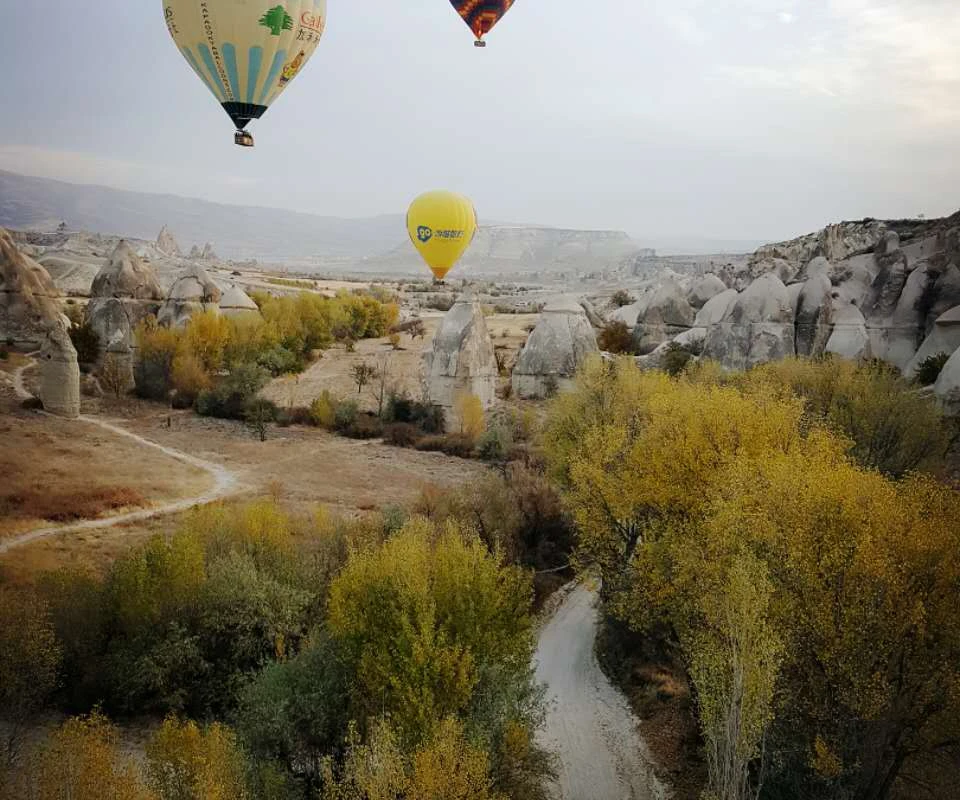
Before dawn, I rushed to the hot air balloon base in Cappadocia. This is probably the earliest I have woken up this year. Excitement and anticipation completely defeated my heavy sleepiness. At the camp, various pieces of cloth were spread out – oh, uninflated hot air balloons. They really didn't look as beautiful as they do floating in the sky. The same sight, but two different realities. With banging sounds and bursts of flames, the spherical shape emerged. People scrambled to climb into the baskets, waiting for "takeoff." Slowly, the hot air balloon rose. We couldn't see our own balloon; we could only enjoy the balloons floating around as scenery. Actually, we were also scenery in others' eyes.
I love this photo the most – full of autumn atmosphere.
The rich colors in my lens.
The URANOS SARIKAYA Cave Restaurant in Cappadocia, Turkey, is very famous. I was too busy marveling at the ingenious use of natural conditions to pay much attention to the food. There was no need to build houses; they just carved out the local rock, creating something naturally perfect. The decoration was grand, understated luxury, money-saving, and most importantly, environmentally friendly.
Pigeon Valley is located in Cappadocia, Turkey, a natural landscape. In this beautiful valley, there are large rocks everywhere, covered with dense pigeon holes. Why so many pigeons? It turns out that the cave dwellers of Cappadocia not only used pigeons for sending messages, but their droppings were also a source of agricultural fertilizer.
Before climbing up to the valley, I saw branches full of blue objects shaped like eyes. These are the Turkish people's favorite amulet and mascot – the "Evil Eye." It is said that if you are stared at by the evil eye, you will have bad luck. So they hang blue eye-shaped amulets on trees to attract the attention of the evil god and avoid bad luck.
Cappadocia (KAPADOKIYA)
Crazy jeep ride and Göreme sunset.
This road is simply a crazy roller coaster in Turkey – winding roads plus speed, really thrilling.
Couples waiting for the sunset have a sense of ceremony – outdoor chairs, snacks, red wine. At this moment, I just want a cup of hot tea.
The landscape of Cappadocia is actually the work of nature after a volcanic eruption 3 million years ago.
On the high ground, there are solitary photographers and couples leaning together. Happiness is simple at this moment!
October 29: Cappadocia (KAPADOKIYA) – Don't want to say goodbye...
On the way back from Cappadocia to Ankara, luckily I didn't miss you – Lake Tuz.
Lake Tuz is the second largest lake in Turkey, a salt lake.
I was deeply shocked by the scene before me, lost in the boundless white salt plain, a mirror of the sky without end.
In Turkey's winter, the salt of the lake has crystallized. In the distance, white clouds and the salt flats merge. It is not a unity of water and sky, but the salt melts the clouds, and the clouds dissolve the salt... A pure white world.
Because of fascination, I crave. Turkey, your myriad charms have made me fall in love with you! Saying goodbye to you, I will store you in my memory, I will miss you! Snapshots.
This is the Turkish beauty who accompanied us for 8 days. Finally, she gave me a tight hug, reluctant to part!
Still craving your charms – Blue Turkey. The same place, but with different people, so it's still a different journey!
Looking forward to the next stop, or the next time...
PS: Some photos have brighter colors. I edited them according to my preferences, matching Turkey's richness.