The Gate of the Ottoman Cannon – Topkapı Palace, Istanbul, Turkey
Flying from Hong Kong to Istanbul is very convenient, a ten-hour overnight flight. When you wake up, it's exactly early morning in Istanbul. The rental car is picked up within a ten-minute walk; the airport is not far, and it takes less than an hour to drive to the center of Istanbul's old city, where our hotel is located. The major attractions are all within walking distance, highly recommended.
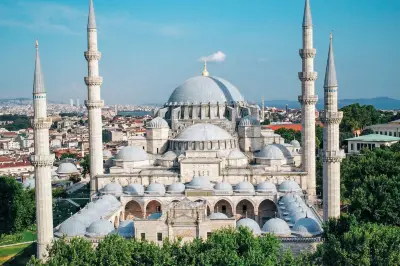
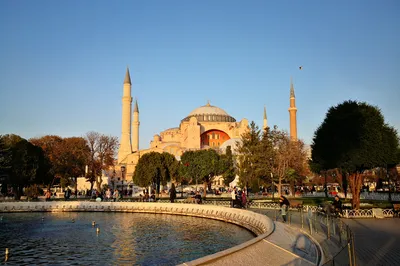
Istanbul, influenced by the culture, language, and religion of its rulers, has had old names such as Byzantium, Constantinople, and Konstantiniyye. Besides these, Istanbul was also called 'New Rome' or 'Second Rome' because Constantine the Great established this purely Christian capital of the Roman Empire on the Greek colony of Byzantium, to counterbalance the decadent and corrupt Roman city still full of pagans. Istanbul also has the name 'City of Seven Hills' because the old city was built by Constantine on seven hills, mirroring Rome's seven hills. Unfortunately, now on these seven hills stand mosques of diverse architectural styles—a hint at the strength of the Muslim world?
The old city is full of historical sites spanning over a thousand years, and among them, Topkapı Palace stands out. Topkapı Palace, also known as the Old Palace, is located at the northeastern corner of the old city, on Seraglio Point, surrounded by the sea on three sides. It sits on a hill, the highest point near the sea, overlooking the Golden Horn and the Bosphorus Strait, a strategically important location. When the Greeks first established the Byzantine city, they built an acropolis in this hilly area as a defensive fortress.
As a symbol of royal power, the palaces of once-flourishing dynasties left behind magnificent palace complexes. Among the so-called top ten palaces in the world, Topkapı Palace is one. From 1465 to 1853, it served as the official residence and main dwelling of the Ottoman sultans, as well as a venue for state ceremonies and royal entertainment. The name 'Topkapı' translates to 'Cannon Gate.' In the past, cannons were placed in the fortress, but they are now gone.
Today, Topkapı Palace is a museum. The palace is roughly rectangular, consisting of four main courtyards and the harem, with the main axis running from south to north, each courtyard with a gate. This layout has some similarities to the four-courtyard layout of Chinese traditional residences. The palace covers an area of 700,000 square meters, surrounded by a five-kilometer wall. The Imperial Gate is the outer gate, through which sultans entered the palace. The portico is an arched structure with two false doors on each side, identical in style but half the size of the main gate. The false doors do not lead anywhere, but visually expand the apparent area of the main gate.
Above the main gate is Islamic calligraphy in gold leaf, reading: 'This blessed palace was built with the consent and grace of Allah. The Sultan of the lands, the Khan of the seas, the shadow of Allah in both realms, protected by Allah, the hero of East and West, sea and land, the conqueror of Constantinople and the father of world conquest, Sultan Mehmed, may Allah make his reign eternal and raise his station above the brightest stars!'
There is a fixed trope here: the Ottoman sultans always considered themselves the shadow of Allah on earth—a clever expression. These words were left by Mehmed the Conqueror. As the conqueror of the Christian world, he indeed had the capital to look down upon the world. Below the inscription is a black-and-gold circular disk, which is the so-called tughra, meaning 'monogram.'
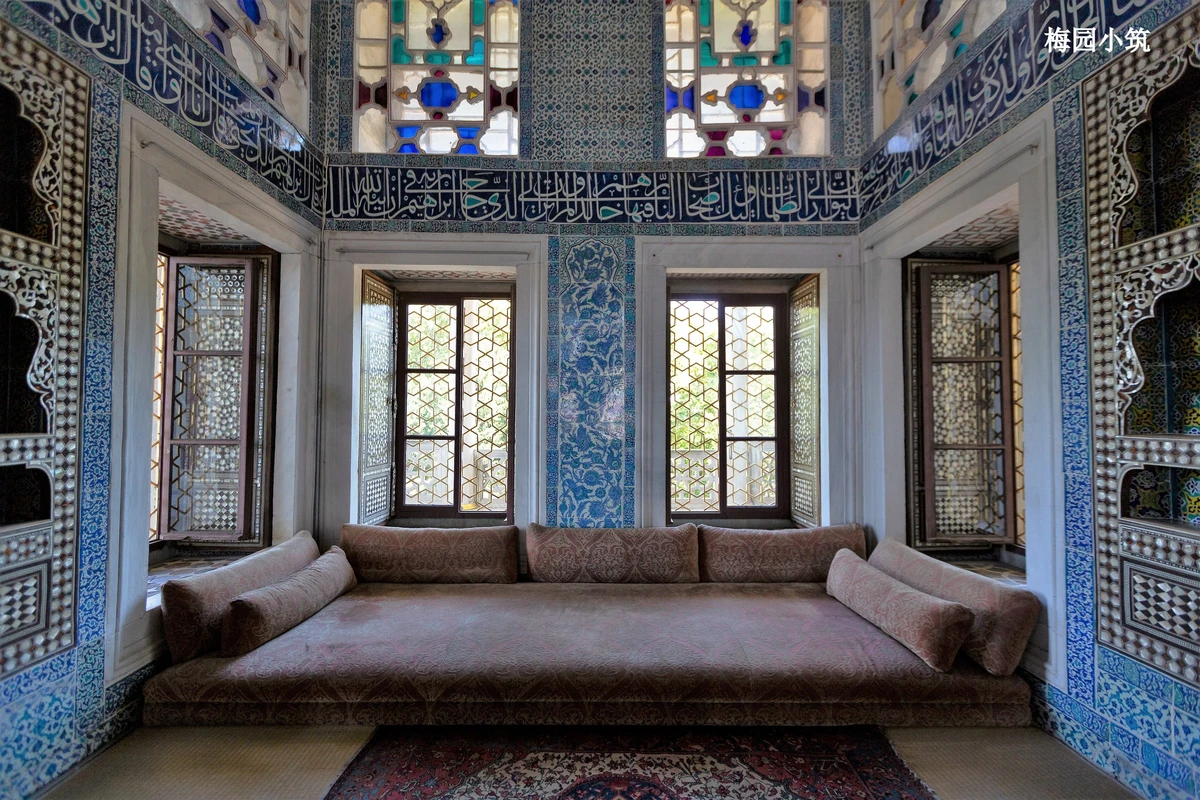
The decorative patterns in the palace follow three traditional Muslim types: first, floral and plant patterns, mainly with flowers, leaves, and columns, intertwining into countless designs. Each pattern has rules, emphasizes symmetry, and is orderly. Some flowers and leaves are exaggerated or distorted to form a unique style. Second, geometric patterns, including circles, ovals, diamonds, wave patterns, polygons, etc., used singly or in combination. Within geometric patterns, there are also floral designs, which are also very standardized. Third, decorative borders using Arabic script. This type of decoration is particularly charming, different from the regularity and symmetry of plant and geometric patterns. The curved strokes of the letters can be neatly arranged yet varied, giving a sense of movement. Thus, the decorative patterns of calligraphy are both masterpieces of Arabic calligraphy and excellent works of border art.
These exquisite patterns appear everywhere visible. The palace is filled with calligraphic border patterns and miniature paintings—the main text is admirable, and the decorative borders are equally beautiful. On ceramics, metal, and glassware, border patterns are also used; on Persian carpets, exquisite border patterns form the main theme of the carpet. The aesthetic sense of Muslim artists is most concentrated in border patterns.
It is said that during the lifetime of the Prophet Muhammad, a painter painted a portrait of the Prophet. The portrait was lifelike and vivid. The companions passed it around and kept it, unable to let it go. When the painting reached the Prophet, he was shocked and immediately ordered the portrait to be burned, saying, 'Depicting human figures is the work of the devil.' Later, the Prophet also said, 'The creators of images will be severely punished on the Day of Judgment.' Therefore, while medieval European artists extensively depicted figures from the Bible in religious art, Islamic art adhered strictly to the rules, with no paintings or sculptures of humans or animals. The interiors of the entire palace, composed of these patterns, are elegant and solemn, not ostentatious, with few ornaments, giving a spacious and grand feeling.
Although the palace is overall in Islamic style, one can still feel the influence of Byzantine architecture and architects. The Arabs were originally nomadic, with no architectural tradition. At the beginning of their conquest, they commissioned Byzantine and Syrian architects to build their palaces. Even after incorporating other cultural features such as Persian ones, the greatness of Byzantine architecture—especially solving the longstanding problem of Roman architecture: how to place a complete hemispherical dome on a square base—greatly benefited this palace complex. Semi-circular domes are everywhere.
This palace also encompasses the history of the Ottoman Empire from its glory to its decline. At the entrance, you can rent a Chinese audio guide and listen carefully to the introductions—what happened in which hall, which courtyard records a little-known historical event. After all, this Ottoman Empire, spanning six centuries, not only crossed three continents but also had ruthless and merciless sultans. In particular, the old king's method of selecting a successor was truly bloody and violent: after choosing a successor, he would kill all his other sons. And this was actually a law, enacted by Mehmed II, who ascended the throne at the age of 21.
Speaking of Mehmed II, he was a good sultan, accomplished in both civil and military affairs. It was he who conquered Constantinople, destroyed the Byzantine Empire, and conquered the Balkans and Asia Minor. Perhaps accustomed to conquest by force, he treated outsiders and his own family alike. After becoming sultan, he executed all his brothers, not even sparing the infant ones. At the same time, he explicitly stipulated in law that any prince who inherited the throne should kill all his brothers. That is, he legalized this cruel and cold-blooded practice. By the time of Selim I, the father of Suleiman the Magnificent, this practice reached a crazy level. The old sultan, through continuous observation, selected Suleiman as his heir. To ensure Suleiman's smooth succession, he personally killed his other twenty-odd sons, even including nephews and daughters. Of course, it must be said that Selim I's ruthlessness seemed to have a good effect: the Suleiman he selected achieved brilliant results in both civil and military affairs. He turned the Ottoman Empire into a vast empire spanning three continents, reaching its peak.
This bloody system of the Ottoman Empire actually produced many wise rulers over dozens of generations. Moreover, the Ottoman Empire lasted six hundred years in total, longer than any dynasty after Qin Shi Huang in ancient China. Perhaps it was precisely this cruel practice that made the Ottoman princes engage in fierce and bloody competition from childhood. 'If you don't work hard, you'll die'—that was the reality they faced every day when they opened their eyes. Pity for those born into royal families!
This brutal and bloody history inexplicably adds a chill to this magnificent palace. Among the carved beams and painted rafters of the palace halls, blood stains flow everywhere. Around the imperial power, it is a place more dangerous than the battlefield.