The Legacy of the Byzantine Empire – Hagia Sophia in Istanbul, Turkey
Napoleon once said that if the world were a single country, its capital would certainly be Istanbul. And Ottoman Sultan Mehmed II also said, 'I only want one thing, and that is Constantinople.' The charm of this city is evident. And at the heart of this city lies Hagia Sophia, which has stood for fourteen or fifteen centuries, witnessing glory, decline, conquest, prosperity, downfall, war, famine...
What a magical place it is! After leaving Topkapi Palace and having a luxurious lunch, we couldn't wait to come to this dreamlike colossal structure. The moment we stepped through its gates, it had been exactly 1,482 years since its completion. The building itself had transformed from a pagan temple to a church, then from a church to a mosque, and later into a museum. The vicissitudes of time and changing circumstances can perhaps only be glimpsed through the rusty iron gate at the entrance and the hollows worn into the stone pavement beside it, formed by countless footsteps.
The entrance to the church is now on the side. After walking through a long corridor, a vast hall suddenly appears before you. This is truly a museum spanning a thousand years. Beneath your feet lies marble that has endured a millennium; above your head is a dome that has survived a thousand years; everything your eyes meet is history. The floor is paved with polychrome marble, green-and-white porphyry with purple veins, and golden mosaics, forming a colorful shell over the brickwork. These coverings conceal the pillars and at the same time make the interior appear brighter by reflecting both indoor and outdoor light. All the columns inside the church are also made of marble with varying colors and patterns. The largest column is about 20 meters high, with a diameter of about 1.5 meters, made of granite and weighing over 70 tons. Emperor Justinian I ordered eight Corinthian columns from Baalbek in Lebanon to be dismantled and transported to Constantinople for the construction of Hagia Sophia. Since then, these columns have stood faithfully and silently in this magnificent church, staying put for a millennium.
Chandelier-shaped lamps hanging from the high ceiling occupy a vast amount of space. It is said that this was done to give people a sense of comfort in such a huge space. Perhaps those sitting on the ground praying might feel a little of that, but for us standing, the strongest feeling was oppression. The interior is still somewhat dim. Due to years of renovation, scaffolding is erected everywhere, stretching from the ground floor to the second floor and even higher, making it look a bit messy. Old buildings like this are always either under repair or undergoing major renovation.
This scaffolding somewhat blocks the most iconic view of Hagia Sophia in the distance—the image of the Virgin Mary holding Jesus on the apse, set against a golden background that complements the golden dome. But on the two walls connecting the apse and the nave hang large circular disks with Arabic calligraphy, black letters on a gold background, each 7.5 meters in diameter—about the height of four or five people combined. There are six such disks in the church, bearing the names of Allah, Muhammad, the four Rightly Guided Caliphs, and the grandson of Muhammad. This kind of decoration is probably unique. Even in a real mosque, such huge plaques resembling monograms are usually not seen. With the Virgin and Child high above at the apse and Islamic calligraphy shining below, two great religions are compressed into the same frame, coexisting for centuries.
It is said that during the reign of Justinian, the walls of Hagia Sophia were already covered with marble slabs, and the vaults were adorned with simple mosaic designs. On the spandrels of the pulpit, there were mosaics of the Archangels Gabriel and Michael. The spandrels of the galleries were decorated using an incised technique, with black marble as the background and precious white marble slices embedded to form floral and bird patterns. Later, figurative mosaics were added for decoration, but most of these were destroyed during the Iconoclastic period (8th–9th centuries, a movement in the Byzantine Empire that destroyed religious images). The existing mosaics are mostly from the post-Iconoclastic period.
The image of Christ in the central dome, the Orthodox saints, prophets, and church fathers below the drum, historical figures related to the church such as Ignatius, and some images of the four Evangelists in the galleries were all added in the late 9th century. These images are considered early works in mosaic history, and whether human figures or decorative paintings, they appear somewhat rough compared to the exquisite mosaic works in Italy and the Vatican. Yet they strangely match the weathered and aged Hagia Sophia.
From a dim, narrow gravel-paved passage on one side of the church, you can wind your way up to the two-tiered galleries that surround the interior on three sides. Originally rough stone, after a thousand years of trampling and rubbing, it has become polished enough to reflect light. On the second-floor gallery, you can see many exquisite Christian mosaic paintings. When the Ottomans converted the church into a mosque, they did not chisel away the original mosaic paintings on the walls but merely covered them with a layer of plaster, on which they painted Islamic decorative patterns. When the building was turned into a museum, some of the plaster was removed, revealing the original mosaics, which are now considered rare treasures.
The mosaic 'Christ and Empress Zoe' is one of the relatively well-preserved mosaic murals in the entire church. Empress Zoe, the most powerful empress of the Byzantine Empire, was married three times. It is said that the face of the husband in this mosaic was changed three times, and even the face of Christ was altered once. Since Empress Zoe's last husband, Constantine IX, outlived her, his image was preserved. Like other mosaic murals, the emperor holds a bag of gold, symbolizing offering all his wealth to Jesus, while the empress holds a scroll, symbolizing offering all her land to Jesus. The inscription above Constantine IX reads: 'Constantine, pious emperor of God Christ, Roman emperor, Monomachos.' The inscription above Empress Zoe reads: 'Zoe, the most pious Augusta.' The entire image is complete and devout, and after centuries, it still shines with a calm light under the lamps.
As a symbol of Byzantine architecture, Hagia Sophia can satisfy the needs of all kinds of visitors: history lovers can admire this isolated former pearl of Christendom, which witnessed the rise and fall of empires as a mosque and then as a museum displayed its depth and stillness; religious history enthusiasts can venerate the birthplace of Eastern Orthodoxy, marveling at the determination and steadfastness of the first Ecumenical Patriarch of Constantinople, Patriarch John Chrysostom; architecture aficionados can study the landmark creativity of Hagia Sophia in architectural history—it successfully combined a huge central dome with a square structure, laying the foundation for the paradigm of later Byzantine architecture. The innovative use of pendentives allowed a massive circular dome to rest on a square base, uniting heaven and earth. The Greek cross and the large dome became the external features of Byzantine architecture, while the pendentives formed its soul. This cathedral, built without a single nail, was assembled brick by brick. The Roman stone arch was extended by the Byzantines to the dome, and thus the history of human architecture has produced astonishing chapters crafted by artisans.
Having undergone changes of time and religious shifts, standing today under this still magnificent dome, in this hall that once soaked in blood, recalling its grandeur during construction and lamenting its unpredictable fate, is no less than a great fortune! A thousand years of history have left layer upon layer of marks on this massive architectural complex; cultural changes have enriched these accumulated layers even more.
As the center of Constantinople, Hagia Sophia held the title of the largest cathedral for a thousand years, until the completion of Seville Cathedral. The magnificence and exquisite decoration of the cathedral made Justinian exclaim, 'Solomon, I have outdone you!' Its solemn and sacred aura presents varied beauty when viewed from different angles. Being inside it, the soul becomes peaceful and serene.
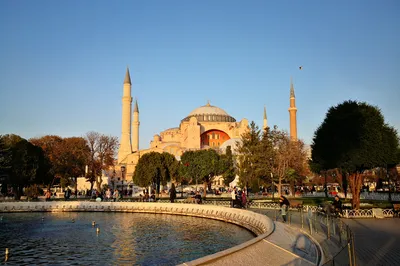
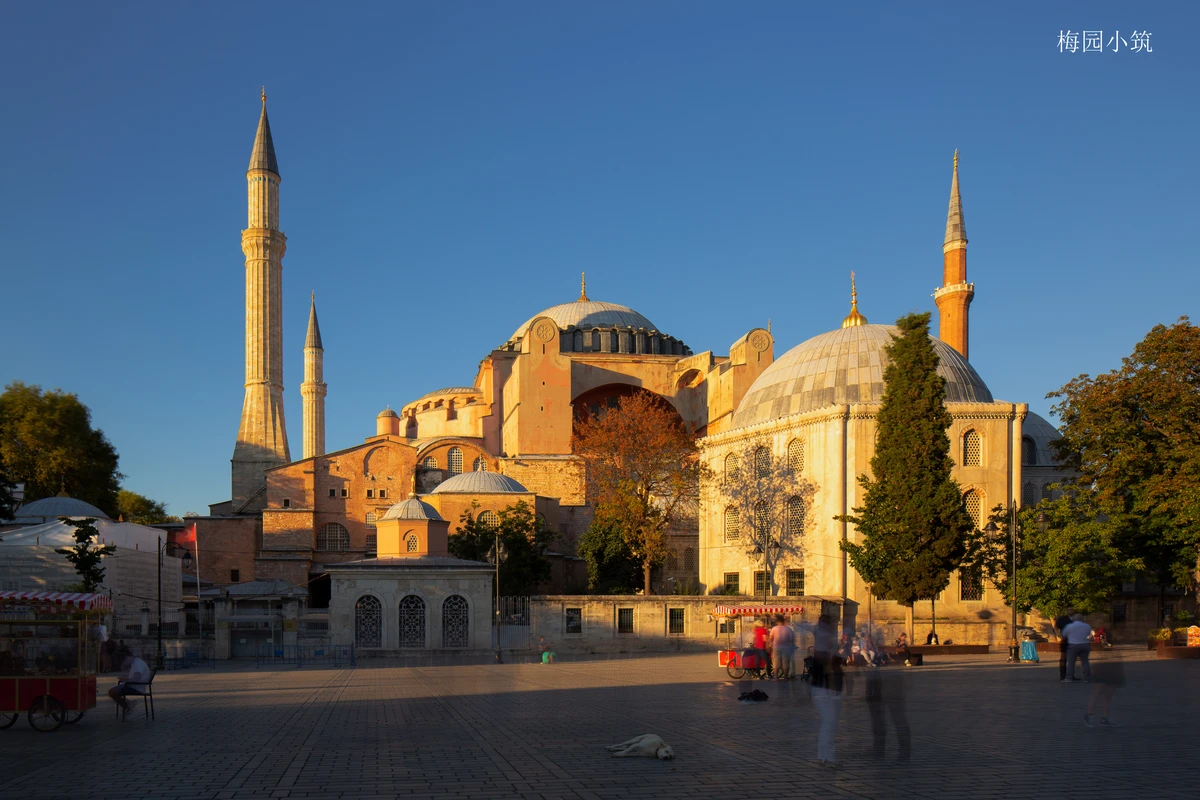
From another perspective, looking at Hagia Sophia from a distance, luxury and inclusiveness are hidden within its simplicity and heaviness, evoking awe in the face of this well-preserved masterpiece of human architecture. Tall minarets stand around, and the call to prayer echoes incessantly. The mixed architectural structure silently tells the story of the storms and changes this ancient city has experienced. For Istanbul, this is the ever-living soul of the city.