Medusa the Gorgon – Basilica Cistern, Istanbul, Turkey
One cannot help but admire the Romans' dedication to architecture. Every city founded by the Romans had a vast and sophisticated water supply system. The water sources were rivers, lakes, and springs around the city. Some sources were far away, so water was first stored in various reservoirs and ponds of different sizes around the city, then conveyed through aqueducts at different elevations into the city to meet its water needs. In addition to supplying essential domestic water, it also fed public baths and public fountains. Apart from regular channels, the aqueducts often employed siphons, tunnels, and stone bridges supported by arches. Naturally, there was also an indispensable urban water storage system, and the most awe-inspiring of them all is the Basilica Cistern in Istanbul.
My first encounter with the Basilica Cistern was through the 2016 film Inferno, adapted from Dan Brown's novel Inferno. The climax of Inferno takes place in the Basilica Cistern in Istanbul. At the most critical moment, the protagonist finally discovers that the virus has been placed next to the head statue of Medusa. The Black Death in 1348 spread from Constantinople (the then name of Istanbul) via Sicily, Venice, and Pisa to Florence, then throughout Italy, and finally across the whole of Europe. If the protagonist failed and the plague virus was successfully released, it could well trigger another Black Death pandemic, starting again from Istanbul. This is also the undercurrent of Dan Brown's novel.
In fact, within the underwater palace, there are only two head statues of Medusa: one placed upside down and the other on its side. Medusa is one of the most famous 'sorceresses' in Western mythology. Legend has it that because she was too beautiful, Athena cursed her, turning her hair into venomous snakes, and anyone who looked directly into her eyes would turn to stone. However, why the head of Medusa was placed under the columns of the underwater palace remains an unsolved mystery. Some say it was to ward off evil spirits from disturbing the environment. Others say it was simply because two columns were too short, and blocks carved with the head of Medusa were used as shims.
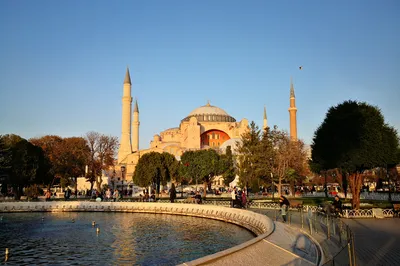
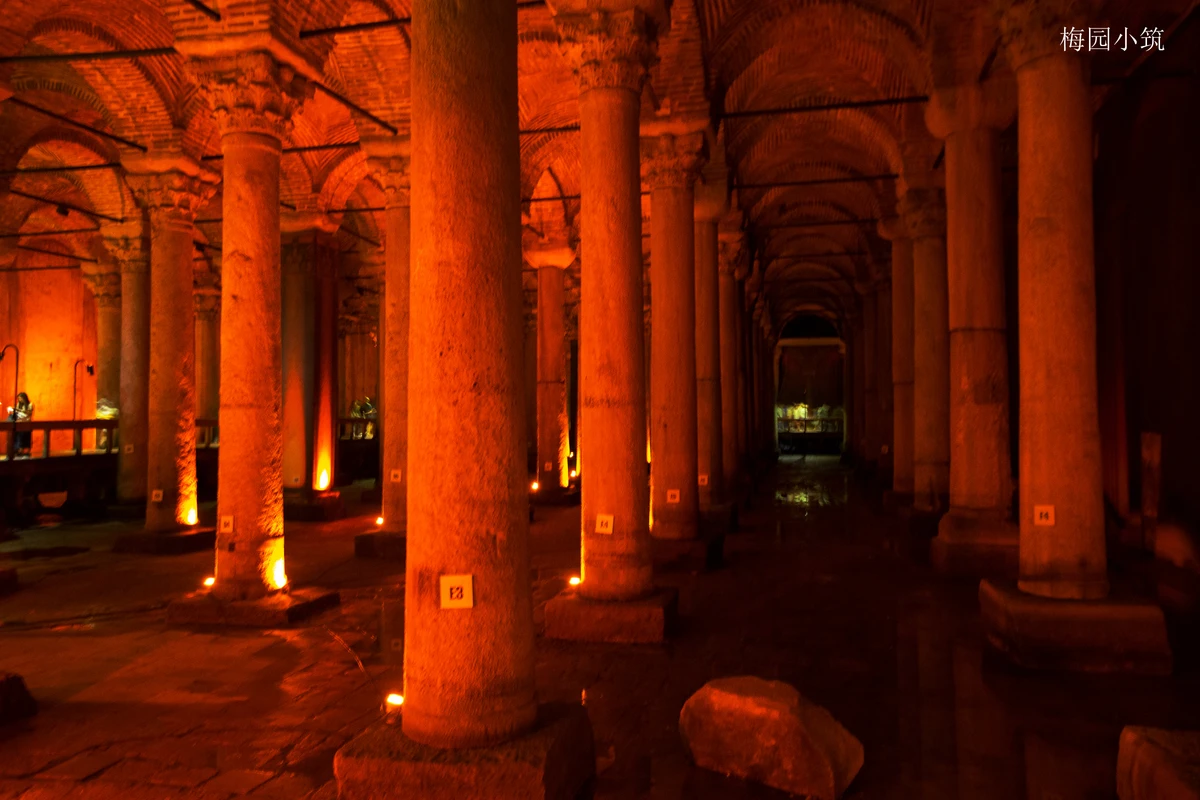
This is a magical and understated scenic spot. The entrance to the palace is near Hagia Sophia. Walking down the stairs from ground level feels like stepping into another world; the scorching heat is instantly taken away by the deep, spacious underground palace. The entire underwater palace measures 140 meters long and 70 meters wide, supported by 336 Corinthian columns 9 meters high. The roof is enormous, and it is said that the arched structures were brought from temples in the Antalya region. The columns are arranged in 12 rows and 28 columns, standing like towering trees in the vast hall, with exquisite patterns carved on each column. The surfaces of the columns also bear the marks of time and water erosion. The humid air and the warm reddish dim light emanating from the bases of the columns create an atmosphere of tranquility, remoteness, mystery, and haziness.
The interior of the cistern is very damp, coupled with dim lighting, giving it an overall mysterious aura. According to historical records, the Basilica Cistern was built in AD 542 by Emperor Justinian I, using 7,000 slaves on the ruins of a church, partly to ensure the palace's water supply and partly to prepare against enemy sieges. The cistern could hold up to 100,000 tons of water; if filled, it was said to provide drinking water for the entire city for a month. During the Ottoman Empire, the cistern fell into disuse until the mid-16th century, when a Dutchman accidentally discovered it, bringing it back to light.