Bathed in Divine Light – Süleymaniye Mosque in Istanbul, Turkey
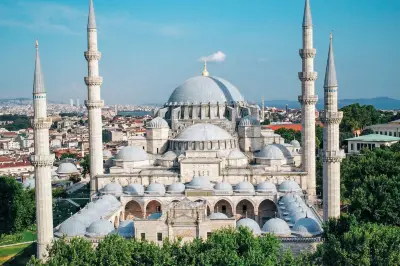
Although the Blue Mosque is widely renowned, many consider the Süleymaniye Mosque the most beautiful in Istanbul. Built under the reign of Suleiman the Magnificent, during the peak of the Ottoman Empire, it was designed and constructed by the famous architect Sinan between 1550 and 1557.
Mentioning the Süleymaniye Mosque inevitably brings to mind Suleiman I. As the tenth Sultan and the longest-reigning (1520–1566) of the Ottoman Empire, Suleiman I was called Suleiman the Magnificent by the West for his outstanding achievements. Under this extraordinary ruler, the Ottoman Empire reached its golden age in politics, economy, military, and culture. Suleiman the Magnificent personally led the Ottoman army to capture and conquer the Christian strongholds of Belgrade, Rhodes, and much of Hungary. The Ottoman expansion was only temporarily halted at the Siege of Vienna in 1529. Suleiman the Magnificent occupied most of the Middle East in wars with the Safavid dynasty of Persia (modern-day Iran) and incorporated much of North Africa, west to Algeria, into the Ottoman Empire. During his reign, the Ottoman fleet dominated the Mediterranean, Red Sea, and Persian Gulf, spanning across Eurasia. The Süleymaniye Mosque was begun in the thirtieth year of Suleiman the Magnificent's reign and completed seven years later.
From the old city square in Istanbul, one can walk to the Süleymaniye Mosque, weaving through streets and alleys. It takes only about twenty to thirty minutes at a leisurely pace to reach this renowned site. When the minarets of the Süleymaniye Mosque suddenly appear above the roofline, a small thrill arises. At noon, just after prayer time, only a few Muslims are washing their hands and feet at the fountain by the main gate. According to the Quran: 'O you who have believed, when you rise to [perform] prayer, wash your faces and your forearms to the elbows and wipe over your heads and wash your feet to the ankles.' Usually, even if not performing prayer, Muslims perform ablution (wudu) before entering a mosque as a sign of respect.
Mosques typically do not charge admission. The Süleymaniye Mosque consists of a square hall and front and rear courtyards, vast and magnificent. It is impossible to step back far enough to capture a full panoramic view. Entering the hall with the crowd, the central dome is supported by four piers, with its lateral thrust balanced by a series of smaller domes, semi-domes, and arches, continuing the structural system of the Byzantine era. A massive red-based carpet covers the entire floor. Many mosques seem to use red-based carpets; some say the red carpet symbolizes the earth. Is that true?
The interior decoration is solemn and ornate, yet elegant and dignified. As a witness to the heyday of the Ottoman Empire, the interior decoration fully reflects the aesthetics of that era. Large areas are left blank without intricate ornamentation, drawing focus instead to the exquisite dome and honeycomb-like vaults.
In the middle of the hall, an imam who looks like a scholar sits inside a railing, explaining scriptures. There is no seat; he simply stands casually. Dozens of Muslims and tourists sit cross-legged on the carpet listening to his lecture. It is the drowsy afternoon, so we also sit among the crowd, listening as he patiently answers questions from Muslims and tourists. His voice is low and gentle, quite hypnotic, yet clear and crisp. It is said that Sinan embedded 64 jars of 0.5 meters in diameter into the walls under the main dome, giving the entire building excellent acoustics. No matter which corner of the hall you are in, the imam's sermon is accurately transmitted.
The Süleymaniye Mosque appears austere, but it is actually said to represent the rebuilt City of a Thousand Columns, Iram, which is also a metaphor for paradise. The numerous columns of ordinary-looking granite, porphyry, and marble are said to have extraordinary origins. For instance, records state that 17 columns were brought from the Hippodrome of Constantinople. The difficulties encountered in transporting these heavy stone columns have left many legends, similar to those of the Hagia Sophia, naturally reflecting the immense material and financial power of the Ottoman Empire at its peak.
Hagia Sophia is considered an imitation of Solomon's Temple, and Suleiman used the same style when building his mosque: a large dome, two semi-domes, and two pediments. Like Hagia Sophia, Suleiman had priceless columns brought by ship from the Temple of Jupiter in Baalbek. Additionally, he brought columns from the conquered islands of Rhodes, Belgrade, and Malta. Each column brought from afar symbolizes the conquest of a different nation.
Under the pediments are two enormous rose granite columns; legend says they came from Alexandria and Baalbek respectively. Two other great columns came from the former Roman palace and the Hippodrome of Istanbul. These four columns also represent the four successors of Muhammad: Abu Bakr, Umar I, Uthman ibn Affan, and Ali ibn Abi Talib. The four minarets of the mosque similarly symbolize these four successors. Additionally, the four minarets signify that Suleiman was the fourth Sultan after the Ottoman conquest of Constantinople. The four minarets have a total of ten balconies, representing that Suleiman was the tenth Sultan since the founding of the Ottoman Empire.
The mosque is fond of using verses from the Quran as decoration. The calligraphy on the dome is taken from a Quranic verse: 'Allah holds the heavens and the earth, lest they cease; and if they should cease, no one can hold them after Him. Indeed, He is Forbearing and Forgiving.' The words radiate outward like sunlight, similar to the decorations in Ottoman tents. Although the dome does not have specific ritual requirements like the mihrab, it holds extremely important significance in the Ottoman Empire and among Muslims as a symbol of the firmament, bearing a resemblance to the ancient Chinese concept of 'round heaven and square earth.'
Stepping out of the hall back into the courtyard, the white marble buildings appear transcendent against the blue sky. The golden Quranic verses on the lintel shine brightly in the sun. No wonder this is called the most beautiful mosque in Istanbul. Unfortunately, the fountain in the front courtyard, which symbolizes the celestial river of paradise, has been locked inside a building.
The mosque was built on the third of Istanbul's seven hills, likely a deliberate choice by Suleiman the Magnificent. This special location makes the Süleymaniye Mosque especially dazzling and prominent on the city's skyline. One can also sit on the rear courtyard wall and overlook the flowing Golden Horn...