A 1600-Year-Old Capital of Two Empires: Where Eurasian Civilizations Meet - Travel Notes on Istanbul
From November 1 to 4, 2023, a group of six friends and I visited Turkey's largest city, the ancient capital of two empires (Byzantine/Eastern Roman and Ottoman) spanning nearly 1600 years. Our four-day trip exceeded expectations, prompting me to write this travelogue.
Let me state upfront: general introductions here are largely compiled from various websites, with many deletions. This is not academic research, so I won't cite sources individually. Personalized descriptions are my own.
Videos referenced are all taken by our group members. Photos are mostly our own. A few high-quality photos are taken from the internet, and they will be noted.
The city now known as Istanbul has been a human settlement for about three thousand years. Its earliest known name was Lygos, founded by Thracian tribes. In the 7th century BC, Greeks established a colony here. In 196 BC, it was conquered by the Roman Republic and called Byzantium until 330 AD, when it was renamed Constantinople and became the new capital of the Roman Empire. In late classical antiquity, it became the largest city in the Western world, peaking at nearly half a million people. Constantinople was the capital of the Eastern Roman (Byzantine) Empire, which adhered to Eastern Orthodox Christianity, until its fall in 1453, spanning 1113 years. Thereafter, Constantinople became the capital of the Ottoman Empire, a Muslim state, for another 480 years.
During the Middle Ages, the city's population declined, but under the Ottoman Empire it reached a historical peak. In the 16th century, the population grew to nearly 700,000, making it one of the most populous cities in the world. When the Republic of Turkey was founded in 1923, the capital moved from Constantinople to Ankara. In 1930, "Istanbul" became the sole official Turkish name, replacing the traditional name Constantinople. (Wikipedia)
We arranged a guide in Istanbul through a Chinese travel agency. To our surprise, our guide was a petite Turkish woman. She had studied Chinese in Beijing for three years and spoke Mandarin with 90% accuracy. She was very warm, outgoing, and attentive, satisfying us greatly.
Mina's in-laws are Uyghurs from Xinjiang who immigrated to Turkey. Unexpectedly, according to Mina, her father-in-law has a favorable view of China, saying that everything is made in China and that everything there is much better than here. I didn't ask why he immigrated to Turkey. Mina's husband is a second-generation immigrant, dealing in marble business, and is well-off. Due to business, he and his parents and children live in another city hundreds of kilometers from Istanbul. Mina is 39 and a mother of three, but she insists on having her own career—being a Chinese-speaking tour guide. So she is often on the road, with her in-laws taking care of the children.
Seeing her wearing a headscarf, we asked if it was mandatory in Turkey. She said no, describing Turkey as the most liberal Islamic country; except when entering mosques and a few similar places, women are not required to wear headscarves. She started wearing one only in recent years because, despite being 39, she looks young. Without it, she appears like a young girl and often gets harassed by young men. Wearing it makes her look more conservative and reduces harassment.
She is not conservative at all, always smiling and proactively taking photos with us. Sometimes after taking our photos, she would turn around for a selfie with us. As shown below:
Leaving the dock, our first destination was to cross the bridge called the Martyrs' Bridge or July 15 Bridge, a sea-crossing bridge, to the opposite shore, the highest point of Istanbul's Asian side, Camlica Hill, also known as Love Hill because many couples come here to express their love.
Our guide told us that this famous sea-crossing bridge got its name because on July 15, 1979, a bloody protest occurred on this bridge.
Camlica Hill is the best place to enjoy a panoramic view of Istanbul. It is about 260 km from the March 15 Martyrs Bridge. It is a lovely leisure spot where you can relax and enjoy the stunning views of Istanbul and the Bosphorus from the hill.
At a café on the hilltop, we each had a glass of local black tea, getting our first taste of local prices. Six customers plus guide and driver, eight delicate glasses of black tea, total 155 Turkish lira. Remember, one euro roughly equals 30 lira. Those eight glasses cost about €5.2 or $5.6. One glass costs about €0.63 or $0.70. Such standard Turkish black tea can be found everywhere in Istanbul, with the same cup, color, and taste.
Our second sightseeing item that day was:
Camlica Mosque
This is a huge and brand-new structure, immensely large. We felt that centuries from now, it would become a great monument like the old mosques on the opposite shore.
Completed only in May 2019, it is currently the largest mosque in Turkey, making it a fourth must-visit mosque alongside Sultan Ahmet Camii, Hagia Sophia Camii, and Süleymaniye Camii. The mosque covers 57,500 square meters, with a total area of about 350,000 square meters, and can accommodate 60,000 worshippers simultaneously.
Designed by two female architects, Bahar Mızrak and Hayriye Gül Totu, it is specifically designated as a "women-friendly mosque," with women-only prayer spaces and childcare facilities. The design style blends Ottoman and Seljuk architecture. The main dome is 72 meters high, symbolizing the 72 districts of Istanbul. Six minarets, representing the six pillars of Islamic faith, are 107.1 meters high, honoring the 1071 Battle of Manzikert between the Seljuk and Byzantine Empires. Its main door weighs 6 tons, is 6.5 meters high and 5 meters wide, making it one of the largest doors in the world.
This mosque is Turkey's most modern complex. Besides being a magnificent place of worship, the complex includes eight art studios, a 3,500-square-meter art gallery, a 3,000-square-meter library, a conference hall seating 1,071, and an indoor parking lot for 3,500 cars. It also includes a newly opened Islamic Civilization Museum.
Every large mosque we saw here had a very similar structure. Two cubes form a rectangle where the long side is roughly twice the short side. One half is a domed square hall, the other half a square courtyard. In the middle or side of the courtyard are large faucets and channels for worshippers to purify themselves. The hall is always spacious, without any chairs. Worshippers can stand, sit, or kneel on the always clean carpets for prayer. Before entering the inner courtyard, everyone must remove their shoes. Women must also cover their heads. If they don't have one, they can borrow for free. Women's prayer area is separate from men's, usually at the back or upper floor. At the four corners of the courtyard or hall are minarets; if there are six, they are at the four corners and the midpoints of the long sides. Our guide told us that only two mosques in Istanbul have six minarets; most others have four. Smaller mosques have only two, at the front corners. Minarets are as striking as the dome, the most important and beautiful part of the mosque. In ancient times, they were used for the muezzin to call for prayer five times a day. Now with loudspeakers, they have lost their practical function, surviving as spectacular decorations from tradition.
Compared to later mosques, this first large mosque had relatively simple interior decoration, likely requiring more historical accumulation. Since its debut in 2019, it has received 25 million visitors. The project was prepared and completed in 60 months, attracting more attention than expected.
This aerial photo is of course taken from the internet. It shows the basic structure of a large mosque with a front courtyard and rear garden, and the standard positions of six minarets.
This is the interior. All have a large dome with an empty space below. As you will see, the interior structures of other large mosques introduced below are very similar; they can only be distinguished by specific decorations (e.g., paintings, calligraphy, colors, hanging lamps).
This is the ablution area in the middle of the front courtyard, essential for every mosque. Worshippers must clean their hands, feet, and face before entering for prayer. Here is a video of the interior we recorded. Click the arrow at the bottom left to play.
We then visited the adjacent:
Camlica Islamic Civilization Museum
We found this museum very modern, with contemporary layout, many dynamic electronic projections, and three-dimensional models. Overall, it is more modern and advanced than most Western historical museums. And it is free!
Naturally, this museum was established later than the mosque it belongs to, opening only in May 2022. Located in the basement of the magnificent Camlica Mosque, it is a must-see gem. Covering 10,000 square meters, it comprises collections from Topkapı Palace and Palace Collection Museum, Istanbul Turkish and Islamic Arts Museum, Archaeological Museum, Istanbul Mausoleum Museum, and Foundation Museum.
The two photos above and below show some of the collections here.
The decor is ultra-modern! Unfortunately, the exhibits are not yet abundant, with plenty of empty space. Again, it needs historical accumulation.
For example, the dome projection below, though we couldn't fully grasp its meaning, deeply moved us with its brilliance.
This giant screen presents a brief history of the Ottoman Empire. It is quite long; we recorded only a short segment, but you can see its vibrancy and ultra-modernity.
The scene above also shocked me. There were several women with disabilities in electric wheelchairs carefully viewing the museum. I haven't seen such a dense concentration in Western museums. They come here for cultural enrichment, needing both material and spiritual fulfillment. This is a prosperity only seen in an era of peace and abundance—rarer than the pigeons that fly to tourists' hands in the square.
The New Palace (Dolmabahçe Palace). To describe it in one word: extremely luxurious.
Dolmabahçe Palace was built after Sultan Abdülmecid I, the 31st sultan of the Ottoman Empire, ascended the throne in 1839. The last six sultans and the Islamic leader Abdülmecid lived in this palace. After the founding of the Republic of Turkey, President Atatürk resided and worked here. After his death, it was restored and converted into a museum.
Though not as large as many European palaces, its luxury is astonishing. Due to few wars, it has been well-preserved for over 150 years. All items inside are genuine, even door handles, curtains, and carpets from that era. In the sultan's bedroom, sandalwood floors are covered with large carpets in various colors and patterns; the ceilings were elaborately painted by famous French and Italian painters hired at great expense; the walls are inlaid with sparkling crystal and cream-colored marble slabs, hung with oil paintings and sultan portraits. Doors and windows are gilded, engraved with lifelike animal and flower reliefs. The rooms display Chinese porcelain, Czech crystal, French fireplaces, Indian ivory, and gifts from various countries—such as a musical clock from Queen Victoria, a polar bear rug from Tsar Nicholas I, and a large porcelain vase from Wilhelm I—each a rare treasure, exquisitely luxurious, leaving one speechless with amazement. You can only stare greedily, feel intensely, and touch the legend behind the opulent world. Additionally, the marble bathroom of Dolmabahçe is a world wonder. Its diamond-shaped ceiling is entirely covered with gold leaf; a huge crystal chandelier hangs in the center; the floor is covered with gray Marmara marble; the door ring is made of crystal, engraved with Abdülmecid's monogram. The bathroom has one large and two small bathtubs, with silver faucets. Outside the bathroom stand statues shipped from Egypt, with the artist's name and date carved on the pedestal. For lighting and ventilation, all bathroom windows face the sea. In Dolmabahçe Palace, you can see glamorous shadows of the Louvre, Buckingham Palace, and Baroque royal palaces, but compared to these internationally famous palaces, Dolmabahçe has more innovative highlights. The palace is large: from the sea, the left is the Selamlık, the center is the Ceremonial Hall, and the right is the Harem.
The construction of the New Palace satisfied the sultan's desires and vanity but brought heavy debt. Six sultans lived here, and within less than 70 years, the Ottoman Empire collapsed. Every dynasty before its fall has a magnificent chapter; Dolmabahçe was the final glory of the Ottoman Empire.
This is the main gate.
This is the first view inside the gate: the front garden.
The right side of the palace faces the sea—a rare view for a palace.
This is a group photo of our six members in front of the New Palace.
Interior photography is not allowed, so I can only find some online. (All photos in this section are from the internet, not individually noted.) In short, its luxury can definitely rival the French Versailles. Some rooms even surpass it.
Does Versailles have such a grand hall?
What other palace in the world has such a large chandelier?
This is the famous crystal staircase in the palace. All balusters, upstairs and downstairs, are made of crystal. Such luxury, Louis XIV probably didn't have either.
Dinner on the first day was a highlight. Many restaurants are on rooftops to overlook the beautiful surroundings. Unfortunately, Ctrip does not allow direct advertising, so I cannot write their names and addresses.
Look at the first two photos below—couldn't they be on calendars? We actually took them!
This is the famous Blue Mosque!
Radiant!
To prove we took them, here are these two.
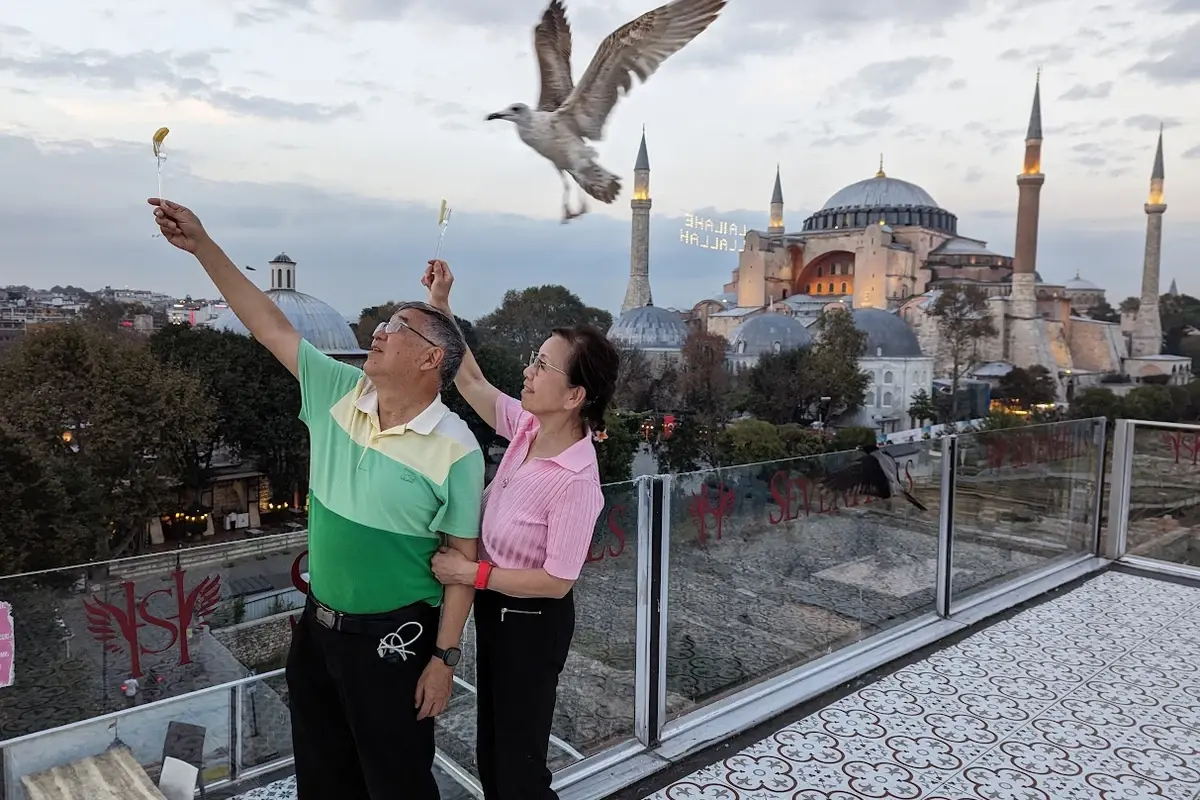
While traveling in Europe, you often see pigeons landing on tourists' hands for food in cathedral squares. This is a rare scene of prosperity. For example, even after 40 years of prosperity in China, have you seen such a scene anywhere in the country?
On the rooftop of this Istanbul restaurant, the birds that fly to your hands for food are not pigeons but seagulls! The restaurant provides bait for you to feed them.
The background is Hagia Sophia Cathedral/Museum/Mosque.
This is the floor below the restaurant where we fed the seagulls. We dined with our guide. It seems to be the custom for private groups here.
As for the food, it was unremarkable.
The Blue Mosque is the work of Mehmet Aga, a proud disciple of Sinan, the greatest architect in the Islamic world, and one of Istanbul's most important buildings. Built in 1609, the mosque's walls are entirely decorated with blue and white İznik tiles. The huge dome is surrounded by six minarets; the Blue Mosque is one of the world's top ten wonders. It was built without a single nail and has survived several earthquakes. 260 small windows, over 20,000 blue tiles, carpets, and Arabic calligraphy are key attractions.
The Blue Mosque is a common name derived from the brilliance of its blue İznik tiles; its real name is Sultanahmet Camii, and it can be considered the center of Istanbul's old city.
Its main dome has a diameter of 27.5 meters, with four smaller domes, creating a pleasing effect. The indispensable minarets are 43 meters high, and there are two more than usual—it is said that only the mosque in Mecca, the holy city of Islam, can have six minarets. During construction, the architect heard the sultan's command for "golden" (altın) minarets, but "altın" sounds like "altı" (six), so the Blue Mosque ended up with six.
Such photos are of course from the internet. Only with favorable conditions can one capture such images.
These two interior photos of the Blue Mosque are also from the internet. Our own didn't reach this quality.
Hagia Sophia Cathedral/Museum/Mosque
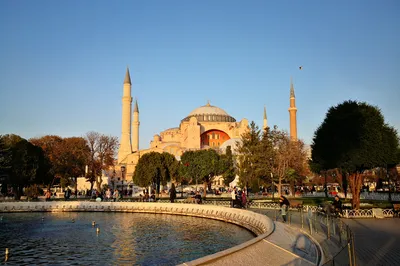
Hagia Sophia, the main cathedral of the Byzantine Empire, is famous worldwide for its huge dome. It represents Byzantine architecture, is the central church of Eastern Orthodoxy, and a monument to the peak of the Byzantine Empire.
Hagia Sophia is a centralized structure: 77.0 meters east-west, 71.0 meters north-south, and 54.8 meters high. It was the third church built by order of Byzantine Emperor Justinian I in 532 AD. With the strong support of Byzantine resources, it was designed by physicist Isidore of Miletus and mathematician Anthemius of Tralles, completed in 537 AD. After 1453, it was occupied by the Turks, who added four minarets and converted it into a mosque. In 1935, it became a museum; in 1985, a UNESCO World Heritage site. On July 2, 2020, President Recep Tayyip Erdoğan revoked the 1934 decree of state founder Atatürk that turned it into a museum, restoring its role as a place of worship. The building has a history of nearly 1500 years.
This colorful photo is taken from the internet.
Women followed local customs, wearing headscarves and sitting for a group photo. One lady couldn't sit down, so she stood—no disrespect intended.
Islam prohibits the worship of icons. It is a rare exception that three human figures here are not covered.
Mosque decoration is grand but lacking in detail. The walls have patterns but no figures; there is little to explain in depth.
This is another group photo of our six members, taken between the two famous mosques.
Between these two most renowned mosques, there is a less towering but crowded building:
The collective mausoleum of Ottoman Sultan Ahmed I and his close relatives.
This mausoleum is the largest, but the sultan (Ahmed I, 1590–1617) did not have a distinguished reign. However, the Blue Mosque was built during his time, so it is also called Sultanahmet Mosque.
This is the dome of the collective tomb. Not too luxurious. Still only patterns, no human figures. Such a rule is unfavorable to artistic development.
The Old Palace, Topkapı Palace
Topkapı Palace was the sultan's official residence and main dwelling in the city from 1465 to 1853. It was a venue for state ceremonies and royal entertainment, now a major tourist attraction. The name "Topkapı" means "Cannon Gate," as cannons were once placed in the fortress.
Sultan Mehmed II, who conquered Constantinople, ordered its construction in 1459. The palace consists of four courtyards and other low buildings; about 4,000 people once lived there. It originally covered a large coastal area. Over centuries, it was expanded and renovated, including after an earthquake in 1509 and a fire in 1665.
Topkapı's importance declined in the 17th century as sultans preferred new palaces near the Bosphorus. In 1853, Sultan Abdülmecid I moved the court to the newly built Dolmabahçe Palace. Topkapı's imperial treasury, library, mosque, and mint were kept.
The Ottoman Empire fell in 1921. On April 3, 1924, Topkapı was turned into a museum of the imperial era under government decree, now under the Ministry of Culture and Tourism. The palace has many rooms and halls, but only the most important parts are open to the public, guarded by ministry staff and armed Turkish military personnel. Topkapı is a masterpiece of Ottoman architecture, containing vast collections of porcelain, court robes, weapons, shields, armor, Ottoman miniatures, Islamic calligraphy manuscripts, murals, and Ottoman jewel treasures.
Topkapı, together with other nearby historical sites, is part of the "Historic Areas of Istanbul," a UNESCO World Heritage site since 1985, described as "the best example of Ottoman imperial palace architecture."
This palace is several centuries older than the New Palace, so its architecture is far less modern. However, its collections are no less impressive and sometimes even surpass. For instance, it houses relics of the Prophet Muhammad. For Islam, these are as precious as relics of the Buddha or Jesus Christ. I asked the guide why these relics are not kept in Mecca. She told me that Muhammad left many relics, and the Islamic world deliberately shares them, as his era is much later than Christ and Buddha, making preservation easier.
Photography is allowed in this palace, but without flash. Modern cameras have high sensitivity, allowing clear photos even at night or in dim rooms without flash.
The courtyards are simpler than the New Palace, and the buildings are plainer. But the indoor collections seem richer than the New Palace.
The most precious are the genuine relics of the Prophet Muhammad, founder of Islam.
I asked the guide why these relics aren't kept in Mecca. She said that since his time is not too distant, there are many relics, and major Islamic countries each keep some for public veneration.
This is the footprint of the Prophet.
This is the inscription on the footprint.
This metal arm is also said to be a relic of the Prophet. It's unclear why he would need a prosthetic arm.
The gold ornaments here seem the most luxurious, but compared to the opulence of the New Palace, they are an order of magnitude less.
Here, we heard the muezzin chanting for the first time (click the video to hear). His voice was quite good. Now he doesn't need to climb the minaret, exposed to wind and rain. Technological progress benefits religious practice!
Unlike the New Palace, which is right by the sea, the Old Palace sits on a small hill, but still offers sea views.
The Basilica Cistern (Turkish: Yerebatan Sarayı (Sunken Palace) / Yerebatan Sarnıcı (Sunken Cistern)) is located in the Sultanahmet district of present-day Istanbul (formerly Constantinople), south of Hagia Sophia. This ancient underground cistern has 336 marble columns and is one of the largest ground-level reservoirs. It was built by Byzantine Emperor Justinian I between 527-565 AD as a water source for the city's residents.
During the Byzantine period, the cistern was built beneath the Stoa Basilica, a large square on the First Hill of Istanbul. Before becoming a cistern, the site housed a church that served as a commercial, legal, and artistic center in the early Roman period (3rd-4th centuries). After a fire in 476 AD, a palace was rebuilt there.
Ancient sources indicate the palace had gardens and was surrounded by colonnades, facing Hagia Sophia. Historians suggest the cistern was initially built by Constantine the Great and later rebuilt and expanded by Justinian after the Nika riots of 532. Records say 7,000 slaves participated in its construction. The expanded cistern provided a filtered water system for Constantinople and other buildings on the First Hill, and continued to supply Topkapı Palace after the Ottoman conquest in 1453.
The cistern is 140 meters long, 70 meters wide, covering 9,800 square meters, with a capacity of 100,000 tons of water. The water was pumped to the surface and distributed via about 20 km of aqueducts. There are 52 stone steps down. The roof is supported by 336 columns arranged in 12 rows of 28, each 9 meters high and spaced 4.8 meters apart, with arches distributing weight. The columns were collected from older buildings, carved from various marbles. Important columns have different carvings: 98 are Corinthian style, others Doric. The walls are 4.8-meter-thick fireproof brick, and the floor is coated with waterproof mortar. The vast tank now holds only a few inches of water.
The cistern has undergone several restorations. Two during the Ottoman period: one in 1723 under Sultan Ahmed III by architect Mehmet Aga from Kayseri; the second in the 19th century under Sultan Abdulhamid II. In the Republican era, it was renovated from 1985-1987, with 50,000 tons of sand used to fill walkways and platforms, and opened to local and foreign visitors. In May 1994, it was cleaned and renovated again.
There are several strange human sculptures here. The guide explained they commemorate the builders who died constructing the cistern.
Wheelchair service is available, with a dedicated elevator. One can push themselves.
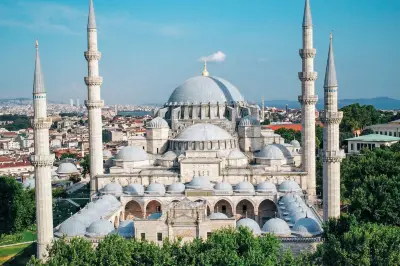
Süleymaniye Mosque (Turkish: Süleymaniye Camii) is one of several large mosques in Istanbul. It was commissioned by Suleiman the Magnificent and built between 1550 and 1557 in a very short time, the masterpiece of architect Mimar Sinan. The grand complex, including the mosque, has both urban and national significance, comparable to the Fatih Mosque.
The entire külliye complex was built on the steep Third Hill, using ingenious architectural solutions to integrate the hill with surrounding streets. For instance, the third and fourth madrasas, completed in 1558 and 1559, descend in terraces toward the Golden Horn, a marvel of architectural history. Inside the mosque, red İznik tiles were used for the first time.
This was the fourth large mosque we visited.
We experienced some aesthetic fatigue. These four large mosques are very similar in form: a large square courtyard in front, a round hall behind, with empty interiors.
The Grand Bazaar (Turkish: Kapalıçarşı) is one of the largest and oldest covered bazaars in the world, with at least 58 indoor streets and over 4,000 shops, attracting 250,000 to 400,000 visitors daily.
It was originally commissioned by Sultan Mehmed II, built between 1455 and 1461, and is famous for jewelry, ceramics, spices, and carpets. Many stalls are grouped by product, such as leather jackets and gold jewelry. The bazaar contains two bedestens (vaulted brick buildings used for storage and safe keeping). It was greatly expanded under Sultan Suleiman I in the 16th century and rebuilt after a major earthquake in 1894. The bazaar comprises 12 main buildings and has 22 gates.
The core of the bazaar is indoors, protected from weather. Large passageways are lined with small shops, very traditional in style.
The four main gates are at the ends of two main streets that cross near the southwestern corner. One street connects Bayezid II Mosque, Bayezid Square, and Nuruosmaniye Mosque.
This is a souvenir I bought from a gift shop in the bazaar—a traditional handmade teapot. Very delicate, isn't it? About 30 cm high, priced at 60 euros—not too expensive, I think.
Private VIP Small Yacht Tour
This VIP private yacht tour is worth it. However, it costs $300 for 2 hours, with capacity limited to the yacht's size (probably no more than 10 people). Large yachts are $10-30 per person, varying in luxury and service.
Day four was less impressive than the first three. It felt like filling in the gaps.
Istiklal Avenue (Turkish: İstiklal Caddesi) is the most famous street in Istanbul, located in the historic Beyoğlu district, on the eastern shore of the Bosphorus, a commercial center since medieval times.
On October 29, 1923, to commemorate the victory of the Turkish War of Independence, the republic's government renamed the street Istiklal (Independence) Avenue. It is about three to four kilometers long, starting from the Genoese neighborhood near Galata Tower and ending at Taksim Square.
This area has historically been important politically, culturally, economically, and socially, and remains one of Istanbul's most iconic locations.
At the entrance of Istiklal Avenue, there is a mosque with only two minarets—considered small.
Look at the prices: remember, 1 euro ≈ 30 Turkish lira. This Turkish sandwich with a pack of fries and a Turkish drink costs about 4 to 5.5 euros—roughly half the price in France. Turkish income is also about half of France's.
Both sides of Istiklal Avenue are lined with various shops, bookstores, art galleries, cinemas, theaters, libraries, cafes, bars, pastry shops, dessert shops, and restaurants—a dazzling array. They attract not only locals but also foreign tourists visiting Istanbul, and are a popular meeting place for younger generations.
There are many shops here that are more modern than those in the Grand Bazaar. For example, this dessert shop: the quality, packaging, and business style are first-rate even by developed country standards.
Colorful trams frequently pass along the street, the most beautiful sight on Istiklal Avenue and a popular check-in spot. Tourists queue to take photos with the tram. The red tram shuttles by, refreshing. Riding it is even more enjoyable.
Watch how vendors here turn ice cream selling into a performance.
You can also sample famous Turkish ice cream. The seller uses a long pole to dangle the ice cream in front of customers, then swiftly retracts it when they reach for it, teasing them repeatedly. The ice cream stays firmly attached to the pole, very amusing.
Our guide told us that Turkey is a religiously tolerant country. On Istiklal Avenue, there are also two beautiful Christian churches, bustling with visitors.
Istanbul's Most Prestigious Cemetery
This is the most prestigious cemetery in Istanbul, nestled against a hill with water and sunlight. It follows the simple burial style of Muslims, with limited space. The guide told me that they bury the dead without any burial objects or coffins; they simply wrap the body in white cloth and bury it directly. The graves are family tombs, containing more than one person. However, they do not cremate. The bodies are interred whole, so the graves cannot be too small.
One of our group members saw these two young Turkish women and suggested taking a photo of them. They were clearly happy and posed immediately. I think Chinese girls, whether at home or abroad, are not as easygoing.
Galata Tower (Turkish: Galata Kulesi), called Christea Turris (Christ Tower) by the medieval Genoese, is a medieval stone tower in the Galata district of Istanbul, just north of the Golden Horn. It is one of the city's most striking landmarks, dominating the skyline.
The tower is 9 stories, 66.9 meters high, and was the city's tallest building when built. Its ground elevation is 35 meters above sea level. Base diameter is 16.45 meters, internal diameter 8.95 meters, and wall thickness 3.75 meters.
On the upper floors are a restaurant and cafe offering spectacular views of Istanbul and the Bosphorus. There is also a nightclub with Turkish shows. The tower now has two passenger elevators.
Due to time constraints, we did not climb the tower, which was a regret of this trip.
This photo is from the internet.
The guide was right: Turkey is indeed the most open Islamic country. On the streets, women wore headscarves only occasionally, like our guide. People walked arm in arm, just like in Western countries. Of course, this is a major tourist area with many foreigners.
This lighthouse is called Galata Tower, said to have been built by a Byzantine emperor 1500 years ago as a lighthouse, originally made of wood, then burned during the Crusades, and rebuilt in stone by the Genoese in 1348.
This ancient tower has served many purposes over the centuries: watchtower, prison, observatory. From Galata Tower, you can overlook all of Istanbul, taking in every vista.
Istanbul New Airport
Istanbul Airport officially opened on October 29, 2018. Phase 1 has an annual passenger capacity of 90 million, and upon full completion, total capacity will reach 200 million. It offers flights to over 350 destinations and is considered a new aviation hub. It promises the highest level of passenger comfort.
Considered a "national project" for Turkey, although slightly delayed, the new airport is seen as a huge success by Turks.
Many Turks believe it will become the world's largest airport, strengthening Istanbul's competitiveness as an aviation hub between Europe and Asia.
The investment exceeded $11 billion. Phase 1 meets 90 million passengers annually; by 2028, when fully complete, it will handle 150 million, with potential to expand to 200 million.
For comparison, the world's current busiest airport, Atlanta Hartsfield-Jackson, handles only 107 million passengers annually.
Given such planned capacity, the scale of Istanbul Airport is naturally massive.
The already operational terminal building covers 1.44 million square meters, making it the world's largest single terminal.
To meet its goal of being the world's number one airport, by 2027, it may have 4 terminals, at least 6 runways, and 16 taxiways.
In the future, only Dubai's new airport and Beijing Daxing International Airport can compare.
A major impression: the peace and safety. In four days, we saw no security incidents. No theft, no robbery, no street quarrels. Everyone was polite and law-abiding. We didn't see a single beggar or homeless tents along the streets. Society is truly orderly. The street prosperity and richness are not yet up to Western developed countries, but among non-Western nations, it is first-rate. Occasionally, you see a few rundown buildings, but that exists in the West as well.
I have visited two Muslim countries: Jordan and Turkey. The people are kind and well-behaved. Unlike in France, where we live, there are no hooligans here. It reminds me of the famous story from ancient Chinese text, "Yanzi's Mission to Chu":
Yanzi arrived, and the King of Chu gave him wine. When merry, two officials brought a bound man to the king. The king asked, "What did this man do?" They replied, "He's a man of Qi, guilty of theft." The king looked at Yanzi and said, "Are men of Qi naturally inclined to steal?" Yanzi left his seat and replied, "I have heard that oranges grown south of the Huai River are sweet oranges, but when grown north of it, they become bitter trifoliate oranges. The leaves are similar, but the taste different. Why? Because the soil and water differ. Now, this man lived in Qi without stealing, but when he came to Chu, he stole. Could it be that the soil and water of Chu make people prone to theft?"
In conclusion, let me rank the must-see attractions:
1. New Palace (Dolmabahçe) – Extremely luxurious.
2. Hagia Sophia Cathedral/Museum/Mosque – Elegant and historic.
3. Blue Mosque – Elegant and dignified, the epitome of Istanbul's mosques.
4. Old Palace (Topkapı) – Collections rich in history.
5. Basilica Cistern – Ancient, grand engineering.
6. Istiklal Avenue – Perfect blend of classic and modern, East and West.
7. Bosphorus Strait Cruise.
8. Grand Bazaar – Vibrant.
9. Süleymaniye Mosque.
10. Camlica Mosque and its Islamic Civilization Museum.
Travelogue Contents: 1. Brief history of Istanbul. 2. Our guide Ms. Mina. 3. Day 1: Camlica Hill (Love Hill), Camlica Mosque, Camlica Art Museum, New Palace. 4. Day 2: Blue Mosque, Hagia Sophia, Old Palace (Topkapı), Basilica Cistern. 5. Day 3: Süleymaniye Mosque, Grand Bazaar, Nuruosmaniye Mosque, Bosphorus cruise (VIP 2 hours). 6. Day 4: Istiklal Avenue, two churches, Pierre Loti Hill cable car, Balat, Taksim Square, Taksim Mosque, Galata Tower.
Travel info: hotel index, guide index, flight index, website navigation, travel index, cruise index, corporate travel index, franchise cooperation, distribution alliance, friend links, corporate gift card procurement, insurance agency, agency cooperation, hotel franchise, destination and scenic spot cooperation, more cooperation. About Ctrip: Ctrip highlights, contact us, careers, user agreement, privacy policy, business license, security center, Ctrip content center, intellectual property, Trip.com Group algorithm disclosure.