Not-so-friendly Turkey is still worth a visit
D1 (May 14) Istanbul
D2/D3 (May 15) Cappadocia 735 km
D4/D5 (May 17) Antalya 556 km
D6/D7 (May 19) Fethiye 200 km
D8/D9 (May 21) Pamukkale (Hierapolis ancient city) 200 km
D10 (May 23) Izmir (Ephesus) 280 km
D11/D13 (May 24) Istanbul 480 km
Flights: Outbound J2068/J2075. Domestic PC316. Return J28230/J2067. Total over 4200 yuan.
The theme of this Turkey trip was saving money. Both flights were with transfers, accommodation mainly small hotels and guesthouses, meals at street restaurants. Currency lira 1 TRY = 0.2253 RM.
Haven't been abroad for a few years, travel costs everywhere have risen sharply. Before coming to Turkey, as usual, I searched on Ctrip and other websites, read many guides and travel notes, including those from April 2024. Although I knew the lira was depreciating and inflation was high, the extent of being ripped off still far exceeded imagination.
Turkey's high prices are truly shocking and frightening. Spending several thousand lira a day on tickets is very common. Turkish attractions each charge their own fees, museums still charge, basically starting from 15 euros, a 7-day pass costs 90 euros, a 15-day pass costs 165 euros, and not all attractions are included. Hagia Sophia plus experience hall 1710 lira. Old Palace 1500 lira. New Palace 1050 lira. Basilica Cistern 800 lira. Ephesus ticket 40 euros, plus experience hall 52 euros (1817 lira). Antalya Museum 15 euros (actually charged 525.6 lira). Aspendos Ancient Theatre 15 euros (actually charged 547 lira). Cappadocia's Uchisar Castle 25 euros, Göreme Open Air Museum 15 euros. Seeing the sign that only charges locals 60 lira made me even more indignant.
Given the soaring prices in Turkey, I, a budget traveler, had to think of every way to save money. Tickets: this can't be saved, only selective entry. For example, although Aspendos Theatre in Antalya is well-preserved, both Ephesus and Pamukkale have ancient theatres, so with those two in the itinerary, I could skip this one, after all, 15 euros for 20 minutes of consumption. As for Pamukkale, it's worth visiting if the sky is blue, but if it's overcast or rainy, there's really nothing to see. Its attached ancient city is in poor condition, far inferior to Ephesus. So there's no need to spend those 30 euros. Ephesus has several types of tickets, the basic price should be 40 euros, plus experience hall 52 euros. This experience hall is not interesting, it's just a widescreen short documentary, shown in segments in several indoor rooms, making people feel tense, and the content is relatively simple. Better to find a documentary online to watch.
Eating is necessary. After eating in Turkey for two days, I found that basically they give free bread or flatbread, plus unlimited yogurt or cheese. At first we ordered pizza, cheese pies, etc., but later we just ordered main courses, fish or meat, most came with some vegetables; if not, we ordered a vegetable salad. The most expensive meal for two people in Turkey was at Seten Anatolian Cuisine in Cappadocia, costing over 530 yuan. The cheapest meal was in Izmir, over 160 yuan, very tasty and couldn't finish. Most were around 200 yuan. This was the result of various calculations.
Regarding transportation, we rented a car for ten days, economy car, 4200 yuan (including highway tolls). Gasoline cost 2050 yuan. I had rented the car in China in advance and included additional insurance. According to guides, buying insurance in advance is cheaper, and at the rental counter, don't be fooled by the staff into buying more insurance. But at the counter, the clerk said that insurance bought in China requires you to pay upfront and then get reimbursement with police evidence. But for minor accidents, the police won't come. This point was really persuasive, and I was fooled. It was over 400 lira per day, about 100 yuan. Because of my own negligence, the international driving permit was expired, but the rental company still gave me the car. So when he recommended buying insurance, to show gratitude, I bought another one. Personally, I feel that in the future, I shouldn't buy insurance on the platform, but buy it on the spot. I communicated with Zuzuche about my international permit issue, and the staff were very helpful. Even though the rental company solved the problem and Zuzuche didn't do much, I still praise their attitude.
Following the navigation, it was easy to find the rental company, but the pick-up location was a few hundred meters away. Although the company gave instructions and a diagram, they didn't provide a map, making it quite difficult to find. Actually, the pick-up was in the underground parking lot of the Sofitel Hotel. It might be easier to navigate to that address.
In Turkey, parking is charged per entry, usually 50 lira. But it seems not unlimited, overnight stays are extra.
In Istanbul, buy a card for public transport. The card costs 70 lira, non-refundable, can be used by several people. A ride is usually around 17-point-something or 20-something lira, depending on the vehicle. Reducing transfers is the key to saving money. The tricky thing is that buying and recharging the card can only be done at self-service machines, and the machines only have Turkish. So I had to ask a kind person for help. Unfortunately, I encountered an enthusiastic scammer who cheated me of about 1500 lira when buying the card and recharging. Later, when I wanted to exchange lira at a bank ATM, I faced the same Turkish language confusion and dared not ask for help. Ultimately, I didn't exchange and managed with card payments throughout the trip.
Speaking of card payments, this is also a good way to save money. I exchanged over 10,000 lira in China at a rate of 4.09. However, repaying with a VISA card gave a rate of 4.27, while cash exchange in Turkey was 4. I didn't withdraw from Turkish ATMs, so I don't know the rate there. But you always need some lira in hand. In the end, we had a problem with the airport bus. It only accepted VISA and MASTERCARD debit cards, not UnionPay, so we had to pay cash. But we had no lira left. I gave 100 yuan, and the driver only gave me 300 lira. If I didn't agree, I had to get off.
Last but not least, the issue of relieving oneself. Public toilets charge a fee, 5-10 lira. You can use toilets at restaurants after dining. Gas station toilets are clean and free, especially big brands like Shell or BP. But not in the city center.
Accommodation in large hotels costs over a thousand, while small hotels or guesthouses can be had for four to five hundred, but hygiene conditions can be off-putting. In Istanbul, I stayed at two places: Florina Hotel (651 yuan per night) and AHG Atlas Hotel Taksim (398 yuan). The second one felt more like a guesthouse. I booked a quad room, spacious, bright, and comfortable, with a view of Taksim Square from the window, very satisfactory. The first was in the old city, from the surroundings to the public spaces to the room, all cramped and narrow. Despite booking a triple room for space, the room was still so small that walking was difficult.
Since we were driving, in Cappadocia we stayed in a small town far from the valleys and Göreme, which was cheaper. Adanos Konuk Evi, one-bedroom apartment, Ctrip listed at 407, but at the guesthouse they charged 3710 lira on card, equivalent to 454 per night. This shows the crazy price increases in Turkey. The guesthouse had basic facilities, shower water temperature and pressure were okay. The bathroom even had heating. The landlady was not particularly warm but was attentive and explained everything clearly. Breakfast was served on demand with a reasonable combination. Don't mind the hygiene; when I lifted the blanket, I found four hairs. The bedding was all rough, dark fabric, and the room was dim, giving a feeling of hidden dirt everywhere.
In Antalya, ALPER BEY HOMES (350 yuan) had two bedrooms, one living room, with kitchenware, located in a city center residential area. The house was quite new, with a small yard for parking. The surrounding environment was poor, but that didn't matter. In Fethiye, Tokgoz Butik Hotel & Apartment (565 yuan) excelled in service. Manager Hasan was very enthusiastic, like a host, but the facilities were rather simple and old.
In Pamukkale, Venus Suite Hotel (615 yuan) had old, small, dark rooms, but the public spaces were spacious and comfortable. We enjoyed a wonderful afternoon in the restaurant and courtyard. We also met an elderly couple from Beijing who traveled by bus and said it was very convenient.
Izmir is a big city, so conditions should be good, but I didn't expect the guesthouse to be so basic. Konak Guesthouse (411 yuan) was not cheap. The room was suffocatingly small, and the bathroom had no place to put shampoo or body wash. It was in a large residential area, extremely hard to find. First, the navigation couldn't find the address, so I guided to a nearby landmark. Then I searched again for the address given by navigation, which had the same name but different, and drove into a residential area full of one-way streets. After circling for a long time without finding it, I had to get out and ask people. After several inquiries, I found the street but still couldn't locate the entrance. Seeing someone in a room, I went in and asked, and it turned out to be the place.
With overnight flights and transfers, I experienced two sunrises on the plane. That was a first for me. The plane took off in the middle of the night heading west, and in the morning the orange sunlight filled the cabin. Because we were flying fast, it soon became dark again, until just before landing, I saw the sunrise again.
Istanbul has two airports: ISTANBUL ATATURK (IST) in the European side, and SABIHA GOKCEN (SAW) in the Asian side. It is said that in Turkish airports, you can use WiFi for free for one hour by scanning your passport. We arrived at the European airport and departed from the Asian airport. Sabiha Airport does not provide drinking water; you have to buy from restaurants. A cup of Starbucks coffee costs 289 lira. On the plane, there is no free water; everything costs money, and you need cash or VISA/MASTERCARD debit cards. I had no cash, and my card didn't work. However, there is always a twist. While I was blaming the Turkish airline for being stingy, a flight attendant brought us two cups of water. I felt the joy of a long-awaited rain, and blamed myself for being petty earlier.
Finally arrived in Istanbul. Thanks to the help from the Ctrip travel group, I found the No. 12 bus at the airport and smoothly reached the METRO station, a transport hub in the old city. Earlier, when boarding, I asked the driver, and he said he could take me to Hagia Sophia. But at the METRO station, he said it was the terminus and kicked us all off. There were still 2-3 kilometers left. Then I took a taxi. After negotiating with three drivers, one finally agreed to 300 lira. After loading the luggage and getting in, he opened the navigation and showed another route, making it 6 kilometers. He wanted to increase the fare to 400. I bargained to 350, but he didn't agree. In the middle of the argument, he started the car. Several drivers said the area I was going to was congested and difficult to drive. I don't know if the detour was due to restrictions or other reasons. The road was indeed congested, and the hotel was on a one-way street. After getting off, I gave him 350 plus a dozen thank-yous. He spread his hands and accepted. From the new airport to the hotel, the bus for two cost 408, plus the taxi, total 758 lira.
In Greek times, this was just a small fishing village. Byzantium built a city here and named it Byzantium. In the 4th century, Emperor Constantine moved the capital here, launched massive construction, intending to make it a Christian city, and renamed it Constantinople. From the 15th to 19th centuries, the Ottoman Empire integrated Islamic culture and renamed it Istanbul. World War I destroyed the empire. The Allies occupied Istanbul. In 1922, Kemal Atatürk led Turkey to independence, established a republic, and moved the capital to Ankara.
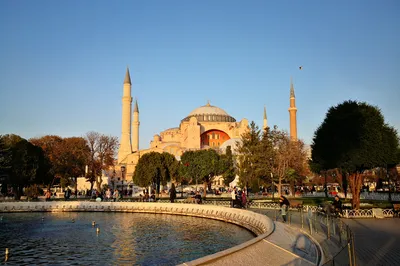
Hagia Sophia was built by Justinian starting in 537 AD. Originally a Christian church, it was converted into a mosque in 1453. The three highlights are: mosaic icons, the wishing column (in the northwest of the main hall), and the six-winged angels on the four pillars of the main hall. Actually, Hagia Sophia is the most disappointing. Because of its fame, not going seems a lifelong regret, but when you go, you can only walk around the upper floor. The main hall is exclusive to Muslims. Non-Muslim tourists are not allowed to enter. 25 euros is really not worth it. Then there is the experience hall, which is basically watching a continuous documentary on an ultra-wide screen. The content is not very detailed, and you have to stand in limited time in each hall, which feels mysterious but is actually empty.
During the Ottoman Empire, the sultan's office was the Old Palace Topkapi, meaning "Cannon Gate." It was the workplace and residence of sultans from the 15th to 19th centuries. There are many artifacts here, including relics of Prophet Muhammad, especially many rare treasures worth seeing. The whole complex is not very large, it seems to have three courtyards. The rear courtyard faces the Bosphorus Strait with a wide view. The trees in the palace show a royal demeanor.
The architecture was built in different periods, overall simple, but the interior details are quite refined. The council hall has a high dome and a small area, which seems a bit disproportionate. It represents that the universe is in the hands of the sultan. The exquisite Gate of Salutation is in the second courtyard, a building that best represents the combination of elements from different periods.
The most worth seeing are the treasure and artifact exhibitions in the side halls of the main courtyard. The quantity and quality are very high. Unfortunately, each exhibition has a long queue. I waited about 20 minutes for each. My husband was unwilling to enter crowded enclosed spaces, so he waited outside, causing me to rush through the exhibitions and hurry along, missing many places and treasures. It is said that the porcelain exhibition in the imperial kitchen is also exquisite. On display were clocks taller than a person, various decorative swords, daggers, cups, plates, and other daily items, all full of gold content. Books handwritten by calligraphers, with miniature illustrations, made the content seem unimportant. Of course, jewelry and gems are blinding. That 86-carat diamond has its own display case, attracting every visitor's attention. But the most precious are the cultural relics: the footprint and flag of Prophet Muhammad, the bones of John the Baptist, clothing of saints, etc.
Ticket price 1500 lira, including audio guide. The audio guide is available on the right side facing the gate. Queue for about ten minutes, leave your passport as deposit, choose language, Chinese is available. Then remember to return it, otherwise you lose your passport. The queue for returning the guide is shorter. Speed depends on luck. From entering to exiting, I spent less than two hours, with queuing taking one hour.
The so-called Basilica Cistern is called Yerebatan. It was an underground water storage facility built by Justinian in 542 AD, with a capacity of 100,000 tons of water. 12 rows of 28 columns, a total of 336 columns, are awe-inspiring. These columns come from ancient Greek and Roman buildings. Some are spliced from broken columns, so you can see various column bases, capitals, and shafts. The cistern is dim and damp, with lights flickering, alternating warm and cold, creating a mysterious and slightly scary atmosphere. Especially the two giant Medusa heads at the far end, staring straight at you. There are also newly added sculptures from the last ten to twenty years, all with eerie figures. Ticket price 800 lira, visit time 30 minutes to one hour. The queue time is uncertain; 30 minutes should be enough.
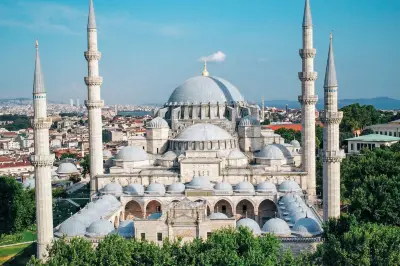
Istanbul is full of mosques. During prayer times, the call to prayer from the minarets echoes everywhere, with no dead spots. The most famous are the Blue Mosque and the Süleymaniye Mosque. The Sultan Ahmed Blue Mosque is in the historic center, crowded with tourists. It was designed and built by Mehmet Aga, a student of Mimar Sinan, in 1600. It is distinguished by six minarets, symbolizing the six pillars of Islamic faith. We arrived after 9 a.m., and there was already a long queue. We saw a couple in green attire preparing for a wedding there. I learned that Islamic brides and grooms wear green. Near the entrance, we picked up headscarves, and at the door, we took off our shoes. Shoes can be placed on racks around the hall, but most people carry them because the exit is on the other side. What impressed me most was not only the grandeur and beauty of the building but also the crowds of tourists and the mixed smell of feet and shoes.
Similarly, arriving at the Süleymaniye Mosque after 9 a.m., it was very quiet. During the reign of Süleyman the Magnificent (1520–1566), the peak of the Ottoman Empire, the famous architect Sinan designed and built this mosque between 1550 and 1557. It is called the most beautiful mosque in Istanbul. The exterior is delicate, the interior decoration is luxurious and grand. Here you can walk to the center of the hall, and the awe and sanctity felt cannot be experienced from the side while squeezed among tourists. The carpet in this mosque is the cleanest and has the best foot feel among the few mosques I have visited. Personally, although mosques are free, it is enough to just visit Süleymaniye.
Next to the mosque are the tombs of Süleyman the Magnificent and his wife. The decoration materials are high-end, and the taste is understated luxury. Süleyman spent his life fighting and died on the battlefield. He was also a poet and a strong supporter of scientists and artists.
After visiting the Süleymaniye Mosque, a short walk leads to the Spice Market. Although called a spice market, I saw more candy and pastries. Besides familiar spices like Sichuan pepper, chili, cumin, curry, etc., there are mainly local seasonings that didn't suit our taste. Curry costs several hundred to over a thousand yuan per jin. The pastries are sickeningly sweet even for someone like me who loves sweets. Many vendors speak Chinese, some even speak quite complex Chinese, showing that many Chinese tourists come here. The building is said to have been built in the 1660s, very magnificent and beautiful. The market is full of dazzling goods: colorful candies, colorful spices arranged in shapes, colorful handicrafts. The most beautiful are the lamps. I kept persuading myself not to buy. This place is more for the eyes than the stomach. As soon as I arrived in Turkey, I felt a strong political atmosphere: flags everywhere, portraits of the president, and even the Spice Market has a huge portrait of the president. Exiting the market, I walked along a street of small shops all the way to the Grand Bazaar. Unfortunately, today is Sunday, and the Grand Bazaar is closed. It is said to have 65 streets and over 4,400 shops. But the hundreds of small shops on both sides were enough to give me an idea of the Grand Bazaar; most sell low-end clothing.
Dolmabahçe Palace is in the new city, not far from Taksim Square. Although its luxury had some attraction, the ticket price kept me out.
İstiklal Avenue in the new city is the most bustling commercial street. The north end is Taksim Square. We stayed on a slope west of İstiklal Avenue, with small streets crisscrossing, like Beijing's hutongs, but with slopes. We walked back and forth on İstiklal Avenue several times. My impression: many dessert shops, many currency exchange shops; clothing and handicrafts had nothing worth buying. There are a few distinctive ice cream shops. Their uniqueness is not the ice cream itself, but the vendor's fancy performance, like a magic show, tossing the ice cream up and down around the customer. This skill is certainly not easily practiced. So an ice cream that used to cost 100 lira becomes 250.
Finally, I did the Cappadocia hot air balloon ride that many people had recommended. Honestly, it wasn't that exciting; towards the end, I wanted it to end earlier. After all, being picked up at 3:30 a.m. raises expectations.
I booked online in advance for 1780, with Air Kapadokya. Later, I found that Ctrip had a better price: 1660. I asked my customer service, and she said that was collecting money from customers in advance but hadn't paid the balloon company yet; they would pay only when the flight was imminent, which was not guaranteed. I don't know if what she said is true, but currently the balloons don't seem to be fully booked; there are always seats. I saw in a group that someone asked the guesthouse owner to book upon arrival in Cappadocia for 275 euros. If they couldn't fly that day, they would have to pay more the next day. They also said others had booked for over 300 euros. From this perspective, domestic websites are cheaper.
Got up in the middle of the night to wait for the van. We lived far, so we were the first pick-up. Along the way, we picked up several more guests and were taken to the company. The company prepared breakfast: a box of soft drink, a piece of cake, and a terribly bad apple. We could make our own coffee from the machine.
Around 4:30, they called our names, and we boarded the van and were taken to the balloon. Everyone climbed into the basket one by one as required. Our basket held no fewer than twenty people. Later, two more squeezed in, making it difficult to turn around.
On the ground, dozens of balloons lit up and rose simultaneously, twinkling in the darkness, colorful. Our balloon lifted off at 5:03. It drifted slowly through the valleys, sometimes descending close to the fairy chimneys, sometimes rising to greet the sunrise, while constantly rotating to show different directions. Not only were the unique landscapes breathtaking, but the sight of hundreds of balloons floating in the sky was also spectacular.
As the sun rose and the valleys fully lit up, the novelty passed, and there was nothing more to see.
The balloon company guaranteed an hour in the air. The last ten-plus minutes were mostly wasted time and finding a landing spot. So many balloons had to land, it felt like a scramble for territory. Each balloon had a trailer truck. The basket had to land on the trailer, so on the ground, trucks chased the balloons, and the minibuses carrying tourists also chased the balloons to take them back to their accommodation. The balloon pilot and the truck driver communicated continuously, directing each other to the designated spot. Watching the vehicles scurrying around on the ground was like watching a spectacle.
After landing, several staff members exerted all their strength to pull the balloon down flat to the ground, allowing tourists to climb out. They set up a small table, poured sweet wine, and celebrated a successful flight. They also sold videos for about 30-40 euros.
The minibus driver took us back to our accommodation around 7:30. This exhausting hot air balloon trip ended. Thinking of the balloon employees, they worked even harder.
In Cappadocia, besides flying in the sky, you also need to explore on the ground. Sightseeing is mainly concentrated in Göreme. The scenic area has two routes: Red and Green, which are group tours. I don't know the price. We only wanted to visit two or three representative spots. Afraid of being too tired on a group tour and wasting money, we drove ourselves to find them.
Since the attractions are scattered, navigation instructions are not clear, and place name translations are inconsistent, we often didn't know where we were supposed to go. For example, I wanted to go to Pigeon Valley. According to navigation, I arrived at the destination and saw two or three cone-shaped hills, but no pigeons. I seriously suspected I had gone to the wrong place. Also, the cave church was nowhere to be found following navigation. I saw a travel agency shop, went in to ask, and was told it was still several kilometers away.
We wandered around the scenic area for half a day without finding much. When we did find spots and saw the expensive tickets, we didn't want to go in. Uchisar Castle alone was 25 euros; just seeing it from outside was enough. Göreme Open Air Museum was 15 euros; we didn't enter either. Fairy Chimneys, Selime Monastery, Özkonak Underground City, etc., were either too far or couldn't be located by navigation.
Known as the City of the Moon, adjacent to the Mediterranean Sea, the starting point of the D400 highway, one of the world's top ten coastal roads. A tram runs along the coastal road. Looking out over the Mediterranean from the Roman Harbour is almost every tourist's expectation; you can take an elevator to the observation deck.
From Cappadocia to Antalya felt like returning from a magical world to the human world. Hadrian's Gate is at the entrance to Kaleiçi old town. Despite being damaged, it still exudes solemnity and majesty. The old city walls are tall and thick, streets crisscross, shops line the streets, mainly selling carpets, porcelain, and glass. Beautiful samples are displayed, but unfortunately, I saw no buyers. The shopkeepers sat alone guarding their wares, cats roamed freely, giving a slightly desolate feeling. Restaurants mainly serve fish and seafood, with more customers in the evening. Before entering the old city, sitting by the roadside, eating a flatbread wrap with meat in front of Hadrian's Gate, I wondered if the taste was the same as two thousand years ago. There seems to be no boundary between the present and the past, the new city and the old city.
Düden Waterfall directly pours into the Mediterranean, a unique sight. A boardwalk is built along the cliff. Walking along it, first there is clear river water, then several small slopes form small waterfalls, gushing cheerfully. Until the cliff edge, where the water plummets down, white foam crashing into the deep blue Mediterranean, creating ripples spreading outward. It was exhilarating. A park has been built around it, with a beautiful environment and a small playground where children played happily.
Antalya Museum is not very famous, but it actually has quite a lot of content and is really worth seeing. The ticket price is high at 15 euros. Part of the exhibition is about the life in this region during the ancient Phrygian and Greek periods. Another part is full of marble statues, mostly emperors and Greek deities, plus some sarcophagi. These unearthed statues are all incomplete, but the reconstructed figures are still stunning. The emperor's grandeur, the queen's dignity, the male god's strength, and the goddess's lightness are all lifelike. The folds of clothing on many statues are so natural that you can't imagine they are made of marble. The central dancer has no legs, but her graceful and dynamic posture is fully revealed by her skirt.
Aspendos Ancient Theatre is not far from Antalya. Built in the 2nd century AD, it is the best-preserved ancient Roman theatre, with a capacity of 15,000 people. From the sound and light equipment on stage, it's clear that the ancient theatre is still used for performances. When we arrived, a group of students was visiting. A middle-aged man who seemed to be a teacher recited a passage of dialogue or poetry on stage, and the students responded from the stands, witnessing the vitality of the ancient theatre. The stage background wall is simple, made of neatly arranged stone blocks, with two layers of eaves, delicately carved patterns on top. On the second layer, the central triangular pediment is carved with Dionysus, the god of drama. A row of arches above the stands (some are later additions) is the most striking part, arranged in a semicircle, elegant and magnificent. Behind the arches, a curved corridor runs. Walking through it, feeling the play of light and shadow, it felt like a thousand years passed in an instant. The site is actually large, with many other ruins, but they are in very poor condition, paths difficult to walk, and almost no one goes there. So for a 15-euro ticket, the vast majority of tourists spend only 20-30 minutes visiting the theatre and leave.
Fethiye's island hopping tour costs 875 lira. Actually, it's a cruise in Ölüdeniz Bay, with only one island among the destinations. The usual six stops include Butterfly Valley, Blue Cave, Aquarium Bay, Camel Beach, Cold Spring, and St. Nicholas Island.
The boats include large ones like Dragon Boat and Hannibal, smaller ones with about half the capacity, and yachts. Each boat was not full; our boat had about 20 people.
We departed at 10:47 and returned around 4 p.m. The first stop was Butterfly Valley, with one hour allocated. Entrance to the valley was 20 lira, one kilometer in. Some people went in, but most stayed by the water.
The second stop was a bay where we had lunch. There were two choices for the main course: chicken and fish. We chose before boarding and received meal tokens. Other items included salad, tomato pasta, potatoes stewed with tomatoes, all vegetarian. By the way, Turkish cuisine is Mediterranean style, very light. Salad is just vegetables together without any dressing; you can add salt, pepper, and olive oil yourself. Grilled meat is not marinated, just grilled directly. Cooked dishes have very little salt, bread is oil-free and sugar-free. Lots of cheese, yogurt, and tomato paste. This kind of diet suits me well.
After eating, the crew started encouraging people to jump into the water. The on-board photographer kept directing where to jump and the posture, livening up the atmosphere. Since we had just eaten and the sea water was cold, I didn't go in.
The third stop was St. Nicholas Island, the only island. It seemed to have ancient castle ruins, but no one was interested. Everyone preferred to play in the clear water. Children jumped into the sea repeatedly, incredibly happy. On another boat, someone threw food and actually caught a small fish.
The fourth stop was at a cliffside with a small stone-enclosed pool. Again, it was time to go into the sea. On the Hannibal boat, two people were encouraged by the host to climb the cliff, swaying to the music, ready to jump. Unfortunately, our boat left before seeing their jump.
The fifth stop should be Aquarium Bay. Again, swimming. I don't recall a Blue Cave. Not sure if it was due to time or if I misremembered.
The sea water here is clear, showing various pure colors from yellow to light green to dark green to light blue to dark blue depending on the depth. It truly deserves the name Jelly Sea. The purity makes you want to dive in. Despite the cold, I went into the water twice.
I had heard of Fethiye's Balik Bazaar fish market for a long time, so I made a special trip. The seafood stalls are arranged in a small circle in the middle, surrounded by a large circle of restaurants. There are only about ten seafood stalls, far smaller in scale than those in China. Sea bass and sea bream dominate, at 400-500 lira per kg. Salmon is 1200 lira. A fish similar in size to salmon is 8000 lira, the most expensive I saw. Regular shrimp are over 300 lira, large shrimp over 500 lira.
Each fish seller has a partner restaurant, some are their own. After buying seafood and paying, you go with the restaurant owner to the eating area.
Turkish cooking is simple: fish and shrimp are grilled directly and served. The cooking fee is charged per person. At our restaurant, it was 80 lira per person. Outside drinks are not allowed; you must buy from the restaurant. A local beer costs 250 lira. Fish and shrimp are chilled fresh; some shrimp weren't very fresh. One fish and three shrimp cost 500 lira. The total meal was 910 lira, about 220 yuan.
Turkey is full of cats and dogs. I never provoke them. While waiting at the table, I felt a tap on my thigh. Looking down, I saw a sturdy tabby cat staring at me expectantly. I turned away and ignored it. After a while, it reached out its right paw and touched my leg again. I looked down to see those bright, longing eyes. Then the shrimp arrived. I gave it the head; it gnawed with some effort. Then I gave it the tail, which it ate in one bite. Then it continued gnawing the head. When the fish came, it ate the fins, the tail, and a piece of meat. I was afraid the head was too hard, so I didn't give it. After finishing everything, it still looked at me. I spread my hands to show no more. It turned and left. Later, I saw it lying under a chair a few meters away, grooming itself, looking content.
On the way to Fethiye, around noon we passed a small town, Kaş, on a peninsula harbor. The coastline here winds around, forming a large bay. From the high D400 road, the deep blue sea looked mysterious. We turned down to the dock for lunch. The outdoor seating under an awning was relaxing and comfortable. The owner only charged for the main course, gave free soup, and of course free bread. Worth mentioning, his yogurt was especially delicious.
Located in Denizli, the hot springs rich in calcium hydroxide form calcium carbonate deposits, creating Pamukkale (cotton castle). The water temperature stays at 35 degrees year-round. The day we went was overcast. The spring water, travertine, and sky merged into a gray mass, a true unity of water and sky with no beauty, and even gave a feeling of snow blindness. The ancient city site adjacent to Pamukkale is Hierapolis, meaning "Holy City," built by the Kingdom of Pergamon in the 2nd century BC. The large theatre is the best restored, while others are very ruined. This theatre is not only large but also has most of the stage background columns and statues restored, giving a more luxurious feel than Aspendos. In ancient times, Hierapolis' hot springs attracted Roman nobles for pleasure and treatment. By the 2nd-3rd centuries AD, it had become a bath center of ancient Rome. Streets crisscrossed, buildings clustered, facilities complete. Unfortunately, it was completely destroyed by a great earthquake in 1334. Cleopatra's Pool is very unique, with broken columns and building fragments piled at the bottom. One seems to travel back 2000 years when in the pool. This requires a separate ticket, about 15 euros. A museum built on one site displays various unearthed items, including statues and daily necessities. The entire site ticket is 30 euros (actually charged 1052 lira). There is an electric cart at the south gate, renting a four-person cart 1300 lira for two hours, six-person cart 65 euros for one hour. Visiting the ancient city takes about an hour, but the hot spring time can be flexible. What is unacceptable is that the cart must be returned to the south gate, meaning if you want to play in the hot spring, you either spend more on the cart or walk in after returning it. If the weather is bad, I suggest not coming; if you want to see an ancient city, go to Ephesus.
Across from Pamukkale is a restaurant called Chinatown. It's on the corner, with a spacious second-floor view. Called Chinatown, it actually serves Turkish food. The salmon portion was generous, with many side dishes, 450 lira, a good price. The cheese mushrooms were a bit raw. The cheese flatbread was crispy outside and soft inside. If I had known they gave free flatbread, I wouldn't have ordered it.
Ephesus was built around 1000 BC. This city recorded in the Bible disappeared for many years and was accidentally discovered in the 19th century. According to legend, around 34-45 AD, after Jesus was crucified, the Virgin Mary was led by Saint Paul to the mountains near Ephesus to spend her final years. The ruins now displayed basically show the layout of a city, including a central square (market), temples for gods and emperors, a theatre, a library, baths, a brothel, and public toilets. Ephesus was originally a coastal city built by Greeks, with extremely developed trade. It was also a center for the worship of Artemis, whose temple was one of the Seven Wonders of the Ancient World. The city was built on a slope, arranged in levels. A 11-meter wide, 500-meter long main road once led directly to the port. Later, the sea receded, and you can no longer see the sea.
During the Roman period, it was the largest metropolis in Asia. Most of the ruins now are from the Roman period. The most exquisite is the Library of Celsus. It was built in 110 AD by a governor of Ephesus in memory of his father Celsus, near his father's tomb. It was the third largest library in the ancient world, after the Library of Alexandria and the Library of Pergamon, with over 12,000 scrolls. The facade, i.e., its front face, is extremely beautiful and has been mostly restored to its original appearance. In the niches are four statues of goddesses representing Virtue (Arete), Thought (Ennoia), Knowledge (Episteme), and Wisdom (Sophia). The statues are headless or armless, only the second is relatively complete. Despite the damage, they exude nobility and elegance. The columns are covered with natural marble veins, and the walls are full of intricate reliefs.
The Temple of Hadrian was built between 118-138 AD. Four Corinthian columns support an archway. In the center of the arch is a relief of Nike, the goddess of victory. On the inner arch is Medusa. On the sides of the arch, there are band reliefs with statues of the founders of Ephesus. The Fountain of Trajan was built between 102-114 AD. It is a two-story, 9-meter high structure surrounding the fountain on three sides. The statue of Emperor Trajan with his foot on a globe in the center of the fountain is missing. At both ends of the site are two theatres, one large and one small, mostly just the seating areas. One building complex is protected under a canopy. These are indoor remains, which are rare. Marble walls, floors, mosaic pavements, and wall paintings faintly show the luxury of the time.
The public toilets are simple but impressive. I was surprised by the openness and sophistication of the ancient Romans regarding excretion. This row toilet design feels comfortable to use. The continuous water flow below keeps things sanitary. U-shaped, with about ten seats on each side. Imagine people sitting side by side or facing each other, chatting while taking care of business.
This city at the end of the D400 highway is Turkey's third largest city, a center for industry, commerce, and foreign trade. It's also a university town with many young people. For us, it was just a rest stop, with nothing much to see. Here we had the most value-for-money meal and the worst guesthouse. While walking around, we saw Gar1960, a pleasant full-day restaurant serving meals, coffee, desserts, and alcohol. The waiter was very enthusiastic and spoke the best English among Turkish restaurants we encountered. Pizza and chicken wrap were delicious, and especially the milkshake was superb.
Although Turkey is at the crossroads of Europe and Asia and actively promotes cultural tourism, it is not friendly to tourists. Not only are there no English signs on the streets, but even in attractions, there are mostly Turkish explanations, rarely English. Is this national pride or cultural arrogance?
Table of Contents for Travel Notes:
1. Summary
2. Money-saving tips
3. Accommodation
4. Arrival
5. Istanbul
6. Cappadocia
7. Antalya
8. Fethiye
9. Pamukkale
10. Ephesus
11. Izmir
Travel information:
Hotel index
Guide index
Airfare index
Website navigation
Tour index
Cruise index
Corporate travel index
Jion us
Distribution alliance
Friendship links
Corporate gift card purchase
Insurance agent
Agent cooperation
Hotel cooperation
Destination and scenic area cooperation
More cooperation
About Ctrip
About Ctrip
Ctrip hotspots
Contact us
Careers
User agreement
Privacy policy
Business license
Security center
Ctrip content center
Intellectual property
Trip.com Group algorithm disclosure