Our Journey: Colorful Turkey
We boarded a flight at 1:40 AM, and after nearly 12 hours of flying, arrived at Istanbul Airport around 7:00 AM (China and Turkey have a 5-hour time difference). This time we were still in transit, but our final destination was Dalaman. At Istanbul Airport, we found it very convenient to use the self-service kiosks to print boarding passes for domestic flights with just our passports. While waiting at the gate to kill time, we had coffee at a café that was twice as expensive as in China—marking the start of a trip with extremely high food and drink costs.
Part 1: Road Trip along the D400 Coastal Highway
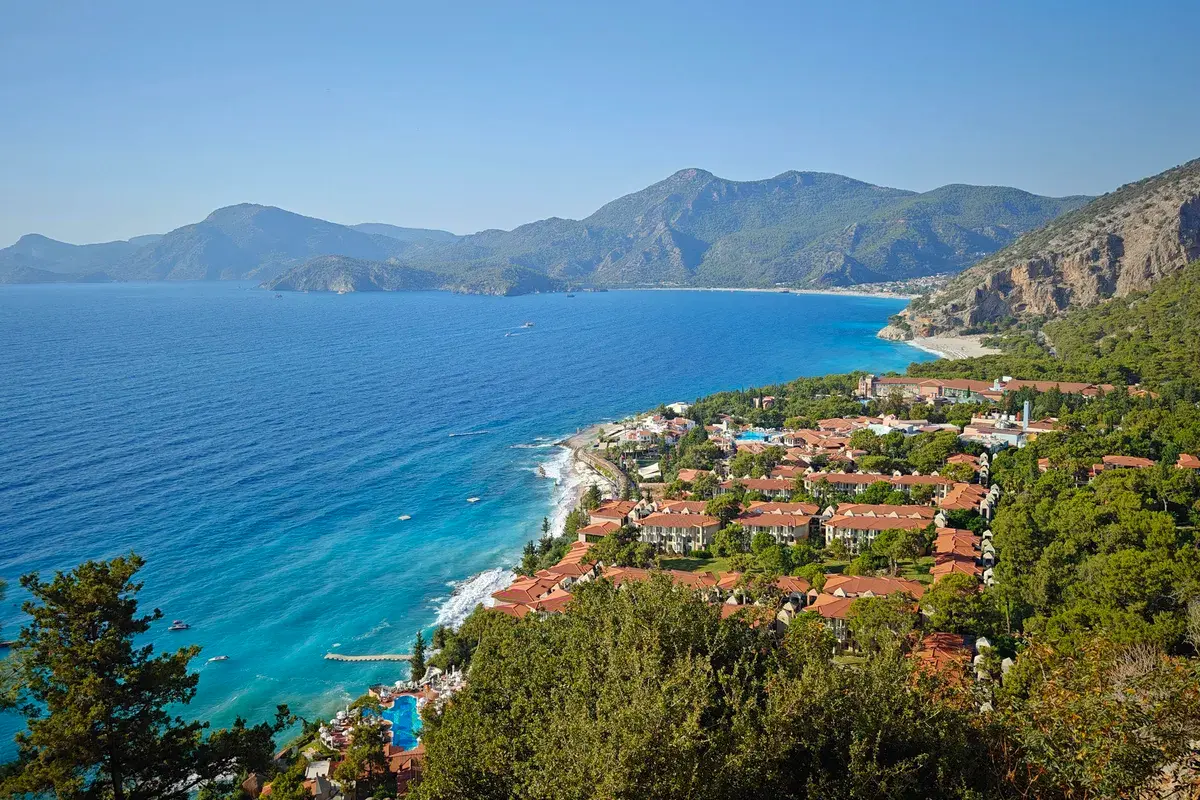
The flight from Istanbul to Dalaman was very short, but picking up the car at Dalaman Airport was marred by some unpleasant incidents that cost us a lot of time. Our destination for the day was Kas, passing through Fethiye along the way (a place almost crowded with Chinese tourists experiencing paragliding). This leg was all about experiencing the famous D400 highway—racing through the mountains, then entering the coastal area at Fethiye, where the Mediterranean showed off its enchanting blues, as well as its colorful bays and beaches of all sizes.
We made many stops along the way and arrived in Kas just after dark. After settling into our accommodation, we found a Turkish restaurant in the pedestrian area. The first Turkish meal tasted pretty good, but later we realized that the menu seemed to lack variety.
The next morning, we visited a small Roman-era theater in Kas. Standing at the very top and looking into the distance, the Mediterranean Sea, under the morning sunlight, with its slightly rippling, silk-like blue surface, sparked our beautiful reverie.
But as the sun grew hotter, we returned to the hotel for breakfast. It turned out that whether in Europe, in Morocco in Africa, or in Turkey, breakfast could still somewhat satisfy our Chinese stomachs (except for American hotel breakfasts).
Our destination for the day was Antalya, continuing along the D400 highway with the beautiful Mediterranean scenery accompanying us all the way.
Part 2: Antalya
Antalya is the third-largest city in Turkey, so the traffic and crowds are naturally heavy. Since our hotel was in the old town, the complex driving routes there caused us to miss navigation prompts multiple times, and we had to go through quite a bit of trouble to finally reach the hotel.
The hotel's location was actually very good—about a ten-minute walk from Hadrian's Gate, and most other city attractions were within walking distance.
After settling in, we went to try a historic Turkish kebab restaurant. The taste was decent but nothing special. Antalya was very lively at night, with buildings beautifully illuminated by lights. The only downside was that in many places, especially at corners, there was an indescribable smell that hit you in the face.
The next morning, we went to Hadrian's Gate. This structure, over 2,000 years old, is remarkably well-preserved. I've always marveled at how China's ancient buildings, mainly made of wood, have few surviving examples, especially from before the Song and Yuan dynasties. Many Roman ancient buildings have survived mainly because they were built primarily of stone.
Leaving Hadrian's Gate, we walked to the Red Tower Mosque. Next to the minaret, there were some Roman-era ruins cordoned off by fences. Looking at these ruins, one could imagine how magnificent they must have been in their day.
From the mosque, we walked to the Roman Harbor, which has been in use as a port since the Roman Empire. Various boats (sailboats and motorboats) mainly for tourists were docked there.
In Antalya, the temperature rises quickly after sunrise, so we soon returned to the hotel for breakfast. At the dining area, we met a pink-haired elderly lady who truly amazed us with her vibrant lifestyle.
The daytime heat made going out unbearable, so we didn't leave again until the evening, heading to Karaalioglu Park. Originally, we had planned to visit the Antalya Museum during the day, but unfortunately it was closed for renovations. In the evening, the park was full of tourists and local residents, and we even encountered many Chinese tourists.
For lunch, we randomly picked a restaurant near the hotel and had the most expensive meal in Turkey. At checkout, a funny thing happened. We said “Check please” in English, but the owner brought each of us a cup of tea. We said in confusion that we just wanted to pay, not order tea. The owner then explained that in Turkish, the pronunciation of “check” is very close to the word for “tea.” He had thought we were asking for tea. Later, we saw local vendors shouting “Chea” when selling tea. Upon listening carefully, it sounded very similar to some Northwestern Chinese dialect pronunciation for tea. This confirmed that tea originated in China and has had a profound and far-reaching influence on the world.
Originally we wanted to watch the sunset, but thick clouds on the western horizon dashed our hopes. We just had to relax and wander aimlessly through the city. Then we remembered passing by a centuries-old Turkish bath near the hotel.
In the evening, we found a restaurant that resembled a local cafeteria, called “Can Can.” Food was prepared and placed in trays by category. Customers ordered as they pleased and paid at the end. It was similar to a community canteen in China. In Turkey, you pay by the category. This meal was the cheapest we had in Turkey, and it also gave us a taste of a different kind of Turkish dining culture. Although Turkey is a coastal country, most ordinary restaurants rarely serve seafood. The meals mainly consist of various meats, with few types of vegetables, usually served raw as salads.
After staying two nights in Antalya, we realized that one night might be enough: arrive early in the afternoon on the first day, stroll around the old town, visit Hadrian's Gate in the evening; the next day, visit the Roman Harbor and a few other major spots, then leave in the afternoon for the next destination.
On the fifth day, after breakfast, we set off for Konya, a midpoint stop on the road trip connecting Antalya and Cappadocia.
Not far from Antalya, we arrived at the famous Aspendos Theater. Built during the Roman Empire and still in use today, it is remarkably well-preserved.
Leaving the theater, we went to the town of Side, an unplanned stop. Side has many Roman-era ruins and is also a coastal resort. After wandering around the town, we regretted not moving one night from Antalya to Side—it would have been perfect.
Soon after leaving Side, we said goodbye to the D400 highway and drove on mountain roads. To be honest, the maintenance quality of Turkish highways is quite poor, and the speed limits are ridiculous. However, there were almost no speed cameras along the way, and traffic was generally light, so we could maintain a relatively high and steady speed, arriving earlier than the navigation predicted.
Konya is one of the most conservative cities in Turkey, but also one with the best economic development. The city's appearance still exudes a vibrant and uplifting spirit. Konya is the birthplace of the Whirling Dervishes, but coincidentally, the theater that hosts the performance was closed that day. What a pity. Since this was the longest driving day in Turkey, we decided to just rest well.
Part 3: Cappadocia
Another energetic day. Today's destination was Cappadocia. But before that, we visited the Konya Museum, where we saw the world's smallest Quran.
We drove to the town of Göreme. On the slope before entering town, we could see the unique fairy chimney landscape spreading out in a valley. We quickly stopped the car and went to a cliff edge to admire the beautiful scenery. Everyone thought that if such a scene were in China, it would have long been enclosed as part of a park, charging hundreds of yuan for entry. Turks really don't know how to do business—they didn't even charge for parking.
After checking into the hotel, we wandered around the town and saw two Chinese restaurants. That evening, we dined at one called Beijing Restaurant. Despite the name, the dishes had almost nothing to do with Beijing cuisine and the taste was lackluster. Later we heard the chef was Korean—ridiculous! This put us off wanting to try any other Chinese restaurant there for the next two days, though we desperately missed Chinese food...
On the second day in Cappadocia, we first went to Derinkuyu Underground City, built during the Roman era to escape barbarian invasions. The scale of the underground city was quite large. The largest underground cave we saw could hold about a hundred people, while the smallest only fit two or three. It consisted of a maze of tunnels connecting at least three or four levels of large and small caves. Some tunnels were very low, some very narrow, others very steep. This layout was probably for easy defense, and it also suggested that the Romans at the time were generally not tall.
After visiting the underground city, we drove to Ortahisar, claimed to be one of the most beautiful towns in the world. The town had few tourists and was small—we finished touring it in less than an hour. However, we had the most delicious meal in Turkey there. The owner single-handedly served customers and cooked in the kitchen, yet he didn't seem flustered.
After eating and strolling in Ortahisar, we headed toward Ürgüp. On the way, we stopped at the Three Beauties Fairy Chimneys. When we arrived, the overcast sky that had been there since morning suddenly cleared to blue skies and white clouds, lifting our spirits. We spent quite a while playing there. Afterward, we no longer felt like going to Ürgüp, so we returned directly to Göreme.
Before sunset, we went up the hill again to take photos of Göreme town at night.
On the third day in Cappadocia, we got up at 5 AM as planned to watch the hot air balloons take off. After waiting in the cold for about an hour, the launch was canceled due to weather. How frustrating!
After sleeping in a bit, we set off for Soğanlı Village, a small village with a few ancient early churches (very small, simple, and rustic, with no trace of modern Western churches—those looking for photo-worthy scenes can skip it) and an easy hiking trail. Soğanlı Village is built in a canyon. We toured the village in about ten minutes, then drove to the top of the canyon. The top was quite flat, stretching endlessly as far as the eye could see. The terrain was very similar to the Loess Plateau in Shaanxi, China—with canyons, ravines, and flat tablelands.
Leaving Soğanlı Village, it was lunchtime. Remembering the delicious meal yesterday, we decided to go to Ortahisar again. On the way, we passed through Ürgüp, a very quiet town that many travelers to Cappadocia choose as a base.
We returned to the small restaurant in Ortahisar. The owner was obviously delighted to see us and gave us two free dishes. We ordered a clay pot beef. The owner asked us to sign our names and countries on the clay pot and hung it on the restaurant wall. Later we noticed the wall was covered with signatures of travelers from all over the world.
Part 4: Istanbul Citywalk
On the fourth morning in Cappadocia, we drove to Nevşehir Airport to return the rental car. To our surprise, it was a tiny airport. Arriving two and a half hours early was completely unnecessary—one hour would have been more than enough. After a flight of just over an hour, we quickly arrived at Istanbul Airport, then took an airport bus for less than 50 minutes to Taksim Square. Our booked hotel was less than a five-minute walk from the bus terminal.
After settling in, we walked across the square to Shanghai Restaurant for lunch. In the vast city of Istanbul, there are only a handful of Chinese restaurants. Fortunately, this one was decent, and it became a gathering point for Chinese tourists traveling in Istanbul. During our 40-minute lunch, three tour groups came in.
After lunch, we strolled to Dolmabahçe Palace (New Palace), then walked along the seaside to Kabataş Ferry Terminal. But soon the scorching sun and strong sea breeze drove us back to the hotel. The walk back was mostly uphill and quite tiring. At a street corner not far from the airport bus terminal, we found a restaurant similar to Antalya's "Can Can," so we had dinner there.
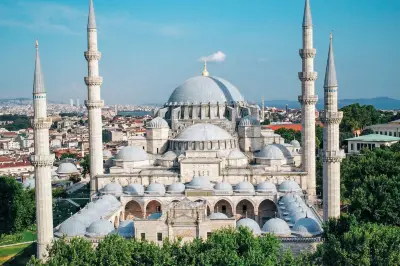
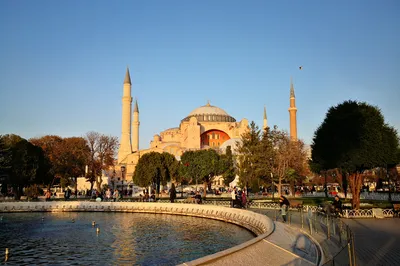
The next morning, we went to the Sultanahmet area, which is home to many famous attractions such as the Blue Mosque, Hagia Sophia, and the Basilica Cistern. We only walked around outside the mosque and the cathedral. Both of us are somewhat socially anxious, and seeing the huge crowds of tourists completely killed our desire to go inside. Without an online reservation for the Basilica Cistern, we would have had to queue in the scorching sun for nearly an hour to enter.
Leaving Sultanahmet, we walked to the Grand Bazaar area, passing many ancient Roman and Ottoman historical sites along the way.
We also inadvertently wandered into Istanbul University.
Then we took the metro to the Beyoğlu area (the old town of Istanbul). However, a torrential rainstorm forced us to cancel our plans, so we returned to Shanghai Restaurant to eat and kill time.
The third day's itinerary was exceptionally relaxed. We walked to Kabataş Ferry Terminal and took a ferry to Cengelköy. From the sea, we could see the full architectural form of the New Palace, the Bosphorus Bridge, and buildings on the Asian side. The weather in Istanbul is extremely peculiar. When we boarded the ferry, the sky was clear with blue clouds. But less than ten minutes into the Bosphorus, a torrential downpour hit. It lasted less than fifteen minutes before gradually clearing up. By the time we exited Kabataş Ferry Terminal again, the sky was already perfectly clear.
Learning from the painful experience of climbing hills earlier, we chose to take the F1 connection line (part of the city metro) back to the hotel. Istanbul's public transportation is relatively developed. You can pay with a chip card or a local transportation card (red card). Using the transportation card is 70% cheaper than using a credit card—a significant difference.
On the last day, we took the airport bus to Istanbul Airport and flew back to China (we had checked in online, but international flights do not allow printing boarding passes with passports at the airport's self-service kiosks). Thus ended our Turkey trip.
Our Turkey trip left many regrets. Hopefully, we will have a chance to make up for them.