Kansai Adventure! A Panoramic Photography, Eating, Shopping, and Fun Tour of Osaka/Kyoto/Kobe
All images/videos above are copyrighted. For reprint, please contact the author for authorization.
As of 2020, it has been the fourth consecutive year exploring Japan: in 2016 I went to Tokyo/Kyoto, 2018 to Hokkaido, 2019 to Kansai, and 2020 back to Hokkaido. And for three consecutive years, I've been in Japan during January. This trip is the 2019 Kansai journey, themed on urban landscape photography, eating, shopping, and fun. Highlights include shooting the tallest buildings and landmark night views of Osaka, Kobe, and Kyoto, including Japan's tallest building, Abeno Harukas in Osaka, iconic Osaka Castle, Umeda Sky Building, Kyoto Tower in Kyoto, and Kobe Port and Kobe Port Tower. Also visited bustling shopping streets like Dotonbori and Shinsaibashi in Osaka, Nankinmachi (Chinatown) in Kobe, and Kiyomizudera Temple in Kyoto...
This trip to Osaka made up for missing it on previous Japan trips. Osaka is a charming, leisurely city known for local cuisine, entertainment, and nightlife, also boasting a long history and vibrant culture. Though only a short Shinkansen ride from Tokyo, it has a completely different vibe from the capital. Jump off the bullet train into a place with simple folk and frank people. Nightlife is lively, and food is unforgettable. Besides numerous shopping spots and modern attractions, Osaka has its historical side, most notably Osaka Castle. This castle is ideal for delving into Japanese history and strolling in scenic neighborhoods, especially during cherry blossom season in April when the blooms are at their peak and the weather is pleasant.
Let's start with an aerial video of the Osaka skyline.
Day 1: Arrival at Kansai International Airport (Izumisano) / Umeda Sky Building
Across the cross-sea bridge is KIX Kansai International Airport.
The Umeda Sky Building near Shin-Osaka Station is known for its unique shape.
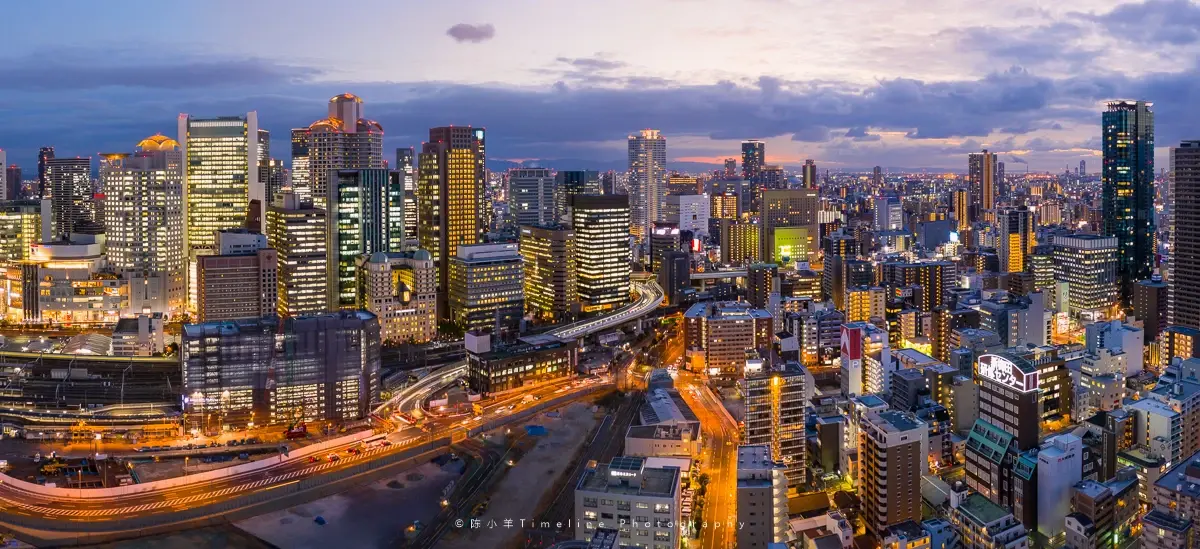
Wait here for sunset and night photography. Umeda is the most "Manhattan-like" area in Osaka, with dense skyscrapers that showcase Osaka's modernity and prosperity when the lights come on.
Umeda Sky Building at night.
Below is Shin-Osaka JR Station.
Day 2: Abeno Harukas / Tsutenkaku
Besides Umeda Sky Building, Osaka has another iconic building, currently Japan's tallest skyscraper—Abeno Harukas. Built by Kintetsu Group with an investment of 130 billion yen (approx. 10.42 billion RMB), it stands 300 meters tall.
Enjoy the daytime view of the Osaka skyline from Abeno. Inside Abeno Harukas is Abeno Harukas Department Store, a huge shopping complex, a must-visit for Chinese tourists shopping in Japan.
Abeno at dusk.
Near Abeno is Tennoji Park, perfect for walks and exercise. Beside the park is the Osaka Museum of Art, as shown below.
Across from Tennoji Park is another Osaka landmark, the Hitachi-sponsored Tsutenkaku.
This is another bustling center of Osaka, with a panoramic view of dense buildings.
Osaka at dusk.
Waiting for nightfall, when the lights come on, another spectacular scene begins.
Osaka's two iconic buildings—Tsutenkaku and Abeno—echo each other.
Tsutenkaku is an observation tower located at 1-18-6 Ebisu-Higashi, Naniwa-ku, Osaka City, Japan. The tower is 103 meters tall (100m body, 3m antenna). It is one of Osaka's landmarks and a registered tangible cultural property of Japan. Its name means "tall building reaching to the sky," coined by Meiji-era Confucian scholar Nanto Sotaku. The designer was Naito Tachu, and it was completed in 1956 (Showa 31). In the following year (1957), a large advertisement for Hitachi was added to the side of the tower.
A bird's-eye view of Tsutenkaku. It's an observation tower; you can buy tickets to go up.
Tsutenkaku changes color constantly.
Abeno Harukas building—with Osaka's vibrant night scenery in the background!
The higher you go, the colder it gets.
Another view of Japan's tallest building, Abeno Harukas.
When it's completely dark, that's when Tsutenkaku is at its liveliest!
Below Tsutenkaku is another food paradise in Osaka.
This pufferfish is an iconic sight at Tsutenkaku. Nearby, sumo hotpot is a super-large portion.
Day 3: Osaka Castle / Naniwa Palace Ruins Park / Dotonbori and Shinsaibashi
Osaka Police Headquarters.
Osaka Castle is another place I absolutely love. Not only is there a relaxing baseball field, but also the Naniwa Palace Ruins Park. On weekday afternoons, many parents bring their kids to play baseball, soccer, etc.—a harmonious scene... In the fast-paced Japanese metropolis, such sights are truly rare.
Osaka Castle was originally built in the Azuchi-Momoyama period in Settsu Province, Higashinari District, Ikutama Shō, Osaka, and later rebuilt in the Edo period. It covers about 710,000 square meters. Also known as Kinjo or Kinko (Golden Castle), it is located within Osaka Castle Park in Chuo Ward, Osaka City. It is one of Osaka's famous sites and, along with Nagoya Castle and Kumamoto Castle, is considered one of Japan's three famous castles. During the unification of Japan in the Momoyama period, it was the residence of Toyotomi Hideyoshi and the center of the Toyotomi government, often called "Taiko's Castle." Later, Tokugawa Ieyasu eliminated the Toyotomi clan in the two Osaka Campaigns (Winter and Summer), so the original Osaka Castle built by Hideyoshi from 1583 to 1598 no longer exists. The visible remains today were rebuilt by Tokugawa Hidetada from 1620 to 1629, essentially a new castle (Tokugawa Osaka Castle). The castle retains 13 wooden buildings, gates, and storehouses built throughout the Edo period. In 1931, the main keep (tenshukaku) was designated a National Treasure. On August 31, 1953, the castle ruins were designated a Special Historic Site. In 1997, it was designated a Tangible Cultural Property.
A distant view of Osaka Castle surrounded by several moats.
Naniwa Palace ruins. Although Osaka was never officially a capital, before Nara (Heijo) and Kyoto (Heian) became capitals, the Naniwa Palace in Osaka was the political center of the ruling class. Today, only partial ruins remain, but the model of the palace in the Osaka Museum of History shows its 7th-century splendor.
Namba is a district in Chuo Ward, Osaka, Japan, and together with Umeda near Osaka Station, it is one of the two main commercial shopping areas. Its name derives from the neighboring Naniwa ward. Namba is a major transportation hub in southern Osaka, serving as a terminal for several railway lines including Nankai Electric Railway and Kintetsu Namba Line, as well as JR West and Osaka Metro. The entire Namba area includes Dotonbori and Sennichimae, with many shopping, dining, and entertainment venues, bars, izakayas, and pachinko parlors.
Walking from Namba to Dotonbori, this is the busiest dining and shopping district in Osaka, also the base for Chinese daigou (personal shoppers) buying goods in Japan. Dotonbori, crowded with people, is a shopping street that will excite and thrill you the first time you enter.
As early as the Edo period, Osaka was a famous commercial and entertainment center. The best shopping and restaurants in Osaka can be found in Shinsaibashi and the brilliantly lit Dotonbori area.
Actually, Dotonbori is a canal in Osaka City, Osaka Prefecture, known for its adjacent theaters, commercial and entertainment venues. It connects to the Kizu and Higashi-Yokobori Rivers, about 2.5 km long, and its name also became the name of a town in Chuo Ward.
In the 1600s, a merchant named Shinsai Okada built a bridge connecting the emerging new town and the theater district of Dotonbori. Since then, shops and merchants gathered around Shinsaibashi to trade.
Today, the traditional kabuki theaters and entertainment venues of Dotonbori have disappeared, replaced by modern drama and entertainment, keeping this area bustling. Shops, bars, and restaurants are everywhere, allowing you to experience the city's vitality.
Along the riverside promenade, you'll see stalls selling takoyaki, freshly cooked ramen, okonomiyaki, and various drinks. You can stop for a drink and leisurely enjoy the lights reflected on the water among the passing crowds.
A well-known ramen shop in the domestic travel circle: Ichiran.
Dotonbori's streets and alleys are filled with izakayas, restaurants, and bars. The crab restaurants here are quite famous.
Dotonbori is a large bustling area along the south bank of the Dotonbori River. Japanese often say "Eat in Osaka," indicating the abundance of restaurants and entertainment facilities, making it a favorite place for Osaka citizens. There are many movie theaters, as well as traditional art theaters like Bunraku-za (puppet plays) and Yose (variety performances). Dotonbori often appears in domestic and international films as a representative area of Osaka. Flowerbeds and fountains have been set up along the moat, creating a pleasant urban environment that attracts tourists and locals. The outdoor advertisements and neon signs on both sides of the canal form a continuous spectacle, with some buildings' entire walls adorned with colorful neon ads. At night, the illuminated signs, neon lights, and reflections on the canal water create a brilliant and beautiful cityscape.
The core area of Dotonbori is Shinsaibashi. As Osaka's largest shopping district, Shinsaibashi gathers many boutiques and specialty stores, bustling from morning to night with locals and tourists. It developed around the arcaded Shinsaibashi-suji shopping street. Here, large department stores, centuries-old shops, and small shops for ordinary people stand in close succession.
Dazzling lights and a prosperous city—that's the unique Osaka style. The most iconic sight in Osaka—Shinsaibashi and the dense outdoor billboards around it. This is Osaka's "Manhattan" and "Times Square"!
The crowded crowds at Shinsaibashi.
Indoor shopping street connecting Shinsaibashi. A place for daigou to buy goods.
Day 4: Kiyomizudera Temple / Kyoto Tower
Take JR from Osaka to Kyoto. Every time I come to Kyoto, I visit Kiyomizudera Temple to make wishes and fulfill them. Incense is very popular here, attracting not only Kyoto locals but also many Japanese from other regions and Chinese tourists. Some come for academic success, others for love, career, etc.
Kiyomizudera is a temple of the Hossō (Northern) school of Japanese Buddhism, located in Higashiyama Ward, Kyoto, covering an area of 130,000 square meters. It was founded in 778. It is the oldest temple in Kyoto, having been burned down and rebuilt several times. The wooden stage in front of the main hall is a National Treasure; surrounded by lush greenery, it is a famous cherry blossom spot in spring and a maple viewing spot in autumn. The temple's tea ceremony is ranked first in Kyoto. In 1994, it was inscribed as a UNESCO World Heritage Site.
Unfortunately, the temple was under renovation during this visit.
Kyoto Station is the busiest commercial district in Kyoto, with many Japanese cuisine restaurants. The revolving sushi on the basement floor is a must-eat every time I come, and there's always a long queue.
Outside the station, Kyoto Tower is a rare modern high-rise in the ancient capital and the tallest building in Kyoto.
Day 5: Kobe Nankinmachi / Kobe Port Tower
Temporarily leaving Nankinmachi, tonight's task is to photograph Kobe's landmark—Kobe Port.
Panoramic bird's-eye view of Kobe Port.
High above Kobe, similar to Osaka.
Kobe Port Park, where visitors stroll leisurely.
Take a sightseeing boat to tour the Kobe coastline.
Sunset at Kobe Port.
Kobe Port Signal Tower—no longer in service, now a relic.
Wealthy people can jump on a cruise ship, enjoy dinner and the night view of Kobe Port. As for me, I'm ready to start shooting.
Kobe Port Tower after sunset, in twilight.
Kobe's lights have already come on.
Beautiful night view of Kobe Port, with downtown Kobe's dense high-rises in the distance.
The best moment for night photography. The illuminated Kobe Port Tower looks enchanting—like a mini "Canton Tower" in Guangzhou! (But it was built many years before Canton Tower!)
The Ferris wheel on the Kobe Port waterfront.
Successfully completed the shooting at Kobe Port. Now it's time to return to Nankinmachi to find a delicious dinner.


